
Markets & Investing
The Midterms and Beyond: What Do Election Results Mean for Your Investment Strategy?
November 17, 2026 · 5 min read
It's been a turbulent fall for investors. Concerns about persistently high prices, growing skepticism about tech companies' AI spending and questions about the U.S. war with Iran have all contributed to an uncertain investment outlook. But the biggest headlines in recent weeks have been around the midterm elections, with a seemingly endless stream of commentary about what the outcomes might mean for the market.
With the elections behind us, we can all look forward to fewer campaign texts. And with the results in, you may be wondering what comes next and what it means for your investment strategy.
History offers some useful perspective, and I'll share it below. But I'll say up front that my approach hasn't changed: focus on your long-term goals rather than trying to anticipate what the market might do in the short term.
What history tells us
There's a lot of conventional wisdom about midterm elections and the stock market, and some of it holds up. The months leading up to midterms have a reputation for making investors uneasy. Stocks have often been more volatile as Election Day approaches, reflecting uncertainty about changes in government policies and priorities. Average annual U.S. stock market returns have historically been weaker in midterm election years, rising about 7.5%, compared with 12.4% in non-midterm years.
What happens after the vote is a different story. Since 1938, the S&P 500 has posted gains in the 12 months following midterm elections 95% of the time, regardless of who wins. The chart below shows each midterm since 1950. The index was higher one year later in all 19 cycles. The smallest gain was 2.0% (after the 1986 election), and the average was about 15.6%.
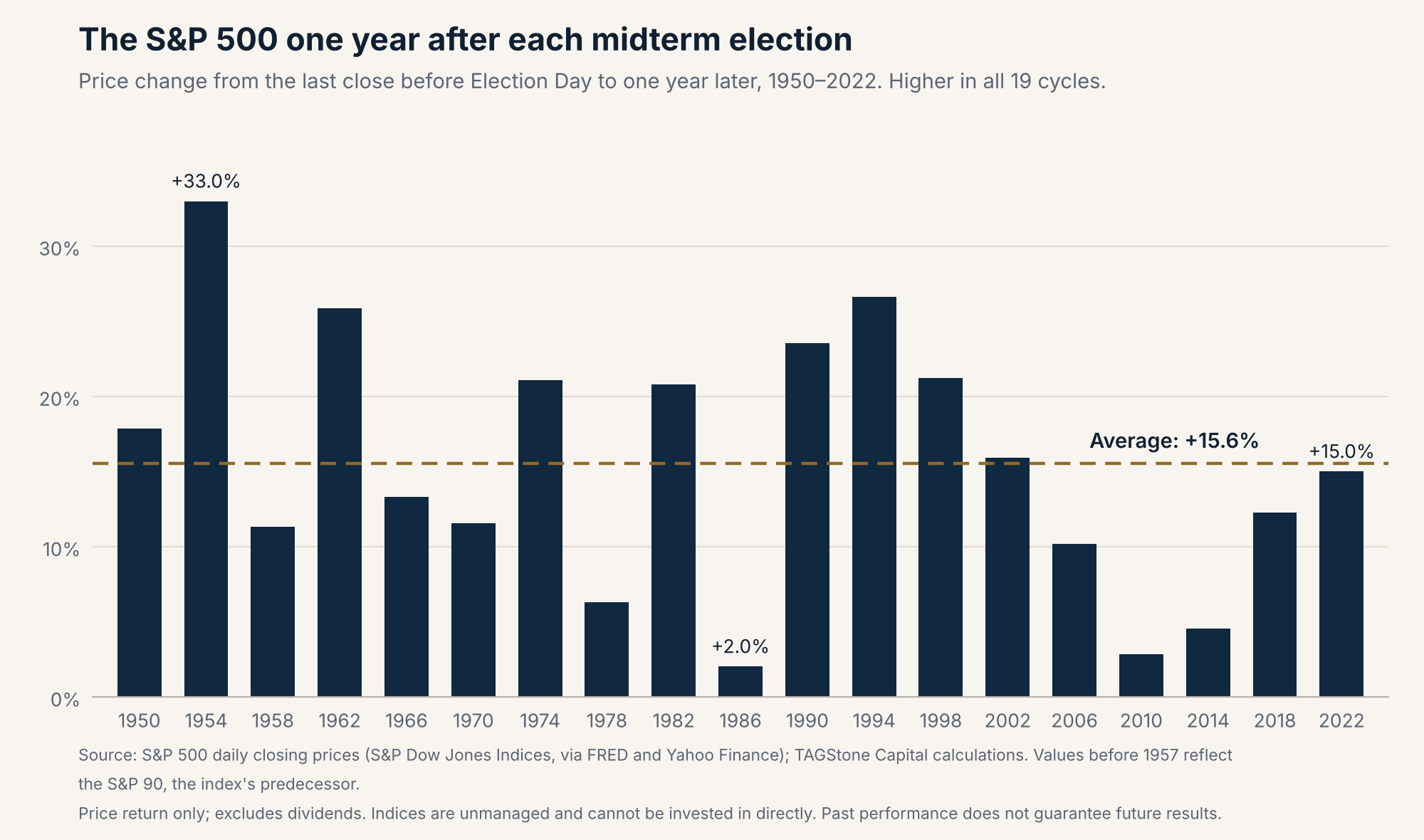
Of course, these are historical averages, not predictions. Nineteen observations is a small sample, every election takes place against a different economic backdrop, and many other factors influence stock prices. A perfect record in the past is not a promise about the next 12 months.
Action after the elections
Going into Election Day, the stock market was strong, with the S&P 500 up about 10.7% for the year through the end of October. On Wednesday, November 4, the day after the election, the S&P 500 rose 1.6% as markets appeared to breathe a sigh of relief now that the outcomes were clear.
The results brought a significant shift in Washington. Democrats won control of both the House and Senate, while a Republican remains in the Oval Office for two more years. That creates a divided government that might make it more difficult for Congress to get much done. Historically, that kind of political gridlock has sometimes been viewed favorably by the market, as it can limit major policy changes.
Then on Thursday, November 5, the S&P 500 fell 4.4%, its worst day since April 2025, as investors continued to question whether investments in AI and data-center infrastructure will generate sufficient returns.
The sharp reversal is a useful reminder of how hard it is to predict the market's next move. Even as one event appears to remove uncertainty, other concerns can quickly take center stage.
Keeping your portfolio on track
While the election may have changed the political landscape, it hasn't changed a fundamental pillar of long-term investing: avoid making major investment decisions based on the latest headlines. Whether you're pleased or disappointed with the results, changing your investments in response to one party's gains or losses can be costly.
Instead, stay focused on your long-term goals. The past 100 years have included dozens of election cycles, political shifts, economic expansions and recessions, wars and other unexpected events. Through it all, the stock market has trended upward over the long term, and investors who stayed invested have historically been rewarded despite the bumps along the way.
Your financial plan was built with uncertainty in mind. You don't need to overhaul it every time the political landscape changes or the market has a difficult week. What matters is having a strategy designed to carry you toward your goals, and giving it the time it needs to work.
Here are three things worth doing instead of reacting to the election:
- Separate your politics from your portfolio. If you feel the urge to make a change because of who won, write down the reason and revisit it in a month. Most of those urges fade.
- Check your cash cushion. Make sure money you'll need in the next year or so isn't depending on where stocks trade next week.
- Watch for policy changes, not party changes. Tax law is what actually affects your plan. If Congress takes up changes that touch your situation, we'll look at them together when there's something concrete to act on.
If the election results or recent market volatility have you questioning your investments, please reach out. Together, we can assess whether any adjustments are warranted and make sure your portfolio stays focused on what really matters: your goals for today and the years to come.
Reid Culp, CFA, CFP®
Owner, TAGStone Capital
Past performance does not guarantee future results. All investments include risk and have the potential for loss as well as gain.
Data sources for returns and standard statistical data are provided by the sources referenced and are based on data obtained from recognized statistical services or other sources we believe to be reliable. However, some or all information has not been verified prior to the analysis, and we do not make any representations as to its accuracy or completeness. Any analysis nonfactual in nature constitutes only current opinions, which are subject to change. Benchmarks or indices are included for information purposes only to reflect the current market environment; no index is a directly tradable investment. There may be instances when consultant opinions regarding any fundamental or quantitative analysis do not agree.
The commentary contained herein has been compiled by W. Reid Culp, III from sources provided by TAGStone Capital, as well as commentary provided by Mr. Culp, personally, and information independently obtained by Mr. Culp. The pronoun "we," as used herein, references collectively the sources noted above.
TAGStone Capital, Inc. provides this update to convey general information about market conditions and not for the purpose of providing investment advice. Investment in any of the companies or sectors mentioned herein may not be appropriate for you. You should consult your advisor from TAGStone for investment advice regarding your own situation.
Related reading
Wondering how this applies to you?
Start with a relaxed, no-obligation conversation about your situation.
Schedule a ConversationPrefer to read first?
TAGStone Insights arrives every other week — a short note on what we're writing about and why it matters.