
25 Years / Seven Panics - What We’ve Learned
It’s our pleasure to report on the progress of your long-term financial plan through what proved to be a highly instructive first half of 2025. If markets seemed unusually dramatic, it's only because they were, but not in ways unfamiliar to seasoned investors.
Let me begin by restating a few principles that have guided us well for many years. These are not predictions or short-term tactics; they are the bedrock beliefs that drive every investment decision we make on your behalf:
- We are goal-focused and plan-driven investors, which means we build portfolios not around forecasts or opinions about the economy, but around your personal financial goals, and we stick with those portfolios through thick and thin.
- We don’t pretend to know what the market will do this month or this year, and we don’t think anyone else can know either. The idea that you can move in and out of markets after fees, taxes, and commissions successfully over time isn’t just unlikely—it’s been proven time and again to be a losing game.
- We believe the best way to benefit from the long-term compounding power of equities and high-quality bonds is to own them continuously in a disciplined allocation aligned with your plan, not occasionally when conditions seem favorable.
- Market declines, while uncomfortable, are a normal part of the journey. Our bond holdings are there to cushion the ride, and dividends—especially when reinvested—allow us to buy more shares when prices are low. That’s not a problem; that’s an opportunity in disguise.
The First Half of 2025
If you had looked at the market on January 2 and again on June 30, you might have thought very little had transpired. And yet, beneath the surface, the markets served up another master class in the emotional nature of investing.
US large-cap stocks hit an all-time high in February, only to drop nearly 22% intraday by early April. The spark? A sudden tariff escalation announced by President Trump. Panic arrived quickly—as it always does—but, like most panics, it didn’t stay long. Once the policy was paused, markets rebounded with equal speed, reminding us again that reacting to headlines is rarely a sound investment strategy.
Meanwhile, the fundamentals didn’t change. The economy remained solid, inflation showed signs of moderation, and well-diversified portfolios, including international holdings, delivered respectable results. Our takeaway? Volatility is not the enemy; abandoning a sound plan is.
Seven Panics in 25 Years
As I discussed with many of you in the days following the April 2 tariff announcement, this particular episode—though abrupt and unsettling—was hardly unique in the grand sweep of market history. While the flavor of each panic may differ, the emotional arc remains the same: fear rises, headlines scream, and investors begin to doubt what they knew just weeks earlier.
We live in a world where crises compete for our attention. In today’s nonstop news cycle, it’s easy to forget just how many moments of market turmoil we’ve lived through—and just how temporary they have all proven to be. It’s not that risks weren’t real; they were. However, each of these past episodes presented us with a choice: to stick to our long-term plan or to abandon it in pursuit of temporary safety, which often comes at a steep long-term cost.
In just the past 25 years, markets have delivered seven major panic attacks. Each felt unique and terrifying in the moment. But they all had the same outcome: the crisis passed, businesses endured, and equities resumed their enduring advance.
Let’s revisit each briefly:
- Panic #1: The Dot-Com Bubble (2000–2002)
A long and productive bull market throughout the 1980s and 1990s—fueled by innovation, deregulation, and disinflation—ultimately gave way to speculation. Investors rushed into internet-related companies, many of which had little more than a website and a press release. US large-cap stocks peaked in March 2000 and fell nearly 50% over the next two and a half years.
The burst of the tech bubble was only part of the story. The September 11 attacks in 2001 shocked the nation, and a series of corporate scandals—Enron, WorldCom, Tyco—shook confidence in financial reporting. The result was a rare moment in modern investing when people stopped believing the numbers. But those who stuck with diversified portfolios saw markets recover, setting the stage for another long expansion.
- Panic #2: The Global Financial Crisis (2007–2009)
This panic was different in kind, not just degree. Years of overleveraged mortgage lending and opaque financial engineering came to a head in 2008. When Lehman Brothers failed, the entire credit system seized up. Banks didn’t trust each other. Money market funds broke the buck. Even seasoned investors were unsure what might come next.
The stock market declined more than 56% over 17 months, and the recession that followed was the worst since the Great Depression. But here again, the American economy proved resilient. Extraordinary measures by the Federal Reserve and Congress helped stabilize the system, and over the years that followed, patient investors were rewarded with one of the strongest bull markets in history.
- Panic #3: The European Debt Crisis (2011)
With the scars of the financial crisis still fresh, fears emerged over whether heavily indebted European nations like Greece, Italy, and Portugal might default—and whether the euro itself could survive. Meanwhile, back home, political brinksmanship over the U.S. debt ceiling led to the first-ever downgrade of U.S. Treasury debt by a major rating agency.
For several months, the markets churned. US large-cap stocks dropped nearly 20%, and investors once again faced unsettling headlines about systemic risk. However, the crisis once again passed. The euro endured. The U.S. honored its obligations. And equity markets resumed their climb.
- Panic #4: The Christmas Eve Massacre (2018)
This episode might be the most forgotten, but it felt very real in the moment. Amid escalating trade tensions with China, repeated rate hikes from the Federal Reserve, and a prolonged government shutdown, markets grew increasingly nervous.
By Christmas Eve, fear was peaking. US large-cap stocks had fallen nearly 20% in just three months. The President publicly criticized the Fed chair. Investors feared the economy was headed for a recession. But almost as quickly as it had begun, the panic lifted. Markets rebounded strongly in early 2019, and fears of imminent collapse faded into memory.
- Panic #5: COVID-19 Pandemic (2020)
This was the fastest bear market in history. In just 33 days, US large-cap stocks lost a third of their value as the world shut down to confront an unfamiliar virus. Restaurants closed, flights were canceled, schools emptied, and offices went remote.
And yet, just one month after the market bottomed, it had already regained a meaningful portion of its losses. By August, stock indices were hitting new highs. Unprecedented monetary and fiscal support helped. But what mattered most was something simpler: businesses adapted, innovation accelerated, and markets—as they always do—looked ahead.
- Panic #6: Inflation & Fed Tightening (2022)
After years of calm prices, inflation roared back in 2022. A combination of pandemic stimulus, disrupted supply chains, and energy price spikes pushed inflation above 9%—a level not seen in nearly four decades. The Fed, initially slow to respond, raised interest rates at a historic pace.
The impact was swift and painful. Both stocks and bonds declined sharply. A traditional 60/40 portfolio had its worst year since 1937. But in time, inflation began to moderate, markets found their footing, and those who stayed invested saw conditions begin to improve.
- Panic #7: The Tariff Typhoon (2025)
This most recent episode may still be fresh in your memory. The April 2 announcement of sweeping tariffs from President Trump caught markets off guard, triggering a swift and sharp decline. At one point, US large-cap stocks were down more than 21% intraday.
But just days later, after a delay in implementation was announced, the market bounced back. It’s a familiar pattern. Policy surprises, political headlines, and market corrections come and go. What endures are the earnings of resilient companies and the power of long-term compounding.
How We Help Clients During Market Panics
The panics always feel different. They usually arrive from a corner of the world we weren’t watching. They feel unresolvable—until suddenly, something shifts, a circuit breaks, and confidence returns. Then, seemingly overnight, the market stops falling and starts sprinting upward. And by the time it’s clear the panic is over, those who sold often find themselves permanently behind.
Time and again, the turning point comes not after all the uncertainty has lifted, but while the uncertainty still looms large. And that’s the crux of it: the moment of maximum fear is almost always the point of maximum opportunity.
Think back to some of those turning points:
- In March 2009, the Financial Accounting Standards Board relaxed the mark-to-market rules that were driving banks to the brink. The market exploded upward.
- In December 2018, President Trump promised not to fire Fed Chair Jerome Powell. The market reversed on a dime.
- In March 2020, the Fed launched an unlimited bond-buying program in response to COVID. Panic turned to euphoria.
- In April 2025, President Trump delayed new tariffs. Another swift reversal.
So, when the next panic arrives—as it surely will—you and I must remember what’s at stake because the real risk in those moments isn’t that the market will go down further. The real risk is that it will go back up—and do so without you. The most painful losses aren’t those that come from holding quality businesses and bonds through a downturn. They’re the gains missed by those who exit at the bottom and hesitate to return.
In those moments, our job is to help you stay focused on what matters. Not the noise. Not the headlines. But the long-term plan we’ve built together, and the wonderful businesses working every day to make that plan a reality.
Is Gold a Safe Haven?
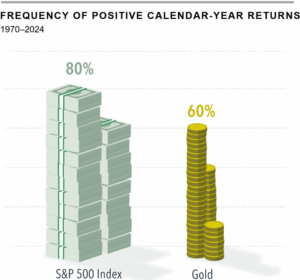
Gold, for example, has been back in the headlines. It has had a strong run year-to-date, and as always in volatile times, some investors view it as a safe haven—a stabilizer when markets become choppy. But that narrative often glosses over the full picture. Gold has experienced numerous drawdowns of its own, and historically, it has been positive in only 60% of calendar years since 1970. By contrast, U.S. large-cap stocks have finished in the black 80% of the time over the same span. Gold doesn’t produce earnings, pay dividends, or fuel innovation. It just sits there. And when it comes to building long-term wealth, the companies doing the building may be a safer bet.
Large Stocks vs. Gold
What We Have Learned
Wealth management, at its core, is a continual battle against human nature. That’s why we remind you again and again—not because you haven’t heard it before, but because we know how easy it is to forget in the fog of panic.
The “25 years / 7 panics” framework is not just history. It’s a tool. Use it. Keep it close. And when the next crisis comes—as surely it will—remember: this, too, shall pass. And when it does, those who held fast to their balanced portfolio—who understood that you can’t separate the long-term compounding power of equities from the short-term discomfort they often bring—will be in the strongest position to move forward. As always, we recommend a portfolio that is anchored by an appropriate mix of stocks and high-quality bonds, tailored to your unique goals, liquidity needs, and risk tolerance.
If you have friends or family who are feeling uneasy about their finances or simply want a steadier hand to help guide their long-term plan, please feel free to share this letter with them. Sometimes a little perspective can make a big difference.
Thank you for the continued trust you place in us. As always, we welcome your thoughts, your questions, and the opportunity to continue walking alongside you in the months and years ahead—with quiet confidence and disciplined optimism.
Past performance does not guarantee future results. All investments include risk and have the potential for loss as well as gain.
Data sources for returns and standard statistical data are provided by the sources referenced and are based on data obtained from recognized statistical services or other sources we believe to be reliable. However, some or all information has not been verified prior to the analysis, and we do not make any representations as to its accuracy or completeness. Any analysis nonfactual in nature constitutes only current opinions, which are subject to change. Benchmarks or indices are included for information purposes only to reflect the current market environment; no index is a directly tradable investment. There may be instances when consultant opinions regarding any fundamental or quantitative analysis do not agree.
The commentary contained herein has been compiled by W. Reid Culp, III from sources provided by TAGStone Capital, as well as commentary provided by Mr. Culp, personally, and information independently obtained by Mr. Culp. The pronoun “we,” as used herein, references collectively the sources noted above.
TAGStone Capital, Inc. provides this update to convey general information about market conditions and not for the purpose of providing investment advice. Investment in any of the companies or sectors mentioned herein may not be appropriate for you. You should consult your advisor from TAGStone or others for investment advice regarding your own situation.