
The Power of Purpose in Retirement

At a Glance

  • Retirement isn’t just financial — it’s psychological. Losing structure, identity and daily rhythm can affect both mental and physical health.
  • Unstructured freedom can backfire. Research links social isolation and loss of purpose to higher risks of dementia, heart disease and premature mortality.
  • Purpose must be designed. A fulfilling retirement requires intentional planning around meaning, relationships, activity and engagement — not just income.

Retirement is often imagined as a well-earned season of freedom—time away from deadlines, schedules, and professional responsibilities. But when the structure that shaped your days for decades suddenly disappears, what replaces it? Endless relaxation may sound appealing, but the reality is often more complex.

Retirement is a major life shift, one that impacts more than just your schedule. It can reshape your sense of identity, daily habits and even your health. In fact, research has shown that retirement can raise the risk of heart disease and other medical issues by up to 40%. The reason? Experts point to a loss of purpose and reduced social connection, both of which can take a toll on mental and physical well-being.

Without a plan for how to spend your time meaningfully, the transition can bring unexpected emotional challenges.

The Risks of Unstructured Retirement

Many retirees begin this new chapter with a “honeymoon phase”—a period marked by the novelty of free time, relaxation or long-awaited travel plans. But this initial high can eventually fade.

When the excitement of sleeping in and checking items off the bucket list wears off, retirees can find themselves facing unexpected emotional challenges. Common struggles include boredom, loss of routine, identity shifts and social isolation. In fact, 24% of older adults are considered to be socially isolated. Isolation can also have a ripple effect on health: It’s associated with a 50% increase in risk of developing dementia and increased risk of premature mortality.


Designing a Retirement with Purpose

To avoid some of the potential pitfalls of an unstructured retirement, it’s important to think carefully—and proactively—about purpose. What do you want this next phase of life to look and feel like? Beyond financial planning, consider how you’ll meet the deeper needs your pre-retirement life—including work and raising kids—may have fulfilled: structure, identity, accomplishment, social connection and a sense of meaning.

What brings you pleasure and meaning? What have you always wanted to try or learn? Pursuing these activities can provide purpose and help ensure retirement’s not just a long vacation, but a rewarding chapter of your life.

Feeling stuck here? Try asking close friends or family what they see light you up. Often, others can reflect back passions or strengths that are hard to see on your own.

Staying Connected and Active

Relationships and physical routines matter more than ever when you retire. Staying active, both physically and socially, offers measurable health benefits. Regular physical activity lowers risks, including the likelihood of dementia, heart disease, stroke and eight types of cancer.

People-centered activity is important, too. Look for ways to stay engaged, whether through volunteering, mentoring, part-time work, creative pursuits or community involvement. Older volunteers, aged 55 and up, who gave 100 hours or more each year were two-thirds less likely to report poor health than non-volunteers.

Spending more time with family is a high priority for many retirees and can be a great way to fulfill social needs. But make sure that vision is shared. Open conversations with loved ones about time together, expectations and boundaries can help align plans and avoid disappointment down the road.

The Retirement Identity Shift

In many ways, it’s hard to define what retirement is. After all, it’s not a single moment but a series of transitions. For instance, rather than an abrupt shift to not working at all, you may consider bridge employment—usually part-time work in a temporary position or as a consultant in your field or in a different industry. This can offer a gradual shift into retirement, providing continued income and engagement as you adjust.

Retirement is not merely about stepping away from work—it is about stepping intentionally into your next season of influence, relationships, and legacy.

As your vision for retirement evolves, keep us in the loop. We’d love to hear what you’re planning—and we’re here to help ensure your financial strategy stays aligned with your goals.


Past performance does not guarantee future results. All investments include risk and have the potential for loss as well as gain.

Data sources for returns and standard statistical data are provided by the sources referenced and are based on data obtained from recognized statistical services or other sources we believe to be reliable. However, some or all information has not been verified prior to the analysis, and we do not make any representations as to its accuracy or completeness. Any analysis nonfactual in nature constitutes only current opinions, which are subject to change. Benchmarks or indices are included for information purposes  only  to  reflect  the  current  market  environment;  no  index  is  a directly  tradable investment.  There  may  be  instances  when  consultant  opinions  regarding any fundamental or quantitative analysis do not agree.

The  commentary  contained  herein  has  been  compiled  by  W.  Reid Culp,  III  from  sources  provided  by  TAGStone  Capital,  as well  as  commentary  provided  by  Mr.  Culp,  personally,  and  information independently  obtained  by  Mr.  Culp.  The  pronoun  “we,”  as  used  herein,  references collectively the sources noted above.

TAGStone Capital, Inc. provides this update to convey general information about market conditions and not for the purpose of providing investment advice. Investment in any of the companies or sectors mentioned herein may not be appropriate for you. You should consult your advisor from TAGStone or others for investment advice regarding your own situation.


At a Glance

  • For high‑net‑worth families still accumulating assets, the decision of when to claim Social Security is not merely a retirement timing question—it is a capital allocation decision.
  • Claiming earlier or later affects lifetime after‑tax income, portfolio withdrawal rates, Medicare premiums (IRMAA), and the ability to execute tax strategies such as Roth conversions in low‑income years.
  • Break‑even analysis provides a useful starting framework, but the optimal claiming strategy must be evaluated in the context of longevity risk, taxes, and overall balance‑sheet management.

What Does a Social Security Break-Even Really Mean for High-Net-Worth Families?

To introduce the concept of break‑even, consider a race between two horses—Early Bird (No. 62) and Late Breaker (No. 70). Late Breaker is the stronger, faster horse, but to keep the race competitive, Early Bird is given a meaningful head start.

Given enough time, Late Breaker will inevitably catch up. The moment when both horses have covered the same total distance is the break‑even. If the race ends after that point, Late Breaker wins decisively. If the race ends before then, Early Bird finishes ahead.

This analogy mirrors how Social Security benefits accumulate. Claiming early provides a head start in the form of more payments, but at a slower pace. Delaying benefits produces larger, inflation‑adjusted payments, but it takes time for those higher payments to overtake the cumulative total received by an early claimant.

For high‑net‑worth families, however, the more important question is not which horse eventually wins the race—it is how this race fits within the broader capital allocation strategy. Social Security represents a government‑backed, inflation‑adjusted income stream with longevity protection. Deciding when to claim determines how much of that future income is effectively “purchased” and how much risk remains on the investment portfolio.

Another way to view delaying Social Security is as a form of longevity insurance. By waiting, you shift the financial risk of living longer than expected away from your portfolio and onto the federal government—while preserving flexibility in the early years of retirement.

How Does Social Security Break-Even Analysis Work in Practice?

In practice, there are more than two horses in the race and more than two claiming options. Social Security benefits can be claimed any time between age 62 and age 70. Each additional year of delay increases monthly benefits, up to age 70. Any two claiming ages have their own unique break‑even point.

Consider three common scenarios:

  1. Claim benefits at age 62.
  2. Claim benefits at full retirement age (67 for individuals born in 1960 or later).
  3. Claim benefits at age 70.

If benefits are claimed at age 62—60 months before full retirement age—the monthly benefit is permanently reduced by 30%. Using a $2,000 full benefit as an example, this results in monthly income of $1,400.

Claiming at full retirement age produces the full $2,000 monthly benefit.

Delaying until age 70 increases benefits by 24% due to delayed retirement credits, resulting in a monthly benefit of $2,480.

When cumulative benefits from these options are plotted over time, the break‑even points become clear—each representing the age at which delaying produces a higher total lifetime payout than claiming earlier:

What Is the Implied Return of Delaying Social Security Benefits?

Using the assumptions above:

  • The break‑even between claiming at age 62 and age 67 occurs around age 78.
  • The break‑even between claiming at age 67 and age 70 occurs around age 82.
  • The break‑even between claiming at age 62 and age 70 occurs around age 80.


Life expectancy is a critical variable, but for affluent households it is not the only one. Another way to evaluate delaying Social Security is through an internal rate of return lens. By delaying benefits, you are effectively exchanging near‑term cash flow for a higher, inflation‑adjusted income stream later in life.

From an internal rate of return perspective, delaying Social Security—particularly from full retirement age to 70—has historically implied a real return in the range of roughly 4% to 5%. For families with sufficient assets to self‑fund the early years of retirement, that return is competitive with high‑quality, low‑risk fixed‑income alternatives while also providing inflation protection and longevity insurance. Framed this way, the decision moves beyond a retirement rule‑of‑thumb and becomes a deliberate capital allocation choice.

What Other Factors Should High-Net-Worth Families Consider When Claiming Social Security?

Break‑even analysis is a helpful starting point, but it does not capture the full picture for successful families.

Taxation of benefits. Up to 85% of Social Security benefits may be subject to federal income tax, depending on other sources of income. Claiming earlier or later can materially affect the taxation of benefits when combined with portfolio withdrawals, earned income, or required minimum distributions.

Medicare premiums (IRMAA). Higher reported income can trigger increased Medicare Part B and Part D premiums through IRMAA surcharges. Coordinating the timing of Social Security with other income sources can help manage these thresholds over time.

Roth conversion opportunities. For many high‑income households, the years between retirement and required minimum distributions represent a valuable planning window. Delaying Social Security during these lower‑income years can create space to execute Roth conversions, potentially reducing future RMDs, lowering lifetime taxes, and mitigating IRMAA exposure. (See our related discussion on Roth conversions prior to RMDs and managing IRMAA during low‑income years.)

Lifestyle and flexibility. Some families prioritize higher income early in retirement to support travel, family support, or philanthropic goals. Others value the certainty of higher guaranteed income later in life. These preferences matter and should be incorporated into the analysis.

Ultimately, Social Security claiming decisions sit at the intersection of longevity, taxes, portfolio withdrawals, and Medicare planning. Break‑even analysis clarifies the math, but optimal outcomes require coordination with a broader financial strategy. This is an area where thoughtful, individualized analysis can meaningfully improve after‑tax results and long‑term financial flexibility.


Past performance does not guarantee future results. All investments include risk and have the potential for loss as well as gain.

Data sources for returns and standard statistical data are provided by the sources referenced and are based on data obtained from recognized statistical services or other sources we believe to be reliable. However, some or all information has not been verified prior to the analysis, and we do not make any representations as to its accuracy or completeness. Any analysis nonfactual in nature constitutes only current opinions, which are subject to change. Benchmarks or indices are included for information purposes  only  to  reflect  the  current  market  environment;  no  index  is  a directly  tradable investment.  There  may  be  instances  when  consultant  opinions  regarding any fundamental or quantitative analysis do not agree.

The  commentary  contained  herein  has  been  compiled  by  W.  Reid Culp,  III  from  sources  provided  by  TAGStone  Capital,  as well  as  commentary  provided  by  Mr.  Culp,  personally,  and  information independently  obtained  by  Mr.  Culp.  The  pronoun  “we,”  as  used  herein,  references collectively the sources noted above.

TAGStone Capital, Inc. provides this update to convey general information about market conditions and not for the purpose of providing investment advice. Investment in any of the companies or sectors mentioned herein may not be appropriate for you. You should consult your advisor from TAGStone or others for investment advice regarding your own situation.


The final weeks of the year tend to blur together in a whirlwind of pie orders, last-minute shopping, school concerts and cross-country flights. But amid the bustle, it’s worth pausing for some 2025 year-end financial planning. A few thoughtful steps now can help you optimize your tax situation, strengthen your savings, and position yourself for a confident start to 2026. Whether you’re a successful individual, business owner, or managing a complex financial life, the right moves in December can make the new year feel more organized and less stressful.

Mind the Evergreens

Balsam and holly aren’t the only evergreens worth considering as December rolls around. Some financial tasks never go out of season, including maximizing retirement contributions, making charitable gifts and managing capital gains and losses.

    • Retirement Accounts: December 31 is the final day to make 2025 contributions to your employer-sponsored retirement plan. This year, you can contribute up to $23,500 to a 401(k), plus an additional $7,500 catch-up contribution if you’re 50 or older. There’s a big change here for 2025: a higher catch-up limit of $11,250 for individuals ages 60 through 63. In 2026, the annual contribution limit rises to $24,500 and catch-up contributions increase to $8,000. The higher catch-up contribution for those 60 to 63 remains the same.

      IRAs and HSAs offer slightly more breathing room—their 2025 contribution deadline isn’t until April 15, 2026. But the earlier you contribute, the longer your investments can benefit from compounding.

      While you’re reviewing retirement accounts, consider increasing your contribution rate for next year or enabling automatic annual increases if you haven’t already. Small boosts add up meaningfully over time.

    • Capital Gains and Losses: If you’ve sold investments at a gain this year, you may be able to reduce your tax bill by realizing losses elsewhere in your portfolio. Through tax-loss harvesting, losses can offset gains, and if your realized losses exceed your gains, you can deduct up to $3,000 against ordinary income. Losses must be realized by year-end.
    • Charitable Contributions: If you plan to deduct charitable contributions for the 2025 tax year, gifts must be made by Dec. 31. (More on charitable strategy below.)

Give Thoughtfully (and Tax Efficiently)

The charitable giving landscape is set to shift in coming years. The recently enacted One Big Beautiful Bill (OBBB) permanently extends the higher standard deduction with further increases in coming years. Rules will change for itemizers as well. In 2026, if you itemize, you will only be able to itemize charitable deductions on contribution amounts that exceed 0.5% of your adjusted gross income. Finally, top earners will see the deduction value of gifting capped at 35% instead of the full marginal rate of 37% in 2026.

Together, these changes mean a more complex charitable giving environment. In some cases, smaller donations may not offer the same tax impact next year as they have in previous years—including this one. It may make sense to increase your giving this year to take advantage of the current rules, perhaps consolidating several years’ worth of giving into a single large gift.

A donor-advised fund (DAF) can be a strategic way to do this. By contributing to a DAF before Dec. 31, you receive an immediate tax deduction while preserving flexibility to recommend grants to charities over time.

Lock in Home Efficiency Tax Credits—While You Still Can

Thinking about upgrading insulation or installing solar panels? Two valuable credits are set to expire at the end of the year: the Energy Efficient Home Improvement Credit and the Residential Clean Energy Credit.

To qualify, improvements must be placed in service—fully installed and ready for use—by Dec. 31, 2025. The purchase date doesn’t matter, but the installation date does. If energy-efficiency upgrades are on your list, don’t wait to try and line up an installer who has the capacity to complete the work before year-end.

Enjoy Some Breathing Room

Beyond its effects on charitable giving, the OBBB also includes broader tax implications worth noting.

The bill preserves the income tax rates and brackets established in 2017 by the Tax Cuts and Jobs Act. Had those expired, the brackets would have reverted to the higher pre-2018 rates. What does this reprieve mean in practice? You may not need to rush to realize income—such as a year-end bonus—before Dec. 31 to avoid being taxed at a higher rate. The extra time could provide more runway for strategic planning.

Allow Yourself to Do Nothing

Year-end planning isn’t only about getting things done. It’s also about protecting your time, energy and emotional bandwidth. Between office gatherings, family obligations, travel and shopping, these weeks can feel overfull. And while holiday obligations can be fun, they can also be draining.

Be honest about what you can take on. Practicing saying “no” when you’re stretched thin is an act of self-care. Doing so often allows you to say “yes” to the experiences that actually bring you joy, like finding time to exercise, curl up with a good book or watch a cheesy Hallmark movie.

If You Want a Clear Year‑End Strategy, We Can Help

If you’re unsure which steps make the most sense for your situation—or want help coordinating taxes, savings, and charitable planning—we’re here to support you. A short conversation can help you make confident decisions before December 31.

If you'd like to review your 2025 year‑end plan, feel free to reach out.


Past performance does not guarantee future results. All investments include risk and have the potential for loss as well as gain.

Data sources for returns and standard statistical data are provided by the sources referenced and are based on data obtained from recognized statistical services or other sources we believe to be reliable. However, some or all information has not been verified prior to the analysis, and we do not make any representations as to its accuracy or completeness. Any analysis nonfactual in nature constitutes only current opinions, which are subject to change. Benchmarks or indices are included for information purposes  only  to  reflect  the  current  market  environment;  no  index  is  a directly  tradable investment.  There  may  be  instances  when  consultant  opinions  regarding any fundamental or quantitative analysis do not agree.

The  commentary  contained  herein  has  been  compiled  by  W.  Reid Culp,  III  from  sources  provided  by  TAGStone  Capital,  as well  as  commentary  provided  by  Mr.  Culp,  personally,  and  information independently  obtained  by  Mr.  Culp.  The  pronoun  “we,”  as  used  herein,  references collectively the sources noted above.

TAGStone Capital, Inc. provides this update to convey general information about market conditions and not for the purpose of providing investment advice. Investment in any of the companies or sectors mentioned herein may not be appropriate for you. You should consult your advisor from TAGStone or others for investment advice regarding your own situation.


In recent months, two themes have dominated investor conversations: AI investing and the renewed belief in gold as a timeless safe haven. Both trends have resurfaced at the exact moments when crowd enthusiasm is high. That’s why we’re taking a closer look at the gold safety myths and the rising excitement around artificial intelligence as we enter the final stretch of 2025.

This quarter’s article, “When the Crowd Rushes In: AI, Gold, and the Enduring Rules of Investing,” explores how investor psychology fuels these cycles — why AI exposure is already embedded in well-diversified portfolios, why gold does not meet the definition of a productive long-term asset, and why the oldest rules of disciplined investing remain the most reliable. When the noise grows louder, the crowd is usually running in the wrong direction.

When the Crowd Rushes In: AI, Gold, and the Enduring Rules of Investing

Technology evolves, headlines shift, and markets transform, but the forces that drive investor behavior—fear, greed, impatience, and hope—remain constant. Human nature doesn’t change.

This quarter, the conversation around artificial intelligence dominated the financial world. A handful of highly profitable firms have transformed how the world works, creating real value and cash flow. But surrounding them is a mix of speculative enterprises and questions about how quickly some have built out their data centers. In that way, AI isn’t just a technology story—it’s a behavioral one.

The Long-Term Power of Stocks in a World Obsessed with AI

Every market cycle needs a story, and AI has become the story of this one. History suggests we’ve been here before. Railroads, radio, the internet—each revolutionized the world, but investors didn’t profit equally. Few doubt that AI will be a game changer, but no one knows for sure which companies will benefit more in the long run.

When enthusiasm runs high, patience and discipline can start to feel outdated. The excitement of innovation often invites speculation. As Warren Buffett observed, “What the wise man does in the beginning, the fool does in the end.”

We forget that companies—not stories—compound wealth. Some of the greatest long-term performers of the last century were unglamorous businesses quietly earning profits year after year while the world’s attention drifted elsewhere.

Why Diversification—and Discipline—Still Drive Real Wealth

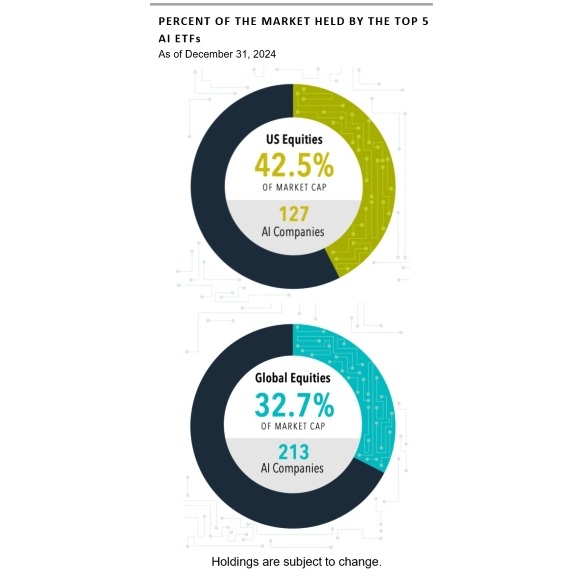
Percent of Market Held by Top 5 AI ETFs

While the world debates how to invest in AI, the truth is simpler—and far more reassuring: you already own it.

Through a well-diversified portfolio of global businesses, you indirectly own hundreds of companies applying AI to become faster, smarter, and more efficient. From NVIDIA to Honeywell to Caterpillar, innovation isn’t a sidecar—it’s embedded in the very fabric of modern enterprise. And for long-term investors, the surest way to benefit from AI’s growth isn’t speculation—it’s ownership.

The rise of AI has inspired new funds and flashy tickers, but according to Dimensional’s research, the five biggest AI-focused ETFs (AIQ, BOTZ, QTUM, ARKQ, and ROBT) already include more than 40% of the entire U.S. stock market. Owning a broad, diversified portfolio already gives you exposure to hundreds of companies using or developing AI—you don’t need to chase new “AI-only” funds to benefit from the trend.

This underscores a comforting truth: investors don’t have to predict which company becomes the next great innovator. A globally diversified portfolio naturally captures the growth of AI and other technologies as they spread across industries. The winners of tomorrow are often found in places few expect today, from industrials and logistics to healthcare and finance.

Gold: The Eternal Mirage of Safety

This year, gold joined AI in the headlines, breaking record highs and rekindling old fascinations. Like AI, it stirs emotion. But unlike AI, gold doesn’t innovate, hire, or compound. It simply sits there.

In his 2012 Fortune essay “Why Stocks Beat Gold and Bonds,” Warren Buffett imagined all the world’s gold—then about 170,000 metric tons—as a 68-foot cube that could fit neatly inside Yankee Stadium’s infield. At that time, the cube was worth about $9.6 trillion. For the same amount, Buffett wrote, one could buy every acre of U.S. farmland (roughly 400 million acres producing $200 billion a year in crops), sixteen ExxonMobils (each earning over $40 billion a year), and still have $1 trillion in “walking-around money.” The gold cube, by contrast, would just sit there. Buffett quipped, “You can fondle the cube, but it will not respond.”

Fast-forward to 2025. At $4,000 per ounce, that same cube—now around 212,000 metric tons—is worth roughly $27 trillion. That’s enough to buy every acre of U.S. farmland plus Apple, Microsoft, and Amazon combined—with change left over. Yet the cube still produces nothing.

If you own an ounce of gold for 100 years, you will still own one ounce at the end. That is its essence—its appeal and its limitation alike. It’s permanent, inert, and emotionally reassuring but financially unproductive.

History bears this out. In 1980, gold traded at $800 per ounce and has increased about 5× to $4,000 per ounce today. Contrast that with $800 invested in large-cap US stocks in 1980, which, with dividends reinvested, would have grown to $141,000, yielding a 176× total return and a 12% annual compound return.

Melt Ups, Behavior, and the “Greater Fool”

The desire to own what everyone else is buying runs deep. Whether it’s AI stocks or gold coins, the underlying impulse is the same—a search for safety, belonging, and certainty.

Behavioral finance has documented this truth repeatedly: investors feel the pain of losses roughly twice as strongly as the pleasure of gains. That imbalance helps explain why people sell in downturns and buy in melt-ups.

The risk during melt-up phases is that you feel you’re missing out on gains others seem to be making, and you buy assets mainly because they have gone up in price without understanding their intrinsic value or fundamentals. Too often, this leads to buying after assets become overpriced—just before a correction or long drawdown.

The Quiet Power of Productive Assets

At TAGStone, our philosophy has never changed: own productive assets, maintain balance, and let time work for you. Stocks represent real businesses creating real goods and services. Bonds represent loans to those businesses and governments. Both have a purpose. Together, they form a resilient system designed to protect purchasing power and generate growth through compounding.

Your edge as a long-term investor isn’t superior information or faster trades. It’s temperament—the ability to stay rational when the crowd isn’t. Buffett has often said that “the stock market is designed to transfer money from the active to the patient.” Every quarter offers fresh evidence that he’s right.

The excitement around AI and gold tells us more about investor psychology than about either asset. If the melt-up phase turns into a market blow-off, watch out for the urge to buy into truly speculative assets. Just as Microsoft, Apple, and Amazon rose from the ashes of the dot-com bust, this cycle will produce some truly profitable companies, but mixed in with those gems will be some busts. As mentioned above, your globally diversified portfolio already owns AI and will continue—quietly and tax‑efficiently—to accumulate the winners as they emerge.

A Final Word

Every cycle arrives with a new rationale for why “this time is different.” Yet history always rhymes. The same impulses that drove investors toward dot-coms in 1999, or toward gold in 1980, are at work again. Technology will continue to reshape our world, and gold will continue to glitter when anxiety rises. But the enduring truths of investing remain the same: productive assets compound, human nature overreacts, and patience wins.

In a world chasing the next big thing, the real opportunity lies in doing what few others can—staying calm, disciplined, and focused on what endures. The crowd will always rush in. The patient investor simply lets them pass.


Past performance does not guarantee future results. All investments include risk and have the potential for loss as well as gain.

Data sources for returns and standard statistical data are provided by the sources referenced and are based on data obtained from recognized statistical services or other sources we believe to be reliable. However, some or all information has not been verified prior to the analysis, and we do not make any representations as to its accuracy or completeness. Any analysis nonfactual in nature constitutes only current opinions, which are subject to change. Benchmarks or indices are included for information purposes  only  to  reflect  the  current  market  environment;  no  index  is  a directly  tradable investment.  There  may  be  instances  when  consultant  opinions  regarding any fundamental or quantitative analysis do not agree.

The  commentary  contained  herein  has  been  compiled  by  W.  Reid Culp,  III  from  sources  provided  by  TAGStone  Capital,  as well  as  commentary  provided  by  Mr.  Culp,  personally,  and  information independently  obtained  by  Mr.  Culp.  The  pronoun  “we,”  as  used  herein,  references collectively the sources noted above.

TAGStone Capital, Inc. provides this update to convey general information about market conditions and not for the purpose of providing investment advice. Investment in any of the companies or sectors mentioned herein may not be appropriate for you. You should consult your advisor from TAGStone or others for investment advice regarding your own situation.


Educating the Next Generation About Family Wealth

Over the next few decades, an enormous amount of wealth is expected to pass from older to younger generations. This has been dubbed the “Great Wealth Transfer,” and one estimate suggests that $124 trillion will change hands by 2048. It’s an eye-popping figure, to be sure, but it also highlights the reality that many families are, or soon will be, navigating how to pass on their wealth. A top-of-mind question: Is the next generation ready to take on the responsibility?

Wealth is not just cash in the bank; it can include investments, real estate, businesses and more that require stewardship and foresight. Successful management means preserving and growing assets and using them wisely. Striking the right balance here is key: For the next generation to succeed, it takes intentional preparation and education.

Plant the Seeds of Financial Literacy Early

Where to begin? In an ideal world, financial education starts in early childhood and is treated as an open and ongoing conversation as kids age. The goal is to build financial literacy gradually, so wealth management feels natural rather than overwhelming.

When kids are young, this might mean introducing simple topics like the difference between saving and spending. Managing an allowance can help put those ideas into practice. As kids get older you can begin introducing more complex topics, such as investing, compound interest, debt and taxes.

It’s equally important to engage adult children, many of whom may have received no other formal financial education. While 29 states now have K–12 financial education requirements in public schools, this focus has largely come to the forefront only in the last few years. If your kids are adults now, they may have missed out. So it’s worth finding out what they know, what they don’t know and what they’d like to know more about.

Putting Structure Around Family Wealth Education

In addition to ongoing conversations about money, your family might benefit from more intentional ways of building financial literacy. Some families hold regular financial meetings where they share goals, key issues and address questions or concerns. Others put together more formal workshops with wealth advisors or other experts.

There also is a wealth of credible educational content online that is built to both educate and engage audiences around financial literacy topics.

Turning Wealth Conversations into Real-World Experience

Eventually, theory should give way to practice. As younger family members learn the basics, you might consider providing a "practice portfolio," giving them the chance to make investment decisions with small amounts of money and learn from their successes and mistakes.

When family members have honed their knowledge, consider assigning them real responsibilities that match their skills and interest. This might mean relatively simple tasks like helping guide gifts made through a donor-advised fund. Or these responsibilities could be more involved, such as taking a role in the family business or helping to make investment decisions with the family’s wealth. With your guidance and oversight, these experiences can help develop confidence and capability.

Grounding Family Wealth in Purpose and Values

One of the most important things that helps guide families on how to grow and spend wealth is imparting a strong value system. Values can help you frame wealth as a tool rather than a goal.

Your values will be unique to you, but some worth considering may be:

  • Stewardship: Recognizing the responsibility that comes with wealth. Stewardship encourages careful management and intentional choices so resources can benefit both current and future generations.
  • Giving back: Using wealth to help create positive change in your community and the greater world.
  • Self-worth beyond wealth: Remembering that wealth is a tool to achieve goals—whether gaining an education, pursuing passion or giving back, for instance—not a measure of personal value.


By grounding financial decisions in values, families can help prevent counterproductive or reckless financial decisions, foster responsibility and ensure wealth is not seen as something to be simply consumed.

Keeping Family Wealth Conversations Going Across Generations

Discussing money isn’t always easy, and for many families, it’s downright taboo. While 66% of Americans say conversations about wealth are important, 62% say they never have them.

But getting over this hurdle is incredibly valuable. The most successful families treat wealth education not as a one-time event, but as an ongoing process that evolves as your family grows and your financial picture changes. We can work with you to create an environment where family members can openly discuss the unique challenges and opportunities that come with wealth.

If you’re thinking about how to prepare the next generation for responsibility—not just inheritance—we’re happy to help.


Past performance does not guarantee future results. All investments include risk and have the potential for loss as well as gain.

Data sources for returns and standard statistical data are provided by the sources referenced and are based on data obtained from recognized statistical services or other sources we believe to be reliable. However, some or all information has not been verified prior to the analysis, and we do not make any representations as to its accuracy or completeness. Any analysis nonfactual in nature constitutes only current opinions, which are subject to change. Benchmarks or indices are included for information purposes  only  to  reflect  the  current  market  environment;  no  index  is  a directly  tradable investment.  There  may  be  instances  when  consultant  opinions  regarding any fundamental or quantitative analysis do not agree.

The  commentary  contained  herein  has  been  compiled  by  W.  Reid Culp,  III  from  sources  provided  by  TAGStone  Capital,  as well  as  commentary  provided  by  Mr.  Culp,  personally,  and  information independently  obtained  by  Mr.  Culp.  The  pronoun  “we,”  as  used  herein,  references collectively the sources noted above.

TAGStone Capital, Inc. provides this update to convey general information about market conditions and not for the purpose of providing investment advice. Investment in any of the companies or sectors mentioned herein may not be appropriate for you. You should consult your advisor from TAGStone or others for investment advice regarding your own situation.


Why Business Exit Planning Matters

If you’re a business owner, business exit planning eventually becomes essential. Whether you sell to an outside buyer, family, or employees, the question is whether you can exit on your own terms. The reality is that most business owners don’t have a clear, documented exit plan. And if you find yourself among them, you could find it leaves you in a tight spot when it’s time for you to step down.

Delaying planning your exit risks settling for a below-market sale price, losing control of choosing your successor or rushing into choices that don’t reflect your vision. Delays also leave you with little time to take steps to boost the business’s valuation and ensure business continuity. A clear exit plan helps maximize options and value. If you haven’t mapped out yours yet, there’s no time like the present. Consider these steps:

Put a Price on Your Business

Proper valuation of your business is the first step in exit planning. Some back-of-the-envelope math can provide a decent starting point. But to really understand what your business is worth, meet with a valuation expert. Besides a healthy dose of objectivity, these professionals bring market expertise and a knowledge of valuation standards. They can identify intangible sources of value you may have overlooked and help ensure your valuation passes muster with potential buyers and the IRS.

There are three main approaches to determining value:

  • The asset approach adds up the value of your company’s tangible and intangible assets, then subtracts liabilities.
  • The income approach calculates value according to your business’s expected future cash flows.
  • The market approach compares your business to recent sales of similar companies.


You may find one approach is more apt than another for the type of business you own, but a comprehensive valuation is likely to incorporate all three in one way or another. Bear in mind that valuation isn’t a one-time event. As your business grows and market conditions change, you’ll likely want to update your valuation.

Clarify Your Vision

Before you can build an effective exit plan, it’s necessary to clarify your goals. Be as specific as possible as you define what a successful transition looks like to you.

Some questions to keep in mind: Do you want to maximize the sale price, selling at the highest price possible? Do you intend to keep the business within your family or pass it to a handpicked successor? What are your obligations to employees? Is it important that your business maintains a consistent set of values when you’re gone? What timeline makes sense for you? How involved—if at all—do you want to be with the business after you exit?

The answers to these questions will guide the decisions that follow. They can be deeply personal, and we’re here to be a resource as you consider what’s truly important to you.

Shape Your Exit

With valuation and goals in hand, there are a range of steps you can take to support your transition. What you do will depend largely on the type of exit you’re planning. For some owners, you might make strategic adjustments to boost the value of your business, such as reducing unnecessary expenses or diversifying revenue streams to make your company more attractive to buyers.

If your plan involves transferring the business to a family member or a long-time employee, the sooner you identify them, the better. That way you’ll have plenty of lead time to train them in the leadership skills necessary to provide a smooth handoff.

Seeking an external buyer? Preparation is equally as important. In addition to boosting your valuation, you’ll need to organize your financial records, legal documents, contracts, employee agreements and operational procedures. One thing to consider is the type of deal structure that works best for you: Would you like to be paid over time or in one lump sum? And would you like to exit the company immediately or would you be open to staying on in an advisory capacity to help the new owner learn the ropes?

Begin the process of finding and vetting buyers early. These could be industry competitors, investment groups or individual entrepreneurs who may be a good fit. A business broker can help you identify potential buyers and spread the word through their network.

Plan Your Exit with Tax Strategy in Mind

Taxes play a major role in what you ultimately keep from a sale, so it’s important to understand your options early.

Your exit is also a key moment for gift and estate planning. Be aware that gifts to family members above the lifetime gift and estate tax exemption ($15 million for individuals in 2026) might trigger gift taxes. With enough lead time—ideally a few years before a sale—you may be able to transfer interests to family members or trusts, use your lifetime gift and estate tax exemption more strategically or coordinate charitable strategies in a way that reduces future estate or capital gains taxes while aligning with your legacy goals.

Meanwhile, sales to employees could trigger capital gains taxes. If your business is structured as an S corp or C corp, you might consider an employee stock ownership plan (ESOP), which could defer or even eliminate capital gain taxes if structured properly.

If you are considering an external buyer and your business is structured as a C corp or S corp, you and the buyer will also need to decide whether the transaction should be a stock sale or an asset sale. A stock sale often benefits sellers because more of the gain is taxed at long-term capital gains rates and may avoid a second layer of tax inside a corporation. Buyers often prefer an asset sale because they can step up the basis of the assets they acquire and may avoid certain liabilities.

In an asset sale, the company sells individual assets—such as equipment, inventory, customer relationships and goodwill—and portions of the gain may be taxed at higher ordinary income rates (for example, depreciation recapture). How the purchase price is allocated across these asset categories can significantly affect after-tax results for both sides.

Because these decisions can be complex and difficult to change once a letter of intent is signed, involving an advisor, CPA, and attorney early can help ensure the deal structure supports your long-term financial plan and minimizes taxes.

Charting the future

For many business owners, exit planning rarely tops the to-do list. After all, there are plenty of day-to-day demands competing for attention, let alone the fact that it can be difficult for owners to think about the day they’ll no longer lead the company they built. Yet the most successful exits are those planned in advance, allowing owners to optimize value, identify an ideal buyer or successor, and prepare their employees for a smooth transition—and structure the sale in a way that makes sense after taxes.

If you’re starting to think about an exit—whether you’re ten years out or already in early conversations with a buyer—you don’t have to navigate these decisions alone. At TAGStone Capital, we help business owners pull all the pieces together: clarifying goals, coordinating with valuation experts, CPAs and attorneys, and designing a plan for turning a one-time liquidity event into durable, tax-efficient cash flow for the next phase of life.

If you’d like help with business exit planning, TAGStone Capital can help you design a tax-efficient strategy that meets your financial goals and protects your legacy.


Past performance does not guarantee future results. All investments include risk and have the potential for loss as well as gain.

Data sources for returns and standard statistical data are provided by the sources referenced and are based on data obtained from recognized statistical services or other sources we believe to be reliable. However, some or all information has not been verified prior to the analysis, and we do not make any representations as to its accuracy or completeness. Any analysis nonfactual in nature constitutes only current opinions, which are subject to change. Benchmarks or indices are included for information purposes  only  to  reflect  the  current  market  environment;  no  index  is  a directly  tradable investment.  There  may  be  instances  when  consultant  opinions  regarding any fundamental or quantitative analysis do not agree.

The  commentary  contained  herein  has  been  compiled  by  W.  Reid Culp,  III  from  sources  provided  by  TAGStone  Capital,  as well  as  commentary  provided  by  Mr.  Culp,  personally,  and  information independently  obtained  by  Mr.  Culp.  The  pronoun  “we,”  as  used  herein,  references collectively the sources noted above.

TAGStone Capital, Inc. provides this update to convey general information about market conditions and not for the purpose of providing investment advice. Investment in any of the companies or sectors mentioned herein may not be appropriate for you. You should consult your advisor from TAGStone or others for investment advice regarding your own situation.


At a Glance

Protecting your assets while you are alive involves planning for periods when you may be unavailable or incapacitated. Key tools include a financial power of attorney, trusted contact persons on financial accounts, and a healthcare advance directive to ensure your wishes are followed.

Protecting What’s Yours (While You’re Alive)

Whether due to disability, dementia, or simply enjoying an exotic vacation, there are many ways you can end up unavailable to make critical financial or health care choices for yourself or your loved ones. If you’ve not documented your desires in advance, it can add extra stress for everyone, plus the outcomes may not be what anyone had in mind!

One source of confusion over when and how to protect your assets is understanding which legal logistics apply during your lifetime, and which don’t come into play until after you pass.

If you’re interested in how estate planning shifts once you’re gone, we cover that separately in Protecting What’s Yours (After You Pass) — including both why it matters and how it works step by step.

Today, we’ll cover a trio of tools for protecting your interests while you are alive:

  1. A financial power of attorney
  2. Trusted contact person(s)
  3. A healthcare advance directive

I. A Financial Power of Attorney

The Basics. A financial power of attorney (POA) is a legal document authorizing someone (your “agent”) to make financial decisions on your behalf. No matter how much authority you grant an agent, they still owe you a fiduciary level of care, which means any decisions they make for you must be based on what they believe to be in your best financial interests.

When It Applies. A POA applies while you are alive, but unavailable to act for yourself. You can structure it to:

  • Begin immediately or upon a triggering event (such as a debilitating accident or illness)
  • Remain in force during a finite time period or be ongoing
  • Apply to all your financial matters, or only to specific transactions


Common Scenarios. A financial POA can be helpful to address:

  • Capacity: If you become incapacitated due to illness, injury or dementia.
  • Availability: If you’re unable to be present for a financial transaction, such as if you’re traveling abroad or you’re otherwise preoccupied.
  • Convenience: If you’d simply like to make it convenient for someone else to be able to make financial decisions for you – such as your spouse or a trusted sibling (in general), your parents (if you’re heading off to college), or your adult children (if you’re aging).


Additional Tips.

  • Again, anyone to whom you grant a POA is only your legal agent while you are alive; their authority ends the moment you pass away. Your estate’s trustees should take it from there, as we discuss in Protecting What’s Yours (After You Pass).
  • Your agent(s) should have access to the documents that describe the POA you’ve granted them. If they can’t prove what their role is, they may not be able to act on it when needed.
  • Some banks and account custodians have their own POA forms they would prefer you use; also, they may be wary of POA paperwork that is several years old. Check with the financial institutions you frequent about their policies, and consider annually reestablishing any durable POAs, to ensure they remain relevant.
  • You cannot grant a POA if you are deemed to be of unsound mind. This makes sense, since you may inadvertently name a “bad” player … or others may be able to contest the POA you’ve established. Don’t wait until it’s too late.

II. Trusted Contact Person(s)

The Basics. In 2017, the SEC approved the role of trusted contact person as part of a FINRA Rule 4512 amendment. The amendment requires your account custodians (brokers) to encourage you to name a trusted contact as an extra line of defense for your investment accounts. If the custodian feels you are being financially exploited, they then have a back-up person they can talk to about some of their concerns. The additional input may enable them to delay disbursing funds from your account “where there is a reasonable belief of financial exploitation.” [Source]

When It Applies. While the primary aim of the FINRA amendment is to prevent financial elder abuse, there are at least two scenarios when a trusted contact can be useful:

  • If you are unavailable, and the custodian believes your account may have been compromised
  • If you are cognitively impaired


Common Scenarios. Imagine you’re on a mid-Atlantic cruise, and your broker receives a suspicious trade order from “you.” They try, but cannot reach you to verify it’s really you. If there is no trusted contact to reach out to, they may have little choice but to execute the trade and disburse the funds as ordered. If a trusted contact can instead provide evidence that the order is likely fraudulent, your broker may be able to place a temporary hold before disbursing the funds.

Similarly, if a loved one is exhibiting signs of dementia, a trusted contact can help prevent them from falling prey to financial exploitation. What if your aging parent tries to empty out their own bank account to help a “friend” in need? If your parents have named you as a trusted contact, an account custodian who suspects foul play can reach out to you, explain the circumstances, and receive your “second opinion.”

Additional Tips. If you’ve named someone as a trusted contact, your broker or account custodian can discuss some of your relevant circumstances with them, and gather pertinent information from them. But a trusted contact cannot make any financial decisions on your behalf, nor can they view your account. Unless you grant it to them separately, a trusted contact does not have a financial power of attorney, as described in Section I.

III. A Healthcare Advance Directive

The Basics. Your healthcare advance directive can offer two types of protection:

  • Your living will provides your life-sustaining and end-of-life medical care instructions, and related healthcare preferences, in case a time comes when you cannot state them for yourself.
  • Your healthcare directive can also name healthcare representative(s), or agent(s) and grant them healthcare power of attorney. If you cannot make your own healthcare decisions, your agent can decide on your behalf, guided by your living will. Medical professionals can also more freely discuss your condition with your agent, without violating HIPAA privacy rules.


When It Applies. Your healthcare advance directive only comes into play if you are alive, but unable to direct your own medical care.

Common Scenarios. Accidents and illnesses can rob you of your mental capacity – temporarily or permanently. If you do not have an advance directive in place, healthcare professionals and/or key family members may have to make medical decisions for you, without knowing what you would have preferred. Also, the individual(s) you would most want to have making decisions on your behalf may not be able to do so if you haven’t named them as your representative(s) in your advance directive. This can be stressful if not heartbreaking for everyone involved.

Additional Tips.

  • Not only should almost everyone have an advance directive, it should be easy to get ahold of it when needed. Distribute copies to your primary physician and any of your other healthcare providers to keep on file. Give it to key family members. At TAGStone Capital, we also maintain a portal for storing clients’ essential paperwork – including advance directives.
  • IMPORTANT: Do you have children who recently turned 18? As soon as your child is an adult, healthcare providers may not be able to even discuss your child’s case with you unless you have a healthcare power of attorney. Also, as described in this Wall Street Journal piece, if your child is attending school in another state, it’s worth establishing a healthcare power of attorney in their state and yours.

How Can TAGStone Capital Help?

We hope our summary has helped clarify the role these protections play in safeguarding what’s yours during your lifetime. In practice, incapacity planning is only one part of a broader continuum that extends into estate administration after death. For families who want to understand how these responsibilities transition to trustees, executors, and heirs, we explore those considerations in our companion series, Protecting What’s Yours (After You Pass).

Professional legal counsel is often warranted as you work through these decisions. If helpful, we can coordinate with your existing advisors or introduce you to experienced professionals, and we can assist in organizing and maintaining these documents as part of a broader planning framework.

Need help coordinating these documents with your financial plan?
Schedule a complimentary 15-minute conversation to discuss how these protections fit into your broader wealth strategy.


Past performance does not guarantee future results. All investments include risk and have the potential for loss as well as gain.

Data sources for returns and standard statistical data are provided by the sources referenced and are based on data obtained from recognized statistical services or other sources we believe to be reliable. However, some or all information has not been verified prior to the analysis, and we do not make any representations as to its accuracy or completeness. Any analysis nonfactual in nature constitutes only current opinions, which are subject to change. Benchmarks or indices are included for information purposes  only  to  reflect  the  current  market  environment;  no  index  is  a directly  tradable investment.  There  may  be  instances  when  consultant  opinions  regarding any fundamental or quantitative analysis do not agree.

The  commentary  contained  herein  has  been  compiled  by  W.  Reid Culp,  III  from  sources  provided  by  TAGStone  Capital,  as well  as  commentary  provided  by  Mr.  Culp,  personally,  and  information independently  obtained  by  Mr.  Culp.  The  pronoun  “we,”  as  used  herein,  references collectively the sources noted above.

TAGStone Capital, Inc. provides this update to convey general information about market conditions and not for the purpose of providing investment advice. Investment in any of the companies or sectors mentioned herein may not be appropriate for you. You should consult your advisor from TAGStone or others for investment advice regarding your own situation.