

Practicing Good Estate Plan Hygiene

Published May 26, 2026

At a Glance

  • An estate plan drifts. Beneficiary designations, fiduciary appointments, and trust funding fall out of sync with real life faster than most families realize.
  • Annual reviews are short. Think of it as a physical for your plan — a scheduled check that catches small issues before they become expensive ones.
  • Five areas to check each year: beneficiaries, fiduciaries, trust funding, life-change triggers, and where your originals are stored.

It’s tempting to think of an estate plan as a one-time project — sign the documents, file them away, and check the box. But an estate plan is only as good as the life it reflects, and your life keeps moving. Beneficiaries change. Fiduciaries age out. Assets get retitled, sold, or acquired. Laws shift. A plan that was airtight three years ago can quietly drift out of alignment with what you actually want today. We covered the foundation of this work in Protecting What’s Yours (After You Pass).

That’s why we encourage clients to think of estate planning the way they think of an annual physical: a short, scheduled review that catches small issues before they become expensive ones. Even in a year without major life changes, a yearly checkup is worth the hour.

Here are five areas worth reviewing each year.

1. Confirm your beneficiary designations

Most of your assets pass under your will or trust. But a meaningful share — retirement accounts, life insurance, certain annuities — passes by beneficiary designation, which overrides whatever your will says. That makes these designations one of the most common sources of unintended outcomes.

Check that named beneficiaries still reflect your wishes. Common red flags: an ex-spouse still listed on a 401(k), a deceased relative as a sole beneficiary (which can force the asset through probate), or a custodian arrangement for a child who is now an adult. Most custodians let you update beneficiaries online in a few minutes. It’s one of the highest-leverage estate planning tasks you can do.

2. Revisit your fiduciary appointments

Your fiduciaries — trustees, executors, agents under power of attorney, health care proxies — are the people who carry out your wishes when you can’t. The right choice ten years ago may not be the right choice today. (We walk through each of these documents in The Core Four.)

Health changes, deaths, and shifting relationships are obvious reasons to update. Less obvious: a sibling you named when your children were small may now reasonably be replaced by an adult child. Check in with named fiduciaries each year — and after any plan update — to confirm they’re still willing and able to serve. Don’t forget the backups.

3. Make sure your trust is actually funded

A revocable trust only works for the assets that are titled in its name. We see this often: a client signs a trust, then buys a new home, opens a new brokerage account, or inherits property — and never retitles it. Those assets bypass the trust and often head straight to probate, defeating one of the main reasons the trust exists. Kiplinger has a useful primer on which assets belong in a revocable trust if you want a refresher on the categories.

Each year, walk through your asset list and confirm everything intended for the trust is properly titled. Real estate, business interests, and non-retirement financial accounts are the usual suspects. (Retirement accounts generally stay in your name with beneficiary designations rather than being retitled into the trust.)

4. Reflect recent life changes

Marriages, divorces, births, adoptions, and deaths in the family are all triggers for a plan review. So are larger financial shifts — the sale of a business, a meaningful inheritance, or a significant change in your overall net worth.

Two reminders that often get overlooked. First, moving to another state matters. Estate and probate rules vary, and community property states have particular rules around spousal rights to retirement assets. Second, federal tax law changes can meaningfully alter the calculus on lifetime gifting, the estate tax exemption, and trust structures. When Washington moves, it’s worth checking whether your plan still does what you think it does.

5. Store documents securely — and accessibly

A plan no one can find is a plan that doesn’t work. Originals of your will, trust, powers of attorney, and health care directives need to be stored somewhere safe and somewhere your fiduciaries can actually get to them when the time comes.

A fireproof home safe or your attorney’s secure storage are usually better choices than a bank safe deposit box, which can require a court order to access after death. Digital copies are useful for reference, but courts and financial institutions generally require originals with wet signatures.

Your fiduciaries don’t need a complete list of account numbers. They generally need to know which institutions hold your assets — with that, a death certificate and your Social Security number are usually enough to identify everything.

Estate planning is a process, not an event

Most annual reviews are short. But a regular cadence is what makes the bigger updates — after a major life change, a relocation, or a tax law shift — feel routine rather than overwhelming. For the procedural side of what your family will face after you’re gone, our estate planning framework walks through it step by step. Protection during your lifetime gets its own treatment in Protecting What’s Yours (While You’re Alive).

If it’s been more than a year since you looked at your estate plan, that’s a reasonable starting point for a conversation. We’re happy to coordinate with your estate planning attorney to make sure what’s on paper still matches what you want for your family today.


Past performance does not guarantee future results. All investments include risk and have the potential for loss as well as gain.

Data sources for returns and standard statistical data are provided by the sources referenced and are based on data obtained from recognized statistical services or other sources we believe to be reliable. However, some or all information has not been verified prior to the analysis, and we do not make any representations as to its accuracy or completeness. Any analysis nonfactual in nature constitutes only current opinions, which are subject to change. Benchmarks or indices are included for information purposes  only  to  reflect  the  current  market  environment;  no  index  is  a directly  tradable investment.  There  may  be  instances  when  consultant  opinions  regarding any fundamental or quantitative analysis do not agree.

The  commentary  contained  herein  has  been  compiled  by  W.  Reid Culp,  III  from  sources  provided  by  TAGStone  Capital,  as well  as  commentary  provided  by  Mr.  Culp,  personally,  and  information independently  obtained  by  Mr.  Culp.  The  pronoun  “we,”  as  used  herein,  references collectively the sources noted above.

TAGStone Capital, Inc. provides this update to convey general information about market conditions and not for the purpose of providing investment advice. Investment in any of the companies or sectors mentioned herein may not be appropriate for you. You should consult your advisor from TAGStone or others for investment advice regarding your own situation.
Published May 19, 2026

At a Glance

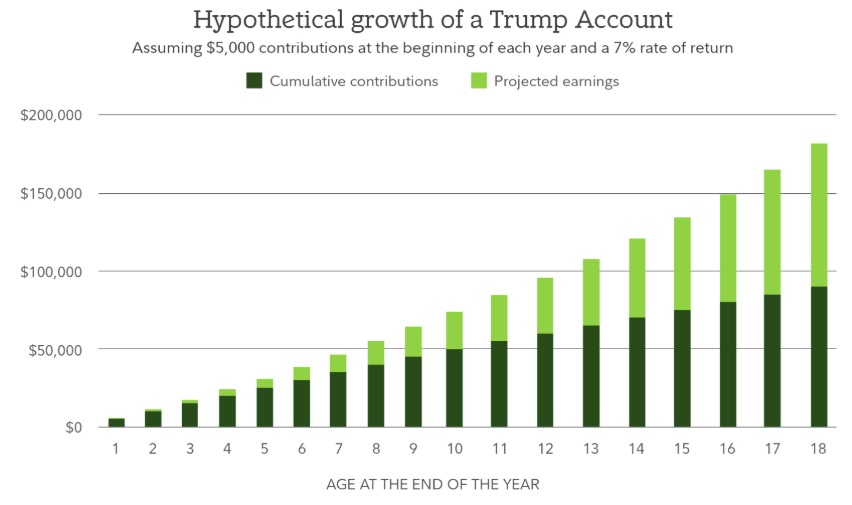
  • New in July 2026: Trump Accounts allow up to $5,000 per year per child (under age 18) in contributions, plus a potential $1,000 government seed deposit for eligible birth years.
  • Tax-Deferred — Not Tax-Free: Growth and most contributions are ultimately taxed as ordinary income unless proactively converted to a Roth IRA after age 18.
  • Planning Opportunity — But Timing Is Critical: The real advantage is a strategic Roth conversion during a child's low-income, financially independent years. Converting too early — while they're still a student claimed as a dependent — can trigger the kiddie tax and eliminate the benefit.

By now, you’ve likely heard something about Trump Accounts — formally known as 530A accounts. They’re one of the more talked-about provisions in recent tax legislation, and for good reason: they’re a brand-new, tax-advantaged savings vehicle for children, launching July 4, 2026. For families thinking through Trump Accounts tax planning, the details matter quite a bit before you commit. Before your family rushes to open one, here’s what you need to understand.

What Are They?

Trump Accounts are a type of custodial account — owned by the child but administered by an adult until the child turns 18. Family members can open accounts online at trumpaccounts.gov or by filing IRS Form 4547. They’re designed to fill a gap in the planning landscape. Custodial brokerage accounts (UTMAs/UGMAs) allow families to invest for a child, but growth is generally taxable. A 529 plan offers tax advantages, but only for qualified education expenses. And while children can contribute to a Roth or traditional IRA, they need earned income to do so — something most young children don’t have.

Trump Accounts require no earned income. Contributions of up to $5,000 per year can be made by parents, grandparents, adult siblings, legal guardians, or employers, as long as the child has a Social Security number and hasn’t yet turned 18 in the year the account is opened. Employers can also make matching contributions, which are deductible up to $2,500 and count toward the annual limit.

For children born between January 1, 2025 and December 31, 2028, there’s an added incentive: a one-time $1,000 federal seed contribution deposited directly into the account (and not counted against the annual cap). Separately, up to 25 million children age 10 or younger in lower-income zip codes may receive an additional $250 through a charitable contribution from the Michael and Susan Dell Foundation.

Investment options will be limited — likely a narrow menu of low-cost U.S. equity index funds, similar to the federal Thrift Savings Plan, with an expense cap of around 0.10%.

How Withdrawals Work — and Why It Matters

Withdrawals from a Trump Account are not allowed before the child turns 18. Beginning January 1 of the year the child turns 18, the account converts to a traditional IRA — subject to standard IRA rules, including a potential 10% early withdrawal penalty before age 59½.

Like a traditional IRA, growth inside the account is tax-deferred, and withdrawals are taxed as ordinary income.

That’s worth pausing on. A family that instead invested in a taxable custodial account (UTMA/UGMA) would likely see long-term growth taxed at capital gains rates — which, for most long-term investors, are meaningfully lower than ordinary income rates. So without additional planning, a Trump Account can effectively convert what might have been long-term capital gains into future ordinary income. That trade-off isn’t necessarily bad, but it’s not automatically a win, either.

Trump Accounts Tax Planning: The Age-18 Roth Conversion

Here’s where the planning story gets interesting — and where these accounts may offer a genuine advantage for families who think ahead.

Under Notice 2025-68, Trump Accounts are explicitly permitted to be converted to a Roth IRA once they become IRAs at age 18. That’s significant.

At 18, many young adults are in college with little to no income. If a child converts their Trump Account to a Roth IRA during a year when their taxable income is low, they may owe conversion taxes at a very low marginal rate — potentially 10% or 12%. Once converted, the account grows completely tax-free, no required minimum distributions apply during their lifetime, and withdrawals in retirement are income-tax free.

Used intentionally this way, a Trump Account becomes something closer to a delayed Roth funding mechanism for minors — one that doesn’t require earned income during childhood. That’s a genuinely useful planning tool.

The Kiddie Tax Caveat

There’s one important wrinkle families need to understand before assuming an 18-year-old college student can simply convert the account at a low rate.

The kiddie tax is a provision in the tax code that taxes a dependent child’s unearned income at the parents’ marginal rate, rather than the child’s own rate. It applies to children under age 19, and to full-time students under age 24 who don’t provide more than half of their own financial support.

A Roth conversion counts as income in the year it occurs. If a child is 18, in college, and still a dependent, the kiddie tax could cause a large Roth conversion to be taxed at the parents’ rate — potentially defeating much of the benefit.

The planning implication: the optimal time for conversion is likely after the child is working, financially self-supporting, and no longer subject to the kiddie tax. That might mean waiting until age 22 or 23 rather than converting the moment the account becomes an IRA. The account continues growing tax-deferred in the meantime, which softens the delay — but families should be deliberate about the timing.

How Trump Accounts Compare


Account Type Tax Treatment Earned Income Required? Use Restrictions
Trump Account (530A) Tax-deferred; withdrawals as ordinary income (Roth conversion possible) No Cannot withdraw before 18
529 Plan Tax-free for qualified education No Education expenses only
Custodial Roth IRA Tax-free growth and withdrawals Yes IRA rules apply
UTMA / UGMA Taxable (capital gains rates) No None

What Should Families Do Now?

For eligible children born between 2025 and 2028, accepting the $1,000 government seed contribution is a straightforward decision — it costs nothing and gives the account a running start. Over 60 years at a 7% annualized return, that $1,000 alone could grow to nearly $58,000. Add $50 per month in family contributions, and the account could reach close to $550,000 over the same period.

Beyond that, the question of whether to make additional contributions deserves a closer look. The answer depends on your family’s overall tax picture, whether a deliberate Roth conversion strategy is part of your plan, and how the account fits alongside other savings vehicles like 529 plans and IRAs.

These accounts have real potential — but the advantage isn’t automatic. It requires coordination.

If you’d like to talk through how a Trump Account might fit into your family’s financial plan, reach out. We’re glad to help.

As with many new legislative programs, details are still being finalized — for a full legislative overview, the Congressional Research Service published a comprehensive summary in April 2026.


Past performance does not guarantee future results. All investments include risk and have the potential for loss as well as gain.

Data sources for returns and standard statistical data are provided by the sources referenced and are based on data obtained from recognized statistical services or other sources we believe to be reliable. However, some or all information has not been verified prior to the analysis, and we do not make any representations as to its accuracy or completeness. Any analysis nonfactual in nature constitutes only current opinions, which are subject to change. Benchmarks or indices are included for information purposes  only  to  reflect  the  current  market  environment;  no  index  is  a directly  tradable investment.  There  may  be  instances  when  consultant  opinions  regarding any fundamental or quantitative analysis do not agree.

The  commentary  contained  herein  has  been  compiled  by  W.  Reid Culp,  III  from  sources  provided  by  TAGStone  Capital,  as well  as  commentary  provided  by  Mr.  Culp,  personally,  and  information independently  obtained  by  Mr.  Culp.  The  pronoun  “we,”  as  used  herein,  references collectively the sources noted above.

TAGStone Capital, Inc. provides this update to convey general information about market conditions and not for the purpose of providing investment advice. Investment in any of the companies or sectors mentioned herein may not be appropriate for you. You should consult your advisor from TAGStone or others for investment advice regarding your own situation.


At a Glance

  • Geopolitical conflicts can trigger short-term market volatility
  • Diversified portfolios are designed to withstand these periods
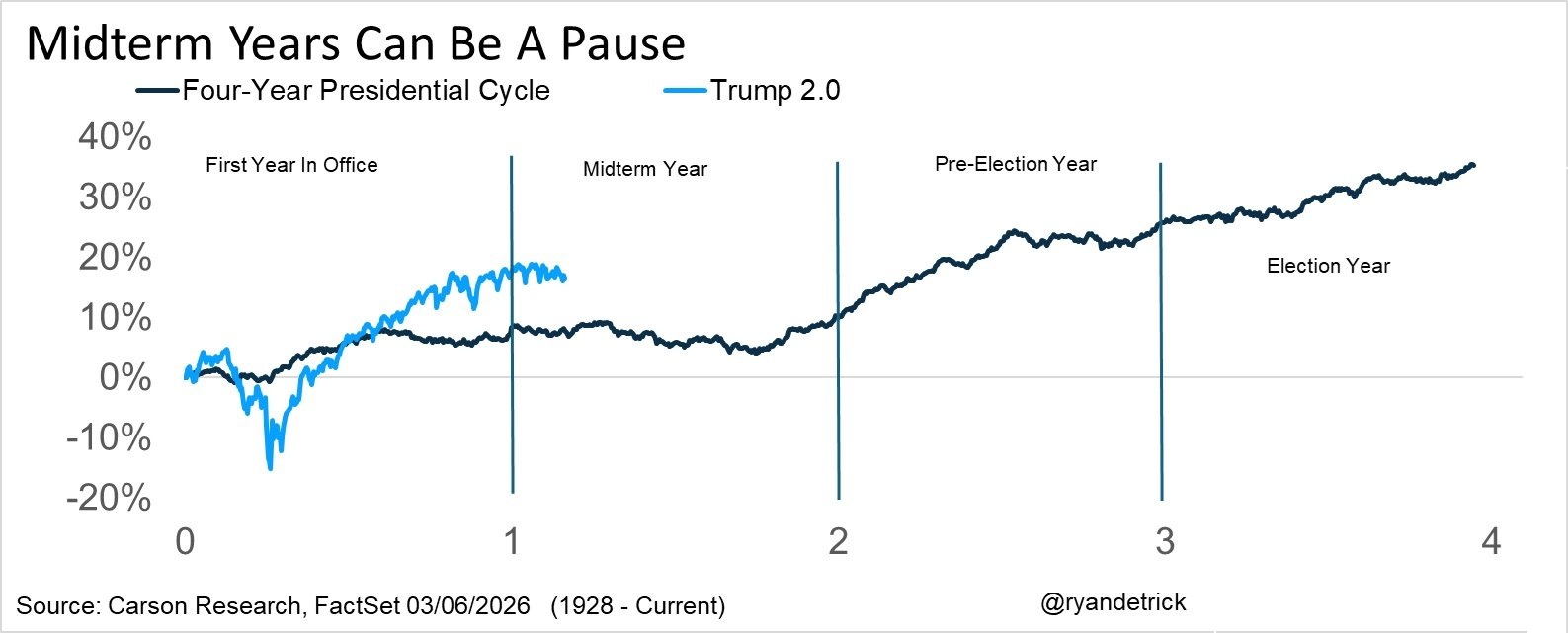
  • Midterm election years often bring volatility, but historically lead into strong market periods

Periods of geopolitical tension can cause sharp market reactions and unsettling headlines.

Recently, events in the Middle East have escalated rapidly. On Feb. 28, the U.S. and Israel launched an attack on Iran, setting off a rapidly escalating conflict across the Middle East. Fighting has spread to other countries, bringing with it destruction and loss of life.

In addition to the humanitarian toll, the conflict is making economic waves globally. As of 2025, 20 million barrels of oil per day—about 20% of global consumption—traveled through the Persian Gulf. That traffic came to a standstill after the attack, and oil prices climbed swiftly.

These events have investors worried and markets reacting. In early March, the CBOE Volatility Index jumped to its highest level since the near bear market last April.

What Exactly Has Markets Concerned?

Investors worry that rising oil prices could slow the economy. Energy is a key input for transportation, manufacturing, and other activities. When oil prices spike, many industries face higher costs.

Investors are also concerned about inflation. Higher energy prices can lead to broader price increases. What’s more, many investors were hoping the Federal Reserve would lower interest rates to boost the economy. If inflation rises, the Fed may be less likely to do so.

Your Portfolio Is Built for Moments Like This

While the headlines are alarming, periods like this are not unusual in long-term investing. At TAGStone, portfolios are designed with the expectation that geopolitical events, economic shocks, and market volatility will occur from time to time.

It’s important to remember that your diversified investment portfolio is built to withstand moments like this.

For instance, your portfolio already includes allocations to U.S. and international stocks, bonds, and cash. The fixed income portion of your portfolio, in particular, can help provide stability when equities become more volatile, helping smooth overall portfolio fluctuations.

Within the equity portion of your portfolio, diversification also helps manage risk. Some sectors may struggle when energy prices rise, such as technology and consumer discretionary.[1] On the other hand, energy companies might benefit from rising prices, potentially helping offset losses elsewhere.

A diversified portfolio does not eliminate losses, but it can help reduce the magnitude of downturns compared to broad market indices such as the S&P 500.

It’s also worth remembering that much of your portfolio is invested for the long term. Short-term market movements can feel uncomfortable, but the assets that fluctuate most today typically are the ones you won’t need to draw on for many years. As a result, you may not need to change anything about your portfolio to respond to the current news cycle.

This year may also naturally bring somewhat higher market volatility. Historically, midterm election years have tended to experience larger intra-year declines—closer to about 17–18% on average versus roughly 14–15% in a typical year. While those declines can feel unsettling in the moment, the period following midterm elections has historically been one of the strongest stretches in the four-year presidential cycle.

A Final Perspective

In times of geopolitical crisis, it is natural for both people and markets to react quickly. History, however, suggests that these events rarely alter the long-term trajectory of markets.

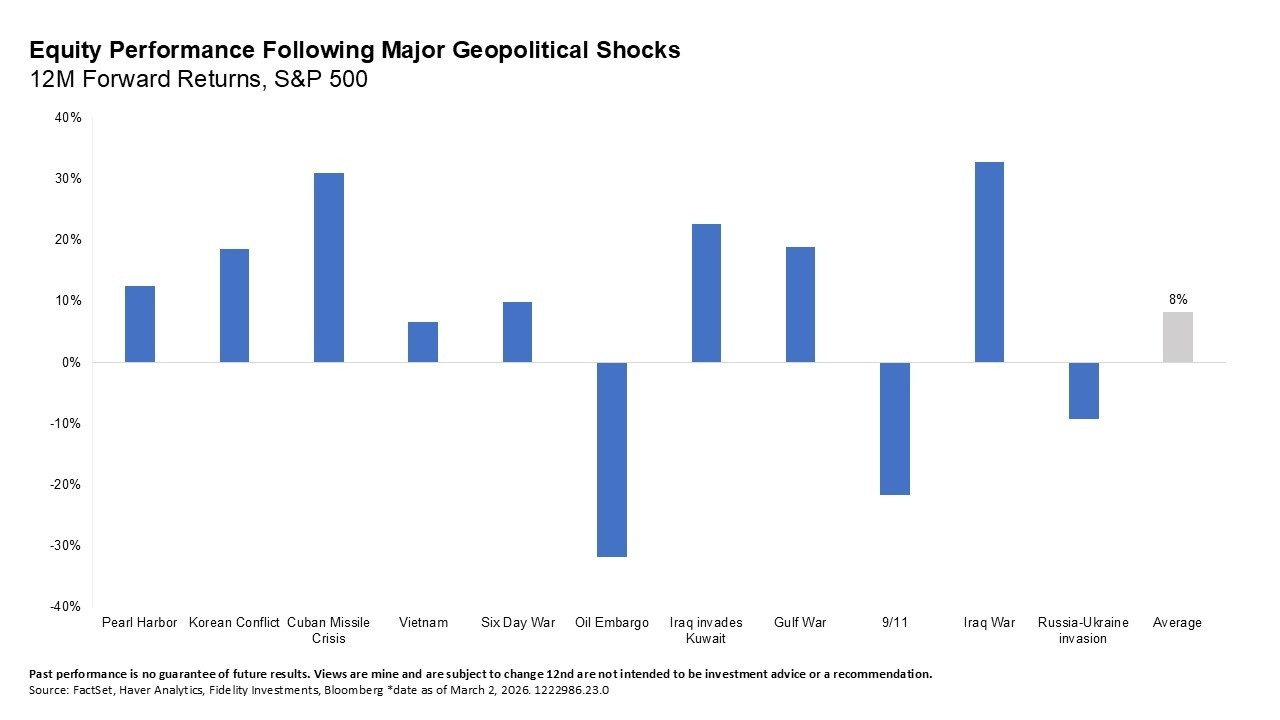
One useful way to think about geopolitical crises is that markets tend to treat them as temporary disruptions rather than permanent economic changes. Denise Chisholm, director of quantitative market strategy at Fidelity, looked into geopolitical shocks from Pearl Harbor through Russia’s 2022 invasion of Ukraine. She found that, on average, U.S. equities returned about 8% over the following year, on par with their long-term annual average. Her conclusion: “It’s the exception, not the rule, that geopolitical events become sustained market headwinds.”

The chart below illustrates how U.S. equities have historically performed in the year following major geopolitical shocks.

If you have questions about how current events may affect your portfolio, don’t hesitate to reach out. We’re always happy to talk through your concerns and help you stay focused on your long-term plan.

[1] See slide 6 of the linked chart pack.


Past performance does not guarantee future results. All investments include risk and have the potential for loss as well as gain.

Data sources for returns and standard statistical data are provided by the sources referenced and are based on data obtained from recognized statistical services or other sources we believe to be reliable. However, some or all information has not been verified prior to the analysis, and we do not make any representations as to its accuracy or completeness. Any analysis nonfactual in nature constitutes only current opinions, which are subject to change. Benchmarks or indices are included for information purposes  only  to  reflect  the  current  market  environment;  no  index  is  a directly  tradable investment.  There  may  be  instances  when  consultant  opinions  regarding any fundamental or quantitative analysis do not agree.

The  commentary  contained  herein  has  been  compiled  by  W.  Reid Culp,  III  from  sources  provided  by  TAGStone  Capital,  as well  as  commentary  provided  by  Mr.  Culp,  personally,  and  information independently  obtained  by  Mr.  Culp.  The  pronoun  “we,”  as  used  herein,  references collectively the sources noted above.

TAGStone Capital, Inc. provides this update to convey general information about market conditions and not for the purpose of providing investment advice. Investment in any of the companies or sectors mentioned herein may not be appropriate for you. You should consult your advisor from TAGStone or others for investment advice regarding your own situation.


At a Glance

  • Most people have one or two of these documents in place — but comprehensive planning requires all four, working together as a coordinated safety net.
  • Each document serves a distinct purpose: financial decisions, medical decisions, end-of-life preferences, and asset distribution.
  • Estate planning failures are rarely about missing documents — they're about outdated designations, poor coordination, and plans that haven't kept pace with life.

No one likes to imagine a time when they might be sick or unable to make decisions for themselves. It ranks alongside cleaning out the garage or scheduling a long-overdue physical—important, but all too easy to postpone. Yet having the right estate planning documents in place can make all the difference.

Without a clear plan in place, the state might step in and appoint a guardian to make financial and medical decisions on your behalf. Someone you didn’t choose could end up deciding where you live, how your money is managed, or what medical treatments you receive. That's not a situation any of us wants to be in.

Incapacity exists on a spectrum. It could look like cognitive decline from Alzheimer’s or dementia, physical incapacity after an injury or illness, a sudden event such as a stroke, or a gradual decline over time.

Because these scenarios unfold differently—and at different life stages—you’ll need four key documents to address them:

  1. a durable power of attorney,
  2. health care proxy,
  3. living will, and
  4. a will or revocable trust.

You may already have one or two of these documents, but comprehensive planning requires all four. Together, these documents create a coordinated safety net. Without one, gaps can appear. It’s like living near a river and buying homeowner’s insurance but skipping flood coverage. You’re mostly protected… until you’re not.

1. Durable Power of Attorney

A durable power of attorney (DPOA) is a legal document that authorizes someone—known as your agent or attorney-in-fact—to manage your financial affairs on your behalf, including bills, banking, investments, and business interests. The word “durable” here is key: it means the document remains valid even if you become mentally incapacitated.

Choosing the right person to fill this role matters. Consider someone who is financially responsible, trustworthy, and capable of handling potential conflict if family members disagree. Many people select a spouse or adult children. If these options don’t feel appropriate, we can help you identify another trusted individual or a professional fiduciary.

It’s also wise to appoint a backup agent in case your first choice is unavailable when needed.

One related tool worth knowing about: a trusted contact person on your financial accounts. Unlike a DPOA agent, a trusted contact cannot make decisions or view your accounts, but they can serve as a point of contact for your financial institutions if something seems wrong.

For a deeper look at how a DPOA and a trusted contact person work in practice, including important tips on keeping it current with your financial institutions, see Protecting What's Yours (While You're Alive).

2. Health Care Proxy

Your health care proxy is a document that designates an agent to make medical decisions for you if you are unable to do so yourself. This covers situations where you are unconscious, severely ill, undergoing surgery, or have lost cognitive capacity.

The health care proxy is typically activated when a physician determines that you lack decision-making capacity. At that point, your agent can step in and make decisions about treatments, surgeries, medications, care facilities, and in some states, end-of-life decisions. Ideally, these decisions are guided by your known wishes or their best judgment of what you would want.

Again, a spouse or adult children are common choices. Whoever you name should be someone who understands your preferences about medical care, is comfortable making decisions under pressure, and can advocate for you with medical professionals.

It’s also common to name different individuals for medical and financial decisions. It creates natural checks and balances and helps prevent one person from carrying the entire weight.

3. Living Will

A living will complements your health care proxy. This document spells out—in your own words—the medical treatments you do and don’t want in specific circumstances, such as a terminal condition, a persistent vegetative state or at the end-stage of an illness with little hope for recovery.

You don’t need to name an agent for a living will. However, it may be helpful to come up with this document in conversation with your physician and estate attorney. Tools like the “Five Wishes” framework can serve as a jumping-off point for clarifying your preferences.

Your living will is part of a broader healthcare advance directive. We cover what that includes, and other practical tips, in Protecting What's Yours (While You're Alive).

4. Will or Revocable Living Trust

The first three documents address what happens when you're living but unable to act. The fourth addresses what comes after.

Your estate plan should also include a will or trust that addresses what happens to your assets.

A will outlines how your property should be distributed after you die, names an executor to carry out your wishes, and designates a guardian for any minor children.

A revocable living trust goes a step further. You transfer assets into the trust during your lifetime—typically naming yourself as the initial trustee so you retain full control—and a successor trustee steps in if you become incapacitated or die.

Because assets in a trust bypass the probate process, transfers tend to be faster, more private, and less expensive. There are several types of revocable trusts, and we can work with you and your estate attorney to determine which structure fits your situation.

A will or trust is just the starting point. The greater risk for most families is execution and coordination after documents are signed. We cover what that looks like in Protecting What's Yours (After You Pass) and the step-by-step process in Part 2.

Keep Your Estate Planning Documents Current

No single document covers every phase of incapacity or death. The goal is to have all four in place, kept current, and accessible to the people who may need them.

One important area these documents don’t cover is beneficiary designations on retirement accounts and life insurance policies. These designations override instructions in your will, so make sure they are up to date and aligned with your wishes.

Finally, remember that life is dynamic. Laws evolve, financial situations shift, and relationships change. Plan to review each of these documents regularly, especially after major life events such as marriage, divorce, the birth of a child, relocation, or significant changes in wealth, and update them as needed.

The Core Four documents are the foundation, but they're only as strong as the planning and coordination around them. At TAGStone Capital, we help clients build and maintain that full picture, from incapacity planning to estate execution. To go deeper on what happens after documents are signed, see Protecting What's Yours (After You Pass). Or, if you're ready to talk through where your own plan stands, schedule a complimentary 15-minute conversation.


Past performance does not guarantee future results. All investments include risk and have the potential for loss as well as gain.

Data sources for returns and standard statistical data are provided by the sources referenced and are based on data obtained from recognized statistical services or other sources we believe to be reliable. However, some or all information has not been verified prior to the analysis, and we do not make any representations as to its accuracy or completeness. Any analysis nonfactual in nature constitutes only current opinions, which are subject to change. Benchmarks or indices are included for information purposes  only  to  reflect  the  current  market  environment;  no  index  is  a directly  tradable investment.  There  may  be  instances  when  consultant  opinions  regarding any fundamental or quantitative analysis do not agree.

The  commentary  contained  herein  has  been  compiled  by  W.  Reid Culp,  III  from  sources  provided  by  TAGStone  Capital,  as well  as  commentary  provided  by  Mr.  Culp,  personally,  and  information independently  obtained  by  Mr.  Culp.  The  pronoun  “we,”  as  used  herein,  references collectively the sources noted above.

TAGStone Capital, Inc. provides this update to convey general information about market conditions and not for the purpose of providing investment advice. Investment in any of the companies or sectors mentioned herein may not be appropriate for you. You should consult your advisor from TAGStone or others for investment advice regarding your own situation.


At a Glance

  • US large cap stocks: +17.88% (third consecutive double-digit year)
  • 2026 earnings growth projected near 15% (Wall Street consensus)
  • Elevated valuations and concentration reinforce disciplined diversification

Equity markets delivered a third consecutive year of double-digit returns in 2025. Several crosscurrents shaped 2025 market performance — from earnings strength and AI enthusiasm to shifting Federal Reserve policy and elevated valuations. Below, we review the key drivers and outline our 2026 investment outlook for disciplined long-term investors.

Investment Principles That Guide Our Decisions

I’ll begin by briefly restating the core principles that shape our planning and investment decisions:

  • We are long-term, goal-focused investors. Our investment policy is designed to support your objectives through broadly diversified portfolios of high-quality equities and bonds.
  • Studies and empirical evidence indicate that the economy cannot be forecast with consistency, nor markets timed with reliability in the short-term. Therefore, to trade profitably, after taxes, on short-term news or market movements is very difficult.
  • From this, we conclude that the best way to capture the long-term return premium of equities is to remain invested through their inevitable, uncomfortable, but normally temporary declines (excluding extraordinary periods such as 1929).
  • As long as your long-term goals remain unchanged, our investment strategy for achieving them will remain consistent. And as long as the investment strategy remains consistent, so too will your portfolio—aside from disciplined, periodic rebalancing.
  • We believe long-term compounding in quality equities, with an appropriate allocation to high-quality bonds, is the most effective way to capture attractive investment returns to support your goals. In that spirit, we remain mindful of Charlie Munger’s reminder that “the first law of compounding is to never interrupt it unnecessarily.”

Economic and Market Backdrop

1. Equity Performance in 2025

In 2025, the broad equity market delivered its third consecutive year of double-digit returns, supported by solid economic growth and meaningful gains in corporate earnings. A broad index of US large cap stocks finished the year up 17.88%.

2. Earnings Growth and AI Expectations

Looking ahead, the general expectation among major financial institutions is that company profits will continue their upward climb, with earnings growth forecasted at nearly 15% for 2026 (source: Yardeni Research). Experts believe this expansion in profits will be fueled by artificial intelligence and a resilient consumer, as detailed in the following earnings per share (EPS) projections:

Select Wall Street 2026 Earnings Per Share (EPS) Forecasts
Institution 2026 EPS Estimate EPS Growth Forecast Notable Driver
Morgan Stanley $317 17% AI-driven efficiency and tax benefits
JPMorgan $306 - $314 13% - 15% AI "supercycle" and resilient economy
Goldman Sachs $305 12% Productivity gains from AI adoption
Consensus (FactSet) $309 14.9% Average of all major analyst estimates

Remarkably, profit margins have also continued to expand, reaching 13.1% in the third quarter of 2025—the highest level in 15 years (source: FactSet). Many expected rising input costs and consumer resistance to price increases to squeeze margins. To date, those concerns have not materialized.

3. Labor Market and Productivity Trends

The main weak spot in the economy has been employment, which continues to soften. However, even this has a bright spot. The relatively flat employment levels have been offset by strong growth in supply, which has led to higher productivity. Though unemployment has risen slightly to about 4.7%, most workers are producing more per hour, enabling wage growth without reigniting inflation.

4. Federal Reserve Policy and Inflation

After six consecutive rate cuts, Federal Reserve policy is now roughly 175 basis points more accommodative than a year ago, while CPI inflation has remained relatively tame near three percent. It is reasonable to expect the lagged effects of this easing to become more visible in 2026—hopefully through continued economic growth as long as productivity remains high.

5. Fiscal Tailwinds and Tax Policy

This tax season, middle-income households are expected to receive meaningful refunds—estimated at around $150 billion in aggregate, or roughly a half percentage point boost to GDP. Key drivers include a higher standard deduction and the temporary increase of the SALT deduction cap to $40,000 from $10,000, which could provide a near-term economic tailwind.

Unfortunately, much of this positive economic data is often under-reported in the financial news because it does not align with their prevailing narrative, which tends to emphasize negative developments—most notably the softening labor market. The information we receive from financial “news” is often skewed toward pessimism because it sells better.

6. Valuations and Market Concentration

Regardless, the strongly rising equity market may already reflect much of this positive information. As a result, the dominant question of 2025 became whether markets have moved into an AI-driven bubble—supplanting 2024’s concern about rate cuts and 2023’s concern about a recession.

There is no denying that today’s market is more concentrated in a small number of large technology companies than at any point in recent decades, and that valuations for the broad US large-cap stock indexes sit near historical highs.


Portfolio Implications

Our response to this environment is straightforward:

  1. Valuations and Expected Returns: While higher starting valuations have historically pointed towards lower-than-average expected returns over the next 5-10 years, valuations have not been a reliable market-timing tool in the short term.
  2. Concentration Risk and Diversification: While higher starting valuations and concentration risk are not ideal, these risks can be addressed through disciplined portfolio construction and systematic rebalancing to provide an attractive investment experience.
  3. Long-Term Plans vs. Short-Term Narratives: Generally, long-term plans should not be altered in response to short-term narratives, popular fears, or even higher starting valuations.
  4. Asset Allocation Discipline: Pick a stock-to-bond ratio you are comfortable with, and only make changes to the ratio if your circumstances change. Cash and bonds are necessary to help you weather inevitable market declines.

Closing Perspective

History suggests that the next market disruption will likely come from an unexpected source (in the jargon, an unknown unknown, as opposed to a known unknown like higher starting valuations or the national debt). Such events tend to matter little to the plans of long-term stock investors except as opportunities to rebalance and invest at more attractive prices.

Plus, the alternatives of trying to invest in private real estate deals or a private operating business can subject you to even greater costs, risks, and, potentially, a permanent loss of capital as opposed to the normally temporary declines a long-term stock investor may experience.

We continue to follow an approach that has worked over full market cycles in that it has provided the best chance to help investors achieve their most precious financial goals. We do not assume “this time is different,” nor do we adjust strategy to accommodate the fears or fashions of the moment. We avoid abandoning markets during periods of stress, and we avoid overcommitting to any single “new era” narrative—AI included.

We wish you and your family a healthy, happy, and prosperous 2026. As always, we are here to answer questions and discuss your plan at any time. Thank you for the trust you place in us—it is a privilege to serve you.


Past performance does not guarantee future results. All investments include risk and have the potential for loss as well as gain.

Data sources for returns and standard statistical data are provided by the sources referenced and are based on data obtained from recognized statistical services or other sources we believe to be reliable. However, some or all information has not been verified prior to the analysis, and we do not make any representations as to its accuracy or completeness. Any analysis nonfactual in nature constitutes only current opinions, which are subject to change. Benchmarks or indices are included for information purposes  only  to  reflect  the  current  market  environment;  no  index  is  a directly  tradable investment.  There  may  be  instances  when  consultant  opinions  regarding any fundamental or quantitative analysis do not agree.

The  commentary  contained  herein  has  been  compiled  by  W.  Reid Culp,  III  from  sources  provided  by  TAGStone  Capital,  as well  as  commentary  provided  by  Mr.  Culp,  personally,  and  information independently  obtained  by  Mr.  Culp.  The  pronoun  “we,”  as  used  herein,  references collectively the sources noted above.

TAGStone Capital, Inc. provides this update to convey general information about market conditions and not for the purpose of providing investment advice. Investment in any of the companies or sectors mentioned herein may not be appropriate for you. You should consult your advisor from TAGStone or others for investment advice regarding your own situation.


At a Glance

  • Higher thresholds, but limited impact for high earners. The standard deduction and Child Tax Credit increased, though many new deductions phase out quickly at higher income levels.
  • Estate exemption remains elevated. The lifetime gift and estate tax exemption rose to $15 million in 2026, providing clarity for long-term gifting and trust planning.
  • New reporting and deduction rules require coordination. Crypto transactions now generate Form 1099-DA, certain new deductions apply through 2028, and IRA contributions remain available before the April filing deadline.

2025 Tax Changes: What to Review Before Filing Your Return

Filing your tax return might seem routine. In reality, small rule changes can have significant planning implications — especially for higher‑income households balancing investment income, business interests, charitable giving, and multi‑generational wealth strategies.

The 2025 tax year introduced several structural changes affecting income reporting, deductions, and estate planning, stemming from the One Big Beautiful Bill Act (OBBBA), passed in July. While many headlines highlight broad taxpayer benefits, some provisions phase out quickly at higher income levels. For affluent families, the technical details, not the headlines, determine the real impact. Understanding how these changes fit into your overall financial plan ultimately shapes the outcome.

A Boost for Traditional Deductions

The OBBBA made several taxpayer-friendly provisions permanent, starting with a higher standard deduction. For 2025, the standard deduction increases to $15,750 for single filers, up from $15,000 in 2024. For married couples filing jointly, the deduction rises to $31,500, up from $30,000.

The legislation also expanded the Child Tax Credit, increasing it to $2,200 per qualifying child, compared with $2,000 under prior law.

For higher‑income households who typically itemize, the increased standard deduction may have limited practical impact — particularly when charitable contributions, mortgage interest and property taxes remain significant. Still, the higher threshold can reduce the marginal benefit of smaller itemized deductions and may influence charitable “bunching” or timing strategies.

New Tax Deductions to Be Aware Of

The OBBBA introduced several new deductions for 2025. Many have income phaseouts that limit their usefulness for higher earners, but they may still be relevant for certain family members or key employees in privately owned businesses.

  • Personal deduction for seniors: If you were born before Jan. 2, 1961, you can take a $6,000 deduction ($12,000 if married filing jointly) in addition to your standard or itemized deduction. This deduction is phased out if your modified adjusted gross income (MAGI) is between $75,000 ($150,000 for joint filers) and $175,000 ($250,000 for joint filers).
  • Tax deduction for tips: Often described politically as “no tax” on tips and overtime, the reality is more nuanced. In practice, there is now a deduction for voluntary cash or charged tips earned in industries where tipping is customary. From 2025 through 2028, eligible single filers can deduct up to $25,000 in tipped income, though the deduction begins to phase out for individuals with MAGI above $150,000.
  • Tax deduction for overtime pay: A similar deduction applies to a portion of qualified overtime pay from 2025 through 2028. In most cases, this refers only to the premium portion of overtime—for example, the extra “half” in “time-and-a-half” pay—rather than the worker’s full hourly wage. For single filers, the deduction is capped at $12,500 of eligible compensation for those with MAGI below $150,000. The deduction is phased out above that amount and is zeroed out once above $275,000.
  • Car loan interest deduction: If you financed the purchase of a new vehicle in 2025, you may be eligible to deduct up to $10,000 in interest paid on that loan, provided the vehicle was built in the United States and is used for personal use. To determine if your car fits the bill, look at your vehicle identification number (VIN). Cars built in the United States will have a VIN that starts with a 1, 4, or 5. The deduction phases out for single filers with MAGI above $100,000. Given the income limits and the fact that many higher‑income households either pay cash or lease vehicles, this provision may have a limited impact in affluent planning contexts. In future years, lenders will be required to report auto loan interest payments directly to both taxpayers and the IRS. For this year, you may need to do a little digging through your loan statements, or you can request a summary of interest paid from your lender.

Gift and Estate Tax Exemptions: Long-Term Clarity

The OBBBA provided clarity to a crucial estate planning rule. The lifetime estate and gift tax exemption was previously scheduled to sunset on December 31, 2025, potentially reducing the exemption from nearly $14 million to approximately $6 million. Instead, the higher exemption has been made permanent. Here’s where things stand now:

  • The estate and gift tax exemption rose to $15 million in 2026 and is indexed to inflation going forward.
  • The annual gift tax exclusion is $19,000 per recipient in 2026.
  • While it’s too late to make a tax-free gift for 2025, now is a good time to begin planning gifting strategies for 2026.


While permanence provides welcome clarity, it does not eliminate planning considerations. Families with estates approaching the exemption threshold should continue evaluating lifetime gifting strategies, trust structures, and long-term liquidity planning. Asset growth, legislative risk, and multi-generational objectives still warrant proactive review.

Tax Reporting on Cryptocurrency

Beginning in 2025, the IRS requires reporting of digital asset transactions. If you sold or exchanged digital assets through a platform such as Coinbase, you should receive a Form 1099‑DA, a form created specifically for digital asset reporting.

Capital gains taxes generally apply to crypto sales and trades. Digital assets received as compensation may be taxed as ordinary income.

Investors holding digital assets outside centralized platforms should pay particular attention to basis tracking and transaction documentation, as reporting discrepancies may increase audit risk.

It’s Not Too Late to Fund Your IRA

While the window for 2025 401(k) contributions closed at year‑end, you may still make 2025 traditional or Roth IRA contributions until the April 15 filing deadline.

The contribution limit for IRAs remains $7,000, with an additional $1,000 catch‑up contribution available for individuals age 50 or older.

Higher‑income households considering backdoor Roth contributions should coordinate carefully to avoid unintended pro‑rata tax consequences.

Planning Ahead Matters

Tax rules change regularly. What matters more is how those rules integrate with your long‑term investment strategy, liquidity needs, and estate planning objectives.

Reviewing your situation before filing allows for greater flexibility — whether that involves IRA funding decisions, charitable contributions, gifting strategies, or managing realized gains.

If you would like to review how these 2025 changes apply to your specific circumstances, we are happy to schedule a conversation.


Past performance does not guarantee future results. All investments include risk and have the potential for loss as well as gain.

Data sources for returns and standard statistical data are provided by the sources referenced and are based on data obtained from recognized statistical services or other sources we believe to be reliable. However, some or all information has not been verified prior to the analysis, and we do not make any representations as to its accuracy or completeness. Any analysis nonfactual in nature constitutes only current opinions, which are subject to change. Benchmarks or indices are included for information purposes  only  to  reflect  the  current  market  environment;  no  index  is  a directly  tradable investment.  There  may  be  instances  when  consultant  opinions  regarding any fundamental or quantitative analysis do not agree.

The  commentary  contained  herein  has  been  compiled  by  W.  Reid Culp,  III  from  sources  provided  by  TAGStone  Capital,  as well  as  commentary  provided  by  Mr.  Culp,  personally,  and  information independently  obtained  by  Mr.  Culp.  The  pronoun  “we,”  as  used  herein,  references collectively the sources noted above.

TAGStone Capital, Inc. provides this update to convey general information about market conditions and not for the purpose of providing investment advice. Investment in any of the companies or sectors mentioned herein may not be appropriate for you. You should consult your advisor from TAGStone or others for investment advice regarding your own situation.


At a Glance

  • Estate planning at higher levels of wealth is an execution and coordination challenge—not merely a legal exercise.
  • The greatest risks arise where intent, legal documents, asset titling, and beneficiary designations drift out of alignment.
  • Sophisticated families approach estate planning as an ongoing, advisor‑guided process that evolves with assets, entities, and family dynamics.

Part 2: Step-by-Step Estate Planning for Sophisticated Families

In Part 1 of this series, we addressed why estate planning matters—and why, for many families, it represents one of the most meaningful acts of stewardship they can undertake. In this follow‑up, we turn to the how.

For families with significant assets, multiple entities, or multigenerational considerations, estate planning is rarely a single document or moment in time. It is a procedural process that requires clarity of intent, disciplined implementation, and ongoing coordination across advisors.

What follows is a practical framework that reflects how sophisticated families typically approach estate planning—methodically, deliberately, and with an eye toward fiduciary, tax, and governance risk.

Hurdle #1: Deciding Who Gets What

The first step is deceptively simple: defining what should happen after you pass. In practice, this is where many long‑term issues are either resolved—or unintentionally created.

At higher levels of wealth, this exercise often extends beyond a single balance sheet. It may involve operating businesses, real estate partnerships, concentrated investment positions, family trusts, or philanthropic structures. Decisions made here can have downstream consequences for estate taxes, GST planning, liquidity, and family governance.

Rather than attempting to control every detail, sophisticated families focus first on priorities:

  • Who are the intended beneficiaries, and at what stages of life?
  • Are there second marriages, blended families, or differing levels of financial maturity?
  • Which assets are illiquid, and which are expected to fund liquid needs?


These questions are best addressed while capacity is intact and family dynamics can be navigated thoughtfully—often in parallel with broader lifetime planning decisions.

Who Gets What? A Strategic Checklist

  • Estimate net worth across all major assets and liabilities (ballpark is sufficient initially).
  • Identify primary beneficiaries, contingent beneficiaries, and charitable interests.
  • Consider how the bulk of the estate should be allocated, recognizing potential estate tax and GST implications.
  • Identify specific assets or heirlooms with emotional or historical significance.
  • Consider to whom or what entity you might like to leave these particular possessions.
  • Identify who you’d like to name as executor and/or trustee, to settle your estate and administer your trusts once you pass. (As described in this ACTEC article, “What It Means to be a Trustee: A Guide for Clients,” the person should be reliable to carry out their duties in a timely and responsible manner.)
  • Flag potential conflicts of interest or competing expectations among beneficiaries, such as multiple heirs each hoping to inherit the family cabin.
  • Identify individuals you would explicitly exclude, such as ex-spouses or estranged family members.


For many families, this stage benefits from advisor facilitation—not to dictate outcomes, but to surface blind spots before they harden into documents.

Hurdle #2: Making It Legal

Once intent is clear, the next step is translating that intent into enforceable legal structures. This is where technical precision matters—and where coordination failures can be costly.

While it is technically possible to rely on generic templates, we rarely see it hold up over time—particularly for families with layered trusts, operating entities, or long-term legacy objectives. Missing or imprecise legal language can easily undermine even well-intentioned plans. A reputable estate planning attorney does more than draft documents: they take the time to understand your family, translate intent into enforceable structures, anticipate tax and fiduciary risk, and collaborate with your financial advisors to ensure documents, asset ownership, and beneficiary designations work together. Once established, that relationship materially improves the plan’s durability and ease of ongoing maintenance.

Sophisticated estate plans often involve a combination of:

  • Will. Nearly every estate plan begins with a will. At a minimum, a will directs how assets passing through probate are distributed, names one or more executors to administer the estate, and appoints guardians for minor children where applicable. For families with modest complexity and clear beneficiary designations, a will may address the essentials. For more complex estates, the will functions as a backstop—capturing assets not otherwise titled or governed by trust arrangements and ensuring orderly administration through the probate process.
  • Revocable Living Trust (RLT). As assets, relationships, or family dynamics become more complex, many families supplement a will with a revocable living trust. An RLT allows the bulk of the estate to bypass public probate, providing greater privacy, continuity, and administrative efficiency. More importantly, it enables flexibility that a will alone cannot provide—such as supporting a surviving spouse during their lifetime while preserving remainder interests for children from a prior marriage, staging distributions for beneficiaries who are not yet ready to manage wealth, or protecting assets from a beneficiary’s creditors or spendthrift tendencies. Properly structured, an RLT also facilitates seamless management during incapacity and a smoother transition at death.
  • Specialized Trusts. Families with business interests, philanthropic goals, or multigenerational planning objectives often rely on additional trust structures to address specific risks and opportunities. These may include trusts designed to mitigate estate and GST taxes, support business succession, fund charitable initiatives, or establish long‑term family governance frameworks.


For families pursuing dynasty‑style planning, documents may also incorporate directed trustees, trust protectors, or successor governance provisions—structures that require careful alignment between legal language and real‑world administration.

A recurring risk at this stage is assuming that documents alone are sufficient. In reality, fiduciary risk often arises when documents say one thing and accounts, titles, or beneficiary forms say another.

Equally important is incapacity planning. Powers of attorney, healthcare directives, and trustee succession provisions should be evaluated alongside the broader lifetime planning framework, not treated as afterthoughts.

Hurdle #3: Getting It Together

This final step is where many estate plans quietly fail—not due to poor legal drafting, but due to incomplete implementation.

For trustees and executors, administrative clarity is not a convenience; it is a fiduciary necessity. Even well‑constructed plans can unravel if assets are mis‑titled, beneficiary designations are outdated, or key information is inaccessible.

Implementation and Governance Checklist

  • Maintain a detailed and current inventory of financial assets, including investment accounts, bank accounts, retirement plans, insurance policies, business interests, and any entities or partnerships in which you hold an interest.
  • Document who should receive specific collectibles, heirlooms, or personal property—typically through a separate, adjustable memorandum referenced by your will or trust.
  • Identify key professionals your trustees, executors, or beneficiaries may need to contact, such as your financial advisor, estate planning attorney, accountant, or insurance advisor.
  • Compile practical information fiduciaries will need to administer the estate efficiently: where legal documents are stored; how to access digital accounts, security codes, and devices; and contact information for household, caregiving, or pet care arrangements.
  • Confirm that revocable living trusts are fully funded with major assets so they can function as intended, with assistance from your estate planning counsel where needed.
  • Ensure homes, vehicles, business interests, and other titled assets are properly owned and aligned with the estate plan (individual, joint, trust, or entity ownership).
  • Review beneficiary designations on retirement accounts, insurance policies, and transfer on death assets regularly to ensure consistency with overall intent.
  • Reduce accumulated physical clutter and outdated records to avoid imposing unnecessary administrative and emotional burdens on fiduciaries and heirs.
  • Revisit each of these steps on a recurring basis—particularly after births, deaths, marriages, divorces, relocations, major financial events, legislative changes, or material shifts in family or trust structures.


For families with ongoing trusts or multigenerational arrangements, this review cadence is not optional; it is a core governance discipline as assets grow, laws evolve, and fiduciary responsibilities expand.

Security also warrants explicit treatment as a fiduciary risk-mitigation issue. Trustees and executors have a duty to safeguard sensitive personal and financial information against identity theft, fraud, and unauthorized access—while still being able to locate and act on that information efficiently when required. Poor security practices can delay administration, increase costs, and expose fiduciaries to avoidable liability. For this reason, many sophisticated families use secure digital vaults or reputable password managers to centralize account access, document locations, and critical credentials. When selecting these tools, it is prudent to designate an emergency or fiduciary contact with clearly defined access rights, so information is neither inaccessible nor overly exposed at the moment it is needed most.

How We Help

Estate planning is often described as a legal exercise. In practice, for families with meaningful complexity, it is a coordination challenge that unfolds over time—across advisors, entities, and generations.

We work with families and fiduciaries to ensure that intent, legal structures, asset ownership, beneficiary designations, and administrative execution remain aligned—not just at the moment documents are signed, but as circumstances evolve. Our role is not to replace estate counsel or trustees, but to help orchestrate the process so decisions made during life carry through cleanly after death.

For families who already have documents in place, we are often engaged to review implementation and readiness: asset titling, beneficiary alignment, liquidity planning, fiduciary access, and trustee coordination—before issues surface and before execution risk becomes visible.

Estate plans are not static. Neither are families, assets, or laws. A disciplined, advisor-guided coordination process helps ensure that what you have built—and what you intend—is ultimately carried out as designed.


Past performance does not guarantee future results. All investments include risk and have the potential for loss as well as gain.

Data sources for returns and standard statistical data are provided by the sources referenced and are based on data obtained from recognized statistical services or other sources we believe to be reliable. However, some or all information has not been verified prior to the analysis, and we do not make any representations as to its accuracy or completeness. Any analysis nonfactual in nature constitutes only current opinions, which are subject to change. Benchmarks or indices are included for information purposes  only  to  reflect  the  current  market  environment;  no  index  is  a directly  tradable investment.  There  may  be  instances  when  consultant  opinions  regarding any fundamental or quantitative analysis do not agree.

The  commentary  contained  herein  has  been  compiled  by  W.  Reid Culp,  III  from  sources  provided  by  TAGStone  Capital,  as well  as  commentary  provided  by  Mr.  Culp,  personally,  and  information independently  obtained  by  Mr.  Culp.  The  pronoun  “we,”  as  used  herein,  references collectively the sources noted above.

TAGStone Capital, Inc. provides this update to convey general information about market conditions and not for the purpose of providing investment advice. Investment in any of the companies or sectors mentioned herein may not be appropriate for you. You should consult your advisor from TAGStone or others for investment advice regarding your own situation.


At a Glance

  • Estate planning failures are rarely legal—they are usually coordination failures that surface at the worst possible time.
  • Even financially sophisticated families often delay planning, leaving loved ones to manage complex estates under emotional stress.
  • A well‑coordinated estate plan reduces settlement delays, costs, and family conflict while preserving long‑term intent.

Part 1: The Strategic Importance of Estate Planning

Fact: When you pass, you will leave behind an estate—and someone will be responsible for settling it. The size and complexity of that estate will vary, but there is no escaping death, taxes, and the operational realities that follow.

Despite widespread awareness that estate planning matters, execution remains remarkably low. As of 2025, fewer than one in four U.S. adults has a will, and only a small minority have implemented a living trust. In other words, most families still enter the estate settlement process without even basic legal documentation in place. The gap between intent and preparation creates unnecessary costs, delays, and stress for those left behind.

So why do so many families—often highly successful ones—put off estate planning until circumstances force their hand?

Estate Planning Is an Act of Leadership

Since 2015, Caring.com has tracked Americans’ estate planning behavior. While recent surveys show modest improvement following the pandemic, procrastination remains the dominant obstacle. In the most recent survey, roughly 43% of those without a will reported that they simply “haven’t gotten around to it.”

This hesitation is rarely about indifference. More often, it reflects the emotional weight of confronting mortality, paired with the logistical complexity of modern wealth. Families with multiple entities, closely held businesses, real estate, trusts, and multigenerational goals are busy managing today’s demands—until an unexpected event turns delay into disruption.

For families with meaningful wealth, estate planning is not merely an administrative task. It is an act of leadership—one that spares loved ones from having to make difficult decisions under emotional distress and time pressure.

The Real Benefits of a Well‑Coordinated Estate Plan

If you’ve been postponing estate planning, you are far from alone. But regardless of age or stage of life, proactive planning delivers tangible benefits—especially when coordination is prioritized over paperwork alone.

A thoughtfully structured and well‑maintained estate plan is one of the most meaningful gifts you can leave your family. It reduces uncertainty, minimizes friction, and allows those you care about to focus on healing rather than logistics.

According to EstateExec’s most recent data, the process of settling an estate now averages nearly 16 months, and complex or multi‑entity estates often take significantly longer—as much as 42 months for estates over $5 million. Delays are rarely caused by a single missing document; they are usually the result of poor coordination among accounts, entities, beneficiaries, and decision‑makers.

Effective estate planning delivers several critical advantages:

  • Clarity: Clearly documented intentions—supported by proper titling and beneficiary designations—make it far more likely that your wishes are carried out as intended.
  • Speed: Coordinated planning reduces administrative bottlenecks and shortens the time required to transfer assets to heirs.
  • Cost Control: Fewer delays and disputes generally translate into lower legal, tax, and administrative expenses.
  • Tax Efficiency: Thoughtful planning allows families to implement both foundational and advanced strategies to transfer wealth more efficiently.
  • Protection: Anticipating risks in advance helps shield assets from unintended recipients, creditor claims, and avoidable family conflict.

The Hidden Cost: Coordination Failure

Many families assume estate planning is complete once documents are signed. In reality, the most common failures occur after the ink dries.

Unfunded trusts, outdated beneficiary designations, unclear successor roles, and missing information can derail even well‑drafted plans. The result is often prolonged settlement timelines, increased expenses, and avoidable strain among family members.

At TAGStone Capital, we work closely with families, their attorneys, and trustees to ensure estate plans function as intended—not just legally, but operationally. Effective coordination before and after death is what transforms good documents into successful outcomes.

Step‑by‑Step Planning: What Comes Next

So what prevents families from turning good intentions into durable plans?

In Part 2 of this series, Protecting What’s Yours (After You Pass) – Part 2: The Estate Planning Process, we will walk through the three most common hurdles that stand between families and effective estate planning:

  1. Deciding who gets what
  2. Making it legal
  3. Getting—and staying—organized

Each step matters. Skipping any one of them increases the likelihood that your estate plan creates confusion instead of clarity.

Planning Doesn’t Begin at Death

Estate planning is not a one‑time event, and it does not begin after you pass. It starts with how your assets, accounts, entities, and decision‑making structures are organized while you are alive.

If you have not yet addressed that foundation, we recommend starting with our earlier post: Protecting What’s Yours (While You’re Alive).

How We Help

If your family’s legacy matters—not just in principle but in practice—coordination matters. We help families align their estate plans with their broader financial picture, working directly with their attorneys and trustees to reduce complexity, improve execution, and preserve family harmony.

Schedule a 15‑minute estate coordination call to discuss how your current plan fits together—and where it may need attention.


Past performance does not guarantee future results. All investments include risk and have the potential for loss as well as gain.

Data sources for returns and standard statistical data are provided by the sources referenced and are based on data obtained from recognized statistical services or other sources we believe to be reliable. However, some or all information has not been verified prior to the analysis, and we do not make any representations as to its accuracy or completeness. Any analysis nonfactual in nature constitutes only current opinions, which are subject to change. Benchmarks or indices are included for information purposes  only  to  reflect  the  current  market  environment;  no  index  is  a directly  tradable investment.  There  may  be  instances  when  consultant  opinions  regarding any fundamental or quantitative analysis do not agree.

The  commentary  contained  herein  has  been  compiled  by  W.  Reid Culp,  III  from  sources  provided  by  TAGStone  Capital,  as well  as  commentary  provided  by  Mr.  Culp,  personally,  and  information independently  obtained  by  Mr.  Culp.  The  pronoun  “we,”  as  used  herein,  references collectively the sources noted above.

TAGStone Capital, Inc. provides this update to convey general information about market conditions and not for the purpose of providing investment advice. Investment in any of the companies or sectors mentioned herein may not be appropriate for you. You should consult your advisor from TAGStone or others for investment advice regarding your own situation.