

When Geopolitics Rattle the Markets

At a Glance

  • Geopolitical conflicts can trigger short-term market volatility
  • Diversified portfolios are designed to withstand these periods
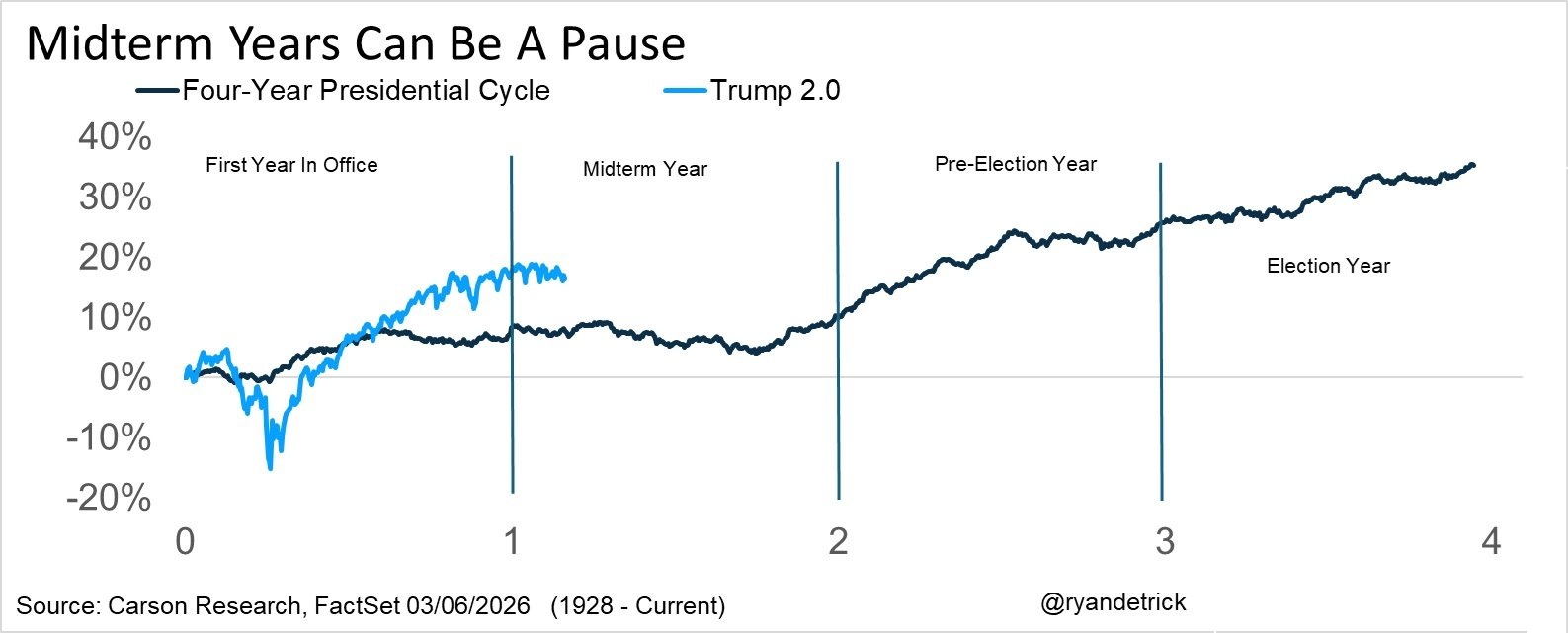
  • Midterm election years often bring volatility, but historically lead into strong market periods

Periods of geopolitical tension can cause sharp market reactions and unsettling headlines.

Recently, events in the Middle East have escalated rapidly. On Feb. 28, the U.S. and Israel launched an attack on Iran, setting off a rapidly escalating conflict across the Middle East. Fighting has spread to other countries, bringing with it destruction and loss of life.

In addition to the humanitarian toll, the conflict is making economic waves globally. As of 2025, 20 million barrels of oil per day—about 20% of global consumption—traveled through the Persian Gulf. That traffic came to a standstill after the attack, and oil prices climbed swiftly.

These events have investors worried and markets reacting. In early March, the CBOE Volatility Index jumped to its highest level since the near bear market last April.

What Exactly Has Markets Concerned?

Investors worry that rising oil prices could slow the economy. Energy is a key input for transportation, manufacturing, and other activities. When oil prices spike, many industries face higher costs.

Investors are also concerned about inflation. Higher energy prices can lead to broader price increases. What’s more, many investors were hoping the Federal Reserve would lower interest rates to boost the economy. If inflation rises, the Fed may be less likely to do so.

Your Portfolio Is Built for Moments Like This

While the headlines are alarming, periods like this are not unusual in long-term investing. At TAGStone, portfolios are designed with the expectation that geopolitical events, economic shocks, and market volatility will occur from time to time.

It’s important to remember that your diversified investment portfolio is built to withstand moments like this.

For instance, your portfolio already includes allocations to U.S. and international stocks, bonds, and cash. The fixed income portion of your portfolio, in particular, can help provide stability when equities become more volatile, helping smooth overall portfolio fluctuations.

Within the equity portion of your portfolio, diversification also helps manage risk. Some sectors may struggle when energy prices rise, such as technology and consumer discretionary.[1] On the other hand, energy companies might benefit from rising prices, potentially helping offset losses elsewhere.

A diversified portfolio does not eliminate losses, but it can help reduce the magnitude of downturns compared to broad market indices such as the S&P 500.

It’s also worth remembering that much of your portfolio is invested for the long term. Short-term market movements can feel uncomfortable, but the assets that fluctuate most today typically are the ones you won’t need to draw on for many years. As a result, you may not need to change anything about your portfolio to respond to the current news cycle.

This year may also naturally bring somewhat higher market volatility. Historically, midterm election years have tended to experience larger intra-year declines—closer to about 17–18% on average versus roughly 14–15% in a typical year. While those declines can feel unsettling in the moment, the period following midterm elections has historically been one of the strongest stretches in the four-year presidential cycle.
A Final Perspective

In times of geopolitical crisis, it is natural for both people and markets to react quickly. History, however, suggests that these events rarely alter the long-term trajectory of markets.

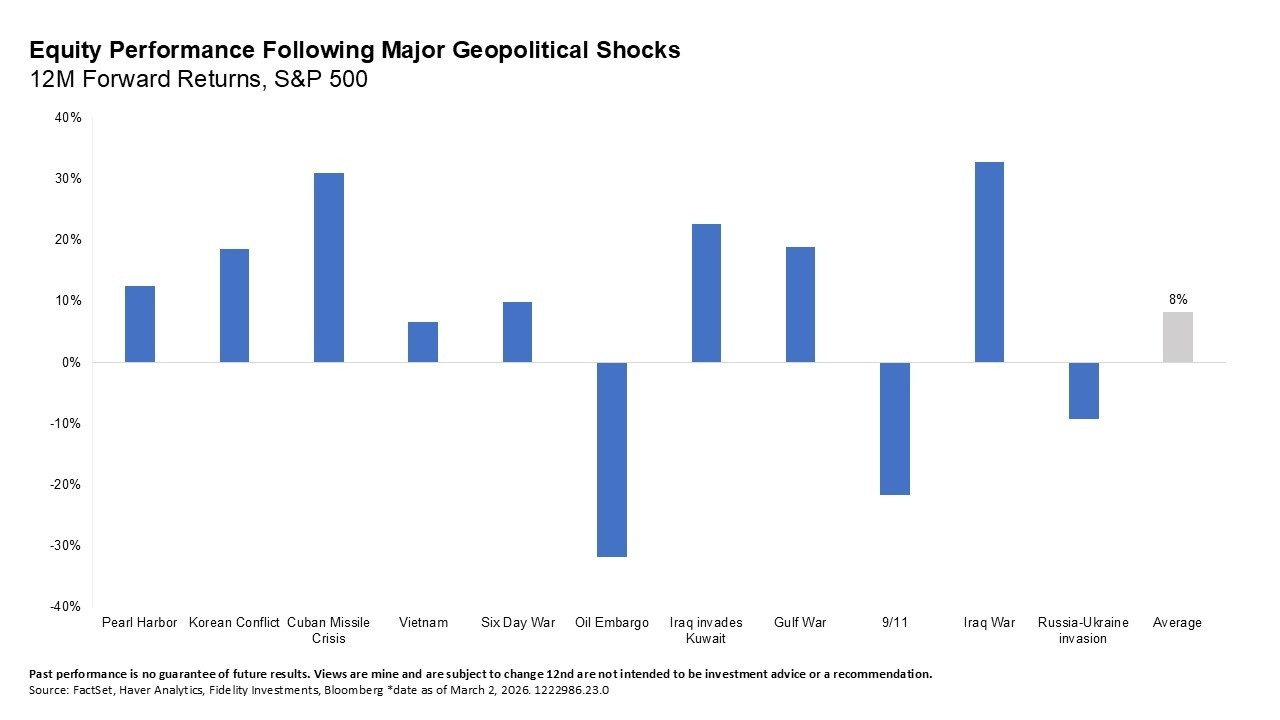
One useful way to think about geopolitical crises is that markets tend to treat them as temporary disruptions rather than permanent economic changes. Denise Chisholm, director of quantitative market strategy at Fidelity, looked into geopolitical shocks from Pearl Harbor through Russia’s 2022 invasion of Ukraine. She found that, on average, U.S. equities returned about 8% over the following year, on par with their long-term annual average. Her conclusion: “It’s the exception, not the rule, that geopolitical events become sustained market headwinds.”

The chart below illustrates how U.S. equities have historically performed in the year following major geopolitical shocks.
If you have questions about how current events may affect your portfolio, don’t hesitate to reach out. We’re always happy to talk through your concerns and help you stay focused on your long-term plan.

[1] See slide 6 of the linked chart pack.


Past performance does not guarantee future results. All investments include risk and have the potential for loss as well as gain.

Data sources for returns and standard statistical data are provided by the sources referenced and are based on data obtained from recognized statistical services or other sources we believe to be reliable. However, some or all information has not been verified prior to the analysis, and we do not make any representations as to its accuracy or completeness. Any analysis nonfactual in nature constitutes only current opinions, which are subject to change. Benchmarks or indices are included for information purposes  only  to  reflect  the  current  market  environment;  no  index  is  a directly  tradable investment.  There  may  be  instances  when  consultant  opinions  regarding any fundamental or quantitative analysis do not agree.

The  commentary  contained  herein  has  been  compiled  by  W.  Reid Culp,  III  from  sources  provided  by  TAGStone  Capital,  as well  as  commentary  provided  by  Mr.  Culp,  personally,  and  information independently  obtained  by  Mr.  Culp.  The  pronoun  “we,”  as  used  herein,  references collectively the sources noted above.

TAGStone Capital, Inc. provides this update to convey general information about market conditions and not for the purpose of providing investment advice. Investment in any of the companies or sectors mentioned herein may not be appropriate for you. You should consult your advisor from TAGStone or others for investment advice regarding your own situation.


At a Glance

  • Most people have one or two of these documents in place — but comprehensive planning requires all four, working together as a coordinated safety net.
  • Each document serves a distinct purpose: financial decisions, medical decisions, end-of-life preferences, and asset distribution.
  • Estate planning failures are rarely about missing documents — they're about outdated designations, poor coordination, and plans that haven't kept pace with life.

No one likes to imagine a time when they might be sick or unable to make decisions for themselves. It ranks alongside cleaning out the garage or scheduling a long-overdue physical—important, but all too easy to postpone. Yet having the right estate planning documents in place can make all the difference.

Without a clear plan in place, the state might step in and appoint a guardian to make financial and medical decisions on your behalf. Someone you didn’t choose could end up deciding where you live, how your money is managed, or what medical treatments you receive. That's not a situation any of us wants to be in.

Incapacity exists on a spectrum. It could look like cognitive decline from Alzheimer’s or dementia, physical incapacity after an injury or illness, a sudden event such as a stroke, or a gradual decline over time.

Because these scenarios unfold differently—and at different life stages—you’ll need four key documents to address them:

  1. a durable power of attorney,
  2. health care proxy,
  3. living will, and
  4. a will or revocable trust.

You may already have one or two of these documents, but comprehensive planning requires all four. Together, these documents create a coordinated safety net. Without one, gaps can appear. It’s like living near a river and buying homeowner’s insurance but skipping flood coverage. You’re mostly protected… until you’re not.

1. Durable Power of Attorney

A durable power of attorney (DPOA) is a legal document that authorizes someone—known as your agent or attorney-in-fact—to manage your financial affairs on your behalf, including bills, banking, investments, and business interests. The word “durable” here is key: it means the document remains valid even if you become mentally incapacitated.

Choosing the right person to fill this role matters. Consider someone who is financially responsible, trustworthy, and capable of handling potential conflict if family members disagree. Many people select a spouse or adult children. If these options don’t feel appropriate, we can help you identify another trusted individual or a professional fiduciary.

It’s also wise to appoint a backup agent in case your first choice is unavailable when needed.

One related tool worth knowing about: a trusted contact person on your financial accounts. Unlike a DPOA agent, a trusted contact cannot make decisions or view your accounts, but they can serve as a point of contact for your financial institutions if something seems wrong.

For a deeper look at how a DPOA and a trusted contact person work in practice, including important tips on keeping it current with your financial institutions, see Protecting What's Yours (While You're Alive).

2. Health Care Proxy

Your health care proxy is a document that designates an agent to make medical decisions for you if you are unable to do so yourself. This covers situations where you are unconscious, severely ill, undergoing surgery, or have lost cognitive capacity.

The health care proxy is typically activated when a physician determines that you lack decision-making capacity. At that point, your agent can step in and make decisions about treatments, surgeries, medications, care facilities, and in some states, end-of-life decisions. Ideally, these decisions are guided by your known wishes or their best judgment of what you would want.

Again, a spouse or adult children are common choices. Whoever you name should be someone who understands your preferences about medical care, is comfortable making decisions under pressure, and can advocate for you with medical professionals.

It’s also common to name different individuals for medical and financial decisions. It creates natural checks and balances and helps prevent one person from carrying the entire weight.

3. Living Will

A living will complements your health care proxy. This document spells out—in your own words—the medical treatments you do and don’t want in specific circumstances, such as a terminal condition, a persistent vegetative state or at the end-stage of an illness with little hope for recovery.

You don’t need to name an agent for a living will. However, it may be helpful to come up with this document in conversation with your physician and estate attorney. Tools like the “Five Wishes” framework can serve as a jumping-off point for clarifying your preferences.

Your living will is part of a broader healthcare advance directive. We cover what that includes, and other practical tips, in Protecting What's Yours (While You're Alive).

4. Will or Revocable Living Trust

The first three documents address what happens when you're living but unable to act. The fourth addresses what comes after.

Your estate plan should also include a will or trust that addresses what happens to your assets.

A will outlines how your property should be distributed after you die, names an executor to carry out your wishes, and designates a guardian for any minor children.

A revocable living trust goes a step further. You transfer assets into the trust during your lifetime—typically naming yourself as the initial trustee so you retain full control—and a successor trustee steps in if you become incapacitated or die.

Because assets in a trust bypass the probate process, transfers tend to be faster, more private, and less expensive. There are several types of revocable trusts, and we can work with you and your estate attorney to determine which structure fits your situation.

A will or trust is just the starting point. The greater risk for most families is execution and coordination after documents are signed. We cover what that looks like in Protecting What's Yours (After You Pass) and the step-by-step process in Part 2.

Keep Your Estate Planning Documents Current

No single document covers every phase of incapacity or death. The goal is to have all four in place, kept current, and accessible to the people who may need them.

One important area these documents don’t cover is beneficiary designations on retirement accounts and life insurance policies. These designations override instructions in your will, so make sure they are up to date and aligned with your wishes.

Finally, remember that life is dynamic. Laws evolve, financial situations shift, and relationships change. Plan to review each of these documents regularly, especially after major life events such as marriage, divorce, the birth of a child, relocation, or significant changes in wealth, and update them as needed.

The Core Four documents are the foundation, but they're only as strong as the planning and coordination around them. At TAGStone Capital, we help clients build and maintain that full picture, from incapacity planning to estate execution. To go deeper on what happens after documents are signed, see Protecting What's Yours (After You Pass). Or, if you're ready to talk through where your own plan stands, schedule a complimentary 15-minute conversation.


Past performance does not guarantee future results. All investments include risk and have the potential for loss as well as gain.

Data sources for returns and standard statistical data are provided by the sources referenced and are based on data obtained from recognized statistical services or other sources we believe to be reliable. However, some or all information has not been verified prior to the analysis, and we do not make any representations as to its accuracy or completeness. Any analysis nonfactual in nature constitutes only current opinions, which are subject to change. Benchmarks or indices are included for information purposes  only  to  reflect  the  current  market  environment;  no  index  is  a directly  tradable investment.  There  may  be  instances  when  consultant  opinions  regarding any fundamental or quantitative analysis do not agree.

The  commentary  contained  herein  has  been  compiled  by  W.  Reid Culp,  III  from  sources  provided  by  TAGStone  Capital,  as well  as  commentary  provided  by  Mr.  Culp,  personally,  and  information independently  obtained  by  Mr.  Culp.  The  pronoun  “we,”  as  used  herein,  references collectively the sources noted above.

TAGStone Capital, Inc. provides this update to convey general information about market conditions and not for the purpose of providing investment advice. Investment in any of the companies or sectors mentioned herein may not be appropriate for you. You should consult your advisor from TAGStone or others for investment advice regarding your own situation.