

Practicing Good Estate Plan Hygiene

Published May 26, 2026

At a Glance

  • An estate plan drifts. Beneficiary designations, fiduciary appointments, and trust funding fall out of sync with real life faster than most families realize.
  • Annual reviews are short. Think of it as a physical for your plan — a scheduled check that catches small issues before they become expensive ones.
  • Five areas to check each year: beneficiaries, fiduciaries, trust funding, life-change triggers, and where your originals are stored.

It’s tempting to think of an estate plan as a one-time project — sign the documents, file them away, and check the box. But an estate plan is only as good as the life it reflects, and your life keeps moving. Beneficiaries change. Fiduciaries age out. Assets get retitled, sold, or acquired. Laws shift. A plan that was airtight three years ago can quietly drift out of alignment with what you actually want today. We covered the foundation of this work in Protecting What’s Yours (After You Pass).

That’s why we encourage clients to think of estate planning the way they think of an annual physical: a short, scheduled review that catches small issues before they become expensive ones. Even in a year without major life changes, a yearly checkup is worth the hour.

Here are five areas worth reviewing each year.

1. Confirm your beneficiary designations

Most of your assets pass under your will or trust. But a meaningful share — retirement accounts, life insurance, certain annuities — passes by beneficiary designation, which overrides whatever your will says. That makes these designations one of the most common sources of unintended outcomes.

Check that named beneficiaries still reflect your wishes. Common red flags: an ex-spouse still listed on a 401(k), a deceased relative as a sole beneficiary (which can force the asset through probate), or a custodian arrangement for a child who is now an adult. Most custodians let you update beneficiaries online in a few minutes. It’s one of the highest-leverage estate planning tasks you can do.

2. Revisit your fiduciary appointments

Your fiduciaries — trustees, executors, agents under power of attorney, health care proxies — are the people who carry out your wishes when you can’t. The right choice ten years ago may not be the right choice today. (We walk through each of these documents in The Core Four.)

Health changes, deaths, and shifting relationships are obvious reasons to update. Less obvious: a sibling you named when your children were small may now reasonably be replaced by an adult child. Check in with named fiduciaries each year — and after any plan update — to confirm they’re still willing and able to serve. Don’t forget the backups.

3. Make sure your trust is actually funded

A revocable trust only works for the assets that are titled in its name. We see this often: a client signs a trust, then buys a new home, opens a new brokerage account, or inherits property — and never retitles it. Those assets bypass the trust and often head straight to probate, defeating one of the main reasons the trust exists. Kiplinger has a useful primer on which assets belong in a revocable trust if you want a refresher on the categories.

Each year, walk through your asset list and confirm everything intended for the trust is properly titled. Real estate, business interests, and non-retirement financial accounts are the usual suspects. (Retirement accounts generally stay in your name with beneficiary designations rather than being retitled into the trust.)

4. Reflect recent life changes

Marriages, divorces, births, adoptions, and deaths in the family are all triggers for a plan review. So are larger financial shifts — the sale of a business, a meaningful inheritance, or a significant change in your overall net worth.

Two reminders that often get overlooked. First, moving to another state matters. Estate and probate rules vary, and community property states have particular rules around spousal rights to retirement assets. Second, federal tax law changes can meaningfully alter the calculus on lifetime gifting, the estate tax exemption, and trust structures. When Washington moves, it’s worth checking whether your plan still does what you think it does.

5. Store documents securely — and accessibly

A plan no one can find is a plan that doesn’t work. Originals of your will, trust, powers of attorney, and health care directives need to be stored somewhere safe and somewhere your fiduciaries can actually get to them when the time comes.

A fireproof home safe or your attorney’s secure storage are usually better choices than a bank safe deposit box, which can require a court order to access after death. Digital copies are useful for reference, but courts and financial institutions generally require originals with wet signatures.

Your fiduciaries don’t need a complete list of account numbers. They generally need to know which institutions hold your assets — with that, a death certificate and your Social Security number are usually enough to identify everything.

Estate planning is a process, not an event

Most annual reviews are short. But a regular cadence is what makes the bigger updates — after a major life change, a relocation, or a tax law shift — feel routine rather than overwhelming. For the procedural side of what your family will face after you’re gone, our estate planning framework walks through it step by step. Protection during your lifetime gets its own treatment in Protecting What’s Yours (While You’re Alive).

If it’s been more than a year since you looked at your estate plan, that’s a reasonable starting point for a conversation. We’re happy to coordinate with your estate planning attorney to make sure what’s on paper still matches what you want for your family today.


Past performance does not guarantee future results. All investments include risk and have the potential for loss as well as gain.

Data sources for returns and standard statistical data are provided by the sources referenced and are based on data obtained from recognized statistical services or other sources we believe to be reliable. However, some or all information has not been verified prior to the analysis, and we do not make any representations as to its accuracy or completeness. Any analysis nonfactual in nature constitutes only current opinions, which are subject to change. Benchmarks or indices are included for information purposes  only  to  reflect  the  current  market  environment;  no  index  is  a directly  tradable investment.  There  may  be  instances  when  consultant  opinions  regarding any fundamental or quantitative analysis do not agree.

The  commentary  contained  herein  has  been  compiled  by  W.  Reid Culp,  III  from  sources  provided  by  TAGStone  Capital,  as well  as  commentary  provided  by  Mr.  Culp,  personally,  and  information independently  obtained  by  Mr.  Culp.  The  pronoun  “we,”  as  used  herein,  references collectively the sources noted above.

TAGStone Capital, Inc. provides this update to convey general information about market conditions and not for the purpose of providing investment advice. Investment in any of the companies or sectors mentioned herein may not be appropriate for you. You should consult your advisor from TAGStone or others for investment advice regarding your own situation.
Published May 5, 2026

At a Glance

  • Disruption — tariffs, geopolitical shocks, pandemics — is a recurring feature of markets, not a new condition.
  • Markets have historically absorbed shocks and recovered, but "long term" can mean a decade-plus (NASDAQ took 15 years to reclaim its dot-com peak).
  • A diversified, properly allocated portfolio is built to weather these moments without reactive trading.

If it feels like the headlines have been relentless lately, that's because they have been. Over the past year, investors have had to process an ongoing trade war, sharp market swings and now the geopolitical shock of a war in Iran—all while trying to stay focused on their long-term financial goals. As we discussed in our Q1 2026 quarterly letter, economic news in the first quarter was dominated by the conflict in the Middle East and its effects on markets.

These are the kinds of disruptive forces that test our patience as investors. And while the current backdrop may feel uniquely unsettling, it's worth stepping back and asking: how does this moment compare to other periods of disruption? And more importantly, how should you respond?

Disruption itself is not new. It could come from government policy like tariffs, from geopolitical crises, from unexpected shocks like the Covid pandemic, or even from something as improbable as one of the world's biggest container ships blocking the Suez Canal for a week. History can give us a clue as to how events like these have shaken out—though, as the SEC likes to remind us, past performance is not indicative of future results. There's no way to know what will happen six days, six months or even six years after a disruptive event takes place.

What History Can Teach Us

Let's start with tariffs, since they've been a persistent feature of the economic landscape since early 2025. When the Trump Administration announced sweeping tariffs on Canada, Mexico and China—with rates ranging from 20% to 25% and climbing higher in subsequent rounds—markets reacted sharply. A series of stutter steps followed as the Administration alternately paused tariffs on some goods while increasing them on others.

History offers useful context. The Smoot-Hawley Tariff Act of 1930 is the most cautionary example: enacted during the Great Depression, it triggered retaliatory tariffs from Canada and European countries, contributed to a collapse in global trade and deepened the economic downturn. The first Trump Administration's 2018 tariffs told a different story—they didn't spark the same cascade, though they also didn't achieve their stated goal of reducing the trade deficit with Mexico, which actually increased by 159%.

As for the 2025 tariff round—we now have the benefit of hindsight. Markets absorbed the initial shock, experienced significant volatility and, true to form, began recovering as investors recalibrated. This is consistent with what more than a century of market history has shown: disruptions are painful in the short term, but markets have generally found their footing.

That said, it's worth being honest about what "long term" really means. The NASDAQ didn't reclaim its dot-com-era peak until 2015—15 years after the bubble burst. The S&P 500 delivered a negative annualized return for the entire decade from 2000 to 2009, underperforming both bonds and cash over that stretch. The long-term direction of markets has been upward—but the path can be grueling, and it can test even the most patient investors. This is precisely why a properly diversified portfolio matters as much as it does.

The same perspective applies to the Iran conflict that has dominated headlines in 2026. As we explored in When Geopolitics Rattle the Markets, geopolitical crises are unsettling by nature and their market effects can be sharp in the short term. But looking back at major geopolitical events over the past century—World War II, the Korean War, the Gulf Wars, the September 11 attacks—markets have ultimately found their footing, even when the recovery took longer than anyone expected.

Your Next Steps

None of this is to say that disruptions won't touch your daily life—they may. Rising prices from tariffs, energy market volatility from geopolitical conflict, uncertainty about future policy—these are real concerns that may warrant a closer look at your budget and spending, particularly if you're on a fixed income.

When it comes to your investment portfolio, though, remember that it's been designed with disruption in mind. Research shows that diversified portfolios—those that combine stocks, bonds and other asset classes—have historically experienced significantly less pain during downturns than all-equity portfolios, and have recovered more quickly as a result. Proper diversification and disciplined rebalancing are built to help you navigate uncertainty without having to make reactive decisions in the heat of the moment.

We've worked together to create an investment plan that's structured for tax efficiency and allocates your assets according to your need, willingness and ability to take on risk. If your goals or circumstances have changed, we can revisit your allocations. But if nothing fundamental has shifted, you may not need to make any changes to your strategy at all.

The noise can feel deafening right now. That's normal—and expected. Disruptions are, by nature, jarring. So if you have questions about what's happening in the markets, the economy or your own portfolio, please reach out. That's exactly what we're here for.


Past performance does not guarantee future results. All investments include risk and have the potential for loss as well as gain.

Data sources for returns and standard statistical data are provided by the sources referenced and are based on data obtained from recognized statistical services or other sources we believe to be reliable. However, some or all information has not been verified prior to the analysis, and we do not make any representations as to its accuracy or completeness. Any analysis nonfactual in nature constitutes only current opinions, which are subject to change. Benchmarks or indices are included for information purposes  only  to  reflect  the  current  market  environment;  no  index  is  a directly  tradable investment.  There  may  be  instances  when  consultant  opinions  regarding any fundamental or quantitative analysis do not agree.

The  commentary  contained  herein  has  been  compiled  by  W.  Reid Culp,  III  from  sources  provided  by  TAGStone  Capital,  as well  as  commentary  provided  by  Mr.  Culp,  personally,  and  information independently  obtained  by  Mr.  Culp.  The  pronoun  “we,”  as  used  herein,  references collectively the sources noted above.

TAGStone Capital, Inc. provides this update to convey general information about market conditions and not for the purpose of providing investment advice. Investment in any of the companies or sectors mentioned herein may not be appropriate for you. You should consult your advisor from TAGStone or others for investment advice regarding your own situation.


Published April 21, 2026

At a Glance

  • Spending well is just as important as saving — but it's surprisingly easy to fall into behavioral traps like signaling, social comparison, and hedonic adaptation
  • Aligning your spending with your personal values is the most reliable way to avoid buying things that don't actually improve your life
  • A thoughtful spending strategy isn't about cutting back — it's about spending intentionally on what matters most to you

It has never been more tempting to spend money. Every day, we’re pressured to buy something, whether through traditional ads, targeted recommendations or the curated lifestyles of online influencers. The messages are constant and persuasive.

Financial professionals like us spend a lot of time talking about how to save. But knowing how to spend well is equally important. And for many, spending is surprisingly fraught, wrapped up in behavioral biases and the psychological imprints of past experiences.

Unexamined spending can lead to extremes. On one end of the spectrum, you find overspenders who rack up debt and land in financial hot water. On the other end are those afraid to spend, depriving themselves of things they can afford that would give them pleasure.

Ultimately, spending is unavoidable. Ideally, we find a middle path that allows us to cover necessities and spend on the things that truly bring joy, whether that’s hobbies, travel, experiences with your family and friends, or simple everyday pleasures.

So how do you engage in thoughtful spending? These tips can help.

Consider Your Values

One of the best ways to become a mindful spender is to spend in line with your values. Take the time to identify what matters most to you. These could be things like health, family, community, security or creativity. Before making a purchase, consider whether it supports one or more of these values. Doing so can help you avoid potential behavioral traps, such as signaling—spending money to shape how other people think of us.

It’s one thing to buy a nicer car because you need it. It’s another to buy one because you want to broadcast status to neighbors.

If you can truly afford to do this, there’s not necessarily a lot of harm done financially speaking. But it’s still worth asking whether the motivation reflects something you truly value or simply a desire to impress others.

And if the purchase stretches your finances, the irony is clear: Spending to appear wealthy actually undermines your financial security.

Compare and Despair

Closely related to signaling is the phenomenon of keeping up with the proverbial Joneses.

Morgan Housel, partner at The Collaborative Fund and author of The Psychology of Money puts it well: “There are two ways to use money. One is as a tool to live a better life. The other is as a yardstick of status to measure yourself against others. Many people aspire for the former but get caught up chasing the latter.”

When we see other people spending freely—neighbors renovating their kitchen or friends taking pricey vacations—it can create subtle pressure to match their choices. After all, we humans are deeply wired to avoid appearing like outsiders.

But appearances can be misleading. The people you’re comparing yourself to may be financing those purchases or stretching their budget to maintain a perfect front.

So again, before trying to match anyone’s spending, revisit your own priorities. You may find that the security of living within your means is much more important to you.

Be Mindful of Hedonic Adaptation

Besides being a bit of a mouthful, hedonic adaptation is the tendency for humans to return to a baseline level of happiness even after major positive or negative changes in their lives. In other words, the emotional impact of these events fades quickly over time.

This can have important implications for spending. Many purchases—the latest smartphone, a luxury car, a bigger home—promise lasting happiness. These items might provide a short-term boost in satisfaction, but that feeling typically fades faster than we’d expect.

Understanding this tendency can encourage a bit of pause before making big purchases. If it’s greater happiness you seek, whatever you’re considering buying likely isn’t the solution.

Being mindful of hedonic adaptation can also help guard against lifestyle creep, where spending gradually increases as income rises without necessarily improving long-term happiness. Buying that bigger home requires spending more on things like taxes and upkeep, which may quickly make you feel out of control. Or as Housel puts it: “Sometimes the stuff you spend money on has so much influence over your autonomy…that it’s not clear whether you own things or the things own you.”

On a more reassuring note, just as we adapt to positive changes, we also adapt to setbacks. Difficult events like a job loss or a financial downturn can feel overwhelming in the moment, but emotional recovery tends to be swift.

Think Before You Carpe Diem

Popular aphorisms encourage us to “carpe diem,” “YOLO” or “live for the moment.” And on a fundamental level, that message has merit. Life is unpredictable, and it’s important to enjoy it.

However, the idea also can be used to justify impulsive spending, allowing our present selves to win out over our future selves.

Consider a simple example: Spending $200 on a new pair of boots now may not seem like a major decision. However, if that same amount were invested and allowed to grow for decades, it could be worth thousands of dollars in the future.

This doesn’t mean you should never buy those boots—especially if you can afford them. The key is considering the trade-off and making that decision consciously.

Interestingly, carpe diem—often translated as “seize the day”—may have originally carried a more nuanced meaning. Some scholars suggest it would be better translated as “pluck the day,” an allusion to picking fruit or flowers at harvest time. Seen this way, the phrase originally may be more about appreciation and enjoying opportunities when the moment is right, rather than an exhortation to take impulsive action. That, perhaps, is a useful way to think about spending as well.

A Plan That Makes Room for Living

It might be easy to think that financial advice is all about pushing you to cut back and save more. In reality, it’s about finding balance. Together, we can build spending strategies that reflect what matters to you most, so you can feel confident about your future without putting your present happiness on hold.

At TAGStone, our planning conversations aren't just about accumulating wealth, they're about deploying it in ways that reflect what matters most to you. If you'd like to talk through how your spending fits into your broader financial picture, we'd welcome that conversation.


Past performance does not guarantee future results. All investments include risk and have the potential for loss as well as gain.

Data sources for returns and standard statistical data are provided by the sources referenced and are based on data obtained from recognized statistical services or other sources we believe to be reliable. However, some or all information has not been verified prior to the analysis, and we do not make any representations as to its accuracy or completeness. Any analysis nonfactual in nature constitutes only current opinions, which are subject to change. Benchmarks or indices are included for information purposes  only  to  reflect  the  current  market  environment;  no  index  is  a directly  tradable investment.  There  may  be  instances  when  consultant  opinions  regarding any fundamental or quantitative analysis do not agree.

The  commentary  contained  herein  has  been  compiled  by  W.  Reid Culp,  III  from  sources  provided  by  TAGStone  Capital,  as well  as  commentary  provided  by  Mr.  Culp,  personally,  and  information independently  obtained  by  Mr.  Culp.  The  pronoun  “we,”  as  used  herein,  references collectively the sources noted above.

TAGStone Capital, Inc. provides this update to convey general information about market conditions and not for the purpose of providing investment advice. Investment in any of the companies or sectors mentioned herein may not be appropriate for you. You should consult your advisor from TAGStone or others for investment advice regarding your own situation.


At a Glance

  • Geopolitical conflicts can trigger short-term market volatility
  • Diversified portfolios are designed to withstand these periods
  • Midterm election years often bring volatility, but historically lead into strong market periods

Periods of geopolitical tension can cause sharp market reactions and unsettling headlines.

Recently, events in the Middle East have escalated rapidly. On Feb. 28, the U.S. and Israel launched an attack on Iran, setting off a rapidly escalating conflict across the Middle East. Fighting has spread to other countries, bringing with it destruction and loss of life.

In addition to the humanitarian toll, the conflict is making economic waves globally. As of 2025, 20 million barrels of oil per day—about 20% of global consumption—traveled through the Persian Gulf. That traffic came to a standstill after the attack, and oil prices climbed swiftly.

These events have investors worried and markets reacting. In early March, the CBOE Volatility Index jumped to its highest level since the near bear market last April.

What Exactly Has Markets Concerned?

Investors worry that rising oil prices could slow the economy. Energy is a key input for transportation, manufacturing, and other activities. When oil prices spike, many industries face higher costs.

Investors are also concerned about inflation. Higher energy prices can lead to broader price increases. What’s more, many investors were hoping the Federal Reserve would lower interest rates to boost the economy. If inflation rises, the Fed may be less likely to do so.

Your Portfolio Is Built for Moments Like This

While the headlines are alarming, periods like this are not unusual in long-term investing. At TAGStone, portfolios are designed with the expectation that geopolitical events, economic shocks, and market volatility will occur from time to time.

It’s important to remember that your diversified investment portfolio is built to withstand moments like this.

For instance, your portfolio already includes allocations to U.S. and international stocks, bonds, and cash. The fixed income portion of your portfolio, in particular, can help provide stability when equities become more volatile, helping smooth overall portfolio fluctuations.

Within the equity portion of your portfolio, diversification also helps manage risk. Some sectors may struggle when energy prices rise, such as technology and consumer discretionary.[1] On the other hand, energy companies might benefit from rising prices, potentially helping offset losses elsewhere.

A diversified portfolio does not eliminate losses, but it can help reduce the magnitude of downturns compared to broad market indices such as the S&P 500.

It’s also worth remembering that much of your portfolio is invested for the long term. Short-term market movements can feel uncomfortable, but the assets that fluctuate most today typically are the ones you won’t need to draw on for many years. As a result, you may not need to change anything about your portfolio to respond to the current news cycle.

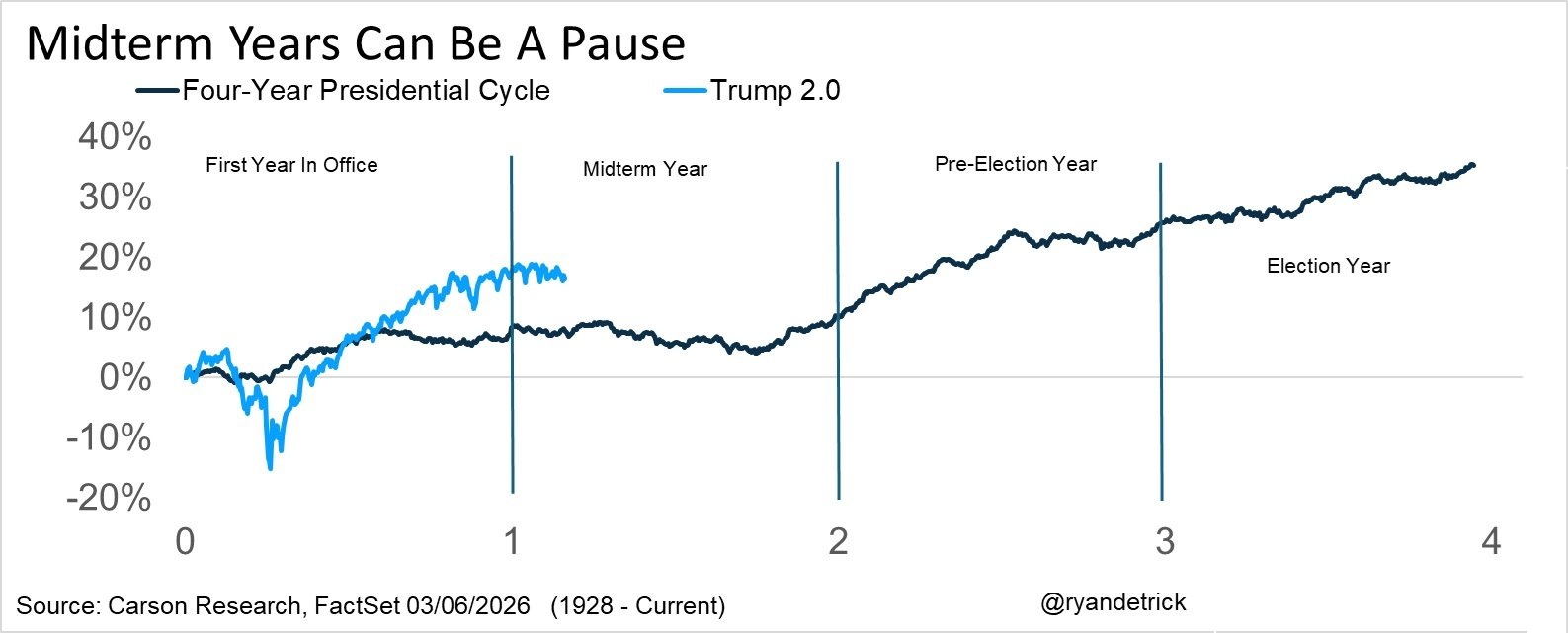
This year may also naturally bring somewhat higher market volatility. Historically, midterm election years have tended to experience larger intra-year declines—closer to about 17–18% on average versus roughly 14–15% in a typical year. While those declines can feel unsettling in the moment, the period following midterm elections has historically been one of the strongest stretches in the four-year presidential cycle.

A Final Perspective

In times of geopolitical crisis, it is natural for both people and markets to react quickly. History, however, suggests that these events rarely alter the long-term trajectory of markets.

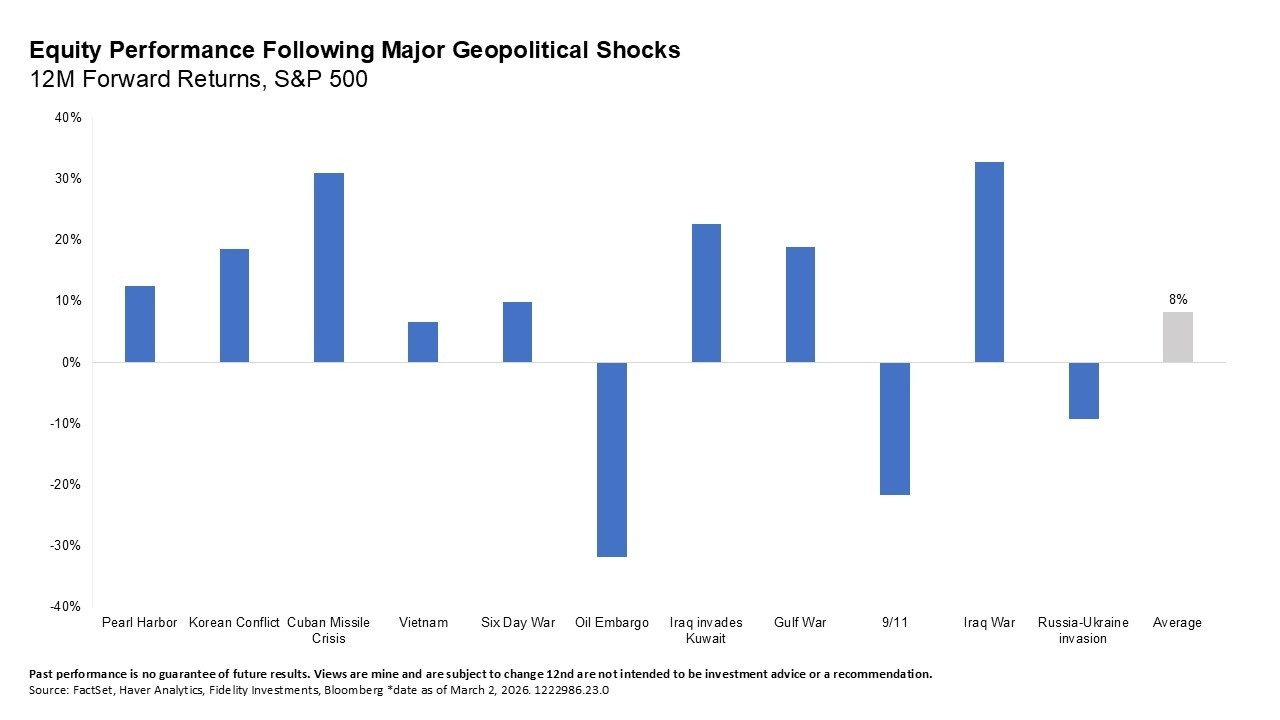
One useful way to think about geopolitical crises is that markets tend to treat them as temporary disruptions rather than permanent economic changes. Denise Chisholm, director of quantitative market strategy at Fidelity, looked into geopolitical shocks from Pearl Harbor through Russia’s 2022 invasion of Ukraine. She found that, on average, U.S. equities returned about 8% over the following year, on par with their long-term annual average. Her conclusion: “It’s the exception, not the rule, that geopolitical events become sustained market headwinds.”

The chart below illustrates how U.S. equities have historically performed in the year following major geopolitical shocks.

If you have questions about how current events may affect your portfolio, don’t hesitate to reach out. We’re always happy to talk through your concerns and help you stay focused on your long-term plan.

[1] See slide 6 of the linked chart pack.


Past performance does not guarantee future results. All investments include risk and have the potential for loss as well as gain.

Data sources for returns and standard statistical data are provided by the sources referenced and are based on data obtained from recognized statistical services or other sources we believe to be reliable. However, some or all information has not been verified prior to the analysis, and we do not make any representations as to its accuracy or completeness. Any analysis nonfactual in nature constitutes only current opinions, which are subject to change. Benchmarks or indices are included for information purposes  only  to  reflect  the  current  market  environment;  no  index  is  a directly  tradable investment.  There  may  be  instances  when  consultant  opinions  regarding any fundamental or quantitative analysis do not agree.

The  commentary  contained  herein  has  been  compiled  by  W.  Reid Culp,  III  from  sources  provided  by  TAGStone  Capital,  as well  as  commentary  provided  by  Mr.  Culp,  personally,  and  information independently  obtained  by  Mr.  Culp.  The  pronoun  “we,”  as  used  herein,  references collectively the sources noted above.

TAGStone Capital, Inc. provides this update to convey general information about market conditions and not for the purpose of providing investment advice. Investment in any of the companies or sectors mentioned herein may not be appropriate for you. You should consult your advisor from TAGStone or others for investment advice regarding your own situation.


At a Glance

  • Most people have one or two of these documents in place — but comprehensive planning requires all four, working together as a coordinated safety net.
  • Each document serves a distinct purpose: financial decisions, medical decisions, end-of-life preferences, and asset distribution.
  • Estate planning failures are rarely about missing documents — they're about outdated designations, poor coordination, and plans that haven't kept pace with life.

No one likes to imagine a time when they might be sick or unable to make decisions for themselves. It ranks alongside cleaning out the garage or scheduling a long-overdue physical—important, but all too easy to postpone. Yet having the right estate planning documents in place can make all the difference.

Without a clear plan in place, the state might step in and appoint a guardian to make financial and medical decisions on your behalf. Someone you didn’t choose could end up deciding where you live, how your money is managed, or what medical treatments you receive. That's not a situation any of us wants to be in.

Incapacity exists on a spectrum. It could look like cognitive decline from Alzheimer’s or dementia, physical incapacity after an injury or illness, a sudden event such as a stroke, or a gradual decline over time.

Because these scenarios unfold differently—and at different life stages—you’ll need four key documents to address them:

  1. a durable power of attorney,
  2. health care proxy,
  3. living will, and
  4. a will or revocable trust.

You may already have one or two of these documents, but comprehensive planning requires all four. Together, these documents create a coordinated safety net. Without one, gaps can appear. It’s like living near a river and buying homeowner’s insurance but skipping flood coverage. You’re mostly protected… until you’re not.

1. Durable Power of Attorney

A durable power of attorney (DPOA) is a legal document that authorizes someone—known as your agent or attorney-in-fact—to manage your financial affairs on your behalf, including bills, banking, investments, and business interests. The word “durable” here is key: it means the document remains valid even if you become mentally incapacitated.

Choosing the right person to fill this role matters. Consider someone who is financially responsible, trustworthy, and capable of handling potential conflict if family members disagree. Many people select a spouse or adult children. If these options don’t feel appropriate, we can help you identify another trusted individual or a professional fiduciary.

It’s also wise to appoint a backup agent in case your first choice is unavailable when needed.

One related tool worth knowing about: a trusted contact person on your financial accounts. Unlike a DPOA agent, a trusted contact cannot make decisions or view your accounts, but they can serve as a point of contact for your financial institutions if something seems wrong.

For a deeper look at how a DPOA and a trusted contact person work in practice, including important tips on keeping it current with your financial institutions, see Protecting What's Yours (While You're Alive).

2. Health Care Proxy

Your health care proxy is a document that designates an agent to make medical decisions for you if you are unable to do so yourself. This covers situations where you are unconscious, severely ill, undergoing surgery, or have lost cognitive capacity.

The health care proxy is typically activated when a physician determines that you lack decision-making capacity. At that point, your agent can step in and make decisions about treatments, surgeries, medications, care facilities, and in some states, end-of-life decisions. Ideally, these decisions are guided by your known wishes or their best judgment of what you would want.

Again, a spouse or adult children are common choices. Whoever you name should be someone who understands your preferences about medical care, is comfortable making decisions under pressure, and can advocate for you with medical professionals.

It’s also common to name different individuals for medical and financial decisions. It creates natural checks and balances and helps prevent one person from carrying the entire weight.

3. Living Will

A living will complements your health care proxy. This document spells out—in your own words—the medical treatments you do and don’t want in specific circumstances, such as a terminal condition, a persistent vegetative state or at the end-stage of an illness with little hope for recovery.

You don’t need to name an agent for a living will. However, it may be helpful to come up with this document in conversation with your physician and estate attorney. Tools like the “Five Wishes” framework can serve as a jumping-off point for clarifying your preferences.

Your living will is part of a broader healthcare advance directive. We cover what that includes, and other practical tips, in Protecting What's Yours (While You're Alive).

4. Will or Revocable Living Trust

The first three documents address what happens when you're living but unable to act. The fourth addresses what comes after.

Your estate plan should also include a will or trust that addresses what happens to your assets.

A will outlines how your property should be distributed after you die, names an executor to carry out your wishes, and designates a guardian for any minor children.

A revocable living trust goes a step further. You transfer assets into the trust during your lifetime—typically naming yourself as the initial trustee so you retain full control—and a successor trustee steps in if you become incapacitated or die.

Because assets in a trust bypass the probate process, transfers tend to be faster, more private, and less expensive. There are several types of revocable trusts, and we can work with you and your estate attorney to determine which structure fits your situation.

A will or trust is just the starting point. The greater risk for most families is execution and coordination after documents are signed. We cover what that looks like in Protecting What's Yours (After You Pass) and the step-by-step process in Part 2.

Keep Your Estate Planning Documents Current

No single document covers every phase of incapacity or death. The goal is to have all four in place, kept current, and accessible to the people who may need them.

One important area these documents don’t cover is beneficiary designations on retirement accounts and life insurance policies. These designations override instructions in your will, so make sure they are up to date and aligned with your wishes.

Finally, remember that life is dynamic. Laws evolve, financial situations shift, and relationships change. Plan to review each of these documents regularly, especially after major life events such as marriage, divorce, the birth of a child, relocation, or significant changes in wealth, and update them as needed.

The Core Four documents are the foundation, but they're only as strong as the planning and coordination around them. At TAGStone Capital, we help clients build and maintain that full picture, from incapacity planning to estate execution. To go deeper on what happens after documents are signed, see Protecting What's Yours (After You Pass). Or, if you're ready to talk through where your own plan stands, schedule a complimentary 15-minute conversation.


Past performance does not guarantee future results. All investments include risk and have the potential for loss as well as gain.

Data sources for returns and standard statistical data are provided by the sources referenced and are based on data obtained from recognized statistical services or other sources we believe to be reliable. However, some or all information has not been verified prior to the analysis, and we do not make any representations as to its accuracy or completeness. Any analysis nonfactual in nature constitutes only current opinions, which are subject to change. Benchmarks or indices are included for information purposes  only  to  reflect  the  current  market  environment;  no  index  is  a directly  tradable investment.  There  may  be  instances  when  consultant  opinions  regarding any fundamental or quantitative analysis do not agree.

The  commentary  contained  herein  has  been  compiled  by  W.  Reid Culp,  III  from  sources  provided  by  TAGStone  Capital,  as well  as  commentary  provided  by  Mr.  Culp,  personally,  and  information independently  obtained  by  Mr.  Culp.  The  pronoun  “we,”  as  used  herein,  references collectively the sources noted above.

TAGStone Capital, Inc. provides this update to convey general information about market conditions and not for the purpose of providing investment advice. Investment in any of the companies or sectors mentioned herein may not be appropriate for you. You should consult your advisor from TAGStone or others for investment advice regarding your own situation.


At a Glance

  • Buffett’s career reinforces a timeless lesson: successful investing depends more on discipline and temperament than predicting markets.
  • Market bubbles and downturns are inevitable. Long-term investors who resist fear and hype are better positioned to stay on course.
  • Time is the most powerful force in investing. Starting early and staying invested are key to building wealth across generations.

On December 31, 2025, legendary investor Warren Buffett retired as CEO of Berkshire Hathaway at age 95. Berkshire Hathaway compounded shareholder capital at approximately 20% annually for over six decades—one of the most remarkable investment records ever achieved. Buffett’s retirement marks the end of one of the greatest investing careers. Yet, the principles that guided him remain just as relevant today for families aiming to grow and preserve wealth across generations.

Sixty years ago, Buffett took over Berkshire Hathaway, a struggling New England textile company, and turned it into a powerhouse that operates everything from insurance firms to household names like Duracell batteries. Along the way, he earned the nickname “Oracle of Omaha” for carefully selecting undervalued companies and holding onto them for the long term—a strategy that has worked well for him. Today, he is the sixth richest person in the world, with a net worth around $154 billion.

Throughout his career, Buffett has shared some of his success secrets, often through his well-known—and often humorous—shareholder letters. Below are some of our favorite insights that continue to guide investors of all kinds.

Navigating Fear and Greed

Investing is carried out by people, and people are emotional. As a result, human behavior heavily influences market movements. Fear and greed can cause investors to jump in and out of the market en masse, often to their own detriment.

Buffett illustrated this idea well when he wrote:

“Occasional outbreaks of those two super-contagious diseases, fear and greed, will forever occur in the investment community…We never try to anticipate the arrival or departure of either disease. Our goal is more modest: we simply attempt to be fearful when others are greedy and to be greedy only when others are fearful.”

Buffett warns us to be cautious when investors are “greedy,” as this can push prices to levels that are not sustainable—sometimes leading to a crash.

Conversely, when investors are fearful, they might miss out on significant opportunities to buy bargains during a market downturn.

The key to successful investing is managing emotional impulses. Buffett has said: “The most important quality for an investor is temperament, not intellect. You need a temperament that neither derives great pleasure from being with the crowd or against the crowd.”

This is one of the reasons we build portfolios that can weather market volatility before it happens, rather than reacting emotionally once it does.

Bursting Bubbles

During market bubbles—such as the Dot Com bubble of the late 1990s or the housing boom leading up to the 2008 crash—prices rise rapidly beyond their true value, fueled by speculation and hype.

Even investors who were initially skeptical may give in to the temptation to join in, entering the market when prices are excessively inflated and due for a crash.

Buffett summarizes this well when he said:

Bubbles blown large enough inevitably pop. And then the old proverb is confirmed once again: ‘What the wise man does in the beginning, the fool does in the end.’”

Buffett has also said, “It’s only when the tide goes out that you learn who’s been swimming naked.” Indeed, when a booming market turns south, you don’t want to be the one who has taken on too much risk and ends up scrambling to get out.

Playing the Long Game

You’ve probably heard us say that investing is a long-term venture. This is also one of Buffett’s core principles: “Our favorite holding period is forever.” He has additionally stated, “Only buy something that you’d be perfectly happy to hold if the market shut down for 10 years.”

The evidence is clear: over the long term, the stock market has traditionally moved higher. For families building multi-generational wealth, committing to long-term holding periods is the best way to navigate the inevitable short-term market fluctuations that accompany the overall upward trend.

Starting Early

 Unsurprisingly, there's a lot of overlap between aphorisms about planting trees and investing. Both require planning and an early start to ensure you reap their benefits.

As Buffett once said:

“Someone’s sitting in the shade today because someone planted a tree a long time ago.”

Similarly, a well-crafted investment plan needs attention and nurturing, supported by disciplined approaches like dollar-cost averaging—the practice of regularly investing a fixed amount regardless of market conditions—and periodic rebalancing. But mostly, wealth and trees simply need time to grow.

In this sense, Buffett’s “secrets” of success have never truly been secrets. They are just simple truths that all investors can follow: stay calm when others panic, resist the hype, invest regularly, and think long term. Even with these principles, it’s not always easy to stay the course—especially when markets become turbulent.

These principles continue to guide how we think about managing wealth for the families we serve. Please reach out when you have questions about the markets and how they affect your long-term plan.


Past performance does not guarantee future results. All investments include risk and have the potential for loss as well as gain.

Data sources for returns and standard statistical data are provided by the sources referenced and are based on data obtained from recognized statistical services or other sources we believe to be reliable. However, some or all information has not been verified prior to the analysis, and we do not make any representations as to its accuracy or completeness. Any analysis nonfactual in nature constitutes only current opinions, which are subject to change. Benchmarks or indices are included for information purposes  only  to  reflect  the  current  market  environment;  no  index  is  a directly  tradable investment.  There  may  be  instances  when  consultant  opinions  regarding any fundamental or quantitative analysis do not agree.

The  commentary  contained  herein  has  been  compiled  by  W.  Reid Culp,  III  from  sources  provided  by  TAGStone  Capital,  as well  as  commentary  provided  by  Mr.  Culp,  personally,  and  information independently  obtained  by  Mr.  Culp.  The  pronoun  “we,”  as  used  herein,  references collectively the sources noted above.

TAGStone Capital, Inc. provides this update to convey general information about market conditions and not for the purpose of providing investment advice. Investment in any of the companies or sectors mentioned herein may not be appropriate for you. You should consult your advisor from TAGStone or others for investment advice regarding your own situation.