

Practicing Good Estate Plan Hygiene

Published May 26, 2026

At a Glance

  • An estate plan drifts. Beneficiary designations, fiduciary appointments, and trust funding fall out of sync with real life faster than most families realize.
  • Annual reviews are short. Think of it as a physical for your plan — a scheduled check that catches small issues before they become expensive ones.
  • Five areas to check each year: beneficiaries, fiduciaries, trust funding, life-change triggers, and where your originals are stored.

It’s tempting to think of an estate plan as a one-time project — sign the documents, file them away, and check the box. But an estate plan is only as good as the life it reflects, and your life keeps moving. Beneficiaries change. Fiduciaries age out. Assets get retitled, sold, or acquired. Laws shift. A plan that was airtight three years ago can quietly drift out of alignment with what you actually want today. We covered the foundation of this work in Protecting What’s Yours (After You Pass).

That’s why we encourage clients to think of estate planning the way they think of an annual physical: a short, scheduled review that catches small issues before they become expensive ones. Even in a year without major life changes, a yearly checkup is worth the hour.

Here are five areas worth reviewing each year.

1. Confirm your beneficiary designations

Most of your assets pass under your will or trust. But a meaningful share — retirement accounts, life insurance, certain annuities — passes by beneficiary designation, which overrides whatever your will says. That makes these designations one of the most common sources of unintended outcomes.

Check that named beneficiaries still reflect your wishes. Common red flags: an ex-spouse still listed on a 401(k), a deceased relative as a sole beneficiary (which can force the asset through probate), or a custodian arrangement for a child who is now an adult. Most custodians let you update beneficiaries online in a few minutes. It’s one of the highest-leverage estate planning tasks you can do.

2. Revisit your fiduciary appointments

Your fiduciaries — trustees, executors, agents under power of attorney, health care proxies — are the people who carry out your wishes when you can’t. The right choice ten years ago may not be the right choice today. (We walk through each of these documents in The Core Four.)

Health changes, deaths, and shifting relationships are obvious reasons to update. Less obvious: a sibling you named when your children were small may now reasonably be replaced by an adult child. Check in with named fiduciaries each year — and after any plan update — to confirm they’re still willing and able to serve. Don’t forget the backups.

3. Make sure your trust is actually funded

A revocable trust only works for the assets that are titled in its name. We see this often: a client signs a trust, then buys a new home, opens a new brokerage account, or inherits property — and never retitles it. Those assets bypass the trust and often head straight to probate, defeating one of the main reasons the trust exists. Kiplinger has a useful primer on which assets belong in a revocable trust if you want a refresher on the categories.

Each year, walk through your asset list and confirm everything intended for the trust is properly titled. Real estate, business interests, and non-retirement financial accounts are the usual suspects. (Retirement accounts generally stay in your name with beneficiary designations rather than being retitled into the trust.)

4. Reflect recent life changes

Marriages, divorces, births, adoptions, and deaths in the family are all triggers for a plan review. So are larger financial shifts — the sale of a business, a meaningful inheritance, or a significant change in your overall net worth.

Two reminders that often get overlooked. First, moving to another state matters. Estate and probate rules vary, and community property states have particular rules around spousal rights to retirement assets. Second, federal tax law changes can meaningfully alter the calculus on lifetime gifting, the estate tax exemption, and trust structures. When Washington moves, it’s worth checking whether your plan still does what you think it does.

5. Store documents securely — and accessibly

A plan no one can find is a plan that doesn’t work. Originals of your will, trust, powers of attorney, and health care directives need to be stored somewhere safe and somewhere your fiduciaries can actually get to them when the time comes.

A fireproof home safe or your attorney’s secure storage are usually better choices than a bank safe deposit box, which can require a court order to access after death. Digital copies are useful for reference, but courts and financial institutions generally require originals with wet signatures.

Your fiduciaries don’t need a complete list of account numbers. They generally need to know which institutions hold your assets — with that, a death certificate and your Social Security number are usually enough to identify everything.

Estate planning is a process, not an event

Most annual reviews are short. But a regular cadence is what makes the bigger updates — after a major life change, a relocation, or a tax law shift — feel routine rather than overwhelming. For the procedural side of what your family will face after you’re gone, our estate planning framework walks through it step by step. Protection during your lifetime gets its own treatment in Protecting What’s Yours (While You’re Alive).

If it’s been more than a year since you looked at your estate plan, that’s a reasonable starting point for a conversation. We’re happy to coordinate with your estate planning attorney to make sure what’s on paper still matches what you want for your family today.


Past performance does not guarantee future results. All investments include risk and have the potential for loss as well as gain.

Data sources for returns and standard statistical data are provided by the sources referenced and are based on data obtained from recognized statistical services or other sources we believe to be reliable. However, some or all information has not been verified prior to the analysis, and we do not make any representations as to its accuracy or completeness. Any analysis nonfactual in nature constitutes only current opinions, which are subject to change. Benchmarks or indices are included for information purposes  only  to  reflect  the  current  market  environment;  no  index  is  a directly  tradable investment.  There  may  be  instances  when  consultant  opinions  regarding any fundamental or quantitative analysis do not agree.

The  commentary  contained  herein  has  been  compiled  by  W.  Reid Culp,  III  from  sources  provided  by  TAGStone  Capital,  as well  as  commentary  provided  by  Mr.  Culp,  personally,  and  information independently  obtained  by  Mr.  Culp.  The  pronoun  “we,”  as  used  herein,  references collectively the sources noted above.

TAGStone Capital, Inc. provides this update to convey general information about market conditions and not for the purpose of providing investment advice. Investment in any of the companies or sectors mentioned herein may not be appropriate for you. You should consult your advisor from TAGStone or others for investment advice regarding your own situation.

Published May 19, 2026

At a Glance

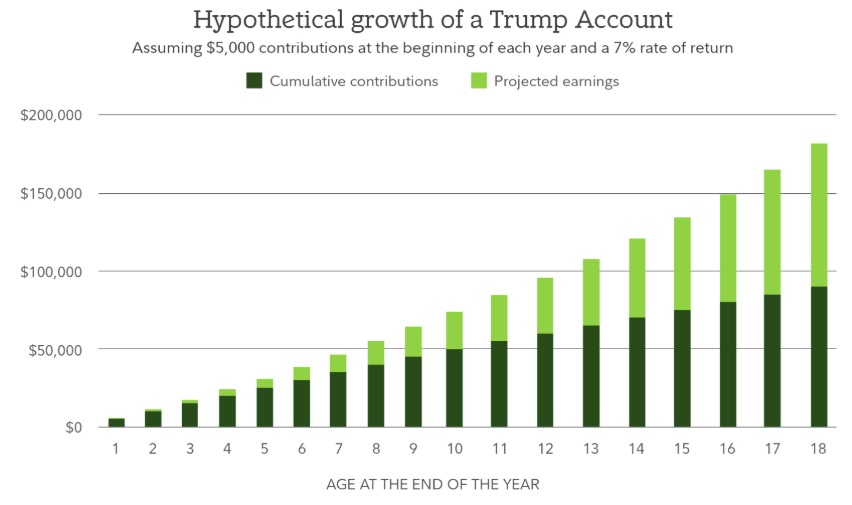
  • New in July 2026: Trump Accounts allow up to $5,000 per year per child (under age 18) in contributions, plus a potential $1,000 government seed deposit for eligible birth years.
  • Tax-Deferred — Not Tax-Free: Growth and most contributions are ultimately taxed as ordinary income unless proactively converted to a Roth IRA after age 18.
  • Planning Opportunity — But Timing Is Critical: The real advantage is a strategic Roth conversion during a child's low-income, financially independent years. Converting too early — while they're still a student claimed as a dependent — can trigger the kiddie tax and eliminate the benefit.

By now, you’ve likely heard something about Trump Accounts — formally known as 530A accounts. They’re one of the more talked-about provisions in recent tax legislation, and for good reason: they’re a brand-new, tax-advantaged savings vehicle for children, launching July 4, 2026. For families thinking through Trump Accounts tax planning, the details matter quite a bit before you commit. Before your family rushes to open one, here’s what you need to understand.

What Are They?

Trump Accounts are a type of custodial account — owned by the child but administered by an adult until the child turns 18. Family members can open accounts online at trumpaccounts.gov or by filing IRS Form 4547. They’re designed to fill a gap in the planning landscape. Custodial brokerage accounts (UTMAs/UGMAs) allow families to invest for a child, but growth is generally taxable. A 529 plan offers tax advantages, but only for qualified education expenses. And while children can contribute to a Roth or traditional IRA, they need earned income to do so — something most young children don’t have.

Trump Accounts require no earned income. Contributions of up to $5,000 per year can be made by parents, grandparents, adult siblings, legal guardians, or employers, as long as the child has a Social Security number and hasn’t yet turned 18 in the year the account is opened. Employers can also make matching contributions, which are deductible up to $2,500 and count toward the annual limit.

For children born between January 1, 2025 and December 31, 2028, there’s an added incentive: a one-time $1,000 federal seed contribution deposited directly into the account (and not counted against the annual cap). Separately, up to 25 million children age 10 or younger in lower-income zip codes may receive an additional $250 through a charitable contribution from the Michael and Susan Dell Foundation.

Investment options will be limited — likely a narrow menu of low-cost U.S. equity index funds, similar to the federal Thrift Savings Plan, with an expense cap of around 0.10%.

How Withdrawals Work — and Why It Matters

Withdrawals from a Trump Account are not allowed before the child turns 18. Beginning January 1 of the year the child turns 18, the account converts to a traditional IRA — subject to standard IRA rules, including a potential 10% early withdrawal penalty before age 59½.

Like a traditional IRA, growth inside the account is tax-deferred, and withdrawals are taxed as ordinary income.

That’s worth pausing on. A family that instead invested in a taxable custodial account (UTMA/UGMA) would likely see long-term growth taxed at capital gains rates — which, for most long-term investors, are meaningfully lower than ordinary income rates. So without additional planning, a Trump Account can effectively convert what might have been long-term capital gains into future ordinary income. That trade-off isn’t necessarily bad, but it’s not automatically a win, either.

Trump Accounts Tax Planning: The Age-18 Roth Conversion

Here’s where the planning story gets interesting — and where these accounts may offer a genuine advantage for families who think ahead.

Under Notice 2025-68, Trump Accounts are explicitly permitted to be converted to a Roth IRA once they become IRAs at age 18. That’s significant.

At 18, many young adults are in college with little to no income. If a child converts their Trump Account to a Roth IRA during a year when their taxable income is low, they may owe conversion taxes at a very low marginal rate — potentially 10% or 12%. Once converted, the account grows completely tax-free, no required minimum distributions apply during their lifetime, and withdrawals in retirement are income-tax free.

Used intentionally this way, a Trump Account becomes something closer to a delayed Roth funding mechanism for minors — one that doesn’t require earned income during childhood. That’s a genuinely useful planning tool.

The Kiddie Tax Caveat

There’s one important wrinkle families need to understand before assuming an 18-year-old college student can simply convert the account at a low rate.

The kiddie tax is a provision in the tax code that taxes a dependent child’s unearned income at the parents’ marginal rate, rather than the child’s own rate. It applies to children under age 19, and to full-time students under age 24 who don’t provide more than half of their own financial support.

A Roth conversion counts as income in the year it occurs. If a child is 18, in college, and still a dependent, the kiddie tax could cause a large Roth conversion to be taxed at the parents’ rate — potentially defeating much of the benefit.

The planning implication: the optimal time for conversion is likely after the child is working, financially self-supporting, and no longer subject to the kiddie tax. That might mean waiting until age 22 or 23 rather than converting the moment the account becomes an IRA. The account continues growing tax-deferred in the meantime, which softens the delay — but families should be deliberate about the timing.

How Trump Accounts Compare


Account Type Tax Treatment Earned Income Required? Use Restrictions
Trump Account (530A) Tax-deferred; withdrawals as ordinary income (Roth conversion possible) No Cannot withdraw before 18
529 Plan Tax-free for qualified education No Education expenses only
Custodial Roth IRA Tax-free growth and withdrawals Yes IRA rules apply
UTMA / UGMA Taxable (capital gains rates) No None

What Should Families Do Now?

For eligible children born between 2025 and 2028, accepting the $1,000 government seed contribution is a straightforward decision — it costs nothing and gives the account a running start. Over 60 years at a 7% annualized return, that $1,000 alone could grow to nearly $58,000. Add $50 per month in family contributions, and the account could reach close to $550,000 over the same period.

Beyond that, the question of whether to make additional contributions deserves a closer look. The answer depends on your family’s overall tax picture, whether a deliberate Roth conversion strategy is part of your plan, and how the account fits alongside other savings vehicles like 529 plans and IRAs.

These accounts have real potential — but the advantage isn’t automatic. It requires coordination.

If you’d like to talk through how a Trump Account might fit into your family’s financial plan, reach out. We’re glad to help.

As with many new legislative programs, details are still being finalized — for a full legislative overview, the Congressional Research Service published a comprehensive summary in April 2026.


Past performance does not guarantee future results. All investments include risk and have the potential for loss as well as gain.

Data sources for returns and standard statistical data are provided by the sources referenced and are based on data obtained from recognized statistical services or other sources we believe to be reliable. However, some or all information has not been verified prior to the analysis, and we do not make any representations as to its accuracy or completeness. Any analysis nonfactual in nature constitutes only current opinions, which are subject to change. Benchmarks or indices are included for information purposes  only  to  reflect  the  current  market  environment;  no  index  is  a directly  tradable investment.  There  may  be  instances  when  consultant  opinions  regarding any fundamental or quantitative analysis do not agree.

The  commentary  contained  herein  has  been  compiled  by  W.  Reid Culp,  III  from  sources  provided  by  TAGStone  Capital,  as well  as  commentary  provided  by  Mr.  Culp,  personally,  and  information independently  obtained  by  Mr.  Culp.  The  pronoun  “we,”  as  used  herein,  references collectively the sources noted above.

TAGStone Capital, Inc. provides this update to convey general information about market conditions and not for the purpose of providing investment advice. Investment in any of the companies or sectors mentioned herein may not be appropriate for you. You should consult your advisor from TAGStone or others for investment advice regarding your own situation.


Published May 12, 2026

At a Glance

  • Time is the greatest investing advantage a child has — even modest early contributions can compound meaningfully over decades.
  • 529 plans, custodial accounts, and custodial Roth IRAs each offer different trade-offs around taxes, control, flexibility, and financial aid.
  • The account matters, but the family conversations around money, investing, and stewardship often matter even more.

Spring is graduation season, and that means it is also the season when we hear a version of this question almost weekly: parents and grandparents asking how to give the young people in their lives a real head start with their money — not just a check tucked into a card, but something with staying power.

It's a thoughtful instinct. Children and grandchildren have one asset working in their favor that no investor can buy back later: time. A modest contribution made when a child is five or ten years old has decades to compound before it's ever drawn down. That is the entire engine behind multi-generational wealth, and it's available to any family willing to start.

The challenge is choosing the right vehicle. Each account type below carries trade-offs — tax treatment, control, financial aid impact, flexibility — and the right answer depends on what the money is for and how much control you want to keep. Here is how we typically frame the choices for clients.

529 Plans: The Workhorse for Education

For most families, a 529 plan is the first account we'd consider. It's built for one purpose — education — and the tax benefits are hard to beat: tax-deferred growth, tax-free withdrawals for qualified education expenses, and no federal contribution limits. Annual contributions above the gift tax exclusion ($19,000 per donor per beneficiary for 2026) start to use lifetime gift exemption, but a five-year "superfunding" election lets grandparents accelerate up to five years of gifts into a single year — a useful tool when timing matters.

Qualified expenses have broadened meaningfully. In addition to college, families can use up to $10,000 per year for K–12 tuition, fund graduate school, or apply $10,000 (lifetime) toward student loan repayment. Unused balances can be rolled to another family member or, in some cases, into a Roth IRA for the beneficiary. We covered the broader question of how to sequence different education dollars in How to Pay for College.

One caveat worth flagging: 529 ownership matters for financial aid. A 529 owned by a parent generally has a smaller impact on need-based aid than one owned by the student or, historically, by a grandparent. Recent FAFSA changes have softened the grandparent-owned 529 penalty, but the rules continue to evolve — coordinate before opening accounts in a grandparent's name if aid eligibility is on the table.

Custodial Accounts (UGMA/UTMA): Flexibility With Real Trade-offs

Not every gift to a child is meant for tuition. For families thinking about a future car, a wedding, a down payment on a first home, or simply a longer-horizon investment account, a UGMA or UTMA custodial account is often the right tool. These accounts are simpler than a trust to set up and can hold a wide range of investments — stocks, bonds, mutual funds, ETFs — and, in the case of UTMAs, even more complex assets like real estate, art, or intellectual property.

There are no contribution limits, and the money can be used for anything that benefits the child while they're still a minor. But here is the trade-off we make sure parents understand before they fund one: at the age of majority — typically 18 to 21, depending on the state — the child takes full ownership and can use the money however they choose. We've seen this work beautifully when families pair the account with conversations about money. We've also seen it become a teachable, expensive lesson when those conversations don't happen. (We've written before about why those conversations matter and how to start them in Family Conversations About Money.)

Custodial accounts also trigger the "kiddie tax," which applies to a minor's unearned income. For 2026, the first $1,350 is tax-free, the next $1,350 is taxed at the child's rate, and amounts above that are taxed at the parent's marginal rate. And because these accounts are considered the child's asset, they typically reduce financial aid eligibility more than a parent-owned 529 would. None of this disqualifies them — but it does mean they should be funded with intention, not as an afterthought.

Custodial Roth IRAs: The Long Game

For the family that wants to give a young person a true generational gift, it's hard to compete with a custodial Roth IRA. Decades of tax-free compounding, followed by tax-free withdrawals in retirement, is precisely the kind of asymmetric outcome time can produce. A child who funds a Roth at age sixteen and never contributes again can still reach retirement with a meaningful balance — without ever paying tax on the growth.

The catch: a Roth IRA requires earned income. Babysitting, lifeguarding, tutoring, a summer job at the family business — all qualify, but the contribution is capped at the lower of the child's actual earnings or the annual limit ($7,500 for 2026). Documentation matters. We typically recommend keeping a simple log of hours and pay, particularly when the earnings come from informal work, so the contributions are defensible if questioned.

Don't Skip the Other Half of This: the Conversation

Setting up accounts is the easy part. The harder, more valuable work is the financial literacy that goes around them. The young people in our clients' families who arrive at adulthood prepared to handle money tend to share a common experience: they grew up in households where money was discussed openly, where investment statements were reviewed at the kitchen table, and where they were brought into decisions early — not handed a portfolio at twenty-two.

Reviewing a 529 statement together is a free lesson in compounding. Letting a teenager help allocate a custodial Roth across a few low-cost funds is a free lesson in diversification. The accounts are the vehicle; the conversations are the road.

One Note on What's Coming

There is one more account type worth flagging that the original framing here didn't anticipate: Trump Accounts, a new vehicle created under recent legislation that adds another option to this toolkit. They have their own contribution rules, tax treatment, and trade-offs, and they fit alongside — not in place of — the accounts above. We'll cover them specifically next week.

How We'd Approach This With Your Family

There is no single right answer to "how should I invest for my kids." The right answer is the combination of accounts that fits your goals, your tax picture, and the role you want money to play in the next generation's life. For families with meaningful gift capacity, the question is often less "which one" and more "in what order, and how do they coordinate with the estate plan." That coordination is where we add the most value — and it's the same lens we apply to estate planning more broadly (see Protecting What's Yours (After You Pass)).

If you're thinking about funding accounts for children or grandchildren this year — particularly before a graduation, a wedding, or a year-end gifting deadline — we're happy to sit down and walk through which combination makes sense. Reach out and we'll set up a time.


Past performance does not guarantee future results. All investments include risk and have the potential for loss as well as gain.

Data sources for returns and standard statistical data are provided by the sources referenced and are based on data obtained from recognized statistical services or other sources we believe to be reliable. However, some or all information has not been verified prior to the analysis, and we do not make any representations as to its accuracy or completeness. Any analysis nonfactual in nature constitutes only current opinions, which are subject to change. Benchmarks or indices are included for information purposes  only  to  reflect  the  current  market  environment;  no  index  is  a directly  tradable investment.  There  may  be  instances  when  consultant  opinions  regarding any fundamental or quantitative analysis do not agree.

The  commentary  contained  herein  has  been  compiled  by  W.  Reid Culp,  III  from  sources  provided  by  TAGStone  Capital,  as well  as  commentary  provided  by  Mr.  Culp,  personally,  and  information independently  obtained  by  Mr.  Culp.  The  pronoun  “we,”  as  used  herein,  references collectively the sources noted above.

TAGStone Capital, Inc. provides this update to convey general information about market conditions and not for the purpose of providing investment advice. Investment in any of the companies or sectors mentioned herein may not be appropriate for you. You should consult your advisor from TAGStone or others for investment advice regarding your own situation.


Published May 5, 2026

At a Glance

  • Disruption — tariffs, geopolitical shocks, pandemics — is a recurring feature of markets, not a new condition.
  • Markets have historically absorbed shocks and recovered, but "long term" can mean a decade-plus (NASDAQ took 15 years to reclaim its dot-com peak).
  • A diversified, properly allocated portfolio is built to weather these moments without reactive trading.

If it feels like the headlines have been relentless lately, that's because they have been. Over the past year, investors have had to process an ongoing trade war, sharp market swings and now the geopolitical shock of a war in Iran—all while trying to stay focused on their long-term financial goals. As we discussed in our Q1 2026 quarterly letter, economic news in the first quarter was dominated by the conflict in the Middle East and its effects on markets.

These are the kinds of disruptive forces that test our patience as investors. And while the current backdrop may feel uniquely unsettling, it's worth stepping back and asking: how does this moment compare to other periods of disruption? And more importantly, how should you respond?

Disruption itself is not new. It could come from government policy like tariffs, from geopolitical crises, from unexpected shocks like the Covid pandemic, or even from something as improbable as one of the world's biggest container ships blocking the Suez Canal for a week. History can give us a clue as to how events like these have shaken out—though, as the SEC likes to remind us, past performance is not indicative of future results. There's no way to know what will happen six days, six months or even six years after a disruptive event takes place.

What History Can Teach Us

Let's start with tariffs, since they've been a persistent feature of the economic landscape since early 2025. When the Trump Administration announced sweeping tariffs on Canada, Mexico and China—with rates ranging from 20% to 25% and climbing higher in subsequent rounds—markets reacted sharply. A series of stutter steps followed as the Administration alternately paused tariffs on some goods while increasing them on others.

History offers useful context. The Smoot-Hawley Tariff Act of 1930 is the most cautionary example: enacted during the Great Depression, it triggered retaliatory tariffs from Canada and European countries, contributed to a collapse in global trade and deepened the economic downturn. The first Trump Administration's 2018 tariffs told a different story—they didn't spark the same cascade, though they also didn't achieve their stated goal of reducing the trade deficit with Mexico, which actually increased by 159%.

As for the 2025 tariff round—we now have the benefit of hindsight. Markets absorbed the initial shock, experienced significant volatility and, true to form, began recovering as investors recalibrated. This is consistent with what more than a century of market history has shown: disruptions are painful in the short term, but markets have generally found their footing.

That said, it's worth being honest about what "long term" really means. The NASDAQ didn't reclaim its dot-com-era peak until 2015—15 years after the bubble burst. The S&P 500 delivered a negative annualized return for the entire decade from 2000 to 2009, underperforming both bonds and cash over that stretch. The long-term direction of markets has been upward—but the path can be grueling, and it can test even the most patient investors. This is precisely why a properly diversified portfolio matters as much as it does.

The same perspective applies to the Iran conflict that has dominated headlines in 2026. As we explored in When Geopolitics Rattle the Markets, geopolitical crises are unsettling by nature and their market effects can be sharp in the short term. But looking back at major geopolitical events over the past century—World War II, the Korean War, the Gulf Wars, the September 11 attacks—markets have ultimately found their footing, even when the recovery took longer than anyone expected.

Your Next Steps

None of this is to say that disruptions won't touch your daily life—they may. Rising prices from tariffs, energy market volatility from geopolitical conflict, uncertainty about future policy—these are real concerns that may warrant a closer look at your budget and spending, particularly if you're on a fixed income.

When it comes to your investment portfolio, though, remember that it's been designed with disruption in mind. Research shows that diversified portfolios—those that combine stocks, bonds and other asset classes—have historically experienced significantly less pain during downturns than all-equity portfolios, and have recovered more quickly as a result. Proper diversification and disciplined rebalancing are built to help you navigate uncertainty without having to make reactive decisions in the heat of the moment.

We've worked together to create an investment plan that's structured for tax efficiency and allocates your assets according to your need, willingness and ability to take on risk. If your goals or circumstances have changed, we can revisit your allocations. But if nothing fundamental has shifted, you may not need to make any changes to your strategy at all.

The noise can feel deafening right now. That's normal—and expected. Disruptions are, by nature, jarring. So if you have questions about what's happening in the markets, the economy or your own portfolio, please reach out. That's exactly what we're here for.


Past performance does not guarantee future results. All investments include risk and have the potential for loss as well as gain.

Data sources for returns and standard statistical data are provided by the sources referenced and are based on data obtained from recognized statistical services or other sources we believe to be reliable. However, some or all information has not been verified prior to the analysis, and we do not make any representations as to its accuracy or completeness. Any analysis nonfactual in nature constitutes only current opinions, which are subject to change. Benchmarks or indices are included for information purposes  only  to  reflect  the  current  market  environment;  no  index  is  a directly  tradable investment.  There  may  be  instances  when  consultant  opinions  regarding any fundamental or quantitative analysis do not agree.

The  commentary  contained  herein  has  been  compiled  by  W.  Reid Culp,  III  from  sources  provided  by  TAGStone  Capital,  as well  as  commentary  provided  by  Mr.  Culp,  personally,  and  information independently  obtained  by  Mr.  Culp.  The  pronoun  “we,”  as  used  herein,  references collectively the sources noted above.

TAGStone Capital, Inc. provides this update to convey general information about market conditions and not for the purpose of providing investment advice. Investment in any of the companies or sectors mentioned herein may not be appropriate for you. You should consult your advisor from TAGStone or others for investment advice regarding your own situation.