

Trump Accounts: What Families Should Know Before They Contribute

Published May 19, 2026

At a Glance

  • New in July 2026: Trump Accounts allow up to $5,000 per year per child (under age 18) in contributions, plus a potential $1,000 government seed deposit for eligible birth years.
  • Tax-Deferred — Not Tax-Free: Growth and most contributions are ultimately taxed as ordinary income unless proactively converted to a Roth IRA after age 18.
  • Planning Opportunity — But Timing Is Critical: The real advantage is a strategic Roth conversion during a child's low-income, financially independent years. Converting too early — while they're still a student claimed as a dependent — can trigger the kiddie tax and eliminate the benefit.

By now, you’ve likely heard something about Trump Accounts — formally known as 530A accounts. They’re one of the more talked-about provisions in recent tax legislation, and for good reason: they’re a brand-new, tax-advantaged savings vehicle for children, launching July 4, 2026. For families thinking through Trump Accounts tax planning, the details matter quite a bit before you commit. Before your family rushes to open one, here’s what you need to understand.

What Are They?

Trump Accounts are a type of custodial account — owned by the child but administered by an adult until the child turns 18. Family members can open accounts online at trumpaccounts.gov or by filing IRS Form 4547. They’re designed to fill a gap in the planning landscape. Custodial brokerage accounts (UTMAs/UGMAs) allow families to invest for a child, but growth is generally taxable. A 529 plan offers tax advantages, but only for qualified education expenses. And while children can contribute to a Roth or traditional IRA, they need earned income to do so — something most young children don’t have.

Trump Accounts require no earned income. Contributions of up to $5,000 per year can be made by parents, grandparents, adult siblings, legal guardians, or employers, as long as the child has a Social Security number and hasn’t yet turned 18 in the year the account is opened. Employers can also make matching contributions, which are deductible up to $2,500 and count toward the annual limit.

For children born between January 1, 2025 and December 31, 2028, there’s an added incentive: a one-time $1,000 federal seed contribution deposited directly into the account (and not counted against the annual cap). Separately, up to 25 million children age 10 or younger in lower-income zip codes may receive an additional $250 through a charitable contribution from the Michael and Susan Dell Foundation.

Investment options will be limited — likely a narrow menu of low-cost U.S. equity index funds, similar to the federal Thrift Savings Plan, with an expense cap of around 0.10%.

How Withdrawals Work — and Why It Matters

Withdrawals from a Trump Account are not allowed before the child turns 18. Beginning January 1 of the year the child turns 18, the account converts to a traditional IRA — subject to standard IRA rules, including a potential 10% early withdrawal penalty before age 59½.

Like a traditional IRA, growth inside the account is tax-deferred, and withdrawals are taxed as ordinary income.

That’s worth pausing on. A family that instead invested in a taxable custodial account (UTMA/UGMA) would likely see long-term growth taxed at capital gains rates — which, for most long-term investors, are meaningfully lower than ordinary income rates. So without additional planning, a Trump Account can effectively convert what might have been long-term capital gains into future ordinary income. That trade-off isn’t necessarily bad, but it’s not automatically a win, either.

Trump Accounts Tax Planning: The Age-18 Roth Conversion

Here’s where the planning story gets interesting — and where these accounts may offer a genuine advantage for families who think ahead.

Under Notice 2025-68, Trump Accounts are explicitly permitted to be converted to a Roth IRA once they become IRAs at age 18. That’s significant.

At 18, many young adults are in college with little to no income. If a child converts their Trump Account to a Roth IRA during a year when their taxable income is low, they may owe conversion taxes at a very low marginal rate — potentially 10% or 12%. Once converted, the account grows completely tax-free, no required minimum distributions apply during their lifetime, and withdrawals in retirement are income-tax free.

Used intentionally this way, a Trump Account becomes something closer to a delayed Roth funding mechanism for minors — one that doesn’t require earned income during childhood. That’s a genuinely useful planning tool.

The Kiddie Tax Caveat

There’s one important wrinkle families need to understand before assuming an 18-year-old college student can simply convert the account at a low rate.

The kiddie tax is a provision in the tax code that taxes a dependent child’s unearned income at the parents’ marginal rate, rather than the child’s own rate. It applies to children under age 19, and to full-time students under age 24 who don’t provide more than half of their own financial support.

A Roth conversion counts as income in the year it occurs. If a child is 18, in college, and still a dependent, the kiddie tax could cause a large Roth conversion to be taxed at the parents’ rate — potentially defeating much of the benefit.

The planning implication: the optimal time for conversion is likely after the child is working, financially self-supporting, and no longer subject to the kiddie tax. That might mean waiting until age 22 or 23 rather than converting the moment the account becomes an IRA. The account continues growing tax-deferred in the meantime, which softens the delay — but families should be deliberate about the timing.

How Trump Accounts Compare


Account Type Tax Treatment Earned Income Required? Use Restrictions
Trump Account (530A) Tax-deferred; withdrawals as ordinary income (Roth conversion possible) No Cannot withdraw before 18
529 Plan Tax-free for qualified education No Education expenses only
Custodial Roth IRA Tax-free growth and withdrawals Yes IRA rules apply
UTMA / UGMA Taxable (capital gains rates) No None

What Should Families Do Now?

For eligible children born between 2025 and 2028, accepting the $1,000 government seed contribution is a straightforward decision — it costs nothing and gives the account a running start. Over 60 years at a 7% annualized return, that $1,000 alone could grow to nearly $58,000. Add $50 per month in family contributions, and the account could reach close to $550,000 over the same period.
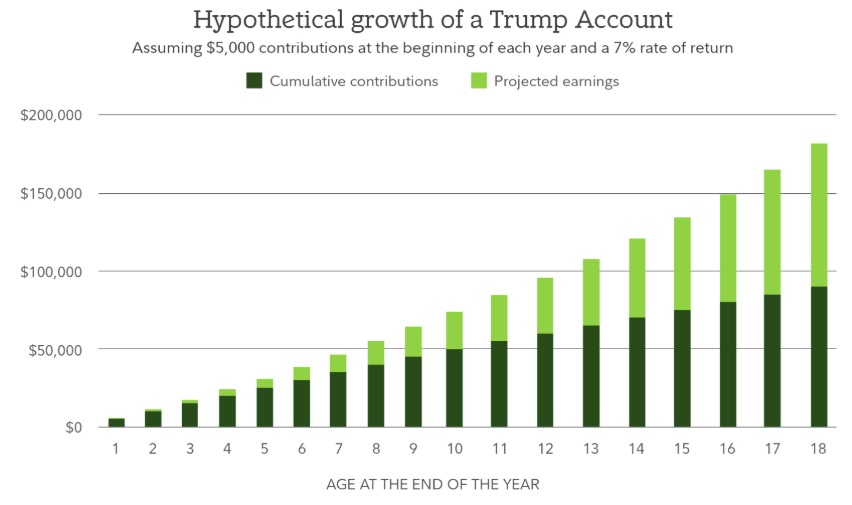
Beyond that, the question of whether to make additional contributions deserves a closer look. The answer depends on your family’s overall tax picture, whether a deliberate Roth conversion strategy is part of your plan, and how the account fits alongside other savings vehicles like 529 plans and IRAs.

These accounts have real potential — but the advantage isn’t automatic. It requires coordination.

If you’d like to talk through how a Trump Account might fit into your family’s financial plan, reach out. We’re glad to help.

As with many new legislative programs, details are still being finalized — for a full legislative overview, the Congressional Research Service published a comprehensive summary in April 2026.


Past performance does not guarantee future results. All investments include risk and have the potential for loss as well as gain.

Data sources for returns and standard statistical data are provided by the sources referenced and are based on data obtained from recognized statistical services or other sources we believe to be reliable. However, some or all information has not been verified prior to the analysis, and we do not make any representations as to its accuracy or completeness. Any analysis nonfactual in nature constitutes only current opinions, which are subject to change. Benchmarks or indices are included for information purposes  only  to  reflect  the  current  market  environment;  no  index  is  a directly  tradable investment.  There  may  be  instances  when  consultant  opinions  regarding any fundamental or quantitative analysis do not agree.

The  commentary  contained  herein  has  been  compiled  by  W.  Reid Culp,  III  from  sources  provided  by  TAGStone  Capital,  as well  as  commentary  provided  by  Mr.  Culp,  personally,  and  information independently  obtained  by  Mr.  Culp.  The  pronoun  “we,”  as  used  herein,  references collectively the sources noted above.

TAGStone Capital, Inc. provides this update to convey general information about market conditions and not for the purpose of providing investment advice. Investment in any of the companies or sectors mentioned herein may not be appropriate for you. You should consult your advisor from TAGStone or others for investment advice regarding your own situation.


At a Glance

  • US large cap stocks: +17.88% (third consecutive double-digit year)
  • 2026 earnings growth projected near 15% (Wall Street consensus)
  • Elevated valuations and concentration reinforce disciplined diversification

Equity markets delivered a third consecutive year of double-digit returns in 2025. Several crosscurrents shaped 2025 market performance — from earnings strength and AI enthusiasm to shifting Federal Reserve policy and elevated valuations. Below, we review the key drivers and outline our 2026 investment outlook for disciplined long-term investors.

Investment Principles That Guide Our Decisions

I’ll begin by briefly restating the core principles that shape our planning and investment decisions:

  • We are long-term, goal-focused investors. Our investment policy is designed to support your objectives through broadly diversified portfolios of high-quality equities and bonds.
  • Studies and empirical evidence indicate that the economy cannot be forecast with consistency, nor markets timed with reliability in the short-term. Therefore, to trade profitably, after taxes, on short-term news or market movements is very difficult.
  • From this, we conclude that the best way to capture the long-term return premium of equities is to remain invested through their inevitable, uncomfortable, but normally temporary declines (excluding extraordinary periods such as 1929).
  • As long as your long-term goals remain unchanged, our investment strategy for achieving them will remain consistent. And as long as the investment strategy remains consistent, so too will your portfolio—aside from disciplined, periodic rebalancing.
  • We believe long-term compounding in quality equities, with an appropriate allocation to high-quality bonds, is the most effective way to capture attractive investment returns to support your goals. In that spirit, we remain mindful of Charlie Munger’s reminder that “the first law of compounding is to never interrupt it unnecessarily.”

Economic and Market Backdrop

1. Equity Performance in 2025

In 2025, the broad equity market delivered its third consecutive year of double-digit returns, supported by solid economic growth and meaningful gains in corporate earnings. A broad index of US large cap stocks finished the year up 17.88%.

2. Earnings Growth and AI Expectations

Looking ahead, the general expectation among major financial institutions is that company profits will continue their upward climb, with earnings growth forecasted at nearly 15% for 2026 (source: Yardeni Research). Experts believe this expansion in profits will be fueled by artificial intelligence and a resilient consumer, as detailed in the following earnings per share (EPS) projections:

Select Wall Street 2026 Earnings Per Share (EPS) Forecasts
Institution 2026 EPS Estimate EPS Growth Forecast Notable Driver
Morgan Stanley $317 17% AI-driven efficiency and tax benefits
JPMorgan $306 - $314 13% - 15% AI "supercycle" and resilient economy
Goldman Sachs $305 12% Productivity gains from AI adoption
Consensus (FactSet) $309 14.9% Average of all major analyst estimates

Remarkably, profit margins have also continued to expand, reaching 13.1% in the third quarter of 2025—the highest level in 15 years (source: FactSet). Many expected rising input costs and consumer resistance to price increases to squeeze margins. To date, those concerns have not materialized.

3. Labor Market and Productivity Trends

The main weak spot in the economy has been employment, which continues to soften. However, even this has a bright spot. The relatively flat employment levels have been offset by strong growth in supply, which has led to higher productivity. Though unemployment has risen slightly to about 4.7%, most workers are producing more per hour, enabling wage growth without reigniting inflation.

4. Federal Reserve Policy and Inflation

After six consecutive rate cuts, Federal Reserve policy is now roughly 175 basis points more accommodative than a year ago, while CPI inflation has remained relatively tame near three percent. It is reasonable to expect the lagged effects of this easing to become more visible in 2026—hopefully through continued economic growth as long as productivity remains high.

5. Fiscal Tailwinds and Tax Policy

This tax season, middle-income households are expected to receive meaningful refunds—estimated at around $150 billion in aggregate, or roughly a half percentage point boost to GDP. Key drivers include a higher standard deduction and the temporary increase of the SALT deduction cap to $40,000 from $10,000, which could provide a near-term economic tailwind.

Unfortunately, much of this positive economic data is often under-reported in the financial news because it does not align with their prevailing narrative, which tends to emphasize negative developments—most notably the softening labor market. The information we receive from financial “news” is often skewed toward pessimism because it sells better.

6. Valuations and Market Concentration

Regardless, the strongly rising equity market may already reflect much of this positive information. As a result, the dominant question of 2025 became whether markets have moved into an AI-driven bubble—supplanting 2024’s concern about rate cuts and 2023’s concern about a recession.

There is no denying that today’s market is more concentrated in a small number of large technology companies than at any point in recent decades, and that valuations for the broad US large-cap stock indexes sit near historical highs.


Portfolio Implications

Our response to this environment is straightforward:

  1. Valuations and Expected Returns: While higher starting valuations have historically pointed towards lower-than-average expected returns over the next 5-10 years, valuations have not been a reliable market-timing tool in the short term.
  2. Concentration Risk and Diversification: While higher starting valuations and concentration risk are not ideal, these risks can be addressed through disciplined portfolio construction and systematic rebalancing to provide an attractive investment experience.
  3. Long-Term Plans vs. Short-Term Narratives: Generally, long-term plans should not be altered in response to short-term narratives, popular fears, or even higher starting valuations.
  4. Asset Allocation Discipline: Pick a stock-to-bond ratio you are comfortable with, and only make changes to the ratio if your circumstances change. Cash and bonds are necessary to help you weather inevitable market declines.

Closing Perspective

History suggests that the next market disruption will likely come from an unexpected source (in the jargon, an unknown unknown, as opposed to a known unknown like higher starting valuations or the national debt). Such events tend to matter little to the plans of long-term stock investors except as opportunities to rebalance and invest at more attractive prices.

Plus, the alternatives of trying to invest in private real estate deals or a private operating business can subject you to even greater costs, risks, and, potentially, a permanent loss of capital as opposed to the normally temporary declines a long-term stock investor may experience.

We continue to follow an approach that has worked over full market cycles in that it has provided the best chance to help investors achieve their most precious financial goals. We do not assume “this time is different,” nor do we adjust strategy to accommodate the fears or fashions of the moment. We avoid abandoning markets during periods of stress, and we avoid overcommitting to any single “new era” narrative—AI included.

We wish you and your family a healthy, happy, and prosperous 2026. As always, we are here to answer questions and discuss your plan at any time. Thank you for the trust you place in us—it is a privilege to serve you.


Past performance does not guarantee future results. All investments include risk and have the potential for loss as well as gain.

Data sources for returns and standard statistical data are provided by the sources referenced and are based on data obtained from recognized statistical services or other sources we believe to be reliable. However, some or all information has not been verified prior to the analysis, and we do not make any representations as to its accuracy or completeness. Any analysis nonfactual in nature constitutes only current opinions, which are subject to change. Benchmarks or indices are included for information purposes  only  to  reflect  the  current  market  environment;  no  index  is  a directly  tradable investment.  There  may  be  instances  when  consultant  opinions  regarding any fundamental or quantitative analysis do not agree.

The  commentary  contained  herein  has  been  compiled  by  W.  Reid Culp,  III  from  sources  provided  by  TAGStone  Capital,  as well  as  commentary  provided  by  Mr.  Culp,  personally,  and  information independently  obtained  by  Mr.  Culp.  The  pronoun  “we,”  as  used  herein,  references collectively the sources noted above.

TAGStone Capital, Inc. provides this update to convey general information about market conditions and not for the purpose of providing investment advice. Investment in any of the companies or sectors mentioned herein may not be appropriate for you. You should consult your advisor from TAGStone or others for investment advice regarding your own situation.


At a Glance

  • Higher thresholds, but limited impact for high earners. The standard deduction and Child Tax Credit increased, though many new deductions phase out quickly at higher income levels.
  • Estate exemption remains elevated. The lifetime gift and estate tax exemption rose to $15 million in 2026, providing clarity for long-term gifting and trust planning.
  • New reporting and deduction rules require coordination. Crypto transactions now generate Form 1099-DA, certain new deductions apply through 2028, and IRA contributions remain available before the April filing deadline.

2025 Tax Changes: What to Review Before Filing Your Return

Filing your tax return might seem routine. In reality, small rule changes can have significant planning implications — especially for higher‑income households balancing investment income, business interests, charitable giving, and multi‑generational wealth strategies.

The 2025 tax year introduced several structural changes affecting income reporting, deductions, and estate planning, stemming from the One Big Beautiful Bill Act (OBBBA), passed in July. While many headlines highlight broad taxpayer benefits, some provisions phase out quickly at higher income levels. For affluent families, the technical details, not the headlines, determine the real impact. Understanding how these changes fit into your overall financial plan ultimately shapes the outcome.

A Boost for Traditional Deductions

The OBBBA made several taxpayer-friendly provisions permanent, starting with a higher standard deduction. For 2025, the standard deduction increases to $15,750 for single filers, up from $15,000 in 2024. For married couples filing jointly, the deduction rises to $31,500, up from $30,000.

The legislation also expanded the Child Tax Credit, increasing it to $2,200 per qualifying child, compared with $2,000 under prior law.

For higher‑income households who typically itemize, the increased standard deduction may have limited practical impact — particularly when charitable contributions, mortgage interest and property taxes remain significant. Still, the higher threshold can reduce the marginal benefit of smaller itemized deductions and may influence charitable “bunching” or timing strategies.

New Tax Deductions to Be Aware Of

The OBBBA introduced several new deductions for 2025. Many have income phaseouts that limit their usefulness for higher earners, but they may still be relevant for certain family members or key employees in privately owned businesses.

  • Personal deduction for seniors: If you were born before Jan. 2, 1961, you can take a $6,000 deduction ($12,000 if married filing jointly) in addition to your standard or itemized deduction. This deduction is phased out if your modified adjusted gross income (MAGI) is between $75,000 ($150,000 for joint filers) and $175,000 ($250,000 for joint filers).
  • Tax deduction for tips: Often described politically as “no tax” on tips and overtime, the reality is more nuanced. In practice, there is now a deduction for voluntary cash or charged tips earned in industries where tipping is customary. From 2025 through 2028, eligible single filers can deduct up to $25,000 in tipped income, though the deduction begins to phase out for individuals with MAGI above $150,000.
  • Tax deduction for overtime pay: A similar deduction applies to a portion of qualified overtime pay from 2025 through 2028. In most cases, this refers only to the premium portion of overtime—for example, the extra “half” in “time-and-a-half” pay—rather than the worker’s full hourly wage. For single filers, the deduction is capped at $12,500 of eligible compensation for those with MAGI below $150,000. The deduction is phased out above that amount and is zeroed out once above $275,000.
  • Car loan interest deduction: If you financed the purchase of a new vehicle in 2025, you may be eligible to deduct up to $10,000 in interest paid on that loan, provided the vehicle was built in the United States and is used for personal use. To determine if your car fits the bill, look at your vehicle identification number (VIN). Cars built in the United States will have a VIN that starts with a 1, 4, or 5. The deduction phases out for single filers with MAGI above $100,000. Given the income limits and the fact that many higher‑income households either pay cash or lease vehicles, this provision may have a limited impact in affluent planning contexts. In future years, lenders will be required to report auto loan interest payments directly to both taxpayers and the IRS. For this year, you may need to do a little digging through your loan statements, or you can request a summary of interest paid from your lender.

Gift and Estate Tax Exemptions: Long-Term Clarity

The OBBBA provided clarity to a crucial estate planning rule. The lifetime estate and gift tax exemption was previously scheduled to sunset on December 31, 2025, potentially reducing the exemption from nearly $14 million to approximately $6 million. Instead, the higher exemption has been made permanent. Here’s where things stand now:

  • The estate and gift tax exemption rose to $15 million in 2026 and is indexed to inflation going forward.
  • The annual gift tax exclusion is $19,000 per recipient in 2026.
  • While it’s too late to make a tax-free gift for 2025, now is a good time to begin planning gifting strategies for 2026.


While permanence provides welcome clarity, it does not eliminate planning considerations. Families with estates approaching the exemption threshold should continue evaluating lifetime gifting strategies, trust structures, and long-term liquidity planning. Asset growth, legislative risk, and multi-generational objectives still warrant proactive review.

Tax Reporting on Cryptocurrency

Beginning in 2025, the IRS requires reporting of digital asset transactions. If you sold or exchanged digital assets through a platform such as Coinbase, you should receive a Form 1099‑DA, a form created specifically for digital asset reporting.

Capital gains taxes generally apply to crypto sales and trades. Digital assets received as compensation may be taxed as ordinary income.

Investors holding digital assets outside centralized platforms should pay particular attention to basis tracking and transaction documentation, as reporting discrepancies may increase audit risk.

It’s Not Too Late to Fund Your IRA

While the window for 2025 401(k) contributions closed at year‑end, you may still make 2025 traditional or Roth IRA contributions until the April 15 filing deadline.

The contribution limit for IRAs remains $7,000, with an additional $1,000 catch‑up contribution available for individuals age 50 or older.

Higher‑income households considering backdoor Roth contributions should coordinate carefully to avoid unintended pro‑rata tax consequences.

Planning Ahead Matters

Tax rules change regularly. What matters more is how those rules integrate with your long‑term investment strategy, liquidity needs, and estate planning objectives.

Reviewing your situation before filing allows for greater flexibility — whether that involves IRA funding decisions, charitable contributions, gifting strategies, or managing realized gains.

If you would like to review how these 2025 changes apply to your specific circumstances, we are happy to schedule a conversation.


Past performance does not guarantee future results. All investments include risk and have the potential for loss as well as gain.

Data sources for returns and standard statistical data are provided by the sources referenced and are based on data obtained from recognized statistical services or other sources we believe to be reliable. However, some or all information has not been verified prior to the analysis, and we do not make any representations as to its accuracy or completeness. Any analysis nonfactual in nature constitutes only current opinions, which are subject to change. Benchmarks or indices are included for information purposes  only  to  reflect  the  current  market  environment;  no  index  is  a directly  tradable investment.  There  may  be  instances  when  consultant  opinions  regarding any fundamental or quantitative analysis do not agree.

The  commentary  contained  herein  has  been  compiled  by  W.  Reid Culp,  III  from  sources  provided  by  TAGStone  Capital,  as well  as  commentary  provided  by  Mr.  Culp,  personally,  and  information independently  obtained  by  Mr.  Culp.  The  pronoun  “we,”  as  used  herein,  references collectively the sources noted above.

TAGStone Capital, Inc. provides this update to convey general information about market conditions and not for the purpose of providing investment advice. Investment in any of the companies or sectors mentioned herein may not be appropriate for you. You should consult your advisor from TAGStone or others for investment advice regarding your own situation.