10 Reasons to be Cheerful – Second Quarter 2016

10 Reasons to be Cheerful

Do you ever listen to the news and find yourself thinking that the world has gone to the dogs?

The roll call of depressing headlines seems endless. But look beyond what the media calls news, and there are also a lot of things going right.

It’s true the world faces challenges in many areas, and the headlines reflect that. Europe has been grappling with a flood of refugees; as of May, the Chinese local A-share market declined by almost 20 percent; and the U.S. is in the middle of a sometimes-rancorous election campaign.

More recently, citizens of the United Kingdom voted to leave the European Union, creating significant uncertainty in markets over the long-term implications.

But it’s also easy to overlook the significant advances made in raising the living standards of millions, increasing global cooperation on various issues, and improving access to healthcare and other services around the world.

Many of the 10 developments cited below don’t tend to make the front pages of daily newspapers or the lead items in the TV news, but they’re worth keeping in mind on those occasions when you feel overwhelmed by all the grim headlines.

So here’s an alternative news bulletin:

1.  Over the last 25 years ending May 2016, one dollar invested in a global portfolio of stocks would have grown to more than five and a half dollars.1

2.  Over the last 25 years, 2 billion people globally have moved out of extreme poverty, according to the latest United Nations Human Development Report.2

3.  Over the same period, mortality rates among children under the age of 5 have fallen by 53%, from 91 deaths per 1000 to 43 deaths per 1000.

4.  Globally, life expectancy has been improving. From 2000 to 2015, according to the World Health Organization, the global increase was 5.0 years, with an even larger increase of 9.4 years in parts of Africa.3

5.  Global trade has expanded as a proportion of GDP from 20% in 1995 to 30% by 2014, signaling greater global integration.4

6.  Access to financial services has greatly expanded in developing countries. According to the World Bank, among adults in the poorest 40% of households within developing economies, the share without a bank account fell by 17 percentage points on average between 2011 and 2014.5

7.  The world’s biggest economy, the U.S., has been recovering. Unemployment has halved in six years from nearly 10% to 5%.6

8.  The world is exploring new sources of renewable energy. According to the International Energy Agency, in 2014, renewable energy such as wind and solar expanded at its fastest rate to date and accounted for more than 45% of net additions to world capacity in the power sector.7

9.  We live in an era of innovation. One report estimates the digital economy now accounts for 22.5% of global economic output.8

10.  The growing speed and scale of data is increasing global connectedness. According to a report by McKinsey & Company, cross-border bandwidth has grown by a factor of 45 in the past decade, boosting productivity and GDP.9

No doubt, many of these advances will lead to new business and investment opportunities. Of course, not all will succeed. But the important point is that science and innovation are evolving in ways that may help mankind.

The world is far from perfect. The human race faces challenges. But just as it is important to be realistic and aware of the downside of our condition, we must also recognize the major advances that we are making.

Just as there is reason for caution, there is always room for hope. And keeping those good things in mind can help when you feel overwhelmed by all the bad news.10

[1] As measured by the MSCI All Country World Index (gross dividends) in USD.

[2] “Human Development Report 2015: Work for Human Development," United Nations. 

[3] “World Health Statistics 2016,” World Health Organization. 

[4] “International Trade Statistics 2015,” World Trade Organization. 

[5] “The Global Findex Database 2014: Measuring Financial Inclusion Around the World,” World Bank.

[6] U.S. Bureau of Labor Statistics, 15 March 2016. 

[7] “Renewable Energy Market Report 2015,” International Energy Agency. 

[8] “Digital Disruption: The Growth Multiplier,” Accenture and Oxford Economics, February 2016. 

[9] “Digital Globalization: The New Era of Global Flows,” McKinsey and Company, March 2016.

[10] Adapted from “10 Reasons to be Cheerful,” Jim Parker, Outside the Flags, DFA, June 2016.

GDP Growth and Equity Returns

Many investors look to gross domestic product (GDP) as an indicator of future equity returns.

According to the advance GDP estimate released by the Bureau of Economic Analysis (BEA) on April 28, annualized real U.S. GDP growth was 0.5% in the first quarter of 2016—below the historical average of 3.2%.11 This might prompt some investors to ask whether below-average quarterly GDP growth has implications for their portfolios.

Market participants continually update their expectations about the future, including expectations about the future state of the economy. The current prices of the stocks and bonds held by investors therefore contain up-to-date information about expected GDP growth and a multitude of other considerations that inform aggregate market expectations. Accordingly, only new information that is not already incorporated in market prices should impact stock and bond returns.

Quarterly GDP estimates are released with a one-month lag and are frequently revised at a later point in time. Initial quarterly GDP estimates were revised for 54 of the 56 quarters from 2002 to 2015.12 Thus, the final estimate for last quarter may end up being higher or lower than 0.5%.

Prices already reflect expected GDP growth prior to the official release of quarterly GDP estimates. The unexpected component (positive or negative) of a GDP growth estimate is quickly incorporated into prices when a new estimate is released. A relevant question for investors is whether a period of low quarterly GDP growth has information about short-term stock returns going forward.13

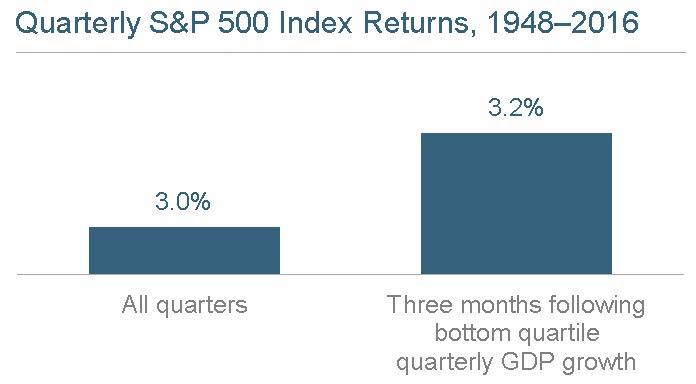
From 1948 to 2016, the average quarterly return for the S&P 500 Index was 3%. When quarterly GDP growth was in the lowest quartile of historical observations, the average S&P 500 return in the subsequent quarter was 3.2%, which is similar to the historical average for all quarters. This data suggests there is little evidence that low quarterly GDP growth is associated with short-term stock returns above or below returns in other periods (Sources: S&P Dow Jones Indices, Bureau of Economic Analysis).

UK’s EU Referendum Result

On June 23, citizens of the United Kingdom voted to leave the European Union. While there has been much speculation leading up to and since the vote, many of the longer-term implications of the referendum remain unclear, as the process for negotiating what a UK exit may look like are just beginning.

TAGStone Capital, and our strategic alliances, have years of experience managing portfolios, including during periods of uncertainty and heightened volatility. We monitor market events—including their impact on investment managers, whose funds we use in client portfolios—very closely and consider the implications of new information as it comes to light. We are paying close attention to market mechanisms and they appear to be functioning well. Our investment philosophy and process have withstood many trying times and we remain committed.

We urge caution in allowing market movements to impact long-term asset allocation. Long-term investors recognize that risks and uncertainty are ever present in markets. A drop in prices is generally due to lower expectations of cash flows, higher discount rates, or both. In some cases, a drop is also due to investors demanding liquidity.

In the current situation, some investors and economists may expect lower cash flows due to possible barriers that may or may not be implemented. Higher discount rates may be occurring due to uncertainty about changes in the economic landscapes and regulations.

We have seen markets increase discount rates in times of uncertainty before, resulting in lower prices and increased expected returns. However, it is difficult to know when good outcomes will materialize in the future. By attempting to time the right moment to invest or redeem, one risks not enjoying the potential benefit of such materializations.

Many of those who exit the markets miss the recoveries. What we have often seen in the past is that investors who remained in well-diversified portfolios were rewarded over time.

Leading up to and since the vote, we have worked with our counterparties, including investment managers, portfolio managers, and custodians, regarding potential operational implications resulting from the UK’s leaving the EU. The UK will have up to two years to negotiate a withdrawal, during which time it remains subject to EU treaties and laws. Any potential operational changes depend on what path the UK and EU decide to take.

TAGStone remains committed to helping its clients have a good investment experience.

[11] Source: Bureau of Economic Analysis

[12] 2002 to 2015 is the longest time period for which BEA provides data comparing initial to final estimates. The average difference between an initial and final estimate was 1% in absolute magnitude over this time period.

[13] Adapted from “GDP Growth and Equity Returns,” Issue Brief, DFA, May 2016.


Past performance does not guarantee future results. All investments include risk and have the potential for loss as well as gain.

Data sources for returns and standard statistical data are provided by the sources referenced and are based on data obtained from recognized statistical services or other sources we believe to be reliable. However, some or all information has not been verified prior to the analysis, and we do not make any representations as to its accuracy or completeness. Any analysis nonfactual in nature constitutes only current opinions, which are subject to change. Benchmarks or indices are included for information  purposes  only  to  reflect  the  current  market  environment;  no  index  is  a directly  tradable  investment.  There  may  be  instances  when  consultant  opinions  regarding any fundamental or quantitative analysis do not agree.

The  commentary  contained  herein  has  been  compiled  by  W.  Reid  Culp,  III  from  sources  provided  by  TAGStone  Capital,  Capital  Directions,  DFA,  Vanguard,  Morningstar,  as  well  as  commentary  provided  by  Mr.  Culp,  personally,  and  information  independently  obtained  by  Mr.  Culp.  The  pronoun  “we,”  as  used  herein,  references collectively the sources noted above.

TAGStone Capital, Inc. provides this update to convey general information about market conditions and not for the purpose of providing investment advice. Investment in any of the companies or sectors mentioned herein may not be appropriate for you. You should consult your advisor from TAGStone for investment advice regarding your own situation.


Climbing a Wall of Worry

First Quarter 2016 proved to be a volatile one for investors. Before suddenly rallying in mid-February, stocks got off to their worst start ever to begin the New Year. From peak to trough (high to low), large U.S. stocks, as measured by the S&P 500 index, fell more than 10% from January 1 to February 11.

This size decline was not unusual for stocks, as the average intra-year decline for the S&P 500 dating back to 1980 is 14.2%. But, what was extraordinary was the timing of the decline.

After a Fourth Quarter 2015 rally, which saw stocks regain their highs after August 2015 lows, investors were shocked to see stocks take a similar decline to begin the year. Speaking with clients, friends, and family, we found a profound sense of pessimism permeating our conversations.

While this pessimism can mute a stock market rally, it is the same force that keeps stock prices in check and provides the higher returns afforded to stocks. Without a sense of pessimism, stock markets can separate from reality, and asset prices can become overpriced.

This is what occurred with technology stocks in the dot-com bubble and home prices in the housing bubble. In periods of irrational exuberance, price action takes over, and people forget that asset prices can go down.

This leads us back to the old Wall Street adage about the market’s ability to “climb a wall of worry.” This saying points to financial markets’ periodic tendency to overcome a host of negative factors and keep rising.

In the last twenty-years (1995-2015), we have experienced the Asian currency crisis (1997), dot-com collapse (2000), 9/11 (2001), subprime mortgage crisis (2007-2008), and the U.S. debt downgrade (2011) to name a few.

Each of these economic, political, or geopolitical issues were significant enough to affect consumer and investor sentiment, which in turn affected stock markets. However, each of these events proved to be a temporary stumbling block, rather than a permanent impediment to stock market advances.

Who Gets What - and Why

There are numerous reasons why stock markets climb a wall of worry—from investor confidence that short-term issues will be resolved to the sheer force of financial markets.

So, what is it that makes financial markets so powerful? To answer this question, it is helpful to look at markets, in general.

Markets are ancient human inventions, which people developed as tools to organize themselves, to cooperate, coordinate, and compete with one another, and ultimately to figure out who gets what.

Markets are all about matchmaking. Markets bring together buyers and sellers, students and teachers, job seekers and those looking to hire, and even sometimes those looking for love.

In his book, “Who Gets What – and Why,” Nobel-Prize-Winning economist, Alvin E. Roth, says markets are human artifacts that “play a role in all things we do and in everything we make (we can’t even make love, let alone war, without them).”

We experience markets through marketplaces, and a stock market is only one type of market we encounter in our daily lives. Other markets include Amazon.com on our smartphones, job and dating markets, and specialized markets like kidney exchanges.

Each of these markets is an advanced form of the first markets used by humans more than 10,000 years ago. In fact, the design and use of markets is older than agriculture, but even after thousands of years, markets are not widely or deeply understood.

This lack of understanding easily leads to the fear and anxiety we experience from investing in stocks. Many people believe investing in stocks is a rigged casino game. And, this is exactly the message that Michael Lewis, the famed author of “The Big Short,” recently espoused while promoting his new book.

Fortunately, this is not the case. In its simplest terms, a stock market is a marketplace where companies go to attract investment capital, and investors go to choose in which companies to invest their savings and investment capital.

Through decades of development and refinement, our capital markets, while not perfect, are as efficient and effective at determining the fair prices of securities as they have ever been.

One of the most significant events of the last fifty years was the fall of communism, which unleashed the power of markets to millions of new consumers and raised their standard of living. The power of markets is still as effective today as it was back then (probably even more so now).

Today, the unrelenting pace of innovation produces better technologies, higher-quality goods, and more effective services. Billions of savvy consumers with money in their pockets are ready to utilize markets to buy these technologies, goods, and services.

When innovation and the market system interact, it produces productivity gains that deliver tremendous benefits to our society. This is one reason our citizens, as a whole have enjoyed and will continue to enjoy major gains in the goods and services they receive.

This point is reiterated by Warren Buffett in his recent annual letter to shareholders, released in February 2016, where he states:

“Nothing rivals the market system in producing what people want – nor, even more so, in delivering what people don’t yet know they want. My parents, when young, could not envision a television set, nor did I, in my 50s, think I needed a personal computer. Both products, once people saw what they could do, quickly revolutionized their lives. I now spend ten hours a week playing bridge online. And, as I write this letter, “search” is invaluable to me. (I’m not ready for Tinder, however.)

“For 240 years it’s been a terrible mistake to bet against America, and now is no time to start. America’s golden goose of commerce and innovation will continue to lay more and larger eggs. America’s social security promises will be honored and perhaps made more generous. And, yes, America’s kids will live far better than their parents did.

Who Gets What - and Why (continued)

“Moreover, investors who diversify widely and simply sit tight with their holdings are certain to prosper: In America, gains from winning investments have always far more than offset the losses from clunkers. (During the 20th Century, the Dow Jones Industrial Average – an index fund of sorts – soared from 66 to 11,497, with its component companies all the while paying ever-increasing dividends.)”

We side with Warren on this one.

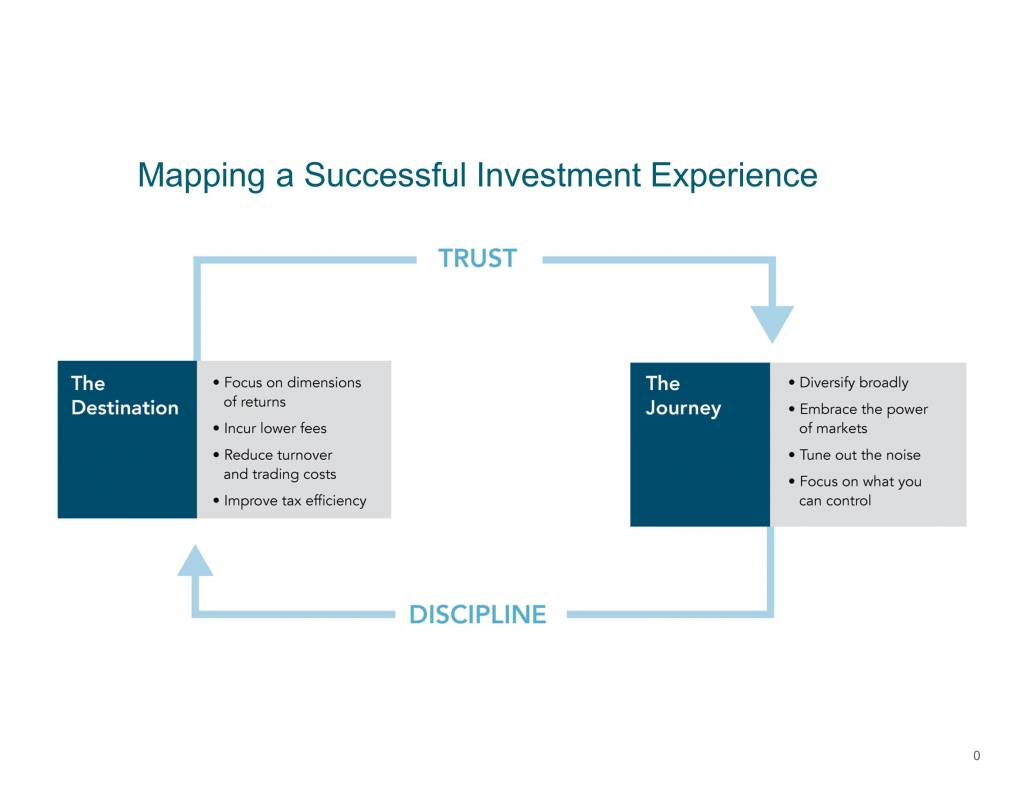
A Successful Investment Experience

“As an investor, what do you regard as the most difficult period in the financial markets during the last 45 years?”

Many older clients regard the 1973–1974 bear market as the toughest period in their investment lifetime. Middle-aged investors may consider the tech boom and bust of the late 1990s and early 2000s to be the bellwether event for a generation of investors who assumed they could get rich on one great stock pick. Today, just about everyone remembers the 2008–2009 global financial crisis, having experienced the anxiety of declining investment accounts themselves or knowing someone who did.

The market decline in early 2016 had much of the same feel as past events. Times like these are never easy for investors, who must confront their concern that “things just might be different this time.” When in the midst of a market decline, it is natural to sense that the volatility is lasting longer and is worse than anything before.

Even though, intellectually, we may understand the power of markets and that stocks climb a wall of worry, emotionally, how do we minimize the fear and anxiety we feel about our investment portfolios and retirement security?

As we know, no single word or story can ease our concerns—and certainly not overnight. But, the more effective course may be to steadily head down a path from worry to calm through conversations about the process of sticking to our investment plans.

This is the same approach world-class athletes use in high-pressure situations. Numerous books and articles describe how the greatest athletes, from Olympians to all-star professionals, focus on process rather than outcome when competing at the highest level.

The prepared athlete does not hope for an outcome or get nervous or scared as the moment approaches. He or she immediately falls back on the tried and tested routine performed countless times in a more serene environment (practice). Following the routine dulls the noise of the crowd and brings clarity of mind.

The same lessons apply to the seasoned investor. A chaotic market is akin to what the visiting team experiences in a gym, where opposing fans and players are doing everything possible to distract you. You stay focused on a routine burned into your nature through coaching and repetitive practice.

The components of the seasoned investor’s routine are similar: the investment policy statement, the regular review of family goals and liquidity needs, and the regular calls an advisor makes during good and bad markets. These and other actions are all part of the process developed to summon that muscle memory needed in stressful times. Just as the great athlete navigates through the moments of pressure in any athletic event, the actions are part of the routine that allows the individual to navigate through a chaotic market like we have today.

Sticking to the Plan

Statistics and data are the bedrock for the insights we gain about the capital markets, but it is often the conversational story that can help us focus on the simplest and most important tenets of investment success.

As always, the financial news media and the Wall Street selling-machine are in full swing and as effective as ever. These forces can make investors lose track of what is important, focus on short-term conditions, and make constant adjustments to their investments.

Instead of responding fearfully to the financial news media and chasing the promises of market-beating returns coming out of Wall Street, we at TAGStone Capital have the responsibility to select the investments that allow our clients to best reach their investment goals and objectives without taking outsized risks.

In addition, investment management is only one part of our clients’ overall wealth management plans—equally important are tax planning, estate planning, and asset protection. It is our job to understand these broad needs to build and adjust investment strategies that are integral to our clients’ overall plans.

This is why we believe in following an investment strategy that is process-based and can be followed regardless of the market or time period. Just like the world-class athlete in a high-pressure situation, we encourage you to maintain the discipline needed to follow a process, which can lead to a great investment experience.


Past performance does not guarantee future results. All investments include risk and have the potential for loss as well as gain.

Data sources for returns and standard statistical data are provided by the sources referenced and are based on data obtained from recognized statistical services or other sources we believe to be reliable. However, some or all information has not been verified prior to the analysis, and we do not make any representations as to its accuracy or completeness. Any analysis nonfactual in nature constitutes only current opinions, which are subject to change. Benchmarks or indices are included for information  purposes  only  to  reflect  the  current  market  environment;  no  index  is  a directly  tradable  investment.  There  may  be  instances  when  consultant  opinions  regarding any fundamental or quantitative analysis do not agree.

The  commentary  contained  herein  has  been  compiled  by  W.  Reid  Culp,  III  from  sources  provided  by  TAGStone  Capital,  Capital  Directions,  DFA,  Vanguard,  Morningstar,  as  well  as  commentary  provided  by  Mr.  Culp,  personally,  and  information  independently  obtained  by  Mr.  Culp.  The  pronoun  “we,”  as  used  herein,  references collectively the sources noted above.

TAGStone Capital, Inc. provides this update to convey general information about market conditions and not for the purpose of providing investment advice. Investment in any of the companies or sectors mentioned herein may not be appropriate for you. You should consult your advisor from TAGStone for investment advice regarding your own situation.


Markets Have Rewarded Discipline

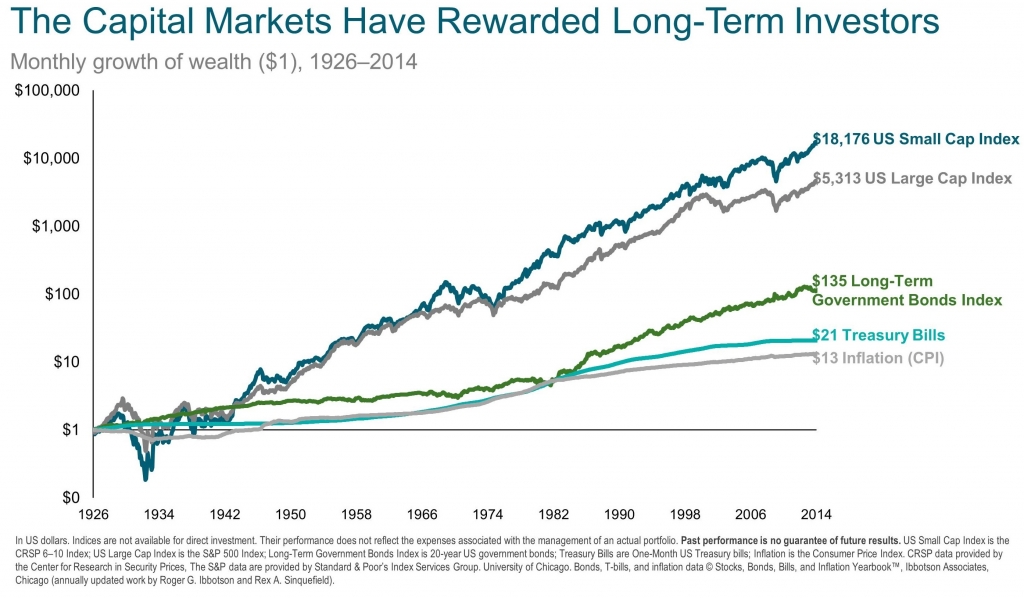
A disciplined investor looks beyond the concerns of today to the long-term growth potential of markets. The chart below shows how $1 invested in 1926 in various asset classes has grown through 2014. The top line shows that $1 invested in small cap U.S. stocks in 1926 would have grown to $18,176 by 2014, which is a full $12,863 more than $1 invested in large cap U.S. stocks over that same period.

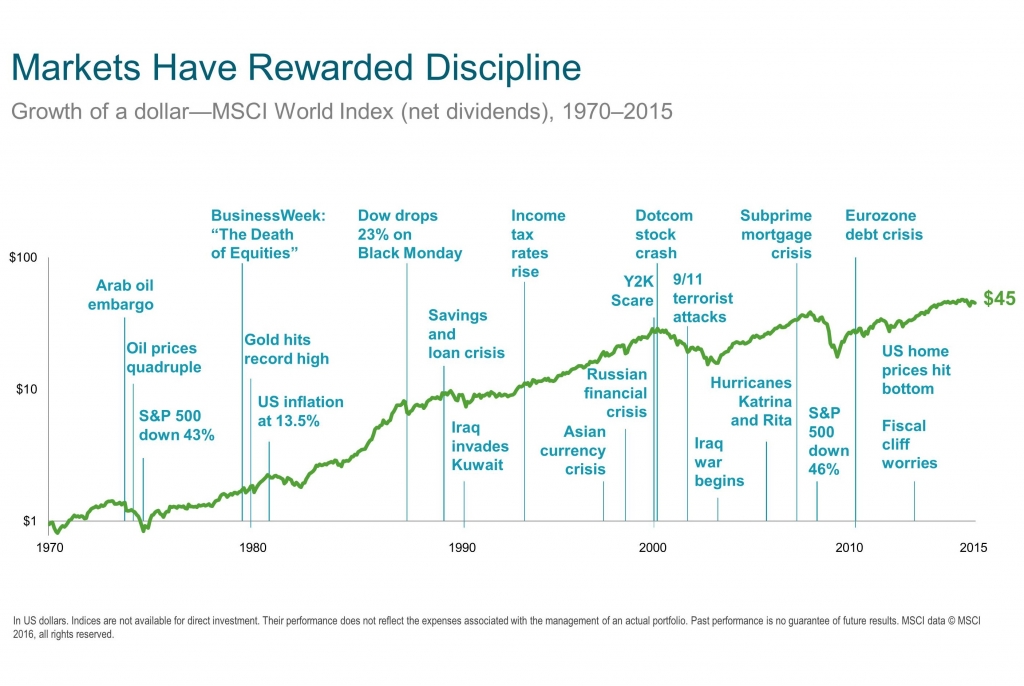
While these lines look relatively straight with only small flickers, we must remember that each small waver can feel like an all or nothing proposition when living through it. The chart below illustrates this point by showing the financial news headlines that have accompanied major market movements of the last 45 years.

While some of the movements may look minor from afar, if you take a closer look you can see how large they actually were in the moment. For example, the S&P 500 Index was down 43% in 1974 and the Dow Jones Industrial Average dropped 23% in one day in 1987. However, the market recovered from these temporary declines and climbed ever higher.

More recently, headlines related to the current market pullback have focused on oil prices and China’s growth. Both of these areas are in transition, and the broader stock markets are reacting to the uncertainty surrounding them. This is not unlike other recent pullbacks when the market was trying to sort out the U.S. fiscal cliff worries and the European sovereign debt crisis. Our opinion is that this too shall pass and the market will regain its footing and climb higher over the long term.

Avoiding Trains

It seems as though the market may continue to be bumpy, but we think your portfolios are well positioned to weather the storm. Many times, there is a tendency to believe that stock investing is similar to walking along a train track. For example, if we are walking along a set of train tracks and see a train coming, it’s easy to get off the tracks, let the train pass, and then get back on the tracks again. However, with stock investing we think this is hard to do, and we have seen firsthand with clients how difficult it can be.

The difficulty is related to timing the market, which requires making two correct decisions:

1) When to get out of the market, and

2) When to get back into the market.

Avoiding Trains (continued)

With so much noise in the news and financial press, it’s hard to find a clear “sell” and “buy” signal for the top and bottom of the market. Moreover, research shows that even professional money managers are not good at making these calls.

The reason for this is that humans are not wired for disciplined investing. The research shows that people tend to apply faulty reasoning to investing, when they follow their natural instincts. This is why we follow a structured investment strategy at TAGStone Capital based on years of academic research.

What we do know is that:

1.  Markets have historically shown to go higher over time,

2.  Certain groups of stocks have shown to outperform others over the long term, but this does not always hold over the short term and it is difficult to pick which groups of stocks will outperform during those shorter periods, and

3.  Having an appropriate balance between stocks and bonds provides the means for an investor to stick to an investment strategy, because all investment strategies have periods of relative underperformance.

The last point is reiterated by David Booth, CEO of Dimensional Fund Advisors, in the Barron’s article we have shown many of you before. In the last paragraph of the article, Booth says, “Where people get killed is getting in and out of investments. They get halfway into something, lose confidence, and then try something else. It’s important to have a philosophy.”

This Too Shall Pass

Although there is substantial weakness in several parts of the market, including energy, commodities, and heavy industry, we believe that the six-plus year expansion led by consumers is still in place.

The large-scale sell off we have seen in energy stocks over the last six months is partly due to high valuations as a result of low energy prices. The general market, on the other hand, as measured by the S&P 500, has recently been trading below its twenty-year forward P/E ratio, and valuations get better as markets decline.

Determining what exactly will happen over the short term is a difficult game. Since volatility tends to arrive in clusters, the market may have more negative volatility ahead as over valuations in certain parts of the market are corrected.

We are optimistic that this too shall pass as the U.S. economy continues its long-term expansion. While we are optimistic, we do recommend that investors periodically review their basic ratio between stocks and bonds to be comfortable that their ratio is consistent with their current risk profile. At the same time, investors should be fully prepared to take advantage of long-term opportunities that may present themselves to rebalance into over-sold asset classes according to their investment strategies.


Past performance does not guarantee future results. All investments include risk and have the potential for loss as well as gain.

Data sources for returns and standard statistical data are provided by the sources referenced and are based on data obtained from recognized statistical services or other sources we believe to be reliable. However, some or all information has not been verified prior to the analysis, and we do not make any representations as to its accuracy or completeness. Any analysis nonfactual in nature constitutes only current opinions, which are subject to change. Benchmarks or indices are included for information  purposes  only  to  reflect  the  current  market  environment;  no  index  is  a directly  tradable  investment.  There  may  be  instances  when  consultant  opinions  regarding any fundamental or quantitative analysis do not agree.

The  commentary  contained  herein  has  been  compiled  by  W.  Reid  Culp,  III  from  sources  provided  by  TAGStone  Capital,  Capital  Directions,  DFA,  Vanguard,  Morningstar,  as  well  as  commentary  provided  by  Mr.  Culp,  personally,  and  information  independently  obtained  by  Mr.  Culp.  The  pronoun  “we,”  as  used  herein,  references collectively the sources noted above.

TAGStone Capital, Inc. provides this update to convey general information about market conditions and not for the purpose of providing investment advice. Investment in any of the companies or sectors mentioned herein may not be appropriate for you. You should consult your advisor from TAGStone for investment advice regarding your own situation.


”It’s always something. And then it’s nothing.”

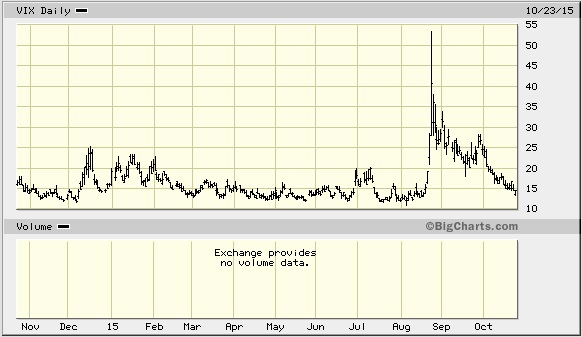
Stocks saw their first true panic selling in Third Quarter 2015 since the U.S. default crisis of 2011. In a particularly volatile week in mid-August, the Dow fell nearly 2,000 points in just five trading sessions. The VIX index, which measures the level of fear in the stock market, spiked into the mid-50 range, a level last seen during the 2008-09 financial crisis. For perspective, a reading of 30 in the VIX index is considered “extreme fear.”

Investors responded predictably to these events: They ran screaming for the exits like their hair was on fire. Net equity mutual fund redemptions for the week of August 25 totaled $29 billion – a new record. Net equity fund outflows the day the selling peaked were at a level not seen since October 2008.

Lost in all this hysteria was the reality that a downturn of this magnitude was hardly out of the ordinary. The average peak-to-trough (high point to low point) decline for the market on a yearly basis going back to 1980 is 14.1%. By that measure this decline was little more than business as usual. Yet another $29 billion now sits parked on the sidelines in cash, having missed the upturn that began in September and has continued to the date of this writing.

Where the stock market heads from here is, of course, anyone’s guess. But even if the coming months see another, even deeper, downturn, we know that whatever events are the cause of it – a slowing Chinese economy, rising interest rates, etc. – will eventually run their course. As financial writer Nick Murray is fond of saying, “it’s always something. And then it’s nothing.” Meaning that events resolve themselves over time and then the stock market commences its inexorable upward climb.

Sometimes those events come and go quickly, like the 2011 bear market following the U.S. default crisis. And sometimes those events are long and worrisome, like the 2008-09 financial crisis. Whatever their nature, though, the goal for long-term investors is the same: to be able to endure those events and come out on the other side with your portfolio intact so that you are there when the inevitable recovery commences, as it always does.

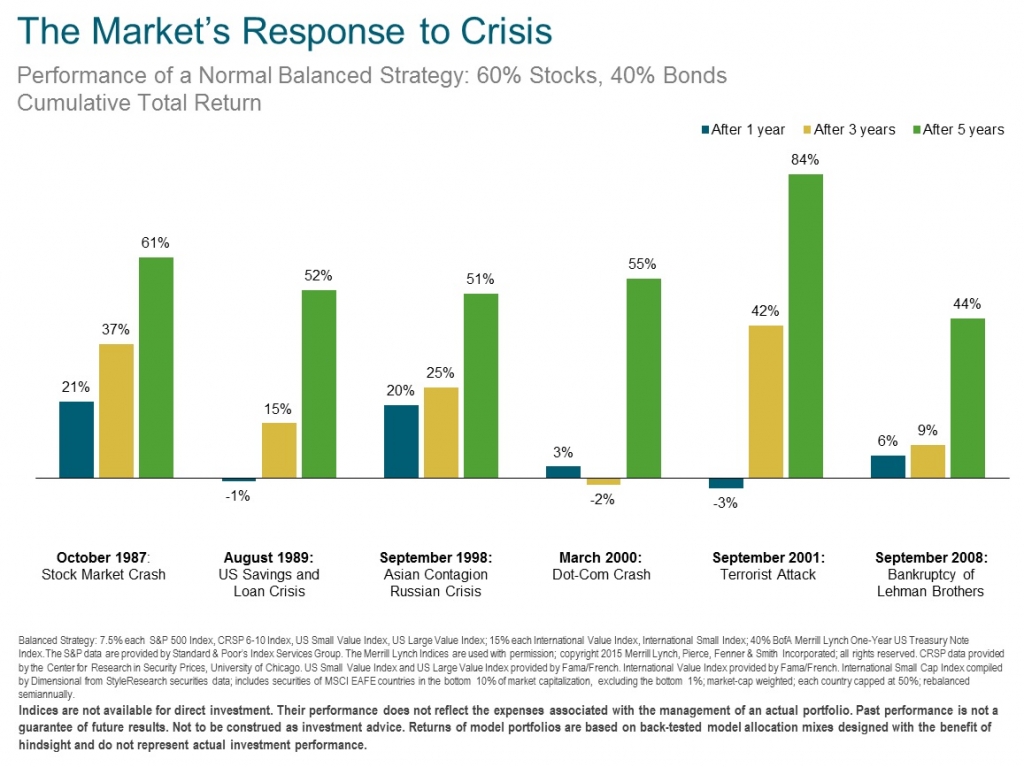
That’s why spreading risk among asset classes and investment styles is so important. Many investors who were concentrated in financial stocks were wiped out when The Great Recession hit and had no assets left to invest when the ensuing recovery began in 2009. In contrast, well-diversified investors recovered relatively quickly – as long as they stayed put.

The long recovery that commenced in 2009 was not unusual; in fact, it was typical of market recoveries after major downturns. Consider the chart on the previous page showing the one-, three-, and five-year returns for a hypothetical 60% stock / 40% bond portfolio following some of the major crises of the past thirty years.

Staying put is, of course, the hard part, as evidenced by the billions of dollars that fled the market a few weeks ago. It’s especially hard when the media gloom machine is in full force as it is right now. CNN breathlessly reported on August 26 that “$2.1 trillion was erased from the U.S. stock market in six days.” Who wouldn’t find that alarming? And yet can you recall any article since then pointing out that the market has since added back about $1 trillion? Or pointing out the fact that U.S. household net worth has increased nearly $17 trillion from the pre-recession levels of 2007? Neither can we.

That’s why it’s imperative to turn off the TV and walk away from the computer when panic hits the markets and a long-term perspective becomes difficult to maintain. Just remember this mantra: It’s always something. And then it’s nothing.

Focus on Things You Can Control

When things get dicey in the market and the emotional need to “take action” becomes acute, we always advocate for taking action on the things we can control – as opposed to worrying about the short-term direction of the market, which we can’t control.

In that regard, there are a number of estate planning and asset protection items to remember to help ensure your total financial picture is being addressed, in addition to your investment portfolio. One of the most important areas to consider relates to wealth transfer. Following are a list of items we can help you review and evaluate to be sure your wealth transfer plan is as efficient as possible:

1.  Review your existing estate plan. We find the majority of estate plans are not up to date. Why? Life intrudes; things change – your net worth, the tax laws, your family situation, and so on. Be sure your plan is up to date.

2.  Create comprehensive financial statements. Be sure you have everything in order. This can be one of the greatest gifts you can give your loved ones in the case of your unexpected death.

3.  Define your family goals. What are you looking to achieve? You don’t want your estate planning to be purely tax-motivated; you want it aligned with your values and goals.

4.  Consider alternatives for education funding. If funding education is one of your goals, there is a variety of options available to help fund education for future generations while reducing the tax burden on your estate.

5.  Consider dynasty or generation-skipping trusts. If there is a desire to pass assets inter-generationally, dynasty trusts can be very helpful in accomplishing this.

6.  Evaluate prospects for “opportunity shifting.” Again, there may be opportunities to shift assets and income between different entities or family members that may be very attractive.

7.  Review your life insurance planning. Life insurance can be a very effective tool to help ensure that your estate passes to your heirs tax free.

8.  Structure a favorable entity package. Setting up the appropriate legal entities is crucial to be sure your wealth transfer goals are optimized, whether those are S corps, LLCs, and others.

9.  Determine your charitable goals and gifting alternatives. Your gifting should be structured so that it helps not only your charitable interests but also your estate as well.

10.  Prepare the family business for transfer or sale. If you have a family business, you want to really think through – whether you’re planning on selling it now or not – how you are ultimately going to transfer or sell it. There are a number of vehicles available that can create more favorable valuations for transfers between family members.

If we can help you think through how any of these strategies may help you meet your unique values and goals, please do not hesitate to call us so we can add it to the agenda for your next regular progress meeting.

Perspective in Volatile Times

For the first time since 2011, panic selling hit the stock market in August. Small investors fled for the hills as volatility suddenly spiked in the market, selling $29 billion in equity mutual fund holdings for the week of August 25 – a new record.

As of this writing, stocks have enjoyed a significant rebound, but those investors who bailed out weren’t in the market to see the recovery. We fielded several calls from nervous clients during the height of the downturn and were able to calm their fears. As we have said before, the first responsibility of an investment advisor is to be the emotional barrier between the client and their money. In the grand scheme, this role may be more important than any other.

Volatility remains high in the market and may continue to be so in the near term. We offered some perspective on this subject above and hope you will keep these points in mind if volatility continues in the months ahead.

It is in times of turmoil that we have historically seen the largest influx of assets into our program as clients seek the counsel of the advisors they trust. This is a remarkable response and a tribute to the investment strategy that does not focus on the product-oriented offerings of stockbrokers, insurance agents, banks, etc.


Past performance does not guarantee future results. All investments include risk and have the potential for loss as well as gain.

Data sources for returns and standard statistical data are provided by the sources referenced and are based on data obtained from recognized statistical services or other sources we believe to be reliable. However, some or all information has not been verified prior to the analysis, and we do not make any representations as to its accuracy or completeness. Any analysis nonfactual in nature constitutes only current opinions, which are subject to change. Benchmarks or indices are included for information  purposes  only  to  reflect  the  current  market  environment;  no  index  is  a directly  tradable  investment.  There  may  be  instances  when  consultant  opinions  regarding any fundamental or quantitative analysis do not agree.

The  commentary  contained  herein  has  been  compiled  by  W.  Reid  Culp,  III  from  sources  provided  by  TAGStone  Capital,  Capital  Directions,  DFA,  Vanguard,  Morningstar,  as  well  as  commentary  provided  by  Mr.  Culp,  personally,  and  information  independently  obtained  by  Mr.  Culp.  The  pronoun  “we,”  as  used  herein,  references collectively the sources noted above.

TAGStone Capital, Inc. provides this update to convey general information about market conditions and not for the purpose of providing investment advice. Investment in any of the companies or sectors mentioned herein may not be appropriate for you. You should consult your advisor from TAGStone for investment advice regarding your own situation.


The All-Weather, All-Road Portfolio

Owners of all-purpose motor vehicles often appreciate their cars most when they leave smooth city freeways for rough gravel country roads. In investment, highly diversified portfolios can provide similar reassurance.

In blue skies and open highways, flimsy city sedans might cruise along just as well as sturdier sports utility vehicles. But the real test occurs when the road and weather conditions deteriorate.

That’s why people who travel through different terrains often invest in an SUV that can accommodate a range of environments, but without sacrificing too much in fuel economy, efficiency, and performance.

Structuring an appropriate portfolio involves similar decisions. You need an allocation that can withstand a range of investment climates while being mindful of fees and taxes.

When certain sectors or stocks are performing strongly, it can be tempting to chase returns in one area. But if the underlying conditions deteriorate, you can end up like a motorist with a flat tire on a desert road without a spare.

Likewise, when the market performs badly, the temptation might be to hunker down completely. But if the investment skies brighten and the roads improve, you risk missing out on better returns elsewhere.

One common solution is to shift strategies according to the climate. But this is a tough, and potentially costly, challenge. It is the equivalent of keeping two cars in the garage when you only need one. You’re paying double the insurance, registration, and upkeep costs.

An alternative is to build a single, diversified portfolio. That means spreading risk in a way that helps your portfolio capture what global markets have to offer, while reducing unnecessary risks. In any one period, some parts of the portfolio will do well. Others will do poorly, although you can’t predict which. That is the point of diversification.

It is important to remember that you can never completely remove risk in any investment. Even a well-diversified portfolio is not bulletproof. We saw that in 2008–09, when there were broad losses in markets.

But you can still work to minimize risks you don’t need to take. These include unduly exposing your portfolio to the influences of individual stocks, sectors, or countries—or relying on the luck of the draw.

An example is those people who made big bets on technology stocks in the late 1990s. These concentrated bets might pay off for a little while, but it is hard to build a consistent strategy out of them. And those fads aren’t free. It’s hard to get your timing right, and it can be costly if you’re buying and selling in a hurry.

By contrast, owning a diversified portfolio is like having an all-weather, all-roads, fuel-efficient vehicle in your garage. This way you’re smoothing out some of the bumps in the road and taking out the guesswork.

Because you can never be sure which markets will outperform from year to year, diversification can help increase the consistency of the outcomes and help you capture what the global markets have to offer.

Add discipline and efficient implementation to the mix, and you may get a structured low-cost, tax-efficient solution.

Just as expert engineers can design fuel-efficient vehicles for all conditions, astute financial advisors know how to construct globally diversified portfolios to help you capture what the markets offer in an efficient way, while reducing the influence of random forces.

There will be rough roads ahead, for sure. But with the right investment vehicle, the ride can be a more comfortable one.

The Seven Roles of an Advisor

What is the benefit of a financial advisor? One view is that advisors have unique insights into market direction that give their clients an advantage. But of the many roles a professional advisor should play, soothsayer is not one of them.

The truth is that no one knows what will happen next in investment markets. And if anyone really did have a working crystal ball, it is unlikely they would be plying their trade as an advisor, broker, analyst, or financial journalist.

Some folks may still think an advisor’s role is to deliver market-beating returns year after year. Generally, those are the same people who believe good advice equates to making accurate forecasts.

But in reality, the value a professional advisor brings is not dependent on the state of markets. Indeed, their value can be even more evident when volatility and emotions are running high.

Effective advisors play multiple and nuanced roles with their clients. None of these roles involve making forecasts about markets or economies. Indeed, there are at least seven hats an advisor can wear to help clients without ever once having to look into a crystal ball:

1.  The Expert: Investors need advisors who can provide client-centered expertise in assessing the state of their finances and developing risk-aware strategies to help them meet their goals.

2.  The Independent Voice: The global financial turmoil of recent years demonstrated the value of an independent and objective voice in a world full of product pushers and salespeople.

3.  The Listener: A good advisor will listen to clients’ fears, tease out the issues driving those feelings, and provide practical, long-term answers.

4.  The Teacher: Getting beyond the fear-and-flight phase often is just a matter of teaching investors about risk and return, diversification, the role of asset allocation, and the virtue of discipline.

5.  The Architect: Once these lessons are understood, the advisor becomes an architect, building a long-term wealth management strategy that matches each person’s risk appetites and lifetime goals.

6.  The Coach: Even when the strategy is in place, doubts and fears inevitably arise. At this point, the advisor becomes a coach, reinforcing first principles and keeping the client on track.

7.  The Guardian: Beyond these experiences is a long-term role for the advisor as a kind of lighthouse keeper, scanning the horizon for issues that may affect the client and keeping them informed.

These are just seven valuable roles an advisor can play in understanding and responding to clients’ whole-of-life needs, which are a world away from the old notions of selling product off the shelf or making forecasts. Knowing the advisor is independent—and not plugging product—can lead to better understanding and advice.

However you characterize these various roles, good financial advice ultimately is defined by the patient building of a long-term relationship founded on the values of trust, independence, and knowledge of each individual.

Staying the Course

Though many stock indices still hover near historical highs, volatility now seems to be the order of the day in capital markets. The potential of rising interest rates and Greece's possible exit from the Eurozone economy will no doubt give short-term traders itchy fingers in the months ahead. Long-term investors, however, should have a different perspective. While there will always be periodic events that temporarily roil the markets, long-term stock investing is about participating in the ongoing growth and innovation of companies around the world.

The benefit of that participation has historically been long-term gains in the range of 9% to 10% for stock investors. (Indeed, despite all the shocks to the market in the past two decades, the S&P 500's twenty-year return presently stands at 8.91%.) The trade-off is that stock investors must endure periods of short-term volatility along the way and avoid the temptation to try to time the market. Such futile efforts usually provided all of the volatility and none of the benefit that comes with being a stock investor.


Past performance does not guarantee future results. All investments include risk and have the potential for loss as well as gain.

Data sources for returns and standard statistical data are provided by the sources referenced and are based on data obtained from recognized statistical services or other sources we believe to be reliable. However, some or all information has not been verified prior to the analysis, and we do not make any representations as to its accuracy or completeness. Any analysis nonfactual in nature constitutes only current opinions, which are subject to change. Benchmarks or indices are included for information  purposes  only  to  reflect  the  current  market  environment;  no  index  is  a directly  tradable  investment.  There  may  be  instances  when  consultant  opinions  regarding any fundamental or quantitative analysis do not agree.

The  commentary  contained  herein  has  been  compiled  by  W.  Reid  Culp,  III  from  sources  provided  by  TAGStone  Capital,  Capital  Directions,  DFA,  Vanguard,  Morningstar,  as  well  as  commentary  provided  by  Mr.  Culp,  personally,  and  information  independently  obtained  by  Mr.  Culp.  The  pronoun  “we,”  as  used  herein,  references collectively the sources noted above.

TAGStone Capital, Inc. provides this update to convey general information about market conditions and not for the purpose of providing investment advice. Investment in any of the companies or sectors mentioned herein may not be appropriate for you. You should consult your advisor from TAGStone for investment advice regarding your own situation.


MasterChef of Investing

In the popular TV program MasterChef, contestants face a series of cooking challenges. From low quality ingredients to inadequate preparation to poor implementation, so many things can, and do, go wrong. It’s a bit like investing.

In the world of investment, there customarily are two broad approaches. The first is some form of stock picking or market timing: managers attempt to find mispriced securities or seek to time their entry and exit points from various parts of the market.

This first approach is akin to the MasterChef challenge, which requires inventing a new and distinctive dish within a set time frame. The apparent advantage for the chef is flexibility of concept.

But what usually happens is that once the chefs have committed to a chosen recipe, they end up racing against the clock and are locked into particular ingredients to create a single dish. Of course, it may work out, but if they lose attention for a second, the dish is ruined and they have nothing to fall back on.

Likewise, in the investment world, the stock picker locks onto an individual idea. This single-mindedness actually results in little flexibility and creates time constraints. The manager tries to trade on information he believes is not reflected in prices, but if he errs, there may not be a Plan B.

If your primary goal is to stand out from the crowd, you are going to build cost and complexity into your process. In the cooking analogy, the price of your ingredients (out-of-season avocados, for example) is going to be a secondary consideration to having an impact. And once you’re committed to your distinctive dish (and high-cost ingredients), you may not be able to turn back.

The second approach to investing is when the investment manager seeks to track as closely as possible to a commercial index. The goal here is not to stand out. This results in the manager being most conscious of “tracking error” (or the deviation from the benchmark).

This approach is more akin to the MasterChef challenge in which contestants must cook a standard, popular dish with set ingredients. The focus is not creativity but following an established process as dictated by an outside party.

The ostensible advantage of the second approach is the chefs don’t have to create something completely new. The ingredients (or securities, in the case of the investment manager) are known. It is just a matter of assembling them.

However, the drawback of this latter approach is the absence of flexibility. The contestants can’t substitute one ingredient—or stock—for another. The recipe must be followed. What’s more, it must be achieved in a designated timeframe.

But what if we had a system that combined the creativity of the first approach with the simplicity of the second?

In this third approach, our contestants do not face unnecessary constraints in terms of either time or ingredients. Instead, they assemble a broad selection of dishes from multiple ingredients appropriate for the season and at times of their choosing.

The difference under this third way is that the chefs can focus on what they can control and eliminate elements that might restrict their choices. After all, their ultimate goal is to efficiently and consistently provide meals that suit a range of palates.

In the world of investing, we believe this third way is the optimal approach. Picking stocks and timing the market, like making brilliant, off-the-cuff meals in any conditions and in an efficient and consistent manner, is a tough task—even for the masters. Cooking meals off a provided menu, like the index managers, can be inflexible, costly and unappetizing

The third way of investing is akin to the strategy followed by TAGStone Capital through its asset allocation strategy and the strategic asset class funds it chooses.

This strategy allows us to design highly diverse portfolios that pursue market premiums with built-in flexibility that efficiently and consistently serve up investment solutions for a wide range of needs.

Call it the MasterChef of investing.

Future Unknown Innovations

We have made the point in this space before about the pace of innovation and its incalculable impact on the value of companies and, by association, stocks. It is an esoteric point to be sure. And yet it is very real. To see its impact, look no further than the following headline:

Apple to Replace AT&T in Dow Jones Industrial Average

– Forbes, March 6, 2015

It wasn’t so very long ago that the shine on Apple, Inc. had faded to a dull gray. The company’s signature Macintosh line of computers had been relegated to a cult following among graphic designers. Serious business users almost all defaulted to Microsoft’s PC platform and its market-dominating Windows software program. For much of the late 1980s and early 1990s, Apple was notable primarily as a grad school case study on the dangers of failing to properly leverage your technology.


Future Unknown Innovations (continued)

Bill Gates had won. Steve Jobs had lost. End of story.

Or not.

In June 2007, Apple unveiled the first iPhone. A mere eight years later, the company has transformed the way the world works, lives and communicates. Desktop computers are now principally tools for drafting long documents and creating spreadsheets. If you asked most folks if they’d rather go a week without their desktop or their smart phone… we all know the answer, don’t we?

The culmination of Apple’s resurgence came this past March, when the company supplanted the venerable AT&T in the Dow Jones Industrial Average. Apple’s market capitalization today stands at around $735 billion – more than twice that of Microsoft – and it has a staggering $180 billion in cash reserves. (By comparison, the U.S. Treasury has $46 billion.) Its stock price has risen about 10,000 percent in the past ten years.

We point all this out not as a valentine to Apple, but as an example of how insufficient it is to analyze current known innovations when trying to assess future unknown innovations and, by extension future stock prices. In the early 2000s, when most analysts were encouraging investors to dump Apple stock, they were assessing what was known about Apple at the time. They were looking at the present and the recent past. Who among them could have predicted the iPhone’s impact in the coming decade, 

not just on the fortunes of Apple, but on the productivity of mankind? The answer, of course, is no one – because the iPhone at that time was just a distant glimmer in Steve Jobs’ eye.

We frequently hear the argument made about valuations being “too high” in the stock market. Earnings, they say, don’t justify present stock valuations.

There is no doubt that the stock market moves in fits and starts, and corrections do occur periodically to curb “irrational exuberance” in the market. But it is also important to remember that future unknown innovations radically alter the fortunes of companies and, by association, their stock prices. And, it is this incessant innovation that our free market system encourages that has led the stock market to ever higher levels.

Staying the Course

For some long-time readers, you may have realized that the title of this last section seems to stay the same. This is not for lack of creativity, but to stress the importance of “staying the course.”

We feel this repetition is needed to provide a balance against the constant noise from the financial media, brokerage houses and our own emotions to constantly trade, churn and change our investment strategies.

As we have said before, one of the most important aspects of a successful investment strategy is to find an asset allocation between stocks and bonds that you can stick with through market highs and lows.

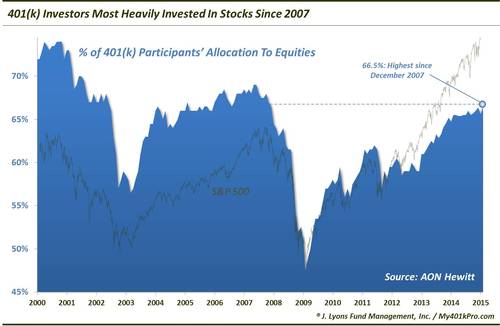
The reason for this is illustrated so well from a recent bit of news this quarter from retirement-industry consulting-giant, Aon/Hewitt.

The company, years ago, created an index that tracks the stock-to-bond ratio of the millions of 401(k) participants covered by the plans it consults.

The interesting news this quarter is that the index shows that the stock allocation percentage among 401(k) participants is now—just now—getting back to its pre-2008 levels.

The discouraging thing about this tidbit is that 401(k) participants have, in whole or in part, missed the huge market recovery that commenced in March 2009, when the Dow bottomed at 6,443. Only in the past couple of years, with the Dow north of 15,000, are 401(k) participants getting back to having the majority of their assets in stocks.

This is hardly the exception to the rule. Looking at the last fifteen years of the Aon/Hewitt 401(k) participant index, we see a long history of buying high and selling low.

Note the two low points of 401(k) participants’ stock allocation – the bottom of the bear markets in 2003 and 2009. Instead of rebalancing their portfolios back to their long-term allocations – which would have had the effect of buying stocks at lower share prices – 401(k) participants sold stocks.

Ideally, a graph like this should look perfectly flat. A participant’s 401(k) allocation between stocks and bonds should remain constant over time, changing only when he or she moves into new phases of life that require a more conservative long-term strategy.

This is a perfect example of the dangers of managing one’s own money. As we have said many times, the first job of a good wealth manager is to be the barrier between the client’s money and their emotions, because it is in the times of emotional extremes – both up and down – that the real damage is done to a portfolio.

Sadly, we need only look at the zig-zag disaster that is the Aon/Hewitt 401(k) index to know that this is true.


Past performance does not guarantee future results. All investments include risk and have the potential for loss as well as gain.

Data sources for returns and standard statistical data are provided by the sources referenced and are based on data obtained from recognized statistical services or other sources we believe to be reliable. However, some or all information has not been verified prior to the analysis, and we do not make any representations as to its accuracy or completeness. Any analysis nonfactual in nature constitutes only current opinions, which are subject to change. Benchmarks or indices are included for information  purposes  only  to  reflect  the  current  market  environment;  no  index  is  a directly  tradable  investment.  There  may  be  instances  when  consultant  opinions  regarding any fundamental or quantitative analysis do not agree.

The  commentary  contained  herein  has  been  compiled  by  W.  Reid  Culp,  III  from  sources  provided  by  TAGStone  Capital,  Capital  Directions,  DFA,  Vanguard,  Morningstar,  as  well  as  commentary  provided  by  Mr.  Culp,  personally,  and  information  independently  obtained  by  Mr.  Culp.  The  pronoun  “we,”  as  used  herein,  references collectively the sources noted above.

TAGStone Capital, Inc. provides this update to convey general information about market conditions and not for the purpose of providing investment advice. Investment in any of the companies or sectors mentioned herein may not be appropriate for you. You should consult your advisor from TAGStone for investment advice regarding your own situation.