

In recent months, two themes have dominated investor conversations: AI investing and the renewed belief in gold as a timeless safe haven. Both trends have resurfaced at the exact moments when crowd enthusiasm is high. That’s why we’re taking a closer look at the gold safety myths and the rising excitement around artificial intelligence as we enter the final stretch of 2025.
This quarter’s article, “When the Crowd Rushes In: AI, Gold, and the Enduring Rules of Investing,” explores how investor psychology fuels these cycles — why AI exposure is already embedded in well-diversified portfolios, why gold does not meet the definition of a productive long-term asset, and why the oldest rules of disciplined investing remain the most reliable. When the noise grows louder, the crowd is usually running in the wrong direction.
When the Crowd Rushes In: AI, Gold, and the Enduring Rules of Investing
Technology evolves, headlines shift, and markets transform, but the forces that drive investor behavior—fear, greed, impatience, and hope—remain constant. Human nature doesn’t change.
This quarter, the conversation around artificial intelligence dominated the financial world. A handful of highly profitable firms have transformed how the world works, creating real value and cash flow. But surrounding them is a mix of speculative enterprises and questions about how quickly some have built out their data centers. In that way, AI isn’t just a technology story—it’s a behavioral one.
The Long-Term Power of Stocks in a World Obsessed with AI
Every market cycle needs a story, and AI has become the story of this one. History suggests we’ve been here before. Railroads, radio, the internet—each revolutionized the world, but investors didn’t profit equally. Few doubt that AI will be a game changer, but no one knows for sure which companies will benefit more in the long run.
When enthusiasm runs high, patience and discipline can start to feel outdated. The excitement of innovation often invites speculation. As Warren Buffett observed, “What the wise man does in the beginning, the fool does in the end.”
We forget that companies—not stories—compound wealth. Some of the greatest long-term performers of the last century were unglamorous businesses quietly earning profits year after year while the world’s attention drifted elsewhere.
Why Diversification—and Discipline—Still Drive Real Wealth
While the world debates how to invest in AI, the truth is simpler—and far more reassuring: you already own it.
Through a well-diversified portfolio of global businesses, you indirectly own hundreds of companies applying AI to become faster, smarter, and more efficient. From NVIDIA to Honeywell to Caterpillar, innovation isn’t a sidecar—it’s embedded in the very fabric of modern enterprise. And for long-term investors, the surest way to benefit from AI’s growth isn’t speculation—it’s ownership.
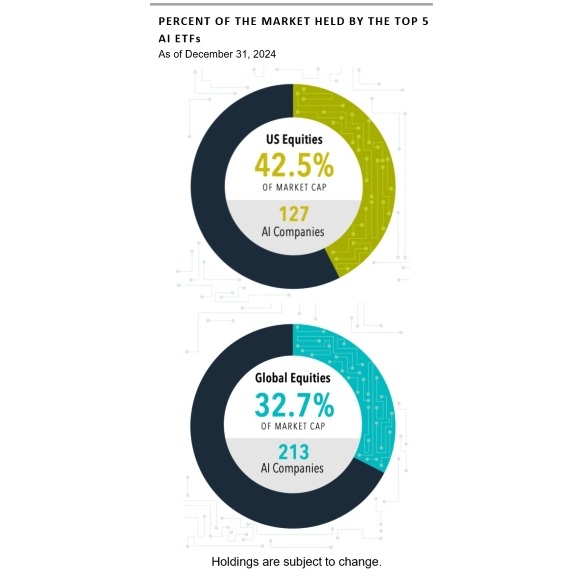
The rise of AI has inspired new funds and flashy tickers, but according to Dimensional’s research, the five biggest AI-focused ETFs (AIQ, BOTZ, QTUM, ARKQ, and ROBT) already include more than 40% of the entire U.S. stock market. Owning a broad, diversified portfolio already gives you exposure to hundreds of companies using or developing AI—you don’t need to chase new “AI-only” funds to benefit from the trend.
This underscores a comforting truth: investors don’t have to predict which company becomes the next great innovator. A globally diversified portfolio naturally captures the growth of AI and other technologies as they spread across industries. The winners of tomorrow are often found in places few expect today, from industrials and logistics to healthcare and finance.
Gold: The Eternal Mirage of Safety

This year, gold joined AI in the headlines, breaking record highs and rekindling old fascinations. Like AI, it stirs emotion. But unlike AI, gold doesn’t innovate, hire, or compound. It simply sits there.
In his 2012 Fortune essay “Why Stocks Beat Gold and Bonds,” Warren Buffett imagined all the world’s gold—then about 170,000 metric tons—as a 68-foot cube that could fit neatly inside Yankee Stadium’s infield. At that time, the cube was worth about $9.6 trillion. For the same amount, Buffett wrote, one could buy every acre of U.S. farmland (roughly 400 million acres producing $200 billion a year in crops), sixteen ExxonMobils (each earning over $40 billion a year), and still have $1 trillion in “walking-around money.” The gold cube, by contrast, would just sit there. Buffett quipped, “You can fondle the cube, but it will not respond.”
Fast-forward to 2025. At $4,000 per ounce, that same cube—now around 212,000 metric tons—is worth roughly $27 trillion. That’s enough to buy every acre of U.S. farmland plus Apple, Microsoft, and Amazon combined—with change left over. Yet the cube still produces nothing.
If you own an ounce of gold for 100 years, you will still own one ounce at the end. That is its essence—its appeal and its limitation alike. It’s permanent, inert, and emotionally reassuring but financially unproductive.

History bears this out. In 1980, gold traded at $800 per ounce and has increased about 5× to $4,000 per ounce today. Contrast that with $800 invested in large-cap US stocks in 1980, which, with dividends reinvested, would have grown to $141,000, yielding a 176× total return and a 12% annual compound return.
Melt Ups, Behavior, and the “Greater Fool”
The desire to own what everyone else is buying runs deep. Whether it’s AI stocks or gold coins, the underlying impulse is the same—a search for safety, belonging, and certainty.
Behavioral finance has documented this truth repeatedly: investors feel the pain of losses roughly twice as strongly as the pleasure of gains. That imbalance helps explain why people sell in downturns and buy in melt-ups.
The risk during melt-up phases is that you feel you’re missing out on gains others seem to be making, and you buy assets mainly because they have gone up in price without understanding their intrinsic value or fundamentals. Too often, this leads to buying after assets become overpriced—just before a correction or long drawdown.
The Quiet Power of Productive Assets
At TAGStone, our philosophy has never changed: own productive assets, maintain balance, and let time work for you. Stocks represent real businesses creating real goods and services. Bonds represent loans to those businesses and governments. Both have a purpose. Together, they form a resilient system designed to protect purchasing power and generate growth through compounding.
Your edge as a long-term investor isn’t superior information or faster trades. It’s temperament—the ability to stay rational when the crowd isn’t. Buffett has often said that “the stock market is designed to transfer money from the active to the patient.” Every quarter offers fresh evidence that he’s right.
The excitement around AI and gold tells us more about investor psychology than about either asset. If the melt-up phase turns into a market blow-off, watch out for the urge to buy into truly speculative assets. Just as Microsoft, Apple, and Amazon rose from the ashes of the dot-com bust, this cycle will produce some truly profitable companies, but mixed in with those gems will be some busts. As mentioned above, your globally diversified portfolio already owns AI and will continue—quietly and tax‑efficiently—to accumulate the winners as they emerge.
A Final Word
Every cycle arrives with a new rationale for why “this time is different.” Yet history always rhymes. The same impulses that drove investors toward dot-coms in 1999, or toward gold in 1980, are at work again. Technology will continue to reshape our world, and gold will continue to glitter when anxiety rises. But the enduring truths of investing remain the same: productive assets compound, human nature overreacts, and patience wins.
In a world chasing the next big thing, the real opportunity lies in doing what few others can—staying calm, disciplined, and focused on what endures. The crowd will always rush in. The patient investor simply lets them pass.
Past performance does not guarantee future results. All investments include risk and have the potential for loss as well as gain.
Data sources for returns and standard statistical data are provided by the sources referenced and are based on data obtained from recognized statistical services or other sources we believe to be reliable. However, some or all information has not been verified prior to the analysis, and we do not make any representations as to its accuracy or completeness. Any analysis nonfactual in nature constitutes only current opinions, which are subject to change. Benchmarks or indices are included for information purposes only to reflect the current market environment; no index is a directly tradable investment. There may be instances when consultant opinions regarding any fundamental or quantitative analysis do not agree.
The commentary contained herein has been compiled by W. Reid Culp, III from sources provided by TAGStone Capital, as well as commentary provided by Mr. Culp, personally, and information independently obtained by Mr. Culp. The pronoun “we,” as used herein, references collectively the sources noted above.
TAGStone Capital, Inc. provides this update to convey general information about market conditions and not for the purpose of providing investment advice. Investment in any of the companies or sectors mentioned herein may not be appropriate for you. You should consult your advisor from TAGStone or others for investment advice regarding your own situation.
