

Timeless Wisdom from Warren Buffett

At a Glance

  • Buffett’s career reinforces a timeless lesson: successful investing depends more on discipline and temperament than predicting markets.
  • Market bubbles and downturns are inevitable. Long-term investors who resist fear and hype are better positioned to stay on course.
  • Time is the most powerful force in investing. Starting early and staying invested are key to building wealth across generations.

On December 31, 2025, legendary investor Warren Buffett retired as CEO of Berkshire Hathaway at age 95. Berkshire Hathaway compounded shareholder capital at approximately 20% annually for over six decades—one of the most remarkable investment records ever achieved. Buffett’s retirement marks the end of one of the greatest investing careers. Yet, the principles that guided him remain just as relevant today for families aiming to grow and preserve wealth across generations.

Sixty years ago, Buffett took over Berkshire Hathaway, a struggling New England textile company, and turned it into a powerhouse that operates everything from insurance firms to household names like Duracell batteries. Along the way, he earned the nickname “Oracle of Omaha” for carefully selecting undervalued companies and holding onto them for the long term—a strategy that has worked well for him. Today, he is the sixth richest person in the world, with a net worth around $154 billion.

Throughout his career, Buffett has shared some of his success secrets, often through his well-known—and often humorous—shareholder letters. Below are some of our favorite insights that continue to guide investors of all kinds.

Navigating Fear and Greed

Investing is carried out by people, and people are emotional. As a result, human behavior heavily influences market movements. Fear and greed can cause investors to jump in and out of the market en masse, often to their own detriment.

Buffett illustrated this idea well when he wrote:

“Occasional outbreaks of those two super-contagious diseases, fear and greed, will forever occur in the investment community…We never try to anticipate the arrival or departure of either disease. Our goal is more modest: we simply attempt to be fearful when others are greedy and to be greedy only when others are fearful.”

Buffett warns us to be cautious when investors are “greedy,” as this can push prices to levels that are not sustainable—sometimes leading to a crash.

Conversely, when investors are fearful, they might miss out on significant opportunities to buy bargains during a market downturn.

The key to successful investing is managing emotional impulses. Buffett has said: “The most important quality for an investor is temperament, not intellect. You need a temperament that neither derives great pleasure from being with the crowd or against the crowd.”

This is one of the reasons we build portfolios that can weather market volatility before it happens, rather than reacting emotionally once it does.

Bursting Bubbles

During market bubbles—such as the Dot Com bubble of the late 1990s or the housing boom leading up to the 2008 crash—prices rise rapidly beyond their true value, fueled by speculation and hype.

Even investors who were initially skeptical may give in to the temptation to join in, entering the market when prices are excessively inflated and due for a crash.

Buffett summarizes this well when he said:

Bubbles blown large enough inevitably pop. And then the old proverb is confirmed once again: ‘What the wise man does in the beginning, the fool does in the end.’”

Buffett has also said, “It’s only when the tide goes out that you learn who’s been swimming naked.” Indeed, when a booming market turns south, you don’t want to be the one who has taken on too much risk and ends up scrambling to get out.

Playing the Long Game

You’ve probably heard us say that investing is a long-term venture. This is also one of Buffett’s core principles: “Our favorite holding period is forever.” He has additionally stated, “Only buy something that you’d be perfectly happy to hold if the market shut down for 10 years.”

The evidence is clear: over the long term, the stock market has traditionally moved higher. For families building multi-generational wealth, committing to long-term holding periods is the best way to navigate the inevitable short-term market fluctuations that accompany the overall upward trend.

Starting Early

 Unsurprisingly, there's a lot of overlap between aphorisms about planting trees and investing. Both require planning and an early start to ensure you reap their benefits.

As Buffett once said:

“Someone’s sitting in the shade today because someone planted a tree a long time ago.”

Similarly, a well-crafted investment plan needs attention and nurturing, supported by disciplined approaches like dollar-cost averaging—the practice of regularly investing a fixed amount regardless of market conditions—and periodic rebalancing. But mostly, wealth and trees simply need time to grow.

In this sense, Buffett’s “secrets” of success have never truly been secrets. They are just simple truths that all investors can follow: stay calm when others panic, resist the hype, invest regularly, and think long term. Even with these principles, it’s not always easy to stay the course—especially when markets become turbulent.

These principles continue to guide how we think about managing wealth for the families we serve. Please reach out when you have questions about the markets and how they affect your long-term plan.


Past performance does not guarantee future results. All investments include risk and have the potential for loss as well as gain.

Data sources for returns and standard statistical data are provided by the sources referenced and are based on data obtained from recognized statistical services or other sources we believe to be reliable. However, some or all information has not been verified prior to the analysis, and we do not make any representations as to its accuracy or completeness. Any analysis nonfactual in nature constitutes only current opinions, which are subject to change. Benchmarks or indices are included for information purposes  only  to  reflect  the  current  market  environment;  no  index  is  a directly  tradable investment.  There  may  be  instances  when  consultant  opinions  regarding any fundamental or quantitative analysis do not agree.

The  commentary  contained  herein  has  been  compiled  by  W.  Reid Culp,  III  from  sources  provided  by  TAGStone  Capital,  as well  as  commentary  provided  by  Mr.  Culp,  personally,  and  information independently  obtained  by  Mr.  Culp.  The  pronoun  “we,”  as  used  herein,  references collectively the sources noted above.

TAGStone Capital, Inc. provides this update to convey general information about market conditions and not for the purpose of providing investment advice. Investment in any of the companies or sectors mentioned herein may not be appropriate for you. You should consult your advisor from TAGStone or others for investment advice regarding your own situation.


At a Glance

  • The greatest investment risk for affluent investors is often behavioral, not financial — emotional reactions, overconfidence, and narrative-driven decisions can quietly erode long-term outcomes.

  • Improving decision quality matters more as wealth grows — avoiding large, irreversible mistakes is far more impactful than trying to optimize short-term returns.

  • Disciplined frameworks and outside perspective help protect long-term plans — especially during periods of volatility, transition, or heightened uncertainty.

As the old year draws to a close and a new one begins, millions of Americans will once again make New Year’s resolutions. For many, these resolutions focus on health or wealth, and when it comes to financial resolutions, the usual suspects tend to surface: spend less, save more, and pay down debt.

For affluent investors and families, however, financial outcomes are rarely limited by access to capital. Instead, the greatest risk often comes from behavioral missteps made during periods of uncertainty, transition, or emotional intensity—when the consequences of a single decision can compound over years or even decades.

These traditional resolutions are, of course, worthwhile. But this year, consider adding another set of commitments that go beyond budgeting and focus on the behavioral tendencies that shape—and sometimes sabotage—financial decision‑making. The following behavioral finance resolutions are designed to help you make sound, deliberate financial choices in the year ahead.

Dial Down Your Emotions

Emotions often move faster than logic. They can override rational thinking and push investors toward decisions that may feel reassuring in the moment but undermine long‑term financial health. This year, resolve to take emotion out of investing as much as possible.

In our work with high‑net‑worth families, we most often see emotional decision‑making surface during market drawdowns, liquidity events, or periods of concentrated exposure—when the dollar impact of reacting impulsively can be material.

Separating feelings from financial choices can help sidestep several potentially damaging behavioral biases, including loss aversion. Loss aversion is the tendency to fear losses more than we value gains. It can lead to panic selling during volatile markets, locking in losses, and missing subsequent recoveries. Conversely, it may cause investors to hold onto losing positions far too long, unwilling to realize losses even when doing so would be financially prudent.

At higher levels of wealth, these decisions are rarely about timing the market perfectly. They are about avoiding large, irreversible allocation errors at precisely the wrong moment.

Emotional investing can also fuel home bias—the instinct to stick with what feels familiar. This might mean favoring a particular company, industry, or even domestic markets at the expense of broader diversification. Instead, it helps to view investments not as reflections of personal preference or identity, but simply as tools designed to support long‑term objectives.

Get a Second Opinion

From time to time, even disciplined investors may feel tempted to alter a long‑term financial plan. Before acting, it often pays to seek a second opinion. Thoughtful counsel can help rein in two common behavioral biases: overconfidence and confirmation bias.

This tendency is especially common among successful professionals and business owners who are accustomed to making confident decisions in their operating lives and may unintentionally carry that same decisiveness into complex investment choices.

Overconfidence bias reflects the belief that one can predict outcomes with greater accuracy than is realistically possible. Left unchecked, it may lead to behaviors such as market timing or taking oversized positions in perceived “can’t‑miss” opportunities.

Confirmation bias, meanwhile, is the tendency to seek out information that supports existing beliefs while discounting evidence to the contrary. This can create an echo chamber, making it difficult to objectively assess whether an investment decision is truly sound.

A thoughtful second opinion is less about outsourcing judgment and more about improving decision quality by introducing disciplined friction before capital is reallocated. Seeking outside perspective helps pressure‑test ideas, surface overlooked assumptions, and move forward with greater clarity.

Keep an Open Mind

Financial markets evolve constantly. Rigid thinking increases the risk of missing emerging opportunities or holding onto investments that no longer serve a portfolio’s goals.

We often encounter this dynamic after long periods of market leadership by a particular asset class, strategy, or geography—when familiarity begins to masquerade as prudence.

Maintaining an open mind allows investors to reevaluate long‑held assumptions and adapt as new information emerges. This helps counter status quo bias, the impulse to stick with the current situation simply because it is familiar. It also mitigates anchoring—the tendency to rely too heavily on the first piece of information encountered. For example, investors may anchor to the original purchase price of a stock and use it as a reference point for future decisions, rather than focusing on more relevant fundamentals.

As portfolios grow more complex, flexibility becomes an asset in its own right.

Look at Things From Different Angles

How information is presented can dramatically influence how it is interpreted. The same facts may feel very different depending on framing, a reality well understood by marketers, pundits, and headline writers seeking attention.

Before accepting any narrative as true—particularly in finance—it is worth examining the issue from multiple angles. Seeking out contrarian viewpoints, reframing the story, and asking what the opposite case might look like can all be valuable exercises.

This approach helps guard against framing bias, where decisions are influenced more by presentation than by substance. For instance, a fund described as having a “5% chance of loss” may feel riskier than one described as having a “95% chance of success,” even though both statements convey the same probability.

For investors managing significant wealth, reframing decisions in probabilistic terms rather than narrative ones can materially reduce emotional influence and support greater long‑term consistency.

Stepping back, asking questions, and challenging initial interpretations often leads to more balanced and resilient decision‑making.

Start a Media Diet

Today’s information ecosystem is noisy, fragmented, and optimized to capture attention. Headlines are designed to provoke emotion, while social media algorithms tend to amplify the most sensational viewpoints.

For affluent investors, persistent exposure to market narratives can encourage unnecessary portfolio activity—even when a well‑constructed long‑term plan is already in place.

A deliberate media diet can help restore balance. This does not require complete disengagement, but it may involve limiting exposure to unvetted commentary and prioritizing sources with strong editorial standards. A healthy media diet also means resisting the urge to check markets constantly; long‑term strategies do not require play‑by‑play updates.

A more intentional media environment helps curb availability bias, where highly publicized events distort perceptions of risk. It also mitigates recency bias, which leads investors to overweight recent market movements. By reducing exposure to trending narratives, it further limits the pull of herding—the impulse to follow the crowd.

Reducing noise is not about disengaging from markets; it is about preserving decision‑making bandwidth for moments that truly matter.

Why Behavioral Discipline Matters More as Wealth Grows

As wealth increases, financial complexity tends to rise alongside it. Additional assets, entities, and stakeholders introduce more variables—and more emotionally charged decisions. In this environment, behavioral discipline becomes increasingly central to long‑term success. The cost of small mistakes grows, while the marginal benefit of impulsive action declines.

Many of the most impactful financial decisions are not urgent, but they are consequential. Having a clear framework—and a thoughtful sounding board—can help ensure those decisions are made deliberately rather than reactively.

If you ever have questions or would like to talk through how these principles apply to your own situation, we would be happy to have a conversation.


Past performance does not guarantee future results. All investments include risk and have the potential for loss as well as gain.

Data sources for returns and standard statistical data are provided by the sources referenced and are based on data obtained from recognized statistical services or other sources we believe to be reliable. However, some or all information has not been verified prior to the analysis, and we do not make any representations as to its accuracy or completeness. Any analysis nonfactual in nature constitutes only current opinions, which are subject to change. Benchmarks or indices are included for information purposes  only  to  reflect  the  current  market  environment;  no  index  is  a directly  tradable investment.  There  may  be  instances  when  consultant  opinions  regarding any fundamental or quantitative analysis do not agree.

The  commentary  contained  herein  has  been  compiled  by  W.  Reid Culp,  III  from  sources  provided  by  TAGStone  Capital,  as well  as  commentary  provided  by  Mr.  Culp,  personally,  and  information independently  obtained  by  Mr.  Culp.  The  pronoun  “we,”  as  used  herein,  references collectively the sources noted above.

TAGStone Capital, Inc. provides this update to convey general information about market conditions and not for the purpose of providing investment advice. Investment in any of the companies or sectors mentioned herein may not be appropriate for you. You should consult your advisor from TAGStone or others for investment advice regarding your own situation.


In recent months, two themes have dominated investor conversations: AI investing and the renewed belief in gold as a timeless safe haven. Both trends have resurfaced at the exact moments when crowd enthusiasm is high. That’s why we’re taking a closer look at the gold safety myths and the rising excitement around artificial intelligence as we enter the final stretch of 2025.

This quarter’s article, “When the Crowd Rushes In: AI, Gold, and the Enduring Rules of Investing,” explores how investor psychology fuels these cycles — why AI exposure is already embedded in well-diversified portfolios, why gold does not meet the definition of a productive long-term asset, and why the oldest rules of disciplined investing remain the most reliable. When the noise grows louder, the crowd is usually running in the wrong direction.

When the Crowd Rushes In: AI, Gold, and the Enduring Rules of Investing

Technology evolves, headlines shift, and markets transform, but the forces that drive investor behavior—fear, greed, impatience, and hope—remain constant. Human nature doesn’t change.

This quarter, the conversation around artificial intelligence dominated the financial world. A handful of highly profitable firms have transformed how the world works, creating real value and cash flow. But surrounding them is a mix of speculative enterprises and questions about how quickly some have built out their data centers. In that way, AI isn’t just a technology story—it’s a behavioral one.

The Long-Term Power of Stocks in a World Obsessed with AI

Every market cycle needs a story, and AI has become the story of this one. History suggests we’ve been here before. Railroads, radio, the internet—each revolutionized the world, but investors didn’t profit equally. Few doubt that AI will be a game changer, but no one knows for sure which companies will benefit more in the long run.

When enthusiasm runs high, patience and discipline can start to feel outdated. The excitement of innovation often invites speculation. As Warren Buffett observed, “What the wise man does in the beginning, the fool does in the end.”

We forget that companies—not stories—compound wealth. Some of the greatest long-term performers of the last century were unglamorous businesses quietly earning profits year after year while the world’s attention drifted elsewhere.

Why Diversification—and Discipline—Still Drive Real Wealth

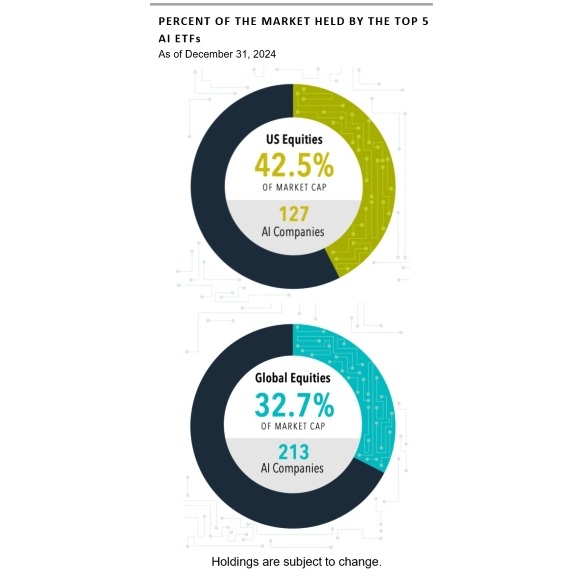
Percent of Market Held by Top 5 AI ETFs

While the world debates how to invest in AI, the truth is simpler—and far more reassuring: you already own it.

Through a well-diversified portfolio of global businesses, you indirectly own hundreds of companies applying AI to become faster, smarter, and more efficient. From NVIDIA to Honeywell to Caterpillar, innovation isn’t a sidecar—it’s embedded in the very fabric of modern enterprise. And for long-term investors, the surest way to benefit from AI’s growth isn’t speculation—it’s ownership.

The rise of AI has inspired new funds and flashy tickers, but according to Dimensional’s research, the five biggest AI-focused ETFs (AIQ, BOTZ, QTUM, ARKQ, and ROBT) already include more than 40% of the entire U.S. stock market. Owning a broad, diversified portfolio already gives you exposure to hundreds of companies using or developing AI—you don’t need to chase new “AI-only” funds to benefit from the trend.

This underscores a comforting truth: investors don’t have to predict which company becomes the next great innovator. A globally diversified portfolio naturally captures the growth of AI and other technologies as they spread across industries. The winners of tomorrow are often found in places few expect today, from industrials and logistics to healthcare and finance.

Gold: The Eternal Mirage of Safety

This year, gold joined AI in the headlines, breaking record highs and rekindling old fascinations. Like AI, it stirs emotion. But unlike AI, gold doesn’t innovate, hire, or compound. It simply sits there.

In his 2012 Fortune essay “Why Stocks Beat Gold and Bonds,” Warren Buffett imagined all the world’s gold—then about 170,000 metric tons—as a 68-foot cube that could fit neatly inside Yankee Stadium’s infield. At that time, the cube was worth about $9.6 trillion. For the same amount, Buffett wrote, one could buy every acre of U.S. farmland (roughly 400 million acres producing $200 billion a year in crops), sixteen ExxonMobils (each earning over $40 billion a year), and still have $1 trillion in “walking-around money.” The gold cube, by contrast, would just sit there. Buffett quipped, “You can fondle the cube, but it will not respond.”

Fast-forward to 2025. At $4,000 per ounce, that same cube—now around 212,000 metric tons—is worth roughly $27 trillion. That’s enough to buy every acre of U.S. farmland plus Apple, Microsoft, and Amazon combined—with change left over. Yet the cube still produces nothing.

If you own an ounce of gold for 100 years, you will still own one ounce at the end. That is its essence—its appeal and its limitation alike. It’s permanent, inert, and emotionally reassuring but financially unproductive.

History bears this out. In 1980, gold traded at $800 per ounce and has increased about 5× to $4,000 per ounce today. Contrast that with $800 invested in large-cap US stocks in 1980, which, with dividends reinvested, would have grown to $141,000, yielding a 176× total return and a 12% annual compound return.

Melt Ups, Behavior, and the “Greater Fool”

The desire to own what everyone else is buying runs deep. Whether it’s AI stocks or gold coins, the underlying impulse is the same—a search for safety, belonging, and certainty.

Behavioral finance has documented this truth repeatedly: investors feel the pain of losses roughly twice as strongly as the pleasure of gains. That imbalance helps explain why people sell in downturns and buy in melt-ups.

The risk during melt-up phases is that you feel you’re missing out on gains others seem to be making, and you buy assets mainly because they have gone up in price without understanding their intrinsic value or fundamentals. Too often, this leads to buying after assets become overpriced—just before a correction or long drawdown.

The Quiet Power of Productive Assets

At TAGStone, our philosophy has never changed: own productive assets, maintain balance, and let time work for you. Stocks represent real businesses creating real goods and services. Bonds represent loans to those businesses and governments. Both have a purpose. Together, they form a resilient system designed to protect purchasing power and generate growth through compounding.

Your edge as a long-term investor isn’t superior information or faster trades. It’s temperament—the ability to stay rational when the crowd isn’t. Buffett has often said that “the stock market is designed to transfer money from the active to the patient.” Every quarter offers fresh evidence that he’s right.

The excitement around AI and gold tells us more about investor psychology than about either asset. If the melt-up phase turns into a market blow-off, watch out for the urge to buy into truly speculative assets. Just as Microsoft, Apple, and Amazon rose from the ashes of the dot-com bust, this cycle will produce some truly profitable companies, but mixed in with those gems will be some busts. As mentioned above, your globally diversified portfolio already owns AI and will continue—quietly and tax‑efficiently—to accumulate the winners as they emerge.

A Final Word

Every cycle arrives with a new rationale for why “this time is different.” Yet history always rhymes. The same impulses that drove investors toward dot-coms in 1999, or toward gold in 1980, are at work again. Technology will continue to reshape our world, and gold will continue to glitter when anxiety rises. But the enduring truths of investing remain the same: productive assets compound, human nature overreacts, and patience wins.

In a world chasing the next big thing, the real opportunity lies in doing what few others can—staying calm, disciplined, and focused on what endures. The crowd will always rush in. The patient investor simply lets them pass.


Past performance does not guarantee future results. All investments include risk and have the potential for loss as well as gain.

Data sources for returns and standard statistical data are provided by the sources referenced and are based on data obtained from recognized statistical services or other sources we believe to be reliable. However, some or all information has not been verified prior to the analysis, and we do not make any representations as to its accuracy or completeness. Any analysis nonfactual in nature constitutes only current opinions, which are subject to change. Benchmarks or indices are included for information purposes  only  to  reflect  the  current  market  environment;  no  index  is  a directly  tradable investment.  There  may  be  instances  when  consultant  opinions  regarding any fundamental or quantitative analysis do not agree.

The  commentary  contained  herein  has  been  compiled  by  W.  Reid Culp,  III  from  sources  provided  by  TAGStone  Capital,  as well  as  commentary  provided  by  Mr.  Culp,  personally,  and  information independently  obtained  by  Mr.  Culp.  The  pronoun  “we,”  as  used  herein,  references collectively the sources noted above.

TAGStone Capital, Inc. provides this update to convey general information about market conditions and not for the purpose of providing investment advice. Investment in any of the companies or sectors mentioned herein may not be appropriate for you. You should consult your advisor from TAGStone or others for investment advice regarding your own situation.