

Evidence-Based Investing in Brief

How do you invest your money over the long term? If you’ve read much of our work, you’ve probably noticed we embrace evidence-based investing. But what does that mean?

What Is Evidence-Based Investing?
Evidence-based investors build and manage their portfolios based on what is expected to enhance future returns and dampen related risk exposures, according to the most robust evidence available. This also means sticking with your evidence-based strategy once it’s in place for the long term, regardless of market uncertainties and self-doubts you’ll experience along the way.


Evidence-Based Investing, Applied

Do you (1) hope investors can come out ahead by finding mispriced stocks, bonds, and other trading opportunities; and by dodging in and out of rising and falling markets?

Or do you (2) accept all investors' investment insights create relatively efficient market pricing that is too random to predict consistently?

An overwhelming body of evidence suggests investors should skip the first approach and adopt the second assumption. This has been the case since at least 1952 when Harry Markowitz published Portfolio Selection in The Journal of Finance. In their book, “In Pursuit of the Perfect Portfolio,” Professors Andrew Lo and Stephen Foerster describe:

“While it’s commonplace now to think of creating a diversified portfolio rather than investing in a collection of securities that each on their own look promising, that wasn’t always the case. It was Harry Markowitz who provided a theory and a process to the notion of diversification. He helped to create the industry of portfolio management.”

Markowitz’s work became known as Modern Portfolio Theory (MPT), academics and practitioners have been building on it ever since. His initial work and others’ subsequent findings strongly support ignoring all the near-term noise and taking a long-view approach. This involves creating a unified investment portfolio and focusing on more manageable details, such as:

  • Tilting toward or away from entire asset classes to tailor your risks and expected returns
  • Minimizing avoidable risks by diversifying globally
  • Reducing unnecessary costs
  • Controlling your own damaging behavioral biases

How Do You Decide Which Evidence to Heed?

At first blush, nearly every investment recommendation may seem “evidence-based.” After all, few forecasters peer into actual crystal balls to make their predictions. And no market guru would admit their stock-picking track record has been no better than a dart-throwing monkey’s (even though that’s usually the case).

Instead, stock-picking and market-timing enthusiasts tend to argue their cases by turning to articulate analyses, clever charts, and convincing investment briefs. They use these props to explain the late-breaking news and recommend what you should supposedly be doing about it.

There’s nothing wrong with facts and figures. The critical difference is how we apply them as evidence-based investors. As financial author Larry Swedroe describes it:

“In investing, there is a major difference between information and knowledge. Information is a fact, data, or an opinion held by someone. Knowledge, on the other hand, is information that is of value.”

— Larry Swedroe, ETF.com

No matter how compelling a call to action may be, we discourage frequent reactions to the never-ending onslaught of information. Before acting, we must ask ourselves:

Which current information might add substantive value to our decisions by refuting or adding to the existing evidence? Or is this “new” information just more of the same old noise, already factored into our evidence-based investment strategy?

The Evidence-Based Silver Bullet: Academic Rigor

Because there is much more noise than valuable knowledge available to investors, the basic recipe for evidence-based investing begins with academic rigor. It should always be a key ingredient in separating likely fact from probable fiction:

  • It requires robust data sets that are large enough, representative enough, and free from other typical data analysis flaws.
  • Authors should be impartial, lacking incentives to “torture” the data to make a point.
  • Other studies should be able to reproduce the same findings under different scenarios, suggesting the results are more likely to persist upon discovery.
  • The data, method, and results should be published in reputable, peer-reviewed forums where informed colleagues can comment on the findings.
  • Enough time must pass to make all the above possible.


After that, we also must be able to apply the results in the real world. In other words, even if a theoretical strategy is expected to enhance your returns, it must do so after considering all practical costs and portfolio-wide tradeoffs involved. For example, sometimes, one source of expected returns may offset another, even more significant, source. Occasionally, we can combine them for even stronger results; other times, it’s best to favor one over the other.

Evidence-Based Investing Factors

So, which factors appear to explain different outcomes among different portfolios best? What combinations of these factors are expected to create the strongest, risk-adjusted portfolios? What explains each factor’s return-generating powers, and can we expect those powers to persist?

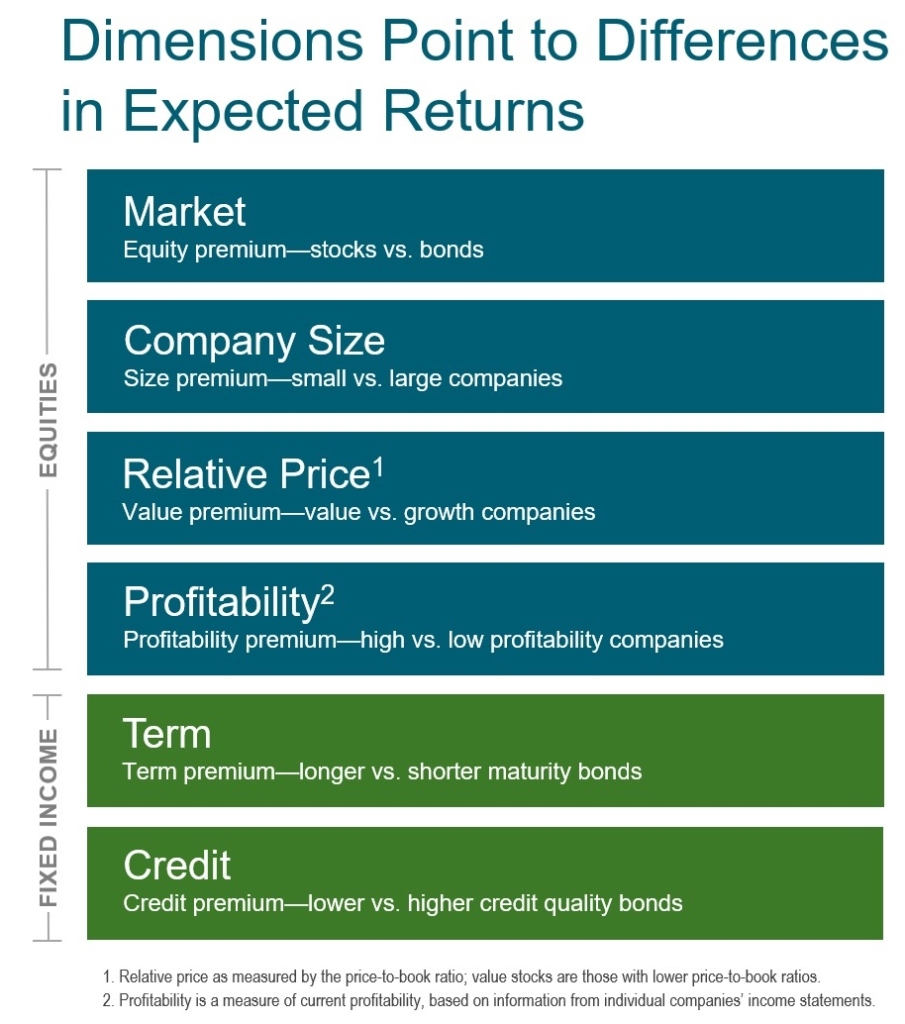
Academic research has found several factors that point to differences in expected returns. Analytical scholars have thoroughly documented the differences in expected returns generated by the various factors in markets around the world and across different time periods.

Based on the academic answers to the practical questions posed above, we typically mix and match the following factors in our evidence-based portfolios, varying specific exposures based on each investor’s personal goals and risk tolerances:

  • The Market: Stocks (equities) vs. bonds (fixed income)
  • Company Size: Small vs. large company stocks
  • Relative Price: Value vs. growth company stocks
  • Profitability: High-profit vs. low-profit company stocks
  • Term: Long-term vs. short-term bonds (based on maturity date)
  • Credit: “Safer” vs. “riskier” bonds (based on credit quality)
 

What’s in An Evidence-Based Name?

Finally, it’s worth mentioning that others may refer to the same or similar approaches by various names, such as factor-based, asset-based, or science-based investing. These terms are relatively interchangeable, but there’s a reason we’ve chosen evidence-based as our preferred expression. Heeding sound reason and rational evidence is at the heart of what we do. Thus, we believe that it should be reflected in what we call it.

How would your best evidence-based investment portfolio look? It depends on your personal financial goals and your willingness, ability, and need to take on investment risks in pursuit of those goals. That’s where we come in to structure the right mix for you and help you navigate through the ever-distracting informational overload. To learn more, let’s talk!


Past performance does not guarantee future results. All investments include risk and have the potential for loss as well as gain.

Data sources for returns and standard statistical data are provided by the sources referenced and are based on data obtained from recognized statistical services or other sources we believe to be reliable. However, some or all information has not been verified prior to the analysis, and we do not make any representations as to its accuracy or completeness. Any analysis nonfactual in nature constitutes only current opinions, which are subject to change. Benchmarks or indices are included for information purposes  only  to  reflect  the  current  market  environment;  no  index  is  a directly  tradable investment.  There  may  be  instances  when  consultant  opinions  regarding any fundamental or quantitative analysis do not agree.

The  commentary  contained  herein  has  been  compiled  by  W.  Reid Culp,  III  from  sources  provided  by  TAGStone  Capital,  as well  as  commentary  provided  by  Mr.  Culp,  personally,  and  information independently  obtained  by  Mr.  Culp.  The  pronoun  “we,”  as  used  herein,  references collectively the sources noted above.

TAGStone Capital, Inc. provides this update to convey general information about market conditions and not for the purpose of providing investment advice. Investment in any of the companies or sectors mentioned herein may not be appropriate for you. You should consult your advisor from TAGStone or others for investment advice regarding your own situation.

Weaving Tax Planning Into the Fabric of Your Life

Managing for tax-efficient investing is just one way we help families reduce their lifetime taxes. We also help integrate all of the tools from the previous posts into your broad financial interests. Following are just a few life events that can pose potential tax-planning challenges and opportunities:

Events Tax-Planning Possibilities
You get a job. Enroll in and max out contributions to any tax-sheltered accounts such as a 401(k) or Health Savings Account (HSA).
You buy a home and start a family. Score extra tax deductions; use the savings to pay down college debt, contribute to an IRA, or establish a 529 plan account for your child.

You receive an executive compensation package.


Work with a financial planner or tax professional to determine how and when to exercise your options for maximum tax efficiency.
You receive a financial windfall, such as an inheritance. Allocate a significant portion of any new wealth to tax-sheltered retirement accounts. (Ditto for those executive compensation benefits.) Seek to offset taxable gains with any available losses.
You sell your first home and buy a bigger one. Keep an eye on any gains from the sale. With some caveats, the Taxpayer Relief Act of 1997 says you can exclude up to $500,000 of the gain as a joint filer ($250,000 for single filers).
You transition to a new, lower-paying career, take a leave of absence from work or incur a financial setback. If your annual income is taking a temporary hit, consider leveraging the lower tax bracket to reduce your lifetime taxes by harvesting capital gains or performing a Roth conversion.
You buy a business. Engage a tax-wise professional financial planner to facilitate the acquisition.
You send your 18-year-old to college. Time to tap their tax-sheltered 529 plan. Adjusting your income levels through practical tax planning may also help secure a more favorable student aid package.
Your 18-year-old decides against college after all. Consider redirecting their 529 savings to a different beneficiary or withdrawing the assets and paying tax + 10% penalty (which may not be so bad if the assets have grown tax-free for years).
You sell a business. Ideally, your succession plan has been in place for years before positioning your business for a tax-efficient transfer. Targeted insurance may also help cover taxes without placing an undue burden on you, your partners, or successors.
You retire. Plan how and when to take Social Security and any pension benefits available, as well as how and when to tap your taxable and tax-sheltered accounts. Once again, during low-income years, you may also plan to engage in some tax-gain harvesting to reduce your overall tax basis.
You downsize to a smaller home. Again, mind your capital gains, as described above. If you’ve lived in the home for at least two years, you should be able to exclude gains of up to $250,000/$500,000 per single/joint filer.
You decide to work part-time in retirement. Good for you! But do some tax projections to determine how the extra income may impact your tax rates, benefits, and bottom line.
You are charitably inclined. Even with the 2017 Tax Cuts and Jobs Act tax code changes, tax breaks remain for the philanthropically minded. For example, you can use well-timed giving to offset unusual taxable events, such as setting up a Donor-Advised Fund in the same year you exercise a taxable stock option, sell a highly appreciated asset, or incur other significant deductible expenses.
You incur high healthcare costs. Speaking of deductible expenses, you may be able to bundle high-priced elective procedures into a single year to take more than your standard deduction that year (especially if you pair it with bundled charitable giving). Or, if you’re not seeking a higher deduction, this may be an excellent time to tap tax-free assets in your HSA.
You prepare to pass your wealth on to heirs or other beneficiaries. The taxable implications of estate planning are extensive and best addressed with a financial planner and estate planning attorney. Especially since the 2020 SECURE Act eliminated the stretch IRA, you may also want to assess whether you’d rather prioritize reducing your own lifetime taxes or those of your heirs and proceed accordingly.

The Big Picture

The above scenarios represent only a handful of the tax-planning events you might encounter throughout your life. Whether you’re building, preserving, or spending your wealth, tax planning remains integral every step of the way. Each financial move you make can and should be leveraged for tax efficiencies as described. Better still, a seasoned tax-planning professional can combine these parts into an integrated whole as you pursue lifelong tax efficiency.

Put another way, ideal tax planning integrates seamlessly with all your greater financial plans. This can get complicated—like a juggling act, in which we must keep an eye on each item as well as the big-picture results.

Could you use an experienced hand to keep your total wealth at play? We’re here to help!


Past performance does not guarantee future results. All investments include risk and have the potential for loss as well as gain.

Data sources for returns and standard statistical data are provided by the sources referenced and are based on data obtained from recognized statistical services or other sources we believe to be reliable. However, some or all information has not been verified prior to the analysis, and we do not make any representations as to its accuracy or completeness. Any analysis nonfactual in nature constitutes only current opinions, which are subject to change. Benchmarks or indices are included for information purposes  only  to  reflect  the  current  market  environment;  no  index  is  a directly  tradable investment.  There  may  be  instances  when  consultant  opinions  regarding any fundamental or quantitative analysis do not agree.

The  commentary  contained  herein  has  been  compiled  by  W.  Reid Culp,  III  from  sources  provided  by  TAGStone  Capital,  as well  as  commentary  provided  by  Mr.  Culp,  personally,  and  information independently  obtained  by  Mr.  Culp.  The  pronoun  “we,”  as  used  herein,  references collectively the sources noted above.

TAGStone Capital, Inc. provides this update to convey general information about market conditions and not for the purpose of providing investment advice. Investment in any of the companies or sectors mentioned herein may not be appropriate for you. You should consult your advisor from TAGStone or others for investment advice regarding your own situation.


Leading with Tax-Wise Investing

It’s one thing to have the tools just described. It’s another to make the best use of them.

We view effective tax planning as a way to reduce your lifetime tax bill—or beyond if you’re preparing for a tax-efficient wealth transfer to your heirs.

In short, tax planning is an ongoing campaign staged on multiple fronts. One of the most powerful ways to ward off excess taxes is to be tax-wise about your investing. And yet, few investors take full advantage of the many opportunities available at every level. These levels include how you manage your investment accounts, select individual holdings, and buy and sell those holdings along the way.

As you manage your investment accounts …

Are you doing all you can to build, manage, and spend down your taxable and tax-sheltered accounts for maximum lifetime tax efficiency? 

  • Building: Are you maxing out your contributions to appropriate tax-sheltered accounts? The more money you hold in various tax-sheltered structures, the more flexibility you’ll have to delete or at least defer taxes otherwise inherent in building capital wealth. 
  • Managing: Are you deliberate about your asset location, dividing your various assets among your taxable vs. tax-sheltered accounts for overall tax efficiency? Ideally, you use your tax-sheltered accounts to hold your least tax-efficient holdings while locating your most tax-efficient holdings in your taxable accounts.
  • Spending: When the time comes to spend your wealth, have you planned for how to tap your taxable, tax-deferred, and tax-free accounts? There is no universal answer to this critical query. Cash-flow planning calls for deep familiarity with the particular accounts and assets you’ve got, the particular rules involved in deploying each, and your particular spending goals. All that while keeping a close eye on any changes that may alter your plans.

As you select individual holdings …

Are you being deliberate about selecting tax-efficient vehicles? Even when different funds share identical investment objectives, some may be considerably better than others at managing their underlying holdings. Seek out fund managers with solid tax-management practices, including: 

  • Patient Investing: Many fund managers try to “beat” the market by actively picking individual stocks or timing their market exposures. We suggest using managers who instead patiently participate in their target market’s long-term expected growth. A patient investment strategy not only makes overall sense, but it’s also typically more tax-efficient as it involves less, potentially taxable action. 
  • Tax-Managed Investing: Some fund managers offer funds that are deliberately tilted toward tax-friendly trading techniques for your taxable accounts. Such methods include avoiding short-term (more costly) capital gains and aggressively realizing capital losses to offset gains.

As you buy and sell holdings …

Like the fund managers you choose, are you also being patient and deliberate about your trading? Do you avoid excessive trading and short-term capital gains (currently taxed at higher rates)? Are you guided by a personalized investment plan? Bottom line, the fewer trades required to stick to your investment plan, the better off you’re likely to be when taxes come due.

Harvesting Capital Gains and Losses

An investment plan also facilitates your or your advisor’s ability to identify and make the best use of tax-loss and tax-gain harvesting opportunities when appropriate.

Tax-loss harvesting typically involves:

  1. Selling all or part of a position in your portfolio when it is worth less than you paid for it.
  2. Reinvesting the proceeds in a similar (not “substantially identical”) position.
  3. Optionally returning the proceeds to the original position after at least 31 days have passed (to avoid the IRS “wash-sale rule”).

Without significantly altering your portfolio mix, you can then use any realized capital losses to offset current or future capital gains.

It’s worth noting, tax-loss harvesting typically lowers a harvested holding’s cost basis. So contrary to popular belief, you’re usually postponing rather than eliminating taxable gains. Why bother? More time gives you more control over when, how, or even if you’ll realize the gains. For example, you could wait until tax rates are more favorable or reduce embedded gains over time through gifting, charitable giving, or estate planning tactics.

Tax-gain harvesting involves selling appreciated holdings to generate taxable income deliberately. Why would you do that? Remember, your goal is to minimize lifetime taxes paid. So, especially once you’re tapping your portfolio in retirement, you may intentionally generate taxable income in years when your tax rates are more favorable. You’re sacrificing a tax return battle or two, hoping to win the tax-planning “war.”


Past performance does not guarantee future results. All investments include risk and have the potential for loss as well as gain.

Data sources for returns and standard statistical data are provided by the sources referenced and are based on data obtained from recognized statistical services or other sources we believe to be reliable. However, some or all information has not been verified prior to the analysis, and we do not make any representations as to its accuracy or completeness. Any analysis nonfactual in nature constitutes only current opinions, which are subject to change. Benchmarks or indices are included for information purposes  only  to  reflect  the  current  market  environment;  no  index  is  a directly  tradable investment.  There  may  be  instances  when  consultant  opinions  regarding any fundamental or quantitative analysis do not agree.

The  commentary  contained  herein  has  been  compiled  by  W.  Reid Culp,  III  from  sources  provided  by  TAGStone  Capital,  as well  as  commentary  provided  by  Mr.  Culp,  personally,  and  information independently  obtained  by  Mr.  Culp.  The  pronoun  “we,”  as  used  herein,  references collectively the sources noted above.

TAGStone Capital, Inc. provides this update to convey general information about market conditions and not for the purpose of providing investment advice. Investment in any of the companies or sectors mentioned herein may not be appropriate for you. You should consult your advisor from TAGStone or others for investment advice regarding your own situation.


The Tools of the Tax-Planning Trade

Whether you’re saving, investing, spending, bequeathing or receiving wealth, there’s scarcely a move you can make without considering how taxes might influence the outcome. But how do we plan when we cannot know?

The particulars may evolve, but it seems there are always an array of tax breaks to encourage us to save toward our major life goals. However, it remains up to us to make the best use of these “tools of the trade.” Today, let’s cover what those tools are, as well as how to integrate them into your investing and financial planning.

Saving for Retirement

The good and bad news about saving for retirement is how many tax-favored savings accounts exist for this purpose. There are a number of employer-sponsored plans, like the 401(k), 403(b), and SIMPLE IRA. There also are individual IRAs you establish outside of work. For both, there are traditional and Roth structures available.

In any of these types of retirement accounts, your dollars have the opportunity to grow tax-free while they remain in the account. This helps your retirement assets accumulate more quickly than if they were subject to the ongoing taxes that taxable accounts incur annually along the way (such as realized capital gains, dividends, or interest paid).

Tax treatments for different types of retirement accounts can differ dramatically from there. You can make pre-tax contributions for some, but withdrawals are taxed at ordinary income rates in the year you take them. For others, you contribute after-tax dollars, but withdrawals are tax-free—again, with some caveats. Each account type has varying rules about when, how, and how much money you can contribute and withdraw without incurring burdensome penalties or unexpected taxes owed.

Saving for Healthcare Costs (HSAs)

The Healthcare Savings Account (HSA) offers a rare, triple-tax-free treatment to help families save for current or future healthcare costs. You contribute to your HSA with pre-tax dollars, HSA investments then grow tax-free, and you can spend the money tax-free on qualified healthcare costs. That’s a good deal. Plus, you can invest unspent HSA dollars and still spend them tax-free years later, as long as it’s on qualified healthcare costs. But again, there are some catches. Most notably, HSAs are only available as a complement to a high-deductible healthcare plan to help cover higher expected out-of-pocket expenses.

Employers also can offer Flexible Spending Accounts (FSAs), into which you and they can add pre-tax dollars to spend on out-of-pocket healthcare costs. However, FSA funds must be spent relatively quickly, so investment and tax-saving opportunities are limited.

Saving for Education (529 Plans)

529 plans are among the most familiar tools for catching a tax break on educational costs. You fund your 529 plan(s) with after-tax dollars. Those dollars can then grow tax-free, and the beneficiary (usually, your kids or grandkids) can spend them tax-free on qualified educational expenses.

Saving for Giving (DAFs)

The Donor-Advised Fund (DAF) is among the simplest but still relatively effective tools for pursuing tax breaks for your charitable giving. Instead of giving smaller amounts annually, you can establish a DAF and fund it with a larger, lump-sum contribution in one year. You then recommend DAF distributions to your charities of choice over future years. Combined with other deductibles, you might be able to take a sizeable tax write-off the year you contribute to your DAF—beyond the currently higher standard deduction. There also are many other resources for higher-end planned giving. For these, you’d typically collaborate with a team of tax, legal, and financial professionals to pursue your tax-efficient philanthropic interests.

Saving for Emergencies

There are also various tax-friendly incentives to facilitate general “rainy day fund” saving and offset crisis spending. These include state, federal, and municipal savings vehicles, along with targeted tax credits and tax deductions.

Saving for Heirs

Last but not least, a bounty of trusts, insurance policies and other estate planning structures help families leverage existing tax breaks to tax-efficiently transfer their wealth to future generations.

With ongoing negotiations over the tax treatment on inherited assets, families may well need to revisit their estate planning in the years ahead. Come what may, there’s always an array of best practices we can aim at reducing your lifetime tax bills by leveraging available investment tools to maximum effect. We’ll cover those next.


Past performance does not guarantee future results. All investments include risk and have the potential for loss as well as gain.

Data sources for returns and standard statistical data are provided by the sources referenced and are based on data obtained from recognized statistical services or other sources we believe to be reliable. However, some or all information has not been verified prior to the analysis, and we do not make any representations as to its accuracy or completeness. Any analysis nonfactual in nature constitutes only current opinions, which are subject to change. Benchmarks or indices are included for information purposes  only  to  reflect  the  current  market  environment;  no  index  is  a directly  tradable investment.  There  may  be  instances  when  consultant  opinions  regarding any fundamental or quantitative analysis do not agree.

The  commentary  contained  herein  has  been  compiled  by  W.  Reid Culp,  III  from  sources  provided  by  TAGStone  Capital,  as well  as  commentary  provided  by  Mr.  Culp,  personally,  and  information independently  obtained  by  Mr.  Culp.  The  pronoun  “we,”  as  used  herein,  references collectively the sources noted above.

TAGStone Capital, Inc. provides this update to convey general information about market conditions and not for the purpose of providing investment advice. Investment in any of the companies or sectors mentioned herein may not be appropriate for you. You should consult your advisor from TAGStone or others for investment advice regarding your own situation.


Part 2: What We Can Do About It

What if inflation does get out of hand and stays that way for a while? Depending on who you heed, the possibility ranges from unexpected, to possible, to a near certainty. For investors, it’s essential to take a step back and look at the big picture before acting on breaking news. As usual, prudent planning is preferred over rash reaction.

In Part 1, we covered the recent uptick in inflation and what to make of it in a historical context.

The Federal Reserve has been suggesting rising rates should wane. We hope they’re right. But we also know the future is still uncharted. Many outcomes are possible, and none is inevitable. This means diversified investing continues to be our preferred strategy for being prepared for whatever the future holds.

Explaining Inflation Doesn’t Predict It

If higher inflation does materialize, will it arrive sooner or later? Will it be moderate or severe? Brief or prolonged? Forecasts vary widely because we often forget the academic evidence that informs us: Even excellent explanatory models rarely serve as effective predictive models.

For example, scientists can readily explain why earthquakes occur, but our ability to forecast times, locations, and severities is shaky at best. The same can be said for inflation. We can explain its intricacies, but accurate predictions remain as elusive as ever. There are simply too many variables: COVID-19, climate change, political action, the Federal Reserve, other central banks, consumer banks/lenders, consumers/borrowers, employers/producers, employees, investors (“the market”), sectors (such as real estate, commodities, and gold), the U.S. dollar, global currency, cryptocurrency, financial economists, the media, the world, time … and YOU.

Each of these could throw off any predictions about the time, degree, and extent of future inflation. Besides, as an investor, you only have control over the last two: You and your time in the market. What will you do with your time?

Because We Don’t Know, We Diversify

It makes sense: Some investments seem to shine when inflation is on the rise. Others deliver their best results at other times. Because we never know precisely when inflation might rise or fall, we believe an investor’s best course is to diversify into and across various investments that tend to respond differently under different economic conditions.

For example, until earlier this year, value stocks had been underperforming growth stocks for quite a while. You may have been tempted to give up on them during their decade-plus lull (during which inflation remained relatively low). And yet, when inflation is high or rising, value stocks have tended to outperform growth, as has been the case year-to-date.

Another example is Treasury Inflation-Protected Securities (TIPS) versus “regular” Treasury bonds. Neither is ideal across all conditions. But if you hold some of both, they can complement each other over time and across various inflationary rates.

In short, if you’ve not yet done so, it’s time to define your financial goals and build your personalized, globally diversified portfolio to complement them. If you’ve already completed these steps, you should be positioned as best you can to manage higher inflation over time, which means your best next step is most likely to stay put. This brings us to our next point.

Stocks vs. Inflation: It’s a Knock-Out

Provided time is on your side; the stock market is your greatest ally against inflation.

Over time, global stock market returns have dramatically outpaced inflation. For example, as reported by Dimensional Fund Advisors, $1 invested in the S&P 500 Index from 1926–2017 would have grown to $533 worth of purchasing power by the end of 2017, after adjusting for inflation. Had that same dollar been held in “safe” one-month Treasury bills over the same period, it would have grown to an inflation-adjusted $1.51.

That T-bill growth is more than nothing and welcome relief during bear markets. That’s one reason we advocate for keeping an appropriate mix between wealth-accumulating and wealth-preserving investments. But what’s “appropriate”? It depends on your personal financial goals. The point is, as long as you have enough time to let your stock allocations ride through the downturns, you can expect them to remain well ahead of inflation simply by being in the market.

It’s important to add; no fancy market-timing moves are required or desired when participating in the stock market. Moving holdings in and out at seemingly opportune times is more likely to detract from the vital, inflation-busting role stocks play in your portfolio. In the words of Nobel Laureate Eugene Fama: “The nature of the stock market is you get a lot of the return in very short periods of time. So, you basically don’t want to be out for short periods of time, where you may actually be missing a good part of the return.”

What If You’re Retired?

So far, so good. But not all your wealth is for spending in the far-off future. What if you depend on your portfolio to supply a reliable income stream here and now? If you’re retired (or you have other upcoming spending needs such as college costs), eventual expected returns offer little comfort when current inflation is eating into today’s spending needs.

Again, you can’t control inflation, but you can manage your own best interests in the face of it.

Engage in Retirement Planning:

Along with a globally diversified investment portfolio, you’ll want a solid strategy for investing for and spending in retirement. For example:

  • Asset Location: Among your taxable and tax-favored accounts, where will you locate your stocks, bonds, and other assets for tax-efficiently accumulating and spending your wealth?
  • Spending: How much can you safely withdraw from your investment portfolio to supplement your other income sources (such as Social Security)?
  • Withdrawal Strategies: Which accounts will you tap first and then next?

Revisit Your Retirement Planning:

Especially when inflation is on the rise, it’s worth revisiting your existing investment and withdrawal strategies. What are the odds your current portfolio won’t deliver as hoped for? We typically use odds-based “Monte Carlo” simulations to ask this critical question and guide any sensible adjustments the answers may warrant.

Don’t Panic:

What if inflation is taking too big a bite? A common misstep is to abandon your carefully structured investments in pursuit of short-cuts. For example, it may be tempting to unload high-quality bonds and pile into gold, dividend stocks, or other ways to seek spendable income. Unfortunately, we believe such substitutes detract from effective retirement planning. The goal is to optimize expected returns and manage unnecessary risks in pursuit of a dependable outcome. As such, we suggest avoiding dubious detours along the way.

Have a “Plan B”:

What can you do instead? In “Your Complete Guide to a Successful and Secure Retirement,” authors Larry Swedroe and Kevin Grogan describe how to prepare an honest “Plan B.” If a worst-case scenario is realized, you’re then better positioned to make any tough decisions required to recover your footing. The authors explain:

“Plan B should list the actions to be taken if financial assets drop below a predetermined level. Those actions might include remaining in, or returning to, the workforce, reducing current spending, reducing the financial goal, and selling a home or moving to a location with a lower cost of living.”

These sorts of belt-tightening choices are never fun. But you should prefer them over chasing unsubstantiated sources of return that could dig your risk hole even deeper.

How Can We Help?

While anyone can embrace the strategies we just described, implementing them can be easier said than done. Plus, there are more steps you can take to defend against inflation, near and far. Examples include engaging in more tax planning, annuitizing a portion of your wealth, tapping lines of credit like a second mortgage, optimizing Social Security benefits, and more.

We hope you’ll contact us today to discuss these and other retirement planning actions worth exploring. Making the most of your possibilities is always a smart move, whether or not inflation is here to stay.


Past performance does not guarantee future results. All investments include risk and have the potential for loss as well as gain.

Data sources for returns and standard statistical data are provided by the sources referenced and are based on data obtained from recognized statistical services or other sources we believe to be reliable. However, some or all information has not been verified prior to the analysis, and we do not make any representations as to its accuracy or completeness. Any analysis nonfactual in nature constitutes only current opinions, which are subject to change. Benchmarks or indices are included for information purposes  only  to  reflect  the  current  market  environment;  no  index  is  a directly  tradable investment.  There  may  be  instances  when  consultant  opinions  regarding any fundamental or quantitative analysis do not agree.

The  commentary  contained  herein  has  been  compiled  by  W.  Reid Culp,  III  from  sources  provided  by  TAGStone  Capital,  as well  as  commentary  provided  by  Mr.  Culp,  personally,  and  information independently  obtained  by  Mr.  Culp.  The  pronoun  “we,”  as  used  herein,  references collectively the sources noted above.

TAGStone Capital, Inc. provides this update to convey general information about market conditions and not for the purpose of providing investment advice. Investment in any of the companies or sectors mentioned herein may not be appropriate for you. You should consult your advisor from TAGStone or others for investment advice regarding your own situation.


Part 1: What We Know

Has the specter of inflation got you spooked? Recent headlines are filled with sightings. In this two-part series, let’s take a closer look at what to make of all the commentary and what you can do about it as an investor. First and foremost, we caution against succumbing to fear or panic in the face of inflation. As usual, careful planning is still your best guide.

What Is Inflation?

Inflation is the rate at which a currency loses its purchasing power as prices increase over time. So, say a cup of coffee cost $1.00 twenty years ago. If the average annual inflation rate had been 2% between then and now, that same pour would now cost you $1.49. Various goods, services, and sectors often experience different inflation rates at separate times, but general inflation is usually calculated based on the Consumer Price Index (CPI) or a similar broad pricing index.

Recent headlines have been reporting a noticeable uptick in inflation. Superlatives like “best” and “worst” grab the most attention, so outlets have been abuzz with reports of how a 5% May consumer pricing surge was “the biggest 12-month inflation spike since 2008.”

Putting Inflation in Proper Context

Before you read too much into these recently rising numbers, it’s worth remembering their context. We’re comparing May 2021 to May 2020, when we were still deep into what The Wall Street Journal called a “screwy” pandemic economy. The WSJ explained, “If a company takes a hit in one year and then gets back to normal the next, it can look like its profits are soaring when in fact they are just getting back on track.”

Zooming out even further, the Federal Reserve’s 10 Year Break-Even Inflation Rate is one common estimate of the market’s expected average annual inflation rate for the next ten years. As of mid-June, that rate stood at 2.3%. That’s up from the lower 1.2% rate expectation from mid-June 2020, but it’s still not eye-popping.

This leads to another crucial point: Not all inflation is bad. A bit of inflation goes hand in hand with economic growth and reasonable interest rates for lenders and borrowers alike. A 2% annual inflation rate is typically considered a desirable norm for greasing the wheels of commerce without destroying the working relationship between currencies and costs.

What if Inflation Runs Amok?

And yet, while inflation has its purposes, it concerns many savers and investors if it goes on a rampage. When it does, uncertainty has spiked as well, wreaking havoc on commerce, the economy, job markets, real estate, and financial markets. (Deflation—the opposite of inflation—can also upset the economy if prices drop too precipitously.)

Investors who were around in the 1970s may remember the last time the U.S. experienced red-hot inflation and what it felt like when it spiked to a feverish 14.8% in 1980.

The New York Times described it as an era when “prices of real assets like houses, gold and oil soared. Average mortgage rates exceeded 17 percent, and interest rates on bank certificates of deposit approached 12 percent. It was hard to know whether a 5 percent pay raise was cause for celebration or despair.” While 12% CD rates may sound great, when interest and inflation rates are comparable, the real returns from even high-interest CDs essentially become a wash.

After the 1980 high-water mark, the Volcker-era Federal Reserve tamped inflation back down. So younger investors have heard of, but never experienced such steep inflation for such an extended time. Despite occasional alarm bells, inflation has mostly continued to hit the snooze button for decades. At least so far.

In Part 2, we’ll cover why forecasts remain as fuzzy as ever and how investors can best prepare for whatever may happen next.


Past performance does not guarantee future results. All investments include risk and have the potential for loss as well as gain.

Data sources for returns and standard statistical data are provided by the sources referenced and are based on data obtained from recognized statistical services or other sources we believe to be reliable. However, some or all information has not been verified prior to the analysis, and we do not make any representations as to its accuracy or completeness. Any analysis nonfactual in nature constitutes only current opinions, which are subject to change. Benchmarks or indices are included for information purposes  only  to  reflect  the  current  market  environment;  no  index  is  a directly  tradable investment.  There  may  be  instances  when  consultant  opinions  regarding any fundamental or quantitative analysis do not agree.

The  commentary  contained  herein  has  been  compiled  by  W.  Reid Culp,  III  from  sources  provided  by  TAGStone  Capital,  as well  as  commentary  provided  by  Mr.  Culp,  personally,  and  information independently  obtained  by  Mr.  Culp.  The  pronoun  “we,”  as  used  herein,  references collectively the sources noted above.

TAGStone Capital, Inc. provides this update to convey general information about market conditions and not for the purpose of providing investment advice. Investment in any of the companies or sectors mentioned herein may not be appropriate for you. You should consult your advisor from TAGStone or others for investment advice regarding your own situation.


All Things in Moderation

The First Quarter 2021 is off to a good start. Most people are eager to return to normal with travel, dining, and shopping this summer. Financial markets are no different.

We see similar pent-up yearnings in an array of analysts’ second-quarter financial forecasts. Check out these second-quarter forecast headlines:

A second coming? That last one shows the extent of optimism found in the current narrative diffusing through the global financial markets.

Now, think back to April 2020. A year ago, fear was tempting many investors to pile into safe-harbor holdings, even as most markets staged robust and surprising recoveries.

This year, we’re seeing many of those same investors chasing all kinds of hot holdings, as they now embrace an absence of fear. Consider these quarter-end headlines:

In its quarter-end recap, The Wall Street Journal summarized similar sentiments as follows:

“If there is a unifying theme to all this, it is that investors big and small showed no fear of risk-taking to start 2021. In fact, they embraced it.”

Sometimes, an extra shot of bravery is just what the doctor ordered. “No fear,” you might tell yourself as you enter your first marathon, launch a new business, or hug your college-bound child farewell. In investing, however, no fear can be as damaging as an excess dose of fear.

There are numerous proverbial sayings in every culture along the lines of “all things in moderation.” While taking things in moderation is often true in life, it’s true in investing too.

Moderation is vital to keep in mind given the investment environment we encounter today. The efficient market hypothesis proposes that asset prices are set by rational investors, whose primary concerns are systematic risk and expected returns. However, asset prices may now, more than normal, be fueled by investors’ desire to be part of a social movement, hopes to strike it rich, or plain old envy. While there are many reasons to own a stock, it helps to keep an accurate assessment of the potential risks and rewards involved in any given approach.

Staying the Course

We hope favorable markets continue, but investing is not a game of chance. If you were a client of ours last April, we were honored to be by your side to remind you that your disciplined investment strategy was in place. Your globally diversified portfolio is structured to help you maximize expected returns while minimizing the risks involved.

At the time, we encouraged you to stick to the plan. Today, we encourage you to do the same. Markets may run hot or cold. The scenery may be different. But your financial journey is still the same.


Past performance does not guarantee future results. All investments include risk and have the potential for loss as well as gain.

Data sources for returns and standard statistical data are provided by the sources referenced and are based on data obtained from recognized statistical services or other sources we believe to be reliable. However, some or all information has not been verified prior to the analysis, and we do not make any representations as to its accuracy or completeness. Any analysis nonfactual in nature constitutes only current opinions, which are subject to change. Benchmarks or indices are included for information purposes  only  to  reflect  the  current  market  environment;  no  index  is  a directly  tradable investment.  There  may  be  instances  when  consultant  opinions  regarding any fundamental or quantitative analysis do not agree.

The  commentary  contained  herein  has  been  compiled  by  W.  Reid Culp,  III  from  sources  provided  by  TAGStone  Capital,  as well  as  commentary  provided  by  Mr.  Culp,  personally,  and  information independently  obtained  by  Mr.  Culp.  The  pronoun  “we,”  as  used  herein,  references collectively the sources noted above.

TAGStone Capital, Inc. provides this update to convey general information about market conditions and not for the purpose of providing investment advice. Investment in any of the companies or sectors mentioned herein may not be appropriate for you. You should consult your advisor from TAGStone or others for investment advice regarding your own situation.


The Power of Small, Quiet Acts


Today, let’s pause and take a moment to reflect on the wondrous powers of small, quiet acts.

Pandemic aside, there have been plenty of great, big year-end reviews and year-ahead teasers, clamoring for your current attention. Describing 2020 as an “everything rally,” One Wall Street Journal columnist wrote, “Investors ended one of Wall Street’s wildest years on record by piling into everything from bitcoin to emerging markets, raising expectations that a powerful economic comeback will fuel even more gains.”

The excitement is not entirely unfounded. Last March, when the S&P 500 dove into a bear market almost overnight, it was hard to expect anything but a long, grim year ahead. Of course, in hindsight, we now know markets rebounded nearly as quickly as they plummeted. They ultimately delivered strong annual returns across most domestic and international asset classes. The fourth quarter was no exception to this tale of remarkable resilience.

Why would markets soar during still-sour economies? We could describe any number of rational reasons near-term market pricing mechanisms are continuing to operate exactly as expected … which is to say, according to anyone’s next lucky guess.

Unfortunately, that hasn’t stopped hordes of hopefuls from trying to score big on the latest tricks of the trade. From the adventures of Robinhood, to record-busting bitcoins, to blank-check SPACs, rising markets often tempt the uninitiated with enticing offers to earn “easy” money.

Whether the temptation is to abandon a free-falling market (like the one we encountered less than a year ago) or chase after winning streaks, an investor’s best move remains the same. Concentrated bets on hot hands generate wildly unpredictable outcomes, making them far closer to being dicey gambles than sturdy investments.

Trust, instead, in the durability of your carefully planned investment portfolio. Focus instead on small, quiet acts. That’s what we’re here for, for example, to:

  • Remind you that your globally diversified portfolio already holds an appropriate allocation to Tesla stock (which may be a lot, a little, or none, depending on your financial goals).
  • Guide you in rebalancing your portfolio if recent gains have overexposed it to market risks.
  • Help you interpret the 5,600 pages of the newly passed Consolidated Appropriations Act, 2021, so you can manage your next financial moves accordingly.
  • Assess potential ramifications of the Biden tax proposals, and advise you on any additional defensive tax planning that may be warranted for you in the years ahead.
  • Remain by your side as you encounter whatever other challenges and opportunities 2021 has in store for you and your family.

These aren’t loud acts you’ll read about in the paper, but they’re the stuff financial dreams are made of. How else can we help you achieve your personal financial goals, come what may in the headline news? Tell us more. We’re here to hear you. In the meantime, we wish you and yours a healthy and prosperous 2021.


Past performance does not guarantee future results. All investments include risk and have the potential for loss as well as gain.

Data sources for returns and standard statistical data are provided by the sources referenced and are based on data obtained from recognized statistical services or other sources we believe to be reliable. However, some or all information has not been verified prior to the analysis, and we do not make any representations as to its accuracy or completeness. Any analysis nonfactual in nature constitutes only current opinions, which are subject to change. Benchmarks or indices are included for information purposes  only  to  reflect  the  current  market  environment;  no  index  is  a directly  tradable investment.  There  may  be  instances  when  consultant  opinions  regarding any fundamental or quantitative analysis do not agree.

The  commentary  contained  herein  has  been  compiled  by  W.  Reid Culp,  III  from  sources  provided  by  TAGStone  Capital,  as well  as  commentary  provided  by  Mr.  Culp,  personally,  and  information independently  obtained  by  Mr.  Culp.  The  pronoun  “we,”  as  used  herein,  references collectively the sources noted above.

TAGStone Capital, Inc. provides this update to convey general information about market conditions and not for the purpose of providing investment advice. Investment in any of the companies or sectors mentioned herein may not be appropriate for you. You should consult your advisor from TAGStone for investment advice regarding your own situation.


Six Financial Best Practices for Year-End 2020

Has 2020 left you feeling like the fabled Sisyphus, forever pushing a boulder up a steep hill? Thankfully, with multiple COVID-19 vaccines in the works, there’s hope the load will lighten in the new year, fast approaching. While we prepare for a fresh start, here are six financial best practices for year-end 2020 and beyond, none of which require any heavy lifting.

  1. Give as you’re able, get a little back. What the 2017 Tax Cuts and Jobs Act (TCJA) took from charitable giving, this year’s CARES Act partially gave back – at least for 2020.
      • A $300 “Gift”: Under the TCJA, it became much harder to realize itemized tax deductions beyond what the increased standard deductions already allow. But this year, the CARES Act lets you donate up to $300 to a qualified charity, and deduct it “above the line.” In other words, even if you’re taking a standard deduction, you can give a little extra, and receive an extra tax break back, without having to itemize your deductions.
      • Giving Large: If you are itemizing deductions, the CARES Act also temporarily suspends the usual “60% of your AGI” limit on qualified cash contributions. The exception does NOT apply to Donor Advised Fund contributions and has a few other restrictions. But if you’ve already been thinking about making a large donation to a favorite charity, 2020 might be an especially good year to do so – for all concerned.
  2. Revisit life’s risks. As the pandemic reminded us, life is full of surprises. That’s why it’s imperative to build wealth and protect it against the inevitable unexpected. Is your current coverage still well-aligned with your potentially altered lifestyle? Perhaps you’re driving less, with lower coverage requirements. Or new health or career risks now warrant stronger disability insurance. Might it be time to consider long-term care or umbrella coverage? Bottom line, there’s no time like the present to prepare for your future greatest risks.
  3. Leverage lower tax rates. While it’s never a sure bet, Federal income tax rates seem more likely to rise than fall over the next little while. Even before this year’s massive relief spending, the TCJA’s reduced individual income tax rates were set to expire after 2025, reverting to their prior, higher levels. As such, it may be worth deliberately incurring some lower-rate income taxes today, if they’ll probably spare you higher taxes on the same income later on. As a prime example, consider converting or contributing to a Roth IRA. You’ll pay income taxes today on the conversions or contributions, but then the assets grow tax-free, and remain tax-free when you withdraw them in retirement.
  4. Harness an HSA. Health Savings Accounts (HSAs) are another often-overlooked tax-planning tool. Instead of paying for a traditional lower-deductible/higher-cost healthcare plan, some may benefit from a higher-deductible/lower-cost plan plus an HSA. If a high-deductible plan/HSA combination is available to you, it may be worth considering – especially if a career change, early retirement, or some other triggering event has altered your healthcare coverage. HSA assets receive generous “triple tax-free” treatment – going in pre-tax, growing tax-free, and coming out tax-free (if spent on qualified medical expenses).
  5. Read a great book (or few). As we swing into a winter of continued social distancing, you may have more time than usual to curl up with a good book – whether in print or on your favorite device. Why not add a best financial book or two to the list? As good timing would have it, The Wall Street Journal personal financial columnist Jason Zweig recently shared an excellent “short shelf” list of his top picks. As Zweig reflects, “they all will help teach you how to think more clearly, which is the only way to become a wiser and better investor.” Looking for our own favorites? Let us know.
  6. Live a little more. Really, it’s always a best practice to ensure your financial priorities are driven by your life’s greatest goals – not the other way around. Perhaps our greatest purpose as your wealth advisor is to assist you and your family in achieving a satisfying work-life balance, come what may. What does this balance look like for you? Speaking of good reads, in his new book, “The Coffeehouse Investor’s Ground Rules,” Bill Schultheis offers his take:

“When you … have everything you need materially, how do you honor that part of your DNA that will forever yearn for more? It seems to me that the challenge is to turn this pursuit of ‘more’ away from material consumption and toward a ‘more’ that fosters more family, more community, more connections, more art, more creativity, more beauty.”

What more can we say about how to make best use of your time and money, this and every year? As always, we’re here to help you implement any or all of these best practices. In the meantime, we wish you and yours a happy and healthy 2021.


Past performance does not guarantee future results. All investments include risk and have the potential for loss as well as gain.

Data sources for returns and standard statistical data are provided by the sources referenced and are based on data obtained from recognized statistical services or other sources we believe to be reliable. However, some or all information has not been verified prior to the analysis, and we do not make any representations as to its accuracy or completeness. Any analysis nonfactual in nature constitutes only current opinions, which are subject to change. Benchmarks or indices are included for information purposes  only  to  reflect  the  current  market  environment;  no  index  is  a directly  tradable investment.  There  may  be  instances  when  consultant  opinions  regarding any fundamental or quantitative analysis do not agree.

The  commentary  contained  herein  has  been  compiled  by  W.  Reid Culp,  III  from  sources  provided  by  TAGStone  Capital,  as well  as  commentary  provided  by  Mr.  Culp,  personally,  and  information independently  obtained  by  Mr.  Culp.  The  pronoun  “we,”  as  used  herein,  references collectively the sources noted above.

TAGStone Capital, Inc. provides this update to convey general information about market conditions and not for the purpose of providing investment advice. Investment in any of the companies or sectors mentioned herein may not be appropriate for you. You should consult your advisor from TAGStone for investment advice regarding your own situation.


How to Master the Markets by Mastering Ourselves

Before we dive into the usual quarterly investment insights, here’s some fun trivia:

Did you know you have to count to 1,000 before you’ll find the letter “a” in a spelled-out number?

We thought you could use that break from the torrent of mid-year market commentaries on 2020’s bipolar extremes. The general theme has been how quickly global markets sold off and came back—even as economic and sociopolitical headlines continued to stoke bonfires of ongoing upheaval.

And the year is only half over.

We’ve seen comparisons to Rip Van Winkle, who could have slept through the extraordinary turmoil and awakened in June with only minor changes to his 60/40 stock/bond portfolio. We’re also seeing predictions that 60/40 portfolios have entered a lost decade of paltry performance. Still, other forecasters (perhaps to cover all grounds) suggest we’re in a time with “equal reasons for caution and optimism.” No kidding.

So, what’s it going to be for the rest of 2020? As always, with respect to your investments, it seems difficult to predict what to expect as an encore through year-end. Instead, we agree with Jason Zweig, who wrote this in his recent “Intelligent Investor” e-newsletter:

“The first half of 2020 should remind us that investing isn’t about conquering markets; it’s about mastering ourselves.”

In this context, perhaps our trivial pursuit is not so disconnected after all. We know markets are highly likely to deliver inflation-busting returns to those who can patiently “count to a thousand” while riding out the inevitable downturns. We also know investment success can take longer than you might think – potentially much longer.

Similar to what you might have first guessed about the elusive “a” in our numbering system, the initial assumptions we make about investing are often off-target until we take the time to think them through. As such, we continue to remind you of the evidence on how to persistently participate in markets, lost and found. We also continue to recommend allocating your wealth appropriately (for you) between the market’s higher-risk, higher-expected-return extremes, and the sheltering calm of more stable, reasonable-return holdings.

Have we mastered the right balance for you and your personal financial goals? If not, let us know, so we can help you revisit your ideal allocations. In the meantime, let others conquer the markets, as you consider these additional words from Zweig:

“To be an intelligent investor is to recognize that you’re in a lifelong struggle for self-control – an unending effort to keep yourself from yielding to fear or greed, believing that you know what the future holds or letting short-term news knock your long-term plans off track.”

Again, let us know if we can help you and your financial plans remain on track.

Long-Term Investors, Don’t Let a Recession Faze You

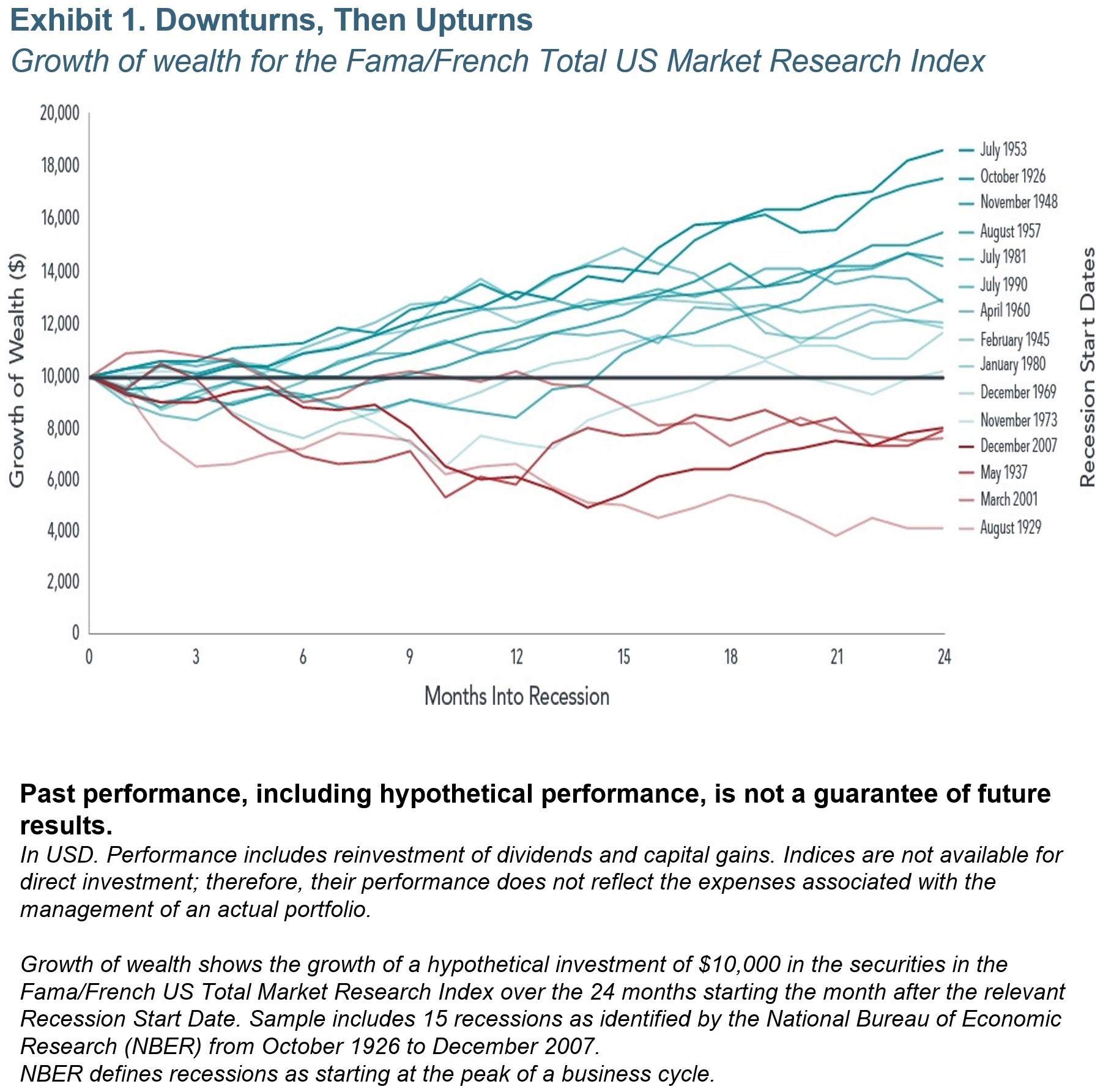
With activity in many industries sharply curtailed in an effort to reduce the chances of spreading the coronavirus, some economists say a recession is inevitable if one hasn’t already begun.1 From a markets perspective, we have already experienced a drop in stocks, as prices have likely incorporated the growing chance of recession. Investors may be tempted to abandon equities and go to cash because of perceptions of recessions and their impact. But across the two years that follow a recession’s onset, equities have a history of positive performance.

Data covering the past century’s 15 US recessions show that investors tended to be rewarded for sticking with stocks. Exhibit 1 shows that in 11 of the 15 instances, or 73% of the time, returns on stocks were positive two years after a recession began. The annualized market return for the two years following a recession’s start averaged 7.8%.

Downturns, Then Upturns

Staying the Course

Recessions understandably trigger worries over how markets might perform. But history can provide comfort to investors wondering whether now may be the time to move out of stocks.


Past performance does not guarantee future results. All investments include risk and have the potential for loss as well as gain.

Data sources for returns and standard statistical data are provided by the sources referenced and are based on data obtained from recognized statistical services or other sources we believe to be reliable. However, some or all information has not been verified prior to the analysis, and we do not make any representations as to its accuracy or completeness. Any analysis nonfactual in nature constitutes only current opinions, which are subject to change. Benchmarks or indices are included for information purposes  only  to  reflect  the  current  market  environment;  no  index  is  a directly  tradable investment.  There  may  be  instances  when  consultant  opinions  regarding any fundamental or quantitative analysis do not agree.

The  commentary  contained  herein  has  been  compiled  by  W.  Reid Culp,  III  from  sources  provided  by  TAGStone  Capital,  as well  as  commentary  provided  by  Mr.  Culp,  personally,  and  information independently  obtained  by  Mr.  Culp.  The  pronoun  “we,”  as  used  herein,  references collectively the sources noted above.

TAGStone Capital, Inc. provides this update to convey general information about market conditions and not for the purpose of providing investment advice. Investment in any of the companies or sectors mentioned herein may not be appropriate for you. You should consult your advisor from TAGStone for investment advice regarding your own situation.