
Client Question: Should I Consolidate My Retirement Accounts?

Published April 14, 2026

At a Glance

  • Consolidation simplifies your financial life and can trim duplicate fees — but a few 401(k) features (the Rule of 55, plan loans, some institutional share classes) disappear the moment you roll those dollars into an IRA.
  • There is no universal right answer. The best path depends on your age, your retirement timing, and what each of your existing accounts actually offers.
  • For most clients, the real payoff isn’t simplicity — it’s getting every retirement dollar aligned to one coherent investment strategy, instead of scattered across five versions of whatever seemed like a good idea in 2014.

If tax season left you digging through 1099s from three old employers, two IRAs, and an account you inherited from a parent, you’re in good company. Some version of this question hits my inbox almost every April: “I’ve got retirement money in six different places. Do I need to pull it all together?”

It’s a fair thing to wonder. After a career of job changes, firm mergers, plan rollovers you meant to finish but didn’t, and a Roth IRA you opened in your thirties, a lot of successful savers look up in their fifties and realize they’re managing more accounts than they intended. The Bureau of Labor Statistics reports that the youngest baby boomers had held an average of 12.9 jobs by age 58. If even half of those came with a workplace retirement plan, you can see how the pile grows.

So: should you consolidate? As with most decisions in planning, the honest answer is it depends — but the factors that matter are knowable, and worth walking through.

The Case for Pulling Things Together

The most obvious benefit of consolidation is simple and not to be underestimated: fewer moving parts. Fewer statements to open. Fewer usernames to remember. Fewer beneficiary forms to update when life changes. When your retirement picture lives in one or two places instead of six, we can actually see it — and so can you.

Cost is the next layer. Multiple legacy accounts often mean multiple sets of administrative, custodial, or advisory fees, quietly compounding against you. Consolidating into a single custodian frequently eliminates that redundancy. It also expands your investment menu. Many old 401(k) plans offer a handful of pre-selected funds; an IRA opens the door to nearly any publicly traded security.

Consolidation also gets easier to appreciate as you approach required minimum distribution age. Calculating and executing one RMD, from one custodian, is meaningfully less error-prone than coordinating three. And on the estate side, fewer accounts across fewer institutions makes life dramatically simpler for whoever has to settle your affairs one day — which is a gift to them, even if it doesn’t feel like one to you today.

What You Might Quietly Give Up

This is where I slow people down. Consolidation isn’t always the right call, and a few specific features can vanish the moment funds leave an old 401(k):

The Rule of 55. If you separate from your employer in or after the year you turn 55, you can take penalty-free distributions from that 401(k) before age 59½. Roll those dollars into an IRA and the exception is gone. For anyone considering early retirement, this is a detail worth protecting.

Plan loans. A 401(k) can be borrowed against in a pinch; an IRA cannot. I’d never recommend borrowing from retirement savings as a first move, but if a current plan has loan provisions you value as a last-resort emergency tool, be thoughtful before rolling that flexibility away.

Institutional share classes. Some large employer plans give participants access to low-cost institutional share classes — share classes you often can’t buy individually, even with a sizable IRA balance. If your old plan’s expense ratios are genuinely lower than what we can replicate elsewhere, staying put can be the right answer.

Before we consolidate anything, I want to compare the expense ratios and fund menus in every account you’re considering moving. Sometimes the old plan is quietly the cheapest and best option you have.

Three Ways to Simplify (Without Doing Too Much)

If consolidation makes sense, you generally have three paths:

Roll everything into an IRA. This tends to offer the broadest investment flexibility and the cleanest administrative picture, and it’s the right move for most people.

Roll into your current employer’s 401(k). If your current plan accepts incoming rollovers and offers strong, low-cost investment options, this preserves 401(k)-specific features (Rule of 55, plan loans) while still reducing the account count.

Same custodian, separate accounts. A middle path: move everything to one institution without commingling account types. You still get one login, one statement, one phone call — but your traditional IRA, Roth IRA, inherited IRA, and rollover IRA each stay in their own lane. This matters more than it sounds; for example, commingling an inherited IRA with a contributory IRA can create tracking and distribution headaches you don’t want.

The Bottom Line

The goal isn’t to own the fewest retirement accounts. The goal is to make sure every retirement dollar you’ve worked for is being managed deliberately — aligned to a single long-term strategy rather than whatever each plan’s default allocation happened to be the year you left that job.

For some clients, that means five separate accounts collapsing into one. For others, it means keeping a legacy 401(k) in place for its unique features while consolidating the rest. The right answer is the one that fits your circumstances — your age, your retirement timeline, your estate plan, and what each of your current accounts actually offers.

If you’ve been meaning to take inventory, this is a good time to do it. Pull your most recent statements together and send them over. A forty-five minute conversation is usually enough to tell whether consolidating is worth your effort, or whether you’re better off leaving things as they are.

This post is part of our Client Questions series. See also: Lump Sum vs. Dollar-Cost Averaging.


Past performance does not guarantee future results. All investments include risk and have the potential for loss as well as gain.

Data sources for returns and standard statistical data are provided by the sources referenced and are based on data obtained from recognized statistical services or other sources we believe to be reliable. However, some or all information has not been verified prior to the analysis, and we do not make any representations as to its accuracy or completeness. Any analysis nonfactual in nature constitutes only current opinions, which are subject to change. Benchmarks or indices are included for information purposes  only  to  reflect  the  current  market  environment;  no  index  is  a directly  tradable investment.  There  may  be  instances  when  consultant  opinions  regarding any fundamental or quantitative analysis do not agree.

The  commentary  contained  herein  has  been  compiled  by  W.  Reid Culp,  III  from  sources  provided  by  TAGStone  Capital,  as well  as  commentary  provided  by  Mr.  Culp,  personally,  and  information independently  obtained  by  Mr.  Culp.  The  pronoun  “we,”  as  used  herein,  references collectively the sources noted above.

TAGStone Capital, Inc. provides this update to convey general information about market conditions and not for the purpose of providing investment advice. Investment in any of the companies or sectors mentioned herein may not be appropriate for you. You should consult your advisor from TAGStone or others for investment advice regarding your own situation.
Published April 1, 2026

At a Glance

  • Geopolitical uncertainty and AI volatility pushed the S&P 500 down 4.63% in Q1 2026
  • Investing during geopolitical uncertainty requires discipline, not reaction
  • Your financial plan was built to withstand exactly these kinds of disruptions

As the second quarter begins, the war in Iran, now entering its second month, remains the dominant economic story. It’s unclear how long the war will last, and markets have reacted accordingly.

Stocks have declined steadily since the war began on Feb. 28. The S&P 500 fell 4.63% during the first quarter, and the Nasdaq briefly fell into correction territory. Volatility has risen as the market attempts to keep up with the rapidly changing global situation.

Energy markets have been at the center of the disruption. The war continues to restrict the flow of oil from the Middle East, pushing prices higher. Brent Crude, the global benchmark for oil, climbed more than 44% between Feb. 27 and the end of the quarter. It remains unclear what continued conflict and damage in the region will mean for energy and the global economy, and investors worry about the downstream effects on inflation, consumer spending and economic growth.

Navigating a Landscape of Unknowns

What happens next depends on a series of interrelated variables that are, by definition, unknowable.

An immediate resolution to the war could lead to a steep drop in energy costs, but a protracted quagmire might push them to extreme highs. Whatever happens to energy costs will have a big impact on overall inflation. In turn, the outlook for inflation will affect Federal Reserve interest rate policy. On Feb. 27, the day before the war, Wall Street traders were expecting two to three interest rate cuts in 2026. Now, a rate hike appears increasingly plausible. Fed policy has big implications for the economy. Rate hikes raise the cost of borrowing, which can cool economic growth.

What Should Investors Do?

It can be tempting to try to interpret every headline and adjust your portfolio accordingly. But when the outcomes are unknowable, that approach is just guessing and gambling.

Even in more normal times, attempting to time the market and trade on evolving news is effectively impossible. The market is incredibly efficient, so stock prices already reflect any information you might have. And any changes you might make reactively may introduce more risk than they remove.

Instead, consider why you’re investing in the first place. The goal isn’t to outsmart the markets today or tomorrow or the next day, but to improve your ability to build the life you want.

That’s why you have a financial and investment plan designed to accommodate uncertainty. Diversification across asset classes, sectors, styles and geographies helps manage the unknown by providing downside protection and maintaining upside potential.

Remember that investing, at its core, is an exercise in navigating the unknown. The future is unpredictable, and sources of long-term returns are rarely obvious in advance. In fact, it’s the uncertainty about the future that fuels stocks’ long-term growth potential: Equities’ return premium compensates investors for the risk of the unknown.

Evolving headlines will continue to create uncertainty in the weeks and months ahead. Through it all, keeping your portfolio aligned to your long-term goals gives you the best chance to achieve them.


Past performance does not guarantee future results. All investments include risk and have the potential for loss as well as gain.

Data sources for returns and standard statistical data are provided by the sources referenced and are based on data obtained from recognized statistical services or other sources we believe to be reliable. However, some or all information has not been verified prior to the analysis, and we do not make any representations as to its accuracy or completeness. Any analysis nonfactual in nature constitutes only current opinions, which are subject to change. Benchmarks or indices are included for information purposes  only  to  reflect  the  current  market  environment;  no  index  is  a directly  tradable investment.  There  may  be  instances  when  consultant  opinions  regarding any fundamental or quantitative analysis do not agree.

The  commentary  contained  herein  has  been  compiled  by  W.  Reid Culp,  III  from  sources  provided  by  TAGStone  Capital,  as well  as  commentary  provided  by  Mr.  Culp,  personally,  and  information independently  obtained  by  Mr.  Culp.  The  pronoun  “we,”  as  used  herein,  references collectively the sources noted above.

TAGStone Capital, Inc. provides this update to convey general information about market conditions and not for the purpose of providing investment advice. Investment in any of the companies or sectors mentioned herein may not be appropriate for you. You should consult your advisor from TAGStone or others for investment advice regarding your own situation.


Published March 24, 2026

At a Glance

  • Lump-sum investing outperforms dollar-cost averaging 68% of the time — but the margin is smaller than most people expect
  • If market volatility might trigger panic selling, dollar-cost averaging is worth the tradeoff
  • How you deploy new money matters far less than whether you're investing efficiently to begin with

What do you do if you’ve just received a big bonus at work, inherited some money, sold a business, or otherwise enjoyed a recent windfall you’d like to invest? Should you invest the money right away—even if the market seems particularly high or low—or little by little over time?

This is a question we often hear from clients and other investors. No wonder: Deciding how to invest a pot of money can indeed feel paralyzing. What if you put the money in, and the market promptly tanks? Or what if you hesitate, and the market soars? It’s perfectly normal to worry that you’ll make the wrong move…or at least not the best one.

Investing a lump sum all at once or over time each has its advantages and disadvantages. Let’s take a look at some of the factors to consider.

Begin with Your Goals

Before making any investment moves, first consider what you want to use your money for.

In the short term, the market can be a volatile place, with the potential for big ups and downs. If some or all of your money is going to be used for short-term goals—say, paying college tuition bills that are just a few years away—you may consider more conservative investments less affected by this volatility, like short-term bonds, bond funds, or certificates of deposit (CDs).

If you want that money to help you pursue long-term goals such as retirement, then investing in the stock market right away is likely worthwhile. Over the long term, volatility tends to smooth out, and the markets have historically continued to move higher.

Compare Lump-Sum Investing vs. Dollar-Cost Averaging

When you invest a lump sum, all your money is exposed to the market right away. If the market is on an upward tack, you can take advantage of immediate gains.

But of course, near-term market returns are not predictable. There could be a downturn after you invest your lump sum. If this potential for a setback bothers you, dollar-cost averaging—investing a set amount of money at regular intervals—may be a more comfortable strategy.

For example, you could use dollar-cost averaging to invest $1,000,000 in a low-cost, total market index fund in $200,000 monthly installments over five months. That way, when the market is at a high, your investment buys fewer fund shares. And when the market is lower, your investment buys more shares. The strategy helps you take advantage of the market’s natural ups and downs and manage the average cost of the shares you buy.

However, be aware that the greater comfort of pacing your investments through dollar-cost averaging may come at a price. Research shows that lump-sum investing outperforms dollar-cost averaging 68% of the time.

That said, keep this in perspective: how you deploy new money is unlikely to matter nearly as much as whether you are investing efficiently to begin with — starting with a plan that reflects your goals and risk tolerance, investing in a diversified mix of low-cost funds, and staying the course through inevitable market swings. The best deployment strategy is simply the one that helps you adhere to those principles.

So, ask yourself: Is maximizing expected returns your top priority? If so, the lump-sum approach might make the most sense for you. On the other hand, the same research suggests the expected outperformance is not by a large margin. If the specter of potential investment losses keeps you awake at night, it may be worth taking a small hit to use dollar-cost averaging, especially if it reduces the risk of panic-induced selling that can lock in even greater losses.

Whatever You Do, Don’t Delay

Historically, stocks and bonds outperform cash holdings over the long term. It’s critical to start investing as soon as possible to take advantage of this outperformance.

Delaying putting cash in the market is a form of market timing, buying or selling shares in an attempt to predict future market movements. This is a complicated game you’re unlikely to win. Consider that average equity fund investor returns trailed the market (as proxied by the S&P 500) by 5.5% in 2023, largely due to trying to time the market. Both lump-sum investing and dollar-cost averaging help you avoid this behavior and take advantage of the tendency for the market to grow over the long term. And this is what you need to meet your long-term financial goals. The important thing is to choose the strategy that will allow you to stick to your long-term plan.

Unsure how to invest some of your cash holdings? Reach out. We’d be happy to discuss which option best suits your needs.


Past performance does not guarantee future results. All investments include risk and have the potential for loss as well as gain.

Data sources for returns and standard statistical data are provided by the sources referenced and are based on data obtained from recognized statistical services or other sources we believe to be reliable. However, some or all information has not been verified prior to the analysis, and we do not make any representations as to its accuracy or completeness. Any analysis nonfactual in nature constitutes only current opinions, which are subject to change. Benchmarks or indices are included for information purposes  only  to  reflect  the  current  market  environment;  no  index  is  a directly  tradable investment.  There  may  be  instances  when  consultant  opinions  regarding any fundamental or quantitative analysis do not agree.

The  commentary  contained  herein  has  been  compiled  by  W.  Reid Culp,  III  from  sources  provided  by  TAGStone  Capital,  as well  as  commentary  provided  by  Mr.  Culp,  personally,  and  information independently  obtained  by  Mr.  Culp.  The  pronoun  “we,”  as  used  herein,  references collectively the sources noted above.

TAGStone Capital, Inc. provides this update to convey general information about market conditions and not for the purpose of providing investment advice. Investment in any of the companies or sectors mentioned herein may not be appropriate for you. You should consult your advisor from TAGStone or others for investment advice regarding your own situation.


At a Glance

  • Geopolitical conflicts can trigger short-term market volatility
  • Diversified portfolios are designed to withstand these periods
  • Midterm election years often bring volatility, but historically lead into strong market periods

Periods of geopolitical tension can cause sharp market reactions and unsettling headlines.

Recently, events in the Middle East have escalated rapidly. On Feb. 28, the U.S. and Israel launched an attack on Iran, setting off a rapidly escalating conflict across the Middle East. Fighting has spread to other countries, bringing with it destruction and loss of life.

In addition to the humanitarian toll, the conflict is making economic waves globally. As of 2025, 20 million barrels of oil per day—about 20% of global consumption—traveled through the Persian Gulf. That traffic came to a standstill after the attack, and oil prices climbed swiftly.

These events have investors worried and markets reacting. In early March, the CBOE Volatility Index jumped to its highest level since the near bear market last April.

What Exactly Has Markets Concerned?

Investors worry that rising oil prices could slow the economy. Energy is a key input for transportation, manufacturing, and other activities. When oil prices spike, many industries face higher costs.

Investors are also concerned about inflation. Higher energy prices can lead to broader price increases. What’s more, many investors were hoping the Federal Reserve would lower interest rates to boost the economy. If inflation rises, the Fed may be less likely to do so.

Your Portfolio Is Built for Moments Like This

While the headlines are alarming, periods like this are not unusual in long-term investing. At TAGStone, portfolios are designed with the expectation that geopolitical events, economic shocks, and market volatility will occur from time to time.

It’s important to remember that your diversified investment portfolio is built to withstand moments like this.

For instance, your portfolio already includes allocations to U.S. and international stocks, bonds, and cash. The fixed income portion of your portfolio, in particular, can help provide stability when equities become more volatile, helping smooth overall portfolio fluctuations.

Within the equity portion of your portfolio, diversification also helps manage risk. Some sectors may struggle when energy prices rise, such as technology and consumer discretionary.[1] On the other hand, energy companies might benefit from rising prices, potentially helping offset losses elsewhere.

A diversified portfolio does not eliminate losses, but it can help reduce the magnitude of downturns compared to broad market indices such as the S&P 500.

It’s also worth remembering that much of your portfolio is invested for the long term. Short-term market movements can feel uncomfortable, but the assets that fluctuate most today typically are the ones you won’t need to draw on for many years. As a result, you may not need to change anything about your portfolio to respond to the current news cycle.

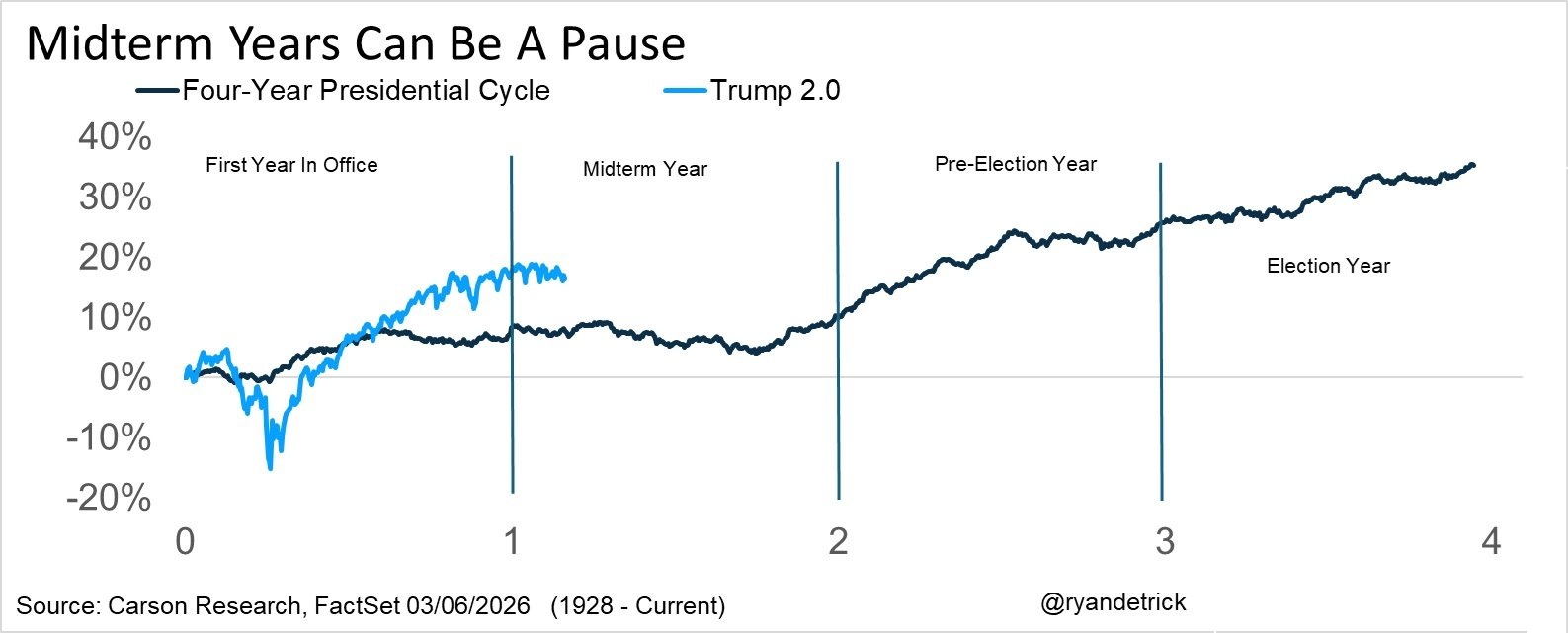
This year may also naturally bring somewhat higher market volatility. Historically, midterm election years have tended to experience larger intra-year declines—closer to about 17–18% on average versus roughly 14–15% in a typical year. While those declines can feel unsettling in the moment, the period following midterm elections has historically been one of the strongest stretches in the four-year presidential cycle.

A Final Perspective

In times of geopolitical crisis, it is natural for both people and markets to react quickly. History, however, suggests that these events rarely alter the long-term trajectory of markets.

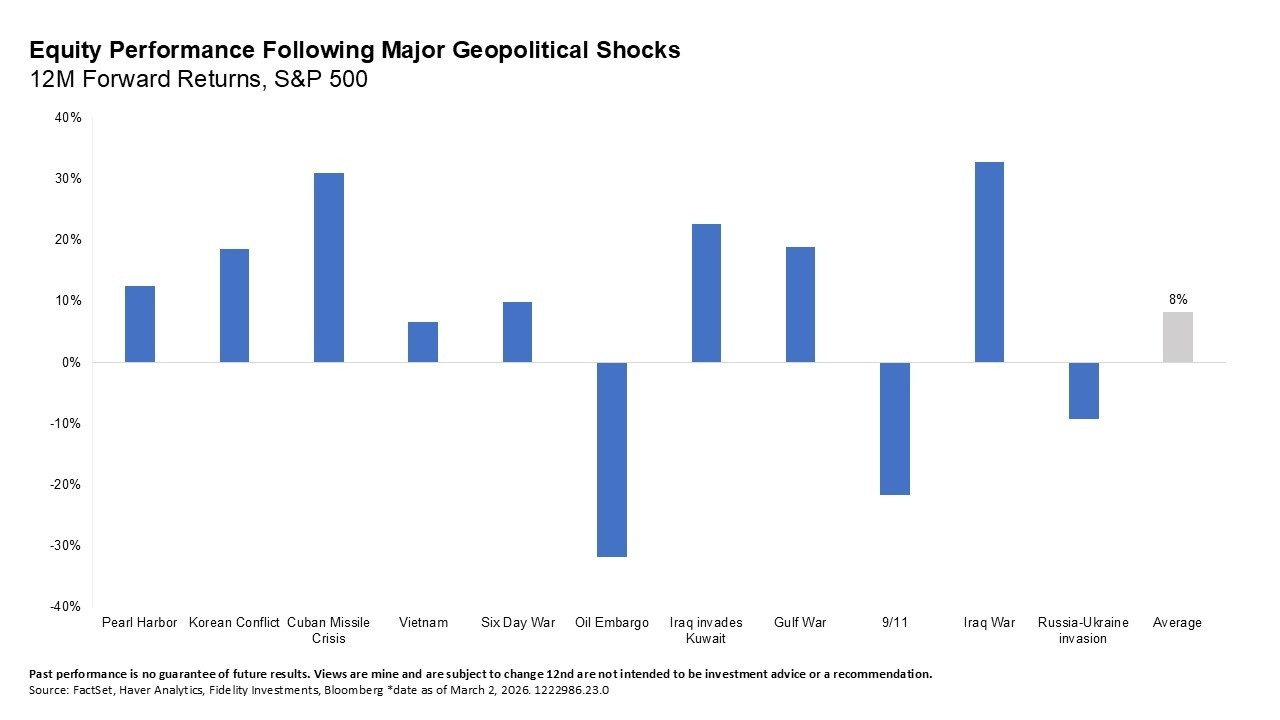
One useful way to think about geopolitical crises is that markets tend to treat them as temporary disruptions rather than permanent economic changes. Denise Chisholm, director of quantitative market strategy at Fidelity, looked into geopolitical shocks from Pearl Harbor through Russia’s 2022 invasion of Ukraine. She found that, on average, U.S. equities returned about 8% over the following year, on par with their long-term annual average. Her conclusion: “It’s the exception, not the rule, that geopolitical events become sustained market headwinds.”

The chart below illustrates how U.S. equities have historically performed in the year following major geopolitical shocks.

If you have questions about how current events may affect your portfolio, don’t hesitate to reach out. We’re always happy to talk through your concerns and help you stay focused on your long-term plan.

[1] See slide 6 of the linked chart pack.


Past performance does not guarantee future results. All investments include risk and have the potential for loss as well as gain.

Data sources for returns and standard statistical data are provided by the sources referenced and are based on data obtained from recognized statistical services or other sources we believe to be reliable. However, some or all information has not been verified prior to the analysis, and we do not make any representations as to its accuracy or completeness. Any analysis nonfactual in nature constitutes only current opinions, which are subject to change. Benchmarks or indices are included for information purposes  only  to  reflect  the  current  market  environment;  no  index  is  a directly  tradable investment.  There  may  be  instances  when  consultant  opinions  regarding any fundamental or quantitative analysis do not agree.

The  commentary  contained  herein  has  been  compiled  by  W.  Reid Culp,  III  from  sources  provided  by  TAGStone  Capital,  as well  as  commentary  provided  by  Mr.  Culp,  personally,  and  information independently  obtained  by  Mr.  Culp.  The  pronoun  “we,”  as  used  herein,  references collectively the sources noted above.

TAGStone Capital, Inc. provides this update to convey general information about market conditions and not for the purpose of providing investment advice. Investment in any of the companies or sectors mentioned herein may not be appropriate for you. You should consult your advisor from TAGStone or others for investment advice regarding your own situation.


At a Glance

  • Most people have one or two of these documents in place — but comprehensive planning requires all four, working together as a coordinated safety net.
  • Each document serves a distinct purpose: financial decisions, medical decisions, end-of-life preferences, and asset distribution.
  • Estate planning failures are rarely about missing documents — they're about outdated designations, poor coordination, and plans that haven't kept pace with life.

No one likes to imagine a time when they might be sick or unable to make decisions for themselves. It ranks alongside cleaning out the garage or scheduling a long-overdue physical—important, but all too easy to postpone. Yet having the right estate planning documents in place can make all the difference.

Without a clear plan in place, the state might step in and appoint a guardian to make financial and medical decisions on your behalf. Someone you didn’t choose could end up deciding where you live, how your money is managed, or what medical treatments you receive. That's not a situation any of us wants to be in.

Incapacity exists on a spectrum. It could look like cognitive decline from Alzheimer’s or dementia, physical incapacity after an injury or illness, a sudden event such as a stroke, or a gradual decline over time.

Because these scenarios unfold differently—and at different life stages—you’ll need four key documents to address them:

  1. a durable power of attorney,
  2. health care proxy,
  3. living will, and
  4. a will or revocable trust.

You may already have one or two of these documents, but comprehensive planning requires all four. Together, these documents create a coordinated safety net. Without one, gaps can appear. It’s like living near a river and buying homeowner’s insurance but skipping flood coverage. You’re mostly protected… until you’re not.

1. Durable Power of Attorney

A durable power of attorney (DPOA) is a legal document that authorizes someone—known as your agent or attorney-in-fact—to manage your financial affairs on your behalf, including bills, banking, investments, and business interests. The word “durable” here is key: it means the document remains valid even if you become mentally incapacitated.

Choosing the right person to fill this role matters. Consider someone who is financially responsible, trustworthy, and capable of handling potential conflict if family members disagree. Many people select a spouse or adult children. If these options don’t feel appropriate, we can help you identify another trusted individual or a professional fiduciary.

It’s also wise to appoint a backup agent in case your first choice is unavailable when needed.

One related tool worth knowing about: a trusted contact person on your financial accounts. Unlike a DPOA agent, a trusted contact cannot make decisions or view your accounts, but they can serve as a point of contact for your financial institutions if something seems wrong.

For a deeper look at how a DPOA and a trusted contact person work in practice, including important tips on keeping it current with your financial institutions, see Protecting What's Yours (While You're Alive).

2. Health Care Proxy

Your health care proxy is a document that designates an agent to make medical decisions for you if you are unable to do so yourself. This covers situations where you are unconscious, severely ill, undergoing surgery, or have lost cognitive capacity.

The health care proxy is typically activated when a physician determines that you lack decision-making capacity. At that point, your agent can step in and make decisions about treatments, surgeries, medications, care facilities, and in some states, end-of-life decisions. Ideally, these decisions are guided by your known wishes or their best judgment of what you would want.

Again, a spouse or adult children are common choices. Whoever you name should be someone who understands your preferences about medical care, is comfortable making decisions under pressure, and can advocate for you with medical professionals.

It’s also common to name different individuals for medical and financial decisions. It creates natural checks and balances and helps prevent one person from carrying the entire weight.

3. Living Will

A living will complements your health care proxy. This document spells out—in your own words—the medical treatments you do and don’t want in specific circumstances, such as a terminal condition, a persistent vegetative state or at the end-stage of an illness with little hope for recovery.

You don’t need to name an agent for a living will. However, it may be helpful to come up with this document in conversation with your physician and estate attorney. Tools like the “Five Wishes” framework can serve as a jumping-off point for clarifying your preferences.

Your living will is part of a broader healthcare advance directive. We cover what that includes, and other practical tips, in Protecting What's Yours (While You're Alive).

4. Will or Revocable Living Trust

The first three documents address what happens when you're living but unable to act. The fourth addresses what comes after.

Your estate plan should also include a will or trust that addresses what happens to your assets.

A will outlines how your property should be distributed after you die, names an executor to carry out your wishes, and designates a guardian for any minor children.

A revocable living trust goes a step further. You transfer assets into the trust during your lifetime—typically naming yourself as the initial trustee so you retain full control—and a successor trustee steps in if you become incapacitated or die.

Because assets in a trust bypass the probate process, transfers tend to be faster, more private, and less expensive. There are several types of revocable trusts, and we can work with you and your estate attorney to determine which structure fits your situation.

A will or trust is just the starting point. The greater risk for most families is execution and coordination after documents are signed. We cover what that looks like in Protecting What's Yours (After You Pass) and the step-by-step process in Part 2.

Keep Your Estate Planning Documents Current

No single document covers every phase of incapacity or death. The goal is to have all four in place, kept current, and accessible to the people who may need them.

One important area these documents don’t cover is beneficiary designations on retirement accounts and life insurance policies. These designations override instructions in your will, so make sure they are up to date and aligned with your wishes.

Finally, remember that life is dynamic. Laws evolve, financial situations shift, and relationships change. Plan to review each of these documents regularly, especially after major life events such as marriage, divorce, the birth of a child, relocation, or significant changes in wealth, and update them as needed.

The Core Four documents are the foundation, but they're only as strong as the planning and coordination around them. At TAGStone Capital, we help clients build and maintain that full picture, from incapacity planning to estate execution. To go deeper on what happens after documents are signed, see Protecting What's Yours (After You Pass). Or, if you're ready to talk through where your own plan stands, schedule a complimentary 15-minute conversation.


Past performance does not guarantee future results. All investments include risk and have the potential for loss as well as gain.

Data sources for returns and standard statistical data are provided by the sources referenced and are based on data obtained from recognized statistical services or other sources we believe to be reliable. However, some or all information has not been verified prior to the analysis, and we do not make any representations as to its accuracy or completeness. Any analysis nonfactual in nature constitutes only current opinions, which are subject to change. Benchmarks or indices are included for information purposes  only  to  reflect  the  current  market  environment;  no  index  is  a directly  tradable investment.  There  may  be  instances  when  consultant  opinions  regarding any fundamental or quantitative analysis do not agree.

The  commentary  contained  herein  has  been  compiled  by  W.  Reid Culp,  III  from  sources  provided  by  TAGStone  Capital,  as well  as  commentary  provided  by  Mr.  Culp,  personally,  and  information independently  obtained  by  Mr.  Culp.  The  pronoun  “we,”  as  used  herein,  references collectively the sources noted above.

TAGStone Capital, Inc. provides this update to convey general information about market conditions and not for the purpose of providing investment advice. Investment in any of the companies or sectors mentioned herein may not be appropriate for you. You should consult your advisor from TAGStone or others for investment advice regarding your own situation.


At a Glance

  • Buffett’s career reinforces a timeless lesson: successful investing depends more on discipline and temperament than predicting markets.
  • Market bubbles and downturns are inevitable. Long-term investors who resist fear and hype are better positioned to stay on course.
  • Time is the most powerful force in investing. Starting early and staying invested are key to building wealth across generations.

On December 31, 2025, legendary investor Warren Buffett retired as CEO of Berkshire Hathaway at age 95. Berkshire Hathaway compounded shareholder capital at approximately 20% annually for over six decades—one of the most remarkable investment records ever achieved. Buffett’s retirement marks the end of one of the greatest investing careers. Yet, the principles that guided him remain just as relevant today for families aiming to grow and preserve wealth across generations.

Sixty years ago, Buffett took over Berkshire Hathaway, a struggling New England textile company, and turned it into a powerhouse that operates everything from insurance firms to household names like Duracell batteries. Along the way, he earned the nickname “Oracle of Omaha” for carefully selecting undervalued companies and holding onto them for the long term—a strategy that has worked well for him. Today, he is the sixth richest person in the world, with a net worth around $154 billion.

Throughout his career, Buffett has shared some of his success secrets, often through his well-known—and often humorous—shareholder letters. Below are some of our favorite insights that continue to guide investors of all kinds.

Navigating Fear and Greed

Investing is carried out by people, and people are emotional. As a result, human behavior heavily influences market movements. Fear and greed can cause investors to jump in and out of the market en masse, often to their own detriment.

Buffett illustrated this idea well when he wrote:

“Occasional outbreaks of those two super-contagious diseases, fear and greed, will forever occur in the investment community…We never try to anticipate the arrival or departure of either disease. Our goal is more modest: we simply attempt to be fearful when others are greedy and to be greedy only when others are fearful.”

Buffett warns us to be cautious when investors are “greedy,” as this can push prices to levels that are not sustainable—sometimes leading to a crash.

Conversely, when investors are fearful, they might miss out on significant opportunities to buy bargains during a market downturn.

The key to successful investing is managing emotional impulses. Buffett has said: “The most important quality for an investor is temperament, not intellect. You need a temperament that neither derives great pleasure from being with the crowd or against the crowd.”

This is one of the reasons we build portfolios that can weather market volatility before it happens, rather than reacting emotionally once it does.

Bursting Bubbles

During market bubbles—such as the Dot Com bubble of the late 1990s or the housing boom leading up to the 2008 crash—prices rise rapidly beyond their true value, fueled by speculation and hype.

Even investors who were initially skeptical may give in to the temptation to join in, entering the market when prices are excessively inflated and due for a crash.

Buffett summarizes this well when he said:

Bubbles blown large enough inevitably pop. And then the old proverb is confirmed once again: ‘What the wise man does in the beginning, the fool does in the end.’”

Buffett has also said, “It’s only when the tide goes out that you learn who’s been swimming naked.” Indeed, when a booming market turns south, you don’t want to be the one who has taken on too much risk and ends up scrambling to get out.

Playing the Long Game

You’ve probably heard us say that investing is a long-term venture. This is also one of Buffett’s core principles: “Our favorite holding period is forever.” He has additionally stated, “Only buy something that you’d be perfectly happy to hold if the market shut down for 10 years.”

The evidence is clear: over the long term, the stock market has traditionally moved higher. For families building multi-generational wealth, committing to long-term holding periods is the best way to navigate the inevitable short-term market fluctuations that accompany the overall upward trend.

Starting Early

 Unsurprisingly, there's a lot of overlap between aphorisms about planting trees and investing. Both require planning and an early start to ensure you reap their benefits.

As Buffett once said:

“Someone’s sitting in the shade today because someone planted a tree a long time ago.”

Similarly, a well-crafted investment plan needs attention and nurturing, supported by disciplined approaches like dollar-cost averaging—the practice of regularly investing a fixed amount regardless of market conditions—and periodic rebalancing. But mostly, wealth and trees simply need time to grow.

In this sense, Buffett’s “secrets” of success have never truly been secrets. They are just simple truths that all investors can follow: stay calm when others panic, resist the hype, invest regularly, and think long term. Even with these principles, it’s not always easy to stay the course—especially when markets become turbulent.

These principles continue to guide how we think about managing wealth for the families we serve. Please reach out when you have questions about the markets and how they affect your long-term plan.


Past performance does not guarantee future results. All investments include risk and have the potential for loss as well as gain.

Data sources for returns and standard statistical data are provided by the sources referenced and are based on data obtained from recognized statistical services or other sources we believe to be reliable. However, some or all information has not been verified prior to the analysis, and we do not make any representations as to its accuracy or completeness. Any analysis nonfactual in nature constitutes only current opinions, which are subject to change. Benchmarks or indices are included for information purposes  only  to  reflect  the  current  market  environment;  no  index  is  a directly  tradable investment.  There  may  be  instances  when  consultant  opinions  regarding any fundamental or quantitative analysis do not agree.

The  commentary  contained  herein  has  been  compiled  by  W.  Reid Culp,  III  from  sources  provided  by  TAGStone  Capital,  as well  as  commentary  provided  by  Mr.  Culp,  personally,  and  information independently  obtained  by  Mr.  Culp.  The  pronoun  “we,”  as  used  herein,  references collectively the sources noted above.

TAGStone Capital, Inc. provides this update to convey general information about market conditions and not for the purpose of providing investment advice. Investment in any of the companies or sectors mentioned herein may not be appropriate for you. You should consult your advisor from TAGStone or others for investment advice regarding your own situation.


At a Glance

  • Retirement isn’t just financial — it’s psychological. Losing structure, identity and daily rhythm can affect both mental and physical health.
  • Unstructured freedom can backfire. Research links social isolation and loss of purpose to higher risks of dementia, heart disease and premature mortality.
  • Purpose must be designed. A fulfilling retirement requires intentional planning around meaning, relationships, activity and engagement — not just income.

Retirement is often imagined as a well-earned season of freedom—time away from deadlines, schedules, and professional responsibilities. But when the structure that shaped your days for decades suddenly disappears, what replaces it? Endless relaxation may sound appealing, but the reality is often more complex.

Retirement is a major life shift, one that impacts more than just your schedule. It can reshape your sense of identity, daily habits and even your health. In fact, research has shown that retirement can raise the risk of heart disease and other medical issues by up to 40%. The reason? Experts point to a loss of purpose and reduced social connection, both of which can take a toll on mental and physical well-being.

Without a plan for how to spend your time meaningfully, the transition can bring unexpected emotional challenges.

The Risks of Unstructured Retirement

Many retirees begin this new chapter with a “honeymoon phase”—a period marked by the novelty of free time, relaxation or long-awaited travel plans. But this initial high can eventually fade.

When the excitement of sleeping in and checking items off the bucket list wears off, retirees can find themselves facing unexpected emotional challenges. Common struggles include boredom, loss of routine, identity shifts and social isolation. In fact, 24% of older adults are considered to be socially isolated. Isolation can also have a ripple effect on health: It’s associated with a 50% increase in risk of developing dementia and increased risk of premature mortality.


Designing a Retirement with Purpose

To avoid some of the potential pitfalls of an unstructured retirement, it’s important to think carefully—and proactively—about purpose. What do you want this next phase of life to look and feel like? Beyond financial planning, consider how you’ll meet the deeper needs your pre-retirement life—including work and raising kids—may have fulfilled: structure, identity, accomplishment, social connection and a sense of meaning.

What brings you pleasure and meaning? What have you always wanted to try or learn? Pursuing these activities can provide purpose and help ensure retirement’s not just a long vacation, but a rewarding chapter of your life.

Feeling stuck here? Try asking close friends or family what they see light you up. Often, others can reflect back passions or strengths that are hard to see on your own.

Staying Connected and Active

Relationships and physical routines matter more than ever when you retire. Staying active, both physically and socially, offers measurable health benefits. Regular physical activity lowers risks, including the likelihood of dementia, heart disease, stroke and eight types of cancer.

People-centered activity is important, too. Look for ways to stay engaged, whether through volunteering, mentoring, part-time work, creative pursuits or community involvement. Older volunteers, aged 55 and up, who gave 100 hours or more each year were two-thirds less likely to report poor health than non-volunteers.

Spending more time with family is a high priority for many retirees and can be a great way to fulfill social needs. But make sure that vision is shared. Open conversations with loved ones about time together, expectations and boundaries can help align plans and avoid disappointment down the road.

The Retirement Identity Shift

In many ways, it’s hard to define what retirement is. After all, it’s not a single moment but a series of transitions. For instance, rather than an abrupt shift to not working at all, you may consider bridge employment—usually part-time work in a temporary position or as a consultant in your field or in a different industry. This can offer a gradual shift into retirement, providing continued income and engagement as you adjust.

Retirement is not merely about stepping away from work—it is about stepping intentionally into your next season of influence, relationships, and legacy.

As your vision for retirement evolves, keep us in the loop. We’d love to hear what you’re planning—and we’re here to help ensure your financial strategy stays aligned with your goals.


Past performance does not guarantee future results. All investments include risk and have the potential for loss as well as gain.

Data sources for returns and standard statistical data are provided by the sources referenced and are based on data obtained from recognized statistical services or other sources we believe to be reliable. However, some or all information has not been verified prior to the analysis, and we do not make any representations as to its accuracy or completeness. Any analysis nonfactual in nature constitutes only current opinions, which are subject to change. Benchmarks or indices are included for information purposes  only  to  reflect  the  current  market  environment;  no  index  is  a directly  tradable investment.  There  may  be  instances  when  consultant  opinions  regarding any fundamental or quantitative analysis do not agree.

The  commentary  contained  herein  has  been  compiled  by  W.  Reid Culp,  III  from  sources  provided  by  TAGStone  Capital,  as well  as  commentary  provided  by  Mr.  Culp,  personally,  and  information independently  obtained  by  Mr.  Culp.  The  pronoun  “we,”  as  used  herein,  references collectively the sources noted above.

TAGStone Capital, Inc. provides this update to convey general information about market conditions and not for the purpose of providing investment advice. Investment in any of the companies or sectors mentioned herein may not be appropriate for you. You should consult your advisor from TAGStone or others for investment advice regarding your own situation.


At a Glance

  • US large cap stocks: +17.88% (third consecutive double-digit year)
  • 2026 earnings growth projected near 15% (Wall Street consensus)
  • Elevated valuations and concentration reinforce disciplined diversification

Equity markets delivered a third consecutive year of double-digit returns in 2025. Several crosscurrents shaped 2025 market performance — from earnings strength and AI enthusiasm to shifting Federal Reserve policy and elevated valuations. Below, we review the key drivers and outline our 2026 investment outlook for disciplined long-term investors.

Investment Principles That Guide Our Decisions

I’ll begin by briefly restating the core principles that shape our planning and investment decisions:

  • We are long-term, goal-focused investors. Our investment policy is designed to support your objectives through broadly diversified portfolios of high-quality equities and bonds.
  • Studies and empirical evidence indicate that the economy cannot be forecast with consistency, nor markets timed with reliability in the short-term. Therefore, to trade profitably, after taxes, on short-term news or market movements is very difficult.
  • From this, we conclude that the best way to capture the long-term return premium of equities is to remain invested through their inevitable, uncomfortable, but normally temporary declines (excluding extraordinary periods such as 1929).
  • As long as your long-term goals remain unchanged, our investment strategy for achieving them will remain consistent. And as long as the investment strategy remains consistent, so too will your portfolio—aside from disciplined, periodic rebalancing.
  • We believe long-term compounding in quality equities, with an appropriate allocation to high-quality bonds, is the most effective way to capture attractive investment returns to support your goals. In that spirit, we remain mindful of Charlie Munger’s reminder that “the first law of compounding is to never interrupt it unnecessarily.”

Economic and Market Backdrop

1. Equity Performance in 2025

In 2025, the broad equity market delivered its third consecutive year of double-digit returns, supported by solid economic growth and meaningful gains in corporate earnings. A broad index of US large cap stocks finished the year up 17.88%.

2. Earnings Growth and AI Expectations

Looking ahead, the general expectation among major financial institutions is that company profits will continue their upward climb, with earnings growth forecasted at nearly 15% for 2026 (source: Yardeni Research). Experts believe this expansion in profits will be fueled by artificial intelligence and a resilient consumer, as detailed in the following earnings per share (EPS) projections:

Select Wall Street 2026 Earnings Per Share (EPS) Forecasts
Institution 2026 EPS Estimate EPS Growth Forecast Notable Driver
Morgan Stanley $317 17% AI-driven efficiency and tax benefits
JPMorgan $306 - $314 13% - 15% AI "supercycle" and resilient economy
Goldman Sachs $305 12% Productivity gains from AI adoption
Consensus (FactSet) $309 14.9% Average of all major analyst estimates

Remarkably, profit margins have also continued to expand, reaching 13.1% in the third quarter of 2025—the highest level in 15 years (source: FactSet). Many expected rising input costs and consumer resistance to price increases to squeeze margins. To date, those concerns have not materialized.

3. Labor Market and Productivity Trends

The main weak spot in the economy has been employment, which continues to soften. However, even this has a bright spot. The relatively flat employment levels have been offset by strong growth in supply, which has led to higher productivity. Though unemployment has risen slightly to about 4.7%, most workers are producing more per hour, enabling wage growth without reigniting inflation.

4. Federal Reserve Policy and Inflation

After six consecutive rate cuts, Federal Reserve policy is now roughly 175 basis points more accommodative than a year ago, while CPI inflation has remained relatively tame near three percent. It is reasonable to expect the lagged effects of this easing to become more visible in 2026—hopefully through continued economic growth as long as productivity remains high.

5. Fiscal Tailwinds and Tax Policy

This tax season, middle-income households are expected to receive meaningful refunds—estimated at around $150 billion in aggregate, or roughly a half percentage point boost to GDP. Key drivers include a higher standard deduction and the temporary increase of the SALT deduction cap to $40,000 from $10,000, which could provide a near-term economic tailwind.

Unfortunately, much of this positive economic data is often under-reported in the financial news because it does not align with their prevailing narrative, which tends to emphasize negative developments—most notably the softening labor market. The information we receive from financial “news” is often skewed toward pessimism because it sells better.

6. Valuations and Market Concentration

Regardless, the strongly rising equity market may already reflect much of this positive information. As a result, the dominant question of 2025 became whether markets have moved into an AI-driven bubble—supplanting 2024’s concern about rate cuts and 2023’s concern about a recession.

There is no denying that today’s market is more concentrated in a small number of large technology companies than at any point in recent decades, and that valuations for the broad US large-cap stock indexes sit near historical highs.


Portfolio Implications

Our response to this environment is straightforward:

  1. Valuations and Expected Returns: While higher starting valuations have historically pointed towards lower-than-average expected returns over the next 5-10 years, valuations have not been a reliable market-timing tool in the short term.
  2. Concentration Risk and Diversification: While higher starting valuations and concentration risk are not ideal, these risks can be addressed through disciplined portfolio construction and systematic rebalancing to provide an attractive investment experience.
  3. Long-Term Plans vs. Short-Term Narratives: Generally, long-term plans should not be altered in response to short-term narratives, popular fears, or even higher starting valuations.
  4. Asset Allocation Discipline: Pick a stock-to-bond ratio you are comfortable with, and only make changes to the ratio if your circumstances change. Cash and bonds are necessary to help you weather inevitable market declines.

Closing Perspective

History suggests that the next market disruption will likely come from an unexpected source (in the jargon, an unknown unknown, as opposed to a known unknown like higher starting valuations or the national debt). Such events tend to matter little to the plans of long-term stock investors except as opportunities to rebalance and invest at more attractive prices.

Plus, the alternatives of trying to invest in private real estate deals or a private operating business can subject you to even greater costs, risks, and, potentially, a permanent loss of capital as opposed to the normally temporary declines a long-term stock investor may experience.

We continue to follow an approach that has worked over full market cycles in that it has provided the best chance to help investors achieve their most precious financial goals. We do not assume “this time is different,” nor do we adjust strategy to accommodate the fears or fashions of the moment. We avoid abandoning markets during periods of stress, and we avoid overcommitting to any single “new era” narrative—AI included.

We wish you and your family a healthy, happy, and prosperous 2026. As always, we are here to answer questions and discuss your plan at any time. Thank you for the trust you place in us—it is a privilege to serve you.


Past performance does not guarantee future results. All investments include risk and have the potential for loss as well as gain.

Data sources for returns and standard statistical data are provided by the sources referenced and are based on data obtained from recognized statistical services or other sources we believe to be reliable. However, some or all information has not been verified prior to the analysis, and we do not make any representations as to its accuracy or completeness. Any analysis nonfactual in nature constitutes only current opinions, which are subject to change. Benchmarks or indices are included for information purposes  only  to  reflect  the  current  market  environment;  no  index  is  a directly  tradable investment.  There  may  be  instances  when  consultant  opinions  regarding any fundamental or quantitative analysis do not agree.

The  commentary  contained  herein  has  been  compiled  by  W.  Reid Culp,  III  from  sources  provided  by  TAGStone  Capital,  as well  as  commentary  provided  by  Mr.  Culp,  personally,  and  information independently  obtained  by  Mr.  Culp.  The  pronoun  “we,”  as  used  herein,  references collectively the sources noted above.

TAGStone Capital, Inc. provides this update to convey general information about market conditions and not for the purpose of providing investment advice. Investment in any of the companies or sectors mentioned herein may not be appropriate for you. You should consult your advisor from TAGStone or others for investment advice regarding your own situation.


At a Glance

  • Higher thresholds, but limited impact for high earners. The standard deduction and Child Tax Credit increased, though many new deductions phase out quickly at higher income levels.
  • Estate exemption remains elevated. The lifetime gift and estate tax exemption rose to $15 million in 2026, providing clarity for long-term gifting and trust planning.
  • New reporting and deduction rules require coordination. Crypto transactions now generate Form 1099-DA, certain new deductions apply through 2028, and IRA contributions remain available before the April filing deadline.

2025 Tax Changes: What to Review Before Filing Your Return

Filing your tax return might seem routine. In reality, small rule changes can have significant planning implications — especially for higher‑income households balancing investment income, business interests, charitable giving, and multi‑generational wealth strategies.

The 2025 tax year introduced several structural changes affecting income reporting, deductions, and estate planning, stemming from the One Big Beautiful Bill Act (OBBBA), passed in July. While many headlines highlight broad taxpayer benefits, some provisions phase out quickly at higher income levels. For affluent families, the technical details, not the headlines, determine the real impact. Understanding how these changes fit into your overall financial plan ultimately shapes the outcome.

A Boost for Traditional Deductions

The OBBBA made several taxpayer-friendly provisions permanent, starting with a higher standard deduction. For 2025, the standard deduction increases to $15,750 for single filers, up from $15,000 in 2024. For married couples filing jointly, the deduction rises to $31,500, up from $30,000.

The legislation also expanded the Child Tax Credit, increasing it to $2,200 per qualifying child, compared with $2,000 under prior law.

For higher‑income households who typically itemize, the increased standard deduction may have limited practical impact — particularly when charitable contributions, mortgage interest and property taxes remain significant. Still, the higher threshold can reduce the marginal benefit of smaller itemized deductions and may influence charitable “bunching” or timing strategies.

New Tax Deductions to Be Aware Of

The OBBBA introduced several new deductions for 2025. Many have income phaseouts that limit their usefulness for higher earners, but they may still be relevant for certain family members or key employees in privately owned businesses.

  • Personal deduction for seniors: If you were born before Jan. 2, 1961, you can take a $6,000 deduction ($12,000 if married filing jointly) in addition to your standard or itemized deduction. This deduction is phased out if your modified adjusted gross income (MAGI) is between $75,000 ($150,000 for joint filers) and $175,000 ($250,000 for joint filers).
  • Tax deduction for tips: Often described politically as “no tax” on tips and overtime, the reality is more nuanced. In practice, there is now a deduction for voluntary cash or charged tips earned in industries where tipping is customary. From 2025 through 2028, eligible single filers can deduct up to $25,000 in tipped income, though the deduction begins to phase out for individuals with MAGI above $150,000.
  • Tax deduction for overtime pay: A similar deduction applies to a portion of qualified overtime pay from 2025 through 2028. In most cases, this refers only to the premium portion of overtime—for example, the extra “half” in “time-and-a-half” pay—rather than the worker’s full hourly wage. For single filers, the deduction is capped at $12,500 of eligible compensation for those with MAGI below $150,000. The deduction is phased out above that amount and is zeroed out once above $275,000.
  • Car loan interest deduction: If you financed the purchase of a new vehicle in 2025, you may be eligible to deduct up to $10,000 in interest paid on that loan, provided the vehicle was built in the United States and is used for personal use. To determine if your car fits the bill, look at your vehicle identification number (VIN). Cars built in the United States will have a VIN that starts with a 1, 4, or 5. The deduction phases out for single filers with MAGI above $100,000. Given the income limits and the fact that many higher‑income households either pay cash or lease vehicles, this provision may have a limited impact in affluent planning contexts. In future years, lenders will be required to report auto loan interest payments directly to both taxpayers and the IRS. For this year, you may need to do a little digging through your loan statements, or you can request a summary of interest paid from your lender.

Gift and Estate Tax Exemptions: Long-Term Clarity

The OBBBA provided clarity to a crucial estate planning rule. The lifetime estate and gift tax exemption was previously scheduled to sunset on December 31, 2025, potentially reducing the exemption from nearly $14 million to approximately $6 million. Instead, the higher exemption has been made permanent. Here’s where things stand now:

  • The estate and gift tax exemption rose to $15 million in 2026 and is indexed to inflation going forward.
  • The annual gift tax exclusion is $19,000 per recipient in 2026.
  • While it’s too late to make a tax-free gift for 2025, now is a good time to begin planning gifting strategies for 2026.


While permanence provides welcome clarity, it does not eliminate planning considerations. Families with estates approaching the exemption threshold should continue evaluating lifetime gifting strategies, trust structures, and long-term liquidity planning. Asset growth, legislative risk, and multi-generational objectives still warrant proactive review.

Tax Reporting on Cryptocurrency

Beginning in 2025, the IRS requires reporting of digital asset transactions. If you sold or exchanged digital assets through a platform such as Coinbase, you should receive a Form 1099‑DA, a form created specifically for digital asset reporting.

Capital gains taxes generally apply to crypto sales and trades. Digital assets received as compensation may be taxed as ordinary income.

Investors holding digital assets outside centralized platforms should pay particular attention to basis tracking and transaction documentation, as reporting discrepancies may increase audit risk.

It’s Not Too Late to Fund Your IRA

While the window for 2025 401(k) contributions closed at year‑end, you may still make 2025 traditional or Roth IRA contributions until the April 15 filing deadline.

The contribution limit for IRAs remains $7,000, with an additional $1,000 catch‑up contribution available for individuals age 50 or older.

Higher‑income households considering backdoor Roth contributions should coordinate carefully to avoid unintended pro‑rata tax consequences.

Planning Ahead Matters

Tax rules change regularly. What matters more is how those rules integrate with your long‑term investment strategy, liquidity needs, and estate planning objectives.

Reviewing your situation before filing allows for greater flexibility — whether that involves IRA funding decisions, charitable contributions, gifting strategies, or managing realized gains.

If you would like to review how these 2025 changes apply to your specific circumstances, we are happy to schedule a conversation.


Past performance does not guarantee future results. All investments include risk and have the potential for loss as well as gain.

Data sources for returns and standard statistical data are provided by the sources referenced and are based on data obtained from recognized statistical services or other sources we believe to be reliable. However, some or all information has not been verified prior to the analysis, and we do not make any representations as to its accuracy or completeness. Any analysis nonfactual in nature constitutes only current opinions, which are subject to change. Benchmarks or indices are included for information purposes  only  to  reflect  the  current  market  environment;  no  index  is  a directly  tradable investment.  There  may  be  instances  when  consultant  opinions  regarding any fundamental or quantitative analysis do not agree.

The  commentary  contained  herein  has  been  compiled  by  W.  Reid Culp,  III  from  sources  provided  by  TAGStone  Capital,  as well  as  commentary  provided  by  Mr.  Culp,  personally,  and  information independently  obtained  by  Mr.  Culp.  The  pronoun  “we,”  as  used  herein,  references collectively the sources noted above.

TAGStone Capital, Inc. provides this update to convey general information about market conditions and not for the purpose of providing investment advice. Investment in any of the companies or sectors mentioned herein may not be appropriate for you. You should consult your advisor from TAGStone or others for investment advice regarding your own situation.


How to Have Family Conversations About Money

Money plays a role in so many of the decisions we make, yet it remains one of the last true taboos in American life. Despite its importance, 62% of people say they don’t talk about money at all—not with family, not with friends and in nearly half of cases, not even with their spouse or partner. In fact, most Americans feel more comfortable discussing politics, religion or even the details of their love lives than their bank accounts.

In our work with families, we see this reluctance constantly—and the avoidable problems it creates. Money is tied to identity and emotion, including feelings of self-worth, fear of judgment, embarrassment or shame around things like spending, saving and debt. As uncomfortable as these feelings may be, avoiding these conversations carries a real cost. Silence can create stress, undermine financial security and strain relationships across generations.

These conversations are especially important to have with family. Understanding each other’s expectations, responsibilities and values leads to smarter planning and strengthens families along the way. Talking about money—even imperfectly—is one of the most powerful steps families can take toward long-term financial well-being.

Discussing Finances with Adult Children: Setting Expectations Early

For parents with adult children, looping them into your financial plan helps give them the information and tools they may need to help you one day or ensure your estate plan and legacy wishes are fulfilled. Consider discussing:

Your financial plan: Share how you expect to spend your retirement and what lifestyle adjustments you expect to make. For instance, do you plan to downsize or relocate? Are you planning to spend more time with the grandkids? Take the time to understand if your plans align with your children’s so there are no misunderstandings.

Your estate plan: Let children know what you intend to leave behind, whether it’s financial assets, property or personal valuables. Surprises can lead to conflict, while clarity early on can help prevent it. There are no hard and fast rules about what you need to share. If you’re uncomfortable with specific dollar amounts, for instance, you could use percentages or rough ballparks.

Your goals and values: Wealth planning isn’t just about assets; it’s also largely about purpose. Explain what’s important to you and what you hope to accomplish with your wealth. For instance, are you hoping to help fund your grandchildren’s education? Are there philanthropic causes you value? Helping your children understand the “why” behind financial decisions can make it more likely your legacy is carried out.

Discussing Finances with Aging Parents: Planning Before a Crisis

For children of aging parents, approaching financial topics can feel daunting. It might feel like prying, or maybe money is a topic you’ve never broached with them before. But doing so now is far easier than navigating decisions in a crisis. Honest conversations about future plans and resources can prevent stressful last-minute decisions later. Consider discussing:

Long-term care plans: Do your parents have long-term care insurance or funds set aside for potential future health care needs? Have they thought about where they want to live as they age?

Key decision-making roles: Understanding responsibilities in advance can eliminate confusion when timing matters most. Find out who holds powers of attorney and will oversee medical or financial decisions if parents are unable to.

Financial safety and organization: Ask how parents have organized important documents and where they are kept. Who needs to know passwords to important accounts and where are they stored? Is there an estate planning attorney who has copies of documents such as wills and trusts?

How to Have Productive Money Conversations

While knowing what to talk about is important, having this discussion is another matter. They can be uncomfortable, to say the least, and they’re often downright emotional. A structured, thoughtful approach helps. Consider the following:

Choose the right setting: Avoid holidays and major family events. These are often already stressful times when emotions may be running high. Instead, schedule a dedicated time that allows for calm, uninterrupted conversation. Let participants know the topic in advance so they can come prepared with questions and concerns.

Set an agenda: Be clear about the purpose of the conversation. Are you educating loved ones about your financial situation? Discussing an estate plan? Addressing specific concerns like debt or spending? Putting the agenda in writing can help keep the discussion focused.

Acknowledge emotions: Money is deeply emotional, and strong feelings are a normal part of the conversation. Acknowledging that reality upfront can help defuse tension. Aim to create an environment where everyone feels heard and respected—by asking open-ended questions, encouraging family members to share their perspectives and resisting the impulse to blame or shame.

Turn conversation into action: By the end of the discussion, make sure everyone understands their role. Sometimes the goal of a meeting is simply transparency, and no follow-up is required. In other cases, families may need to outline next steps or ask for help.

We’re Here to Help

Conversations about money within families can be complex, emotional, and consequential. As your financial advisor, we can help clarify complex issues and outline planning strategies for you and your family to consider. We can also help facilitate family meetings, serving as a resource to guide conversation and answer questions as they come up. If you’re ready to talk to your family about money, reach out. We’re here to support you every step of the way.


Past performance does not guarantee future results. All investments include risk and have the potential for loss as well as gain.

Data sources for returns and standard statistical data are provided by the sources referenced and are based on data obtained from recognized statistical services or other sources we believe to be reliable. However, some or all information has not been verified prior to the analysis, and we do not make any representations as to its accuracy or completeness. Any analysis nonfactual in nature constitutes only current opinions, which are subject to change. Benchmarks or indices are included for information purposes  only  to  reflect  the  current  market  environment;  no  index  is  a directly  tradable investment.  There  may  be  instances  when  consultant  opinions  regarding any fundamental or quantitative analysis do not agree.

The  commentary  contained  herein  has  been  compiled  by  W.  Reid Culp,  III  from  sources  provided  by  TAGStone  Capital,  as well  as  commentary  provided  by  Mr.  Culp,  personally,  and  information independently  obtained  by  Mr.  Culp.  The  pronoun  “we,”  as  used  herein,  references collectively the sources noted above.

TAGStone Capital, Inc. provides this update to convey general information about market conditions and not for the purpose of providing investment advice. Investment in any of the companies or sectors mentioned herein may not be appropriate for you. You should consult your advisor from TAGStone or others for investment advice regarding your own situation.