
When the Crowd Rushes In: AI, Gold, and the Enduring Rules of Investing

In recent months, two themes have dominated investor conversations: AI investing and the renewed belief in gold as a timeless safe haven. Both trends have resurfaced at the exact moments when crowd enthusiasm is high. That’s why we’re taking a closer look at the gold safety myths and the rising excitement around artificial intelligence as we enter the final stretch of 2025.

This quarter’s article, “When the Crowd Rushes In: AI, Gold, and the Enduring Rules of Investing,” explores how investor psychology fuels these cycles — why AI exposure is already embedded in well-diversified portfolios, why gold does not meet the definition of a productive long-term asset, and why the oldest rules of disciplined investing remain the most reliable. When the noise grows louder, the crowd is usually running in the wrong direction.

When the Crowd Rushes In: AI, Gold, and the Enduring Rules of Investing

Technology evolves, headlines shift, and markets transform, but the forces that drive investor behavior—fear, greed, impatience, and hope—remain constant. Human nature doesn’t change.

This quarter, the conversation around artificial intelligence dominated the financial world. A handful of highly profitable firms have transformed how the world works, creating real value and cash flow. But surrounding them is a mix of speculative enterprises and questions about how quickly some have built out their data centers. In that way, AI isn’t just a technology story—it’s a behavioral one.

The Long-Term Power of Stocks in a World Obsessed with AI

Every market cycle needs a story, and AI has become the story of this one. History suggests we’ve been here before. Railroads, radio, the internet—each revolutionized the world, but investors didn’t profit equally. Few doubt that AI will be a game changer, but no one knows for sure which companies will benefit more in the long run.

When enthusiasm runs high, patience and discipline can start to feel outdated. The excitement of innovation often invites speculation. As Warren Buffett observed, “What the wise man does in the beginning, the fool does in the end.”

We forget that companies—not stories—compound wealth. Some of the greatest long-term performers of the last century were unglamorous businesses quietly earning profits year after year while the world’s attention drifted elsewhere.

Why Diversification—and Discipline—Still Drive Real Wealth
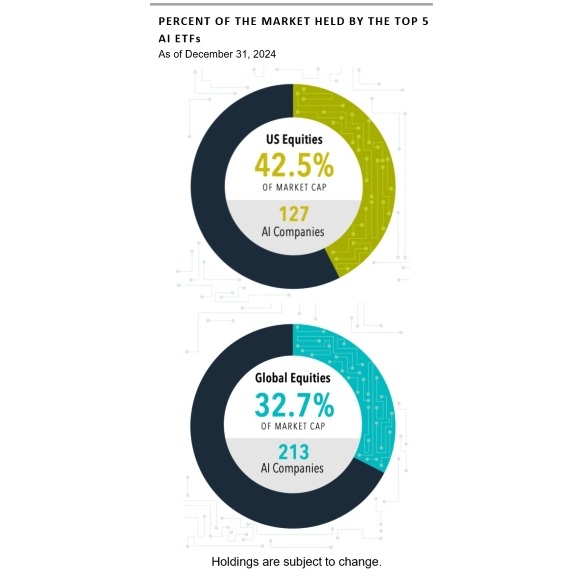
Percent of Market Held by Top 5 AI ETFs

While the world debates how to invest in AI, the truth is simpler—and far more reassuring: you already own it.

Through a well-diversified portfolio of global businesses, you indirectly own hundreds of companies applying AI to become faster, smarter, and more efficient. From NVIDIA to Honeywell to Caterpillar, innovation isn’t a sidecar—it’s embedded in the very fabric of modern enterprise. And for long-term investors, the surest way to benefit from AI’s growth isn’t speculation—it’s ownership.

The rise of AI has inspired new funds and flashy tickers, but according to Dimensional’s research, the five biggest AI-focused ETFs (AIQ, BOTZ, QTUM, ARKQ, and ROBT) already include more than 40% of the entire U.S. stock market. Owning a broad, diversified portfolio already gives you exposure to hundreds of companies using or developing AI—you don’t need to chase new “AI-only” funds to benefit from the trend.

This underscores a comforting truth: investors don’t have to predict which company becomes the next great innovator. A globally diversified portfolio naturally captures the growth of AI and other technologies as they spread across industries. The winners of tomorrow are often found in places few expect today, from industrials and logistics to healthcare and finance.

Gold: The Eternal Mirage of Safety

This year, gold joined AI in the headlines, breaking record highs and rekindling old fascinations. Like AI, it stirs emotion. But unlike AI, gold doesn’t innovate, hire, or compound. It simply sits there.

In his 2012 Fortune essay “Why Stocks Beat Gold and Bonds,” Warren Buffett imagined all the world’s gold—then about 170,000 metric tons—as a 68-foot cube that could fit neatly inside Yankee Stadium’s infield. At that time, the cube was worth about $9.6 trillion. For the same amount, Buffett wrote, one could buy every acre of U.S. farmland (roughly 400 million acres producing $200 billion a year in crops), sixteen ExxonMobils (each earning over $40 billion a year), and still have $1 trillion in “walking-around money.” The gold cube, by contrast, would just sit there. Buffett quipped, “You can fondle the cube, but it will not respond.”

Fast-forward to 2025. At $4,000 per ounce, that same cube—now around 212,000 metric tons—is worth roughly $27 trillion. That’s enough to buy every acre of U.S. farmland plus Apple, Microsoft, and Amazon combined—with change left over. Yet the cube still produces nothing.

If you own an ounce of gold for 100 years, you will still own one ounce at the end. That is its essence—its appeal and its limitation alike. It’s permanent, inert, and emotionally reassuring but financially unproductive.

History bears this out. In 1980, gold traded at $800 per ounce and has increased about 5× to $4,000 per ounce today. Contrast that with $800 invested in large-cap US stocks in 1980, which, with dividends reinvested, would have grown to $141,000, yielding a 176× total return and a 12% annual compound return.
Melt Ups, Behavior, and the “Greater Fool”

The desire to own what everyone else is buying runs deep. Whether it’s AI stocks or gold coins, the underlying impulse is the same—a search for safety, belonging, and certainty.

Behavioral finance has documented this truth repeatedly: investors feel the pain of losses roughly twice as strongly as the pleasure of gains. That imbalance helps explain why people sell in downturns and buy in melt-ups.

The risk during melt-up phases is that you feel you’re missing out on gains others seem to be making, and you buy assets mainly because they have gone up in price without understanding their intrinsic value or fundamentals. Too often, this leads to buying after assets become overpriced—just before a correction or long drawdown.

The Quiet Power of Productive Assets

At TAGStone, our philosophy has never changed: own productive assets, maintain balance, and let time work for you. Stocks represent real businesses creating real goods and services. Bonds represent loans to those businesses and governments. Both have a purpose. Together, they form a resilient system designed to protect purchasing power and generate growth through compounding.

Your edge as a long-term investor isn’t superior information or faster trades. It’s temperament—the ability to stay rational when the crowd isn’t. Buffett has often said that “the stock market is designed to transfer money from the active to the patient.” Every quarter offers fresh evidence that he’s right.

The excitement around AI and gold tells us more about investor psychology than about either asset. If the melt-up phase turns into a market blow-off, watch out for the urge to buy into truly speculative assets. Just as Microsoft, Apple, and Amazon rose from the ashes of the dot-com bust, this cycle will produce some truly profitable companies, but mixed in with those gems will be some busts. As mentioned above, your globally diversified portfolio already owns AI and will continue—quietly and tax‑efficiently—to accumulate the winners as they emerge.

A Final Word

Every cycle arrives with a new rationale for why “this time is different.” Yet history always rhymes. The same impulses that drove investors toward dot-coms in 1999, or toward gold in 1980, are at work again. Technology will continue to reshape our world, and gold will continue to glitter when anxiety rises. But the enduring truths of investing remain the same: productive assets compound, human nature overreacts, and patience wins.

In a world chasing the next big thing, the real opportunity lies in doing what few others can—staying calm, disciplined, and focused on what endures. The crowd will always rush in. The patient investor simply lets them pass.


Past performance does not guarantee future results. All investments include risk and have the potential for loss as well as gain.

Data sources for returns and standard statistical data are provided by the sources referenced and are based on data obtained from recognized statistical services or other sources we believe to be reliable. However, some or all information has not been verified prior to the analysis, and we do not make any representations as to its accuracy or completeness. Any analysis nonfactual in nature constitutes only current opinions, which are subject to change. Benchmarks or indices are included for information purposes  only  to  reflect  the  current  market  environment;  no  index  is  a directly  tradable investment.  There  may  be  instances  when  consultant  opinions  regarding any fundamental or quantitative analysis do not agree.

The  commentary  contained  herein  has  been  compiled  by  W.  Reid Culp,  III  from  sources  provided  by  TAGStone  Capital,  as well  as  commentary  provided  by  Mr.  Culp,  personally,  and  information independently  obtained  by  Mr.  Culp.  The  pronoun  “we,”  as  used  herein,  references collectively the sources noted above.

TAGStone Capital, Inc. provides this update to convey general information about market conditions and not for the purpose of providing investment advice. Investment in any of the companies or sectors mentioned herein may not be appropriate for you. You should consult your advisor from TAGStone or others for investment advice regarding your own situation.


25 Years / Seven Panics - What We’ve Learned

It’s our pleasure to report on the progress of your long-term financial plan through what proved to be a highly instructive first half of 2025. If markets seemed unusually dramatic, it's only because they were, but not in ways unfamiliar to seasoned investors.

Let me begin by restating a few principles that have guided us well for many years. These are not predictions or short-term tactics; they are the bedrock beliefs that drive every investment decision we make on your behalf:

  • We are goal-focused and plan-driven investors, which means we build portfolios not around forecasts or opinions about the economy, but around your personal financial goals, and we stick with those portfolios through thick and thin.
  • We don’t pretend to know what the market will do this month or this year, and we don’t think anyone else can know either. The idea that you can move in and out of markets after fees, taxes, and commissions successfully over time isn’t just unlikely—it’s been proven time and again to be a losing game.
  • We believe the best way to benefit from the long-term compounding power of equities and high-quality bonds is to own them continuously in a disciplined allocation aligned with your plan, not occasionally when conditions seem favorable.
  • Market declines, while uncomfortable, are a normal part of the journey. Our bond holdings are there to cushion the ride, and dividends—especially when reinvested—allow us to buy more shares when prices are low. That’s not a problem; that’s an opportunity in disguise.

The First Half of 2025

If you had looked at the market on January 2 and again on June 30, you might have thought very little had transpired. And yet, beneath the surface, the markets served up another master class in the emotional nature of investing.

US large-cap stocks hit an all-time high in February, only to drop nearly 22% intraday by early April. The spark? A sudden tariff escalation announced by President Trump. Panic arrived quickly—as it always does—but, like most panics, it didn’t stay long. Once the policy was paused, markets rebounded with equal speed, reminding us again that reacting to headlines is rarely a sound investment strategy.

Meanwhile, the fundamentals didn’t change. The economy remained solid, inflation showed signs of moderation, and well-diversified portfolios, including international holdings, delivered respectable results. Our takeaway? Volatility is not the enemy; abandoning a sound plan is.

Seven Panics in 25 Years

As I discussed with many of you in the days following the April 2 tariff announcement, this particular episode—though abrupt and unsettling—was hardly unique in the grand sweep of market history. While the flavor of each panic may differ, the emotional arc remains the same: fear rises, headlines scream, and investors begin to doubt what they knew just weeks earlier.

We live in a world where crises compete for our attention. In today’s nonstop news cycle, it’s easy to forget just how many moments of market turmoil we’ve lived through—and just how temporary they have all proven to be. It’s not that risks weren’t real; they were. However, each of these past episodes presented us with a choice: to stick to our long-term plan or to abandon it in pursuit of temporary safety, which often comes at a steep long-term cost.

In just the past 25 years, markets have delivered seven major panic attacks. Each felt unique and terrifying in the moment. But they all had the same outcome: the crisis passed, businesses endured, and equities resumed their enduring advance.

Let’s revisit each briefly:

  • Panic #1: The Dot-Com Bubble (2000–2002)

A long and productive bull market throughout the 1980s and 1990s—fueled by innovation, deregulation, and disinflation—ultimately gave way to speculation. Investors rushed into internet-related companies, many of which had little more than a website and a press release. US large-cap stocks peaked in March 2000 and fell nearly 50% over the next two and a half years.

The burst of the tech bubble was only part of the story. The September 11 attacks in 2001 shocked the nation, and a series of corporate scandals—Enron, WorldCom, Tyco—shook confidence in financial reporting. The result was a rare moment in modern investing when people stopped believing the numbers. But those who stuck with diversified portfolios saw markets recover, setting the stage for another long expansion.

  • Panic #2: The Global Financial Crisis (2007–2009)

This panic was different in kind, not just degree. Years of overleveraged mortgage lending and opaque financial engineering came to a head in 2008. When Lehman Brothers failed, the entire credit system seized up. Banks didn’t trust each other. Money market funds broke the buck. Even seasoned investors were unsure what might come next.

The stock market declined more than 56% over 17 months, and the recession that followed was the worst since the Great Depression. But here again, the American economy proved resilient. Extraordinary measures by the Federal Reserve and Congress helped stabilize the system, and over the years that followed, patient investors were rewarded with one of the strongest bull markets in history.

  • Panic #3: The European Debt Crisis (2011)

With the scars of the financial crisis still fresh, fears emerged over whether heavily indebted European nations like Greece, Italy, and Portugal might default—and whether the euro itself could survive. Meanwhile, back home, political brinksmanship over the U.S. debt ceiling led to the first-ever downgrade of U.S. Treasury debt by a major rating agency.

For several months, the markets churned. US large-cap stocks dropped nearly 20%, and investors once again faced unsettling headlines about systemic risk. However, the crisis once again passed. The euro endured. The U.S. honored its obligations. And equity markets resumed their climb.

  • Panic #4: The Christmas Eve Massacre (2018)

This episode might be the most forgotten, but it felt very real in the moment. Amid escalating trade tensions with China, repeated rate hikes from the Federal Reserve, and a prolonged government shutdown, markets grew increasingly nervous.

By Christmas Eve, fear was peaking. US large-cap stocks had fallen nearly 20% in just three months. The President publicly criticized the Fed chair. Investors feared the economy was headed for a recession. But almost as quickly as it had begun, the panic lifted. Markets rebounded strongly in early 2019, and fears of imminent collapse faded into memory.

  • Panic #5: COVID-19 Pandemic (2020)

This was the fastest bear market in history. In just 33 days, US large-cap stocks lost a third of their value as the world shut down to confront an unfamiliar virus. Restaurants closed, flights were canceled, schools emptied, and offices went remote.

And yet, just one month after the market bottomed, it had already regained a meaningful portion of its losses. By August, stock indices were hitting new highs. Unprecedented monetary and fiscal support helped. But what mattered most was something simpler: businesses adapted, innovation accelerated, and markets—as they always do—looked ahead.

  • Panic #6: Inflation & Fed Tightening (2022)

After years of calm prices, inflation roared back in 2022. A combination of pandemic stimulus, disrupted supply chains, and energy price spikes pushed inflation above 9%—a level not seen in nearly four decades. The Fed, initially slow to respond, raised interest rates at a historic pace.

The impact was swift and painful. Both stocks and bonds declined sharply. A traditional 60/40 portfolio had its worst year since 1937. But in time, inflation began to moderate, markets found their footing, and those who stayed invested saw conditions begin to improve.

  • Panic #7: The Tariff Typhoon (2025)

This most recent episode may still be fresh in your memory. The April 2 announcement of sweeping tariffs from President Trump caught markets off guard, triggering a swift and sharp decline. At one point, US large-cap stocks were down more than 21% intraday.

But just days later, after a delay in implementation was announced, the market bounced back. It’s a familiar pattern. Policy surprises, political headlines, and market corrections come and go. What endures are the earnings of resilient companies and the power of long-term compounding.

How We Help Clients During Market Panics

The panics always feel different. They usually arrive from a corner of the world we weren’t watching. They feel unresolvable—until suddenly, something shifts, a circuit breaks, and confidence returns. Then, seemingly overnight, the market stops falling and starts sprinting upward. And by the time it’s clear the panic is over, those who sold often find themselves permanently behind.

Time and again, the turning point comes not after all the uncertainty has lifted, but while the uncertainty still looms large. And that’s the crux of it: the moment of maximum fear is almost always the point of maximum opportunity.

Think back to some of those turning points:

  • In March 2009, the Financial Accounting Standards Board relaxed the mark-to-market rules that were driving banks to the brink. The market exploded upward.
  • In December 2018, President Trump promised not to fire Fed Chair Jerome Powell. The market reversed on a dime.
  • In March 2020, the Fed launched an unlimited bond-buying program in response to COVID. Panic turned to euphoria.
  • In April 2025, President Trump delayed new tariffs. Another swift reversal.

So, when the next panic arrives—as it surely will—you and I must remember what’s at stake because the real risk in those moments isn’t that the market will go down further. The real risk is that it will go back up—and do so without you. The most painful losses aren’t those that come from holding quality businesses and bonds through a downturn. They’re the gains missed by those who exit at the bottom and hesitate to return.

In those moments, our job is to help you stay focused on what matters. Not the noise. Not the headlines. But the long-term plan we’ve built together, and the wonderful businesses working every day to make that plan a reality.

Is Gold a Safe Haven?

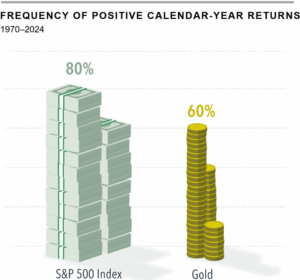
Gold, for example, has been back in the headlines. It has had a strong run year-to-date, and as always in volatile times, some investors view it as a safe haven—a stabilizer when markets become choppy. But that narrative often glosses over the full picture. Gold has experienced numerous drawdowns of its own, and historically, it has been positive in only 60% of calendar years since 1970. By contrast, U.S. large-cap stocks have finished in the black 80% of the time over the same span. Gold doesn’t produce earnings, pay dividends, or fuel innovation. It just sits there. And when it comes to building long-term wealth, the companies doing the building may be a safer bet.

Large Stocks vs. Gold

US Large Cap Stocks vs. Gold - Frequency of Positive Calendar-Year Returns

What We Have Learned

Wealth management, at its core, is a continual battle against human nature. That’s why we remind you again and again—not because you haven’t heard it before, but because we know how easy it is to forget in the fog of panic.

The “25 years / 7 panics” framework is not just history. It’s a tool. Use it. Keep it close. And when the next crisis comes—as surely it will—remember: this, too, shall pass. And when it does, those who held fast to their balanced portfolio—who understood that you can’t separate the long-term compounding power of equities from the short-term discomfort they often bring—will be in the strongest position to move forward. As always, we recommend a portfolio that is anchored by an appropriate mix of stocks and high-quality bonds, tailored to your unique goals, liquidity needs, and risk tolerance.

If you have friends or family who are feeling uneasy about their finances or simply want a steadier hand to help guide their long-term plan, please feel free to share this letter with them. Sometimes a little perspective can make a big difference.

Thank you for the continued trust you place in us. As always, we welcome your thoughts, your questions, and the opportunity to continue walking alongside you in the months and years ahead—with quiet confidence and disciplined optimism.


Past performance does not guarantee future results. All investments include risk and have the potential for loss as well as gain.

Data sources for returns and standard statistical data are provided by the sources referenced and are based on data obtained from recognized statistical services or other sources we believe to be reliable. However, some or all information has not been verified prior to the analysis, and we do not make any representations as to its accuracy or completeness. Any analysis nonfactual in nature constitutes only current opinions, which are subject to change. Benchmarks or indices are included for information purposes  only  to  reflect  the  current  market  environment;  no  index  is  a directly  tradable investment.  There  may  be  instances  when  consultant  opinions  regarding any fundamental or quantitative analysis do not agree.

The  commentary  contained  herein  has  been  compiled  by  W.  Reid Culp,  III  from  sources  provided  by  TAGStone  Capital,  as well  as  commentary  provided  by  Mr.  Culp,  personally,  and  information independently  obtained  by  Mr.  Culp.  The  pronoun  “we,”  as  used  herein,  references collectively the sources noted above.

TAGStone Capital, Inc. provides this update to convey general information about market conditions and not for the purpose of providing investment advice. Investment in any of the companies or sectors mentioned herein may not be appropriate for you. You should consult your advisor from TAGStone or others for investment advice regarding your own situation.


Investing Through Uncertainty and Volatility

The first quarter of 2025 served as another vivid reminder that while history doesn’t repeat itself in investing, it often rhymes.

We entered the year amid considerable volatility, as the largest technology stocks fell into bear market territory, triggering the seventh-fastest 10% correction in the S&P 500 since 1929. This correction gained momentum following President Trump’s tariff announcement on April 2. Although the implementation of these measures was later postponed for 90 days—now set for July 9—the delay has not resolved the underlying uncertainty. The market has staged a partial rebound, but sentiment remains fragile.

At the heart of this volatility is a familiar challenge—how to make confident, informed decisions in the face of economic uncertainty. Just as businesses struggle to operate under constantly shifting conditions, investors too are tested when predictability disappears. This challenge lies at the core of the current market correction.

Of course, periods of turmoil—however unsettling—are nothing new. We’ve navigated them before. Think back to early 2020, when the onset of COVID-19 sparked a swift and brutal decline, with large U.S. stocks plunging 34% in just 33 days amid fears that companies might indefinitely lose their ability to generate profits. That left investors with a critical question: had the world’s strongest businesses really lost a third of their value—or was the market simply overreacting?

History gave us a clear answer. Fueled by aggressive monetary and fiscal stimulus, markets not only rebounded within five months, but went on to compound at nearly 20% annually over the next five years.

Today, amid renewed uncertainty driven by tariffs and global trade tensions, investors face a strikingly similar dilemma: will tariffs cause lasting harm to the long-term earning power of the world’s leading enterprises—or is this another moment when market prices are diverging from economic reality?

We’ve seen this pattern before. During the 2008–2009 Global Financial Crisis, markets dropped 57% at the peak of panic, with the global financial system hanging by a thread. And yet, from that extreme low point, large U.S. stocks delivered a remarkable 16% annualized return over the following sixteen years—fueled by innovation, resilience, and the strength of global enterprise.

As of this writing, a broad basket of large U.S. stocks is roughly 10% off its recent peak—returning us to levels last seen in September 2024. In long-term context, that’s hardly catastrophic. But it’s during moments like these—when fear is elevated—that investors often feel compelled to “do something,” even when doing nothing may be the wiser course.

Fortunately, we can look to historical data for perspective. Periods of heightened volatility, especially those marked by spikes in the VIX (the “fear index”), have often signaled compelling long-term opportunities. Since 1990, when the VIX has closed above 45—as it did on April 4—the average return over the next 12 months has been 39%, with a five-year average return of 139%. That’s not a prediction, but a reminder: fear and opportunity often travel together.

How to Operate in Periods of Maximum Uncertainty

Periods like the one we’re in now are characterized by a wide range of potential outcomes, unreliable or incomplete information, and a heightened emotional atmosphere. These dynamics distort judgment, often pushing people to one of two extremes: freezing in indecision or overreacting in an effort to regain control.

Even the most experienced and well-informed experts cannot reliably forecast how or when today’s uncertainty will resolve. The future is, by its nature, unknowable and influenced by countless factors beyond any individual’s control.

That’s why, in moments like these, long-term investors face a fundamental choice: chase the illusion of clarity or lean on the structure and discipline that have guided successful investors through past crises. We choose the latter.

We ground our approach in a set of enduring principles:

  1. Even in calmer times, markets and economic trends cannot be consistently forecast or timed.
  2. No one—not experts, strategists, or headlines—knows exactly how or when today’s uncertainties will be resolved.
  3. Your portfolio is built on a long-term investment plan tailored to your unique goals, not on short-term speculation.
  4. Your investment and withdrawal strategy is designed for resilience and is based on tests of similar strategies through past market cycles.

In light of these realities, the wisest course of action is to remain grounded in your plan. The strength of our strategy lies not in reacting to every headline, but in maintaining clarity and composure through both calm and turbulent times.

Wealth Management Principles

The challenges of this year have once again reaffirmed the core wealth management principles we outlined in February’s year-end letter. These principles haven’t changed. They continue to serve clients well across every market cycle.

We’ve long emphasized the importance of broad diversification, steering clear of speculative bets and the temptation to chase investment fads. At times—especially last year—this discipline may have felt like driving in the slow lane while faster-moving trends surged ahead. But recent volatility has reminded us that staying the course is often what ultimately keeps investors safely on track.

In that same spirit, we encouraged portfolio rebalancing earlier this year. This simple yet powerful discipline—selling what’s become overweight and buying what’s become underweight—often runs counter to our instincts. It can feel uncomfortable to trim recent winners and add to laggards. Yet this very act of “buying low and selling high” is what positions long-term investors for resilience when markets turn volatile.

We also cautioned that fully valued markets are more susceptible to shocks. Persistent inflation and unpredictable trade policy were two risks we identified as being underappreciated earlier in the year. Both have since materialized—reinforcing the value of maintaining cautious optimism even in seemingly strong markets.

Finally, it’s essential to recognize that volatility is not a deviation from the norm—it’s an expected part of stock investing. Historically, markets experience at least one meaningful correction per year, averaging around 15%, and a deeper downturn about once every five years. These are not market malfunctions—they are the price of admission for the long-term growth stocks have historically delivered. Investors who internalize this truth often find that patience, not panic, is their most valuable ally.

Stocks for the Long-Run--But Not Always

While every significant market downturn has ultimately proven temporary, it’s important to acknowledge that the path is not always smooth. Across wars, recessions, pandemics, and political upheaval, publicly traded businesses—both in the U.S. and globally—have not only recovered, but often emerged stronger. This enduring resilience is why we invest in them for the long term.

Still, long-term investing doesn’t mean uninterrupted progress. Even Jeremy Siegel—the renowned Wharton professor and author of Stocks for the Long Run—has noted that stocks, while unmatched over time, have endured long periods of underperformance. From 1966 to 1982, for example, stocks produced essentially no real return, while cash and bonds outpaced them. Similar stretches occurred in the 1920s and early 2000s. And more recently, Professor Edward McQuarrie’s expanded research, dating back to 1793, has identified several additional multi-decade periods when bonds delivered better returns than stocks.

These insights reinforce a key lesson: long-term investing requires not just optimism, but balance. A diversified portfolio—including bonds or reliable sources of cash flow—provides critical support during periods when stocks may lag. That balance becomes especially important for investors who may not have the luxury of waiting out an extended downturn.

Ultimately, the most effective strategy remains clear: stay patient, stay disciplined, and stay appropriately diversified. While we can’t predict the next headline or policy shift, we can control how we respond. Rest assured, we remain here with you—focused on guiding your portfolio through uncertainty and steadily toward your most important financial goals.


Past performance does not guarantee future results. All investments include risk and have the potential for loss as well as gain.

Data sources for returns and standard statistical data are provided by the sources referenced and are based on data obtained from recognized statistical services or other sources we believe to be reliable. However, some or all information has not been verified prior to the analysis, and we do not make any representations as to its accuracy or completeness. Any analysis nonfactual in nature constitutes only current opinions, which are subject to change. Benchmarks or indices are included for information purposes  only  to  reflect  the  current  market  environment;  no  index  is  a directly  tradable investment.  There  may  be  instances  when  consultant  opinions  regarding any fundamental or quantitative analysis do not agree.

The  commentary  contained  herein  has  been  compiled  by  W.  Reid Culp,  III  from  sources  provided  by  TAGStone  Capital,  as well  as  commentary  provided  by  Mr.  Culp,  personally,  and  information independently  obtained  by  Mr.  Culp.  The  pronoun  “we,”  as  used  herein,  references collectively the sources noted above.

TAGStone Capital, Inc. provides this update to convey general information about market conditions and not for the purpose of providing investment advice. Investment in any of the companies or sectors mentioned herein may not be appropriate for you. You should consult your advisor from TAGStone or others for investment advice regarding your own situation.


Year-End Update

I am pleased to report on another year of steady progress toward your most important financial goals. Our strategy—one grounded in patience and discipline—remains unchanged. We don’t make decisions based on economic forecasts or market predictions and won’t start now. Instead, we stick to what works: owning attractive businesses and high-quality fixed income and allowing time and compounding to do their work.

The past year rewarded those who stayed diversified, though a handful of technology stocks grabbed most of the headlines. As the year closed, we saw signs that other sectors might finally be getting some attention, but trying to predict leadership shifts is a fool’s errand. The best strategy remains the simplest: stay invested, rebalance when needed, and let your portfolio do the heavy lifting.

A Lesson in Market Cycles

“Speculation is most dangerous when it looks easiest.”

—Warren E. Buffett

The markets, like the seasons, follow a familiar rhythm. Euphoria breeds excess, excess leads to reckoning, and from that reckoning emerges opportunity—though few recognize it at the time. Over the years, I have spent more ink cautioning investors about the perils of bear markets rather than celebrating bull markets because discipline is tested in tough times. However, as evidenced by today’s somewhat stretched valuations, let’s talk about the other great pitfall: the fear of missing out (FOMO).

There are two moments that shake investors to their core. The first is when a bear market reaches its final, gut-wrenching phase—when despair is so thick that even sensible people consider throwing in the towel. At that moment, the intrinsic value of attractive companies is quietly rising in relation to their falling stock prices. And yet, the temptation is to believe: This time is different. This is the end.

The second—and possibly more dangerous—moment is when markets soar, optimism is boundless, and prices defy gravity. Suddenly, trees are expected to grow to the sky, and investors forget that every great technological breakthrough, from the railroad to the internet, has followed the same trajectory: from miracle to commodity. And yet, the chorus sings: This time is different. This is a new era.

During such times, rational investors face an irrational urge to abandon a carefully constructed, broadly diversified portfolio and chase what has doubled or tripled in a year. It feels safe—after all, the crowd is doing it—but history has shown that few strategies are more reliable at destroying wealth than performance-chasing.

Price is What You Pay; Value is What You Get

I have always maintained that while prices fluctuate, true value endures. I remain optimistic about the long-term prospects of our global economy. Innovation drives progress, businesses expand, and hardworking people continue to build the future. The secret isn’t to chase last year’s hottest stock; it’s to acquire a well-balanced collection of attractive businesses—whether they're large or small, from various industries and corners of the world. A diversified portfolio, maintained in proper proportions and adjusted when needed, is about as close as you can get to a reliable recipe for long-term success.

Too often, investors stray from their disciplined allocations, piling into stocks simply because their prices have been on a tear. This approach prioritizes price momentum over intrinsic value. A stock that’s risen sharply might not be a bargain if its price no longer reflects its inherent worth. While chasing rising prices might boost short-term returns, it also increases the risk of holding overvalued companies, particularly if revenues, cash flows, or earnings falter.

“The investor of today does not profit from yesterday's growth.”

—Warren E. Buffett

Consider U.S. large-cap tech stocks as an example. These companies have enjoyed an impressive 15-year run. However, history shows that overconcentration in any asset class—especially one with lofty valuations—often leads to below-average returns over the next decade. Chasing yesterday’s winners is effectively betting that past trends will continue uninterrupted. Often, investors end up paying a premium for what has already been realized.

Howard Marks of Oaktree Management highlighted a J.P. Morgan Asset Management graph that illustrates this point. The graph, covering monthly data from 1988 through late 2014, shows the forward P/E ratio on the S&P 500 at the time and the annualized return over the subsequent ten years. This data reveals some key insights:

  • There is a strong relationship between starting valuations and subsequent ten-year returns. Higher starting valuations consistently lead to lower returns and vice versa.
  • Today’s P/E ratio is firmly in the top decile of observations.
  • During that 27-year period, when the S&P 500 was bought at P/E ratios similar to today’s multiple of 22, subsequent ten-year returns ranged from +2% to -2%.

In November, several leading banks projected ten-year returns for the S&P 500 in the low- to mid-single digits. This relationship between price and returns explains their outlook. The return on an investment is significantly influenced by the price paid for it. Therefore, investors should not ignore today’s market valuation when making decisions.

When Horses Turn to Mice

As we reflect on the solid returns of 2023 and 2024, it’s easy to think that a lower expected return for stocks might not be so bad. That’s certainly true if the market were to plateau for the next decade while earnings grow and valuations come back to earth. But before you get too comfortable with that view, consider an alternative: a sharp correction, where market multiples compress rapidly in just a year or two—something akin to the market declines of 1973-74 or 2000-02. This wouldn’t be a “benign” scenario.

Let’s revisit some key lessons from recent years:

  • 2022: Inflation surged to 9%, prompting the Federal Reserve to raise interest rates sharply. The outcome? It was a devastating year for the traditional 60/40 portfolio, which posted its worst performance since 1937.
  • Tech stocks in 2022: These fell by 36%, a sharp contrast to the broader market’s 25% drop.
  • 2020: A global pandemic triggered a near-total shutdown of the economy, sending the market down by 34% in just 33 days.

The big takeaway? Markets rise, and markets fall, often without warning. As investors, we don’t need to predict every twist and turn; instead, we prepare for the inevitable ups and downs that come with the territory.

The Ritual of Rebalancing

There’s an old saying: The stock market is designed to transfer money from the impatient to the patient. And if there’s one discipline that ensures you stay on the right side of that transfer, it’s rebalancing.

Rebalancing isn’t exciting. It won’t make headlines, and nobody brags about selling a high-flyer to buy bonds or an undervalued stock at a cocktail party. But make no mistake—it’s an effective tool that helps investors keep emotions in check and stay the course. By systematically trimming what’s soared and reinvesting in bonds or underweighted stock positions, you keep your emotions in check and resist the temptation to chase performance.

Of course, rebalancing isn’t a magic trick that guarantees success overnight. Instead, it’s the final step in a series of rational decisions made when you set up your investment plan. Those decisions were:

  1. Determine your risk profile. Understand how you feel about and have reacted to price volatility. If you don’t know how you will respond in the future, any portfolio mix will work—but probably not the one you want.
  2. Build a portfolio that aligns with your risk profile. Assemble a mix of stock and bond assets that match your risk profile.
  3. Commit to the plan. Stick with your predetermined asset allocations throughout your investing journey (unless your goals change). Don’t let fads, crowds, or market manias steer you off course.
  4. Be a long-term investor. Attractive businesses create value over years, not weeks. To avoid chasing performance, own a broadly diversified and appropriately weighted portfolio of attractive businesses and high-quality fixed income.
  5. Accept that downturns are part of the deal. Build and maintain your bond positions during bull markets so you can rely on them during the occasional stock market storm. This is the price of earning long-term equity returns.
  6. Tune out the noise. Media headlines and marketplace chatter will always try to make you act. Your job is to stick to your plan and let your investments do the work.
  7. Rebalance when necessary. Do it not when it feels comfortable but when your disciplined approach calls for it.

Rebalancing often feels counterintuitive. Selling what’s been performing well and buying what appears to be lagging isn’t the natural impulse for most, but that’s exactly why it works.

The Sixty-Two-Year Lifetime Scorecard

While performance chasing and valuations may be things to worry about in the short term, the long-term outlook for business remains bright. To affirm this point, let’s consider the lifetime investment scorecard for someone approaching retirement—i.e., the performance of mainstream U.S. equities over the last 62 years.

If you were born in 1963, you’ve lived through wars, recessions, inflation spikes, and technological revolutions. You’ve seen good times and bad times, booms and busts. And yet, despite it all:

  • The price of mainstream U.S. equities has risen 78-fold.
  • Annual dividends have grown from $2.35 in 1963 to $73.40 in 2024.
  • Inflation has climbed from 31 to 318—a nearly tenfold increase.

For someone turning 62 this year, investing in a balanced portfolio of high-quality fixed income and a diversified mix of attractive businesses has been one of the simplest, most effective ways to build real wealth—without needing to predict what would happen next.

As we enter 2025, we wish all our clients and friends—because to us, they’re one and the same—a happy, healthy, and prosperous new year. Thank you for your trust. It is a privilege to serve you.


Past performance does not guarantee future results. All investments include risk and have the potential for loss as well as gain.

Data sources for returns and standard statistical data are provided by the sources referenced and are based on data obtained from recognized statistical services or other sources we believe to be reliable. However, some or all information has not been verified prior to the analysis, and we do not make any representations as to its accuracy or completeness. Any analysis nonfactual in nature constitutes only current opinions, which are subject to change. Benchmarks or indices are included for information purposes  only  to  reflect  the  current  market  environment;  no  index  is  a directly  tradable investment.  There  may  be  instances  when  consultant  opinions  regarding any fundamental or quantitative analysis do not agree.

The  commentary  contained  herein  has  been  compiled  by  W.  Reid Culp,  III  from  sources  provided  by  TAGStone  Capital,  as well  as  commentary  provided  by  Mr.  Culp,  personally,  and  information independently  obtained  by  Mr.  Culp.  The  pronoun  “we,”  as  used  herein,  references collectively the sources noted above.

TAGStone Capital, Inc. provides this update to convey general information about market conditions and not for the purpose of providing investment advice. Investment in any of the companies or sectors mentioned herein may not be appropriate for you. You should consult your advisor from TAGStone or others for investment advice regarding your own situation.


The Constants in a Changing World

“The first rule of compounding is to never interrupt it unnecessarily.”

—Charles T. Munger

As we navigate a world of shifting dynamics, it’s wise to stay grounded in the fundamentals. Inflationary pressures look likely to persist, as government deficits in many developed countries are outpacing economic growth. This kind of environment can erode purchasing power, especially for those in fixed-income investments. In times like these, preserving real financial stability becomes increasingly challenging, and it calls for a focus on long-term strategy rather than reactionary moves.

Our global landscape has changed notably, with recent events in Eastern Europe marking the end of the predictability that shaped the past few decades. We’re facing an era where economic cycles and geopolitical surprises are the norm. But just as we’ve done through past crises—the financial crisis of 2008, the COVID-19 pandemic, and others—we’ll find a way through. The real risk for us isn’t in what the markets might do tomorrow, but in how we might respond to market downturns.

Despite uncertainties, one truth remains: well-run businesses continue to adapt and create long-term value for their shareholders. That’s why staying focused on the strategy we’ve developed matters. We’ve built your equity-based plan with an eye on inflation and growth, so you can meet your goals regardless of what headlines might suggest. Maintaining discipline today is the best preparation for tomorrow.

Staying Resilient in an Uncertain World

It’s hard to escape the noise these days—constant economic reports, market fluctuations, and political developments. We recently saw the S&P 500 drop over 6% in early August, with the CBOE VIX Index spiking to levels unseen since COVID. While unsettling, such volatility is not a reliable predictor of poor returns; historically, periods of high volatility often precede growth. Still, understanding this and experiencing it are two different things.

Success in investing—and in life—requires resilience. Nassim Taleb’s idea of being “antifragile”—thriving in adversity—is something to embrace. A solid plan feels reassuring in stable times, but it’s during downturns that the real test comes. Emotional intelligence, or EQ, counts just as much as knowing the numbers. By staying focused on your plan and tuning out the noise of temporary disruptions, you’re better positioned to see beyond the daily headlines and stay on track.

Understanding the Role of Humane Nature

Before diving into the specifics of our approach, let’s address a constant that can often lead us astray: human nature. Markets may be uncertain, but they’re not our greatest challenge—our instincts are. When markets swing, the urge to sell is strong, especially when headlines turn negative. However, panic selling—unloading quality assets at low prices—is one of the quickest ways to miss out on long-term gains.

Consider this:

  • In most areas of life, a lower price signals a bargain, but in investing, falling prices are often seen as a sign of rising risk.
  • Research shows that we feel the pain of losses twice as strongly as the pleasure of gains, leading us to make emotional decisions that often don’t serve us well in the long run.

Recognizing these natural impulses doesn’t guarantee we’ll overcome them. Doing that takes discipline, patience, and the understanding that “this time” usually isn’t different. True investment success comes from working with these patterns, not against them.

The Plan: Anchoring Your Strategy in Fundamentals

Knowing our natural tendencies, how do we build a resilient plan? Here are seven pillars to guide us:

  1. Align with Long-Term Goals: While maximizing returns is important, your portfolio should align with your family’s broader financial objectives. It should advance steadily, incorporating strategies like dollar-cost averaging, dividend reinvestment, and rebalancing.
  2. Trust the Plan Through Down Markets: Market declines are temporary. History shows that markets recover, and those who stay the course are rewarded over time. Believing in this and staying the course is crucial.
  3. Harness the Power of Compounding: Compounding is a quiet but powerful force in portfolio growth. The earlier we start, the more profound the effect. Consider two investors, one starting at 30 and the other at 40, both investing $10,000 annually. Assuming a 7% return, the early investor accumulates significantly more by age 65, underscoring the exponential impact of compounding.
  4. Rely on Equities for Income Growth: Equities don’t just build wealth; they also grow income. As businesses grow their earnings, they often raise dividends, which help protect against inflation. Since 1960, dividends on large U.S. stocks have compounded at nearly 6%, preserving purchasing power over time.
  5. Focus on Total Return: Dividends and interest are only part of the picture. Total return—capital gains plus income—is what ultimately drives wealth accumulation. Companies that reinvest in their business or buy back shares can increase their stock price, further building value.
  6. Minimize Taxes: Selling assets to avoid short-term volatility can lead to hefty tax bills. Short-term “paper losses” usually recover in a well-diversified portfolio, but you typically cannot recover the tax you paid on gains.
  7. Review Your Asset Allocation: With market valuations historically high, make sure your asset allocation aligns with your risk tolerance. If you’re overweight in stocks, rebalancing into bonds may be timely and help you avoid selling stocks during a market downturn.

Preparing for the Next Market Downturn

When markets are climbing, it’s easy to feel confident. But the real test—the one that separates speculators from investors—comes during downturns. Historically, large U.S. stocks see annual declines of around 15%, with steeper drops of 30% roughly every five years, and even a few major declines of 50% in the past 50 years. Yet over the long term, balanced portfolios have returned 6–10%, rewarding those who stick to their plan.

Each share you own represents a real business with employees, customers, and products. A downturn is simply a sale on these ownership stakes. Long-term investors see these periods as chances to acquire more of these businesses at a discount, confident that prices will eventually recover.

So, next time the market takes a dip, look around. Notice the steady hum of everyday life—the restaurants serving customers, the shops bustling with activity, the hotels with people still checking in. These reminders underscore that the world moves forward and that the companies we invest in continue to adapt and create value. In the long run, it’s those who stand firm and look for opportunity, not those who retreat, who come out ahead.

A Shared Journey

Owning shares in a company makes you more than just a shareholder—you’re a co-owner of real businesses with real opportunities. Together, we’re privileged to watch these companies through cycles of growth and downturn, always with a long-term lens. As we move forward, we’ll rely on the constants of discipline, resilience, and the power of compounding to guide us.

Thank you for your trust and commitment to the journey ahead.


Past performance does not guarantee future results. All investments include risk and have the potential for loss as well as gain.

Data sources for returns and standard statistical data are provided by the sources referenced and are based on data obtained from recognized statistical services or other sources we believe to be reliable. However, some or all information has not been verified prior to the analysis, and we do not make any representations as to its accuracy or completeness. Any analysis nonfactual in nature constitutes only current opinions, which are subject to change. Benchmarks or indices are included for information purposes  only  to  reflect  the  current  market  environment;  no  index  is  a directly  tradable investment.  There  may  be  instances  when  consultant  opinions  regarding any fundamental or quantitative analysis do not agree.

The  commentary  contained  herein  has  been  compiled  by  W.  Reid Culp,  III  from  sources  provided  by  TAGStone  Capital,  as well  as  commentary  provided  by  Mr.  Culp,  personally,  and  information independently  obtained  by  Mr.  Culp.  The  pronoun  “we,”  as  used  herein,  references collectively the sources noted above.

TAGStone Capital, Inc. provides this update to convey general information about market conditions and not for the purpose of providing investment advice. Investment in any of the companies or sectors mentioned herein may not be appropriate for you. You should consult your advisor from TAGStone or others for investment advice regarding your own situation.


Enduring Volatility: The Power of Patience in Investing

I am pleased to update you on our progress in the first half of 2024. Before examining the current market landscape, it is worth reflecting on what our disciplined approach has delivered so far.

Economic and Market Performance

The first six months of 2024 can be distilled into two key observations:

  • Modest Economic Growth: The U.S. economy has continued to grow, albeit at a measured pace.
  • Strong Equity Market Performance: The equity market has delivered impressive gains, driven by earnings growth and rising dividends.

We have seen steady economic growth, avoiding the feared recession, and job growth has held firm. Inflation has begun to ease, allowing the Federal Reserve to hold off on immediate rate cuts, although some are expected later this year. The Fed remains committed to its 2% inflation target.

Even with record-high cash dividends, large U.S. companies are paying out a smaller share of their earnings—about 37%—compared to the 30-year average of nearly 46%. This signals substantial potential for further dividend growth in the coming years.

Ultimately, the long-term value of our core investments—ownership in a diversified portfolio of successful companies—hinges on earnings and dividends. While external factors like national debt, elections, or geopolitical events can make headlines, the true drivers of value are the fundamental performances of the companies we invest in.

Recent Stock Market Volatility and Correction

Since the close of the second quarter, we have seen the stock market go through one of its periodic bouts of volatility, almost dipping into correction territory after peaking on July 16th. A correction is typically defined as a decline of 10% or more from a recent high. While often unsettling, these events are hardly unusual—they happen roughly once a year. Our investment strategy, grounded in the principles of long-term value creation, is built to withstand these inevitable fluctuations.

Historically, the average intra-year decline—the drop from the highest point to the lowest during any calendar year—has been 14.2% since 1980, reminding us that volatility is the price we pay for long-term gains.

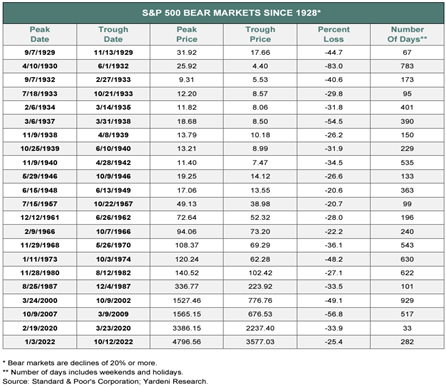
While it's possible that this correction could deepen into a bear market (defined as a 20% decline or more from the peak), predicting the extent of a decline is a fool's errand. Historically, bear markets have occurred about every four years since World War II, with the last one ending in October 2022.

No matter what happens next, our long-term equity plan has proven its worth time and again. Here are the bedrock principles that guide our approach:

  1. Investing for the Growth of Purchasing Power: Our focus is on investments that grow wealth over time, even if they come with perceived risks. Holding cash may feel safer, but it’s a surefire way to lose purchasing power. The best tool for growing wealth is owning a diversified portfolio of successful companies for the long term.
  2. Avoiding Market Timing: Trying to outsmart the market by timing one’s entries and exits is a losing game—especially after accounting for fees and taxes. The most reliable way to harness the full power of compounding is to stay fully invested.
  3. Seizing Opportunities in Market Downturns: We see market dips as opportunities, not causes for panic. Our strategy continues to work during temporary declines by reinvesting dividends and letting the power of compounding do its job. By purchasing more shares at lower prices, we amplify the powerful long-term benefits of compounding.
  4. Understanding Market Fluctuations: It is crucial to recognize that temporary declines in account value are not permanent losses of capital. They only become permanent when an investor sells out of fear.
  5. Rebalancing Periodically: Rebalancing involves trimming back asset classes that have grown beyond their target weight and reinvesting in those that have lagged, ensuring that your portfolio remains aligned with your long-term goals.

Political Turbulence and Investment Stability

It is natural to feel a bit on edge during an election year, with the usual mix of rhetoric and alarmism dominating headlines. With significant global tensions and nearly half the world’s population heading to the polls this year, the noise can seem even louder. However, history tells us that election outcomes have little to no meaningful impact on your long-term investment results.

One of the most persistent myths in investing is the belief that the outcome of the next presidential election will dictate market performance. Many people make short-term decisions based on election predictions, but countless studies have shown that neither the election result nor the occupant of the White House significantly impacts the long-term direction of the stock market.

Let us keep things in perspective with three key points:

  • It does not matter much who the president is.
  • The broad equity market goes up most of the time, regardless.
  • The best course of action is to remain invested.

Never Interrupt the Compounding

The late Charlie Munger’s wisdom rings true as ever: “The first rule of compounding is never to interrupt it unnecessarily.” There is no greater unnecessary interruption than selling in anticipation of a presidential election. With election outcomes and the events of the next hundred days uncertain, our course remains clear:

None of this should concern lifetime investors. The strategy that has always worked is to follow a consistent, long-term plan. Presidents and their policies will come and go, as they always have. But through it all, superior companies continue to serve their customers, grow their earnings, and increase their dividends. At its core, investment success is almost entirely a matter of behavior.

Maintain a Balanced Investment Approach

Our investment philosophy is guided by your most cherished lifetime financial goals, not the ebb and flow of market conditions or economic forecasts. This perspective helps us counsel you toward making prudent financial decisions that favor long-term rewards over immediate gratification. Wise choices often mean delaying indulgence—like prioritizing life insurance over a luxury car, opting for disability insurance over a family vacation, or maximizing 401(k) contributions instead of purchasing a boat.

As financial interactions become more virtual, the value of personal, behavioral advice becomes even more critical. Working with a human financial advisor offers empathy, trust, and genuine connection—qualities that virtual platforms cannot replicate. Our role is to help you stay disciplined and focused on your long-term objectives, particularly when markets turn volatile.

In most areas of life, when prices drop, people flock to buy. When prices rise sharply, they cut back or seek alternatives. Yet, when high-quality equities fall in a bear market, panic often sets in, leading to a desire to sell. Conversely, when a particular stock sector or style surges, the impulse is to buy more of it.

Over a lifetime of investing, rebalancing should yield an incremental increase in your overall portfolio return. More importantly, regular rebalancing reduces positions in asset classes that have become relatively expensive (and potentially overvalued) while increasing positions in those that are relatively cheaper (and potentially more attractive).

The key is to remember that relative price and value are inversely related. Rebalancing forces us to embrace this principle, making us better long-term investors.

Broad diversification’s supreme goal is to spread risk. Once you have settled on the ideal allocation percentages across different asset classes based on your goals, rebalancing becomes a rational method to maintain that target mix while curbing the temptation to chase past performance.

The more we embrace our humanity and connect on a personal level, the more successful and valuable our relationship will be. As we wish you a happy summer, remember that we are here to help with any questions or concerns.

By focusing on the fundamental strengths of our core assets, we can tune out the noise and reduce the risk of emotional overreaction to market fluctuations. I believe in our plan and am confident in what we own.

Thank you, as always, for being my clients. It is a privilege to serve you.


Past performance does not guarantee future results. All investments include risk and have the potential for loss as well as gain.

Data sources for returns and standard statistical data are provided by the sources referenced and are based on data obtained from recognized statistical services or other sources we believe to be reliable. However, some or all information has not been verified prior to the analysis, and we do not make any representations as to its accuracy or completeness. Any analysis nonfactual in nature constitutes only current opinions, which are subject to change. Benchmarks or indices are included for information purposes  only  to  reflect  the  current  market  environment;  no  index  is  a directly  tradable investment.  There  may  be  instances  when  consultant  opinions  regarding any fundamental or quantitative analysis do not agree.

The  commentary  contained  herein  has  been  compiled  by  W.  Reid Culp,  III  from  sources  provided  by  TAGStone  Capital,  as well  as  commentary  provided  by  Mr.  Culp,  personally,  and  information independently  obtained  by  Mr.  Culp.  The  pronoun  “we,”  as  used  herein,  references collectively the sources noted above.

TAGStone Capital, Inc. provides this update to convey general information about market conditions and not for the purpose of providing investment advice. Investment in any of the companies or sectors mentioned herein may not be appropriate for you. You should consult your advisor from TAGStone or others for investment advice regarding your own situation.


Market Reflections: The Urge to Chase Hot Trends

In recent times, our investment guidance has often stressed the importance of maintaining a steady investment strategy, even amid market fluctuations that might tempt one to react impulsively.

This year, we've witnessed a significant shift. Many broad markets have shown impressive gains, ranging from acceptable to remarkable. Alongside this, there have been enticing trends like the surge in NVIDIA (NVDA) stock and the introduction of crypto ETFs, adding a layer of distraction with their appeal.

While strong market performance is encouraging, it can also trigger a less favorable response within the investment community. On the opposite end of the spectrum from selling during market downturns, some restless investors might be tempted to chase after speculative trends, no matter how closely they resemble past “Fear of Missing Out” (FOMO) frenzies.

Understanding Recency Bias

Fear of Missing Out has earned its acronym for good reason—it's a remarkably common affliction. When combined with recency bias, humans are especially prone to sabotaging their own best interests, regardless of market conditions.

The allure of recent events can amplify recency bias, where the latest news gains disproportionate importance. We might begin to believe that current market developments are more significant than the countless similar occurrences throughout the history of capital markets.

It's essential to remember that before today's tech stars like NVIDIA and AI trends, there were the prior eras of industrial innovation in the 1920s, the Nifty Fifty blue chip era of the 1970s, and the Dot-Com boom of the 1990s—each heralded as unstoppable market forces with the familiar refrain of "This time, it's different."

There's almost always something new and supposedly unprecedented that stokes investors' FOMO. However, it's crucial not to give excessive weight to recent high-flyers.

While the latest innovations can be genuinely transformative, the patterns of how capital markets integrate them into long-term returns tend to be more constant.

Regardless of market conditions—whether up or down—one principle remains consistent:

Neither hot nor cold streaks among stocks, sectors, or markets provide sufficient reason to abandon a well-built portfolio.

Avoiding the Pitfalls of Performance Chasing

Long-term investors resist abandoning underperforming segments instead of chasing the hottest trends due to rational investment principles. While panic selling during a market decline poses the greatest risk of permanent capital loss, performance chasing is a close second.

Selling solid but currently out-of-favor investments to pursue popular yet potentially overvalued sectors goes against sound financial strategy. Additionally, selling appreciated assets generates capital gains tax that could otherwise be deferred indefinitely. The goal isn't just short-term outperformance; it's about steadily compounding wealth over the long run.

Furthermore, performance chasing often leads investors to narrow their portfolios to a few sectors or stocks, exposing them to increased portfolio volatility in pursuit of returns they may not necessarily need.

This lesson was underscored by Warren Buffett during a 2007 talk to MBA students at the University of Florida when discussing the collapse of Long-Term Capital Management in 1998. Buffett emphasized the importance of not risking what is essential—for example, financial security—for unnecessary gains. He stressed that incremental wealth does not significantly enhance one's life or legacy beyond a certain point compared to the risk of incurring lifestyle-changing losses. Prioritizing personal contentment over the relentless pursuit of financial gains is crucial.

The Importance of Diversification and Rational Investing

It's easy to be captivated by a single hot asset or market segment and question the need for diversification. However, broad diversification is not just conservative—it's a fundamental risk-management strategy rooted in rational investing principles.

By spreading investments across various asset classes—such as small-cap stocks or international markets—we aim to buffer portfolio volatility and capture superior long-term returns

Despite the recent dominance of U.S. large-cap stocks, diversified portfolios historically offer resilience. Historical patterns suggest that sectors like small-cap or international equities may lead during certain market cycles. Patience is key, echoing Buffett's timeless advice: "The stock market is a device for transferring money from the impatient to the patient."

Aligning Your Investments with Your Financial Goals

In long-term investing, it's important not to let recent high performers dictate your strategy. Instead, focus on your personal financial objectives. As Benjamin Graham, the renowned investor and mentor to Warren Buffett, emphasized:

"The best way to measure your investing success is not by whether you're beating the market but by whether you've put in place a financial plan and a behavioral discipline that are likely to get you where you want to go."

While hot stocks or aggressive strategies have their place, the broader strategy should prioritize sustainable, diversified growth that can navigate market cycles and ultimately achieve long-term financial goals.

Your personal financial goals should guide your investment strategy. Misguided goals can lead to unexpected consequences, as seen in the failure of Long-Term Capital Management. Establishing clear and durable financial goals early on ensures you stay on track to achieve them.

Planning for your financial future in a world of challenges and opportunities may seem daunting. However, lacking well-defined goals only adds to the complexity. Without clarity on how much money you need, when you need it, and why, you may find yourself chasing trends (buying high) or succumbing to market volatility (selling low). This not only results in financial setbacks but can also take a toll on your emotional well-being.

Embracing a Long-Term Perspective

The debate between concentrated portfolios and broader diversification is a perennial topic in investment management. Investors often believe owning recent top performers is the key to long-term success.

However, every investment strategy has limitations, including the risk of underperformance. In reality, very few investors have the temperament to endure market fluctuations without feeling distressed. This stems partly from our natural inclination to seek positive outcomes and avoid negative ones.

This insight underscores the essential role of investment advisors: to guide clients through economic cycles and market fluctuations, helping them to stay on track with a lifetime investment plan.

Diversification is fundamental to this approach. While owning a diversified stock portfolio means accepting that some parts may underperform at times, it also ensures the portfolio includes assets that provide stability and resilience during market volatility.


Past performance does not guarantee future results. All investments include risk and have the potential for loss as well as gain.

Data sources for returns and standard statistical data are provided by the sources referenced and are based on data obtained from recognized statistical services or other sources we believe to be reliable. However, some or all information has not been verified prior to the analysis, and we do not make any representations as to its accuracy or completeness. Any analysis nonfactual in nature constitutes only current opinions, which are subject to change. Benchmarks or indices are included for information purposes  only  to  reflect  the  current  market  environment;  no  index  is  a directly  tradable investment.  There  may  be  instances  when  consultant  opinions  regarding any fundamental or quantitative analysis do not agree.

The  commentary  contained  herein  has  been  compiled  by  W.  Reid Culp,  III  from  sources  provided  by  TAGStone  Capital,  as well  as  commentary  provided  by  Mr.  Culp,  personally,  and  information independently  obtained  by  Mr.  Culp.  The  pronoun  “we,”  as  used  herein,  references collectively the sources noted above.

TAGStone Capital, Inc. provides this update to convey general information about market conditions and not for the purpose of providing investment advice. Investment in any of the companies or sectors mentioned herein may not be appropriate for you. You should consult your advisor from TAGStone or others for investment advice regarding your own situation.


Revealing Market Complexity

The unpredictability of markets became evident in 2023, as The Wall Street Journal aptly reported:

“Almost no one thought 2023 would be a blockbuster year for stocks. They could hardly have been more wrong.”

As we step into the new year, it brings the opportunity to reflect on the intricacies of the equity markets, not only in the past calendar year but spanning the last two years. Summing it up succinctly:

In 2022, the Dow, the S&P 500, and the Nasdaq 100 saw peak-to-trough declines of 21%, 25%, and 35%, respectively. Remarkably, a week before Christmas 2023, all three indices were soaring to new highs on a total return basis, encompassing dividends.

The 'whys' behind these market movements are inconsequential compared to the profound observations we can extract from this experience. The multitude of theories and explanations offered by market commentators, of whom we are not one, only emphasizes the complexity of the forces at play. Notably, the number of commentators accurately forecasting both the market actions of 2022 and 2023 appears, to our knowledge, to hover around zero.

What holds paramount significance for us, as long-term, goal-focused, plan-driven equity investors, is not the 'why' but the 'that' – acknowledging the occurrence of a pervasive and substantial bear market over the course of a year and the subsequent erasure of those declines in the following year. While not always as swift or perfectly symmetrical as the 2022-23 experience, this pattern underscores a larger truth about market dynamics.

Our world is inherently filled with constantly changing variables and unforeseen events, injecting an undeniable element of randomness into the market's historical long-term upward trajectory.

Navigating the Investment Landscape with Timeless Wisdom

Reflecting on the dynamic market movements of 2023, a pivotal lesson emerges - timeless wisdom serves as the compass for making prudent decisions. Rather than getting lost in the minutiae of recent events, drawing guidance from broad historical trends proves to be more meaningful.

In his new book, “Same as Ever,” Morgan Housel encapsulates this concept eloquently:

“The typical attempt to clear up an uncertain future is to gaze further and squint harder—to forecast with more precision, more data, and more intelligence. Far more effective is to do the opposite: Look backward, and be broad. Rather than attempting to figure out little ways the future might change, study the big things the past has never avoided.”

As we delve into subsequent sections, let's explore several enduring principles illuminating our path through uncertainties and opportunities.

Market Timing: An Unpredictable Endeavor

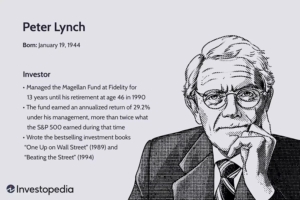
While not groundbreaking, the realization that the long-term upward trend has historically replaced temporary market declines aligns with the wisdom of Peter Lynch, the esteemed Wall Street guru whose Magellan Fund substantially outperformed the market for 13 years, ending in 1990 when he retired. He astutely acknowledged the inherent challenge of predicting short-term market movements:

"Far more money has been lost by investors trying to anticipate market corrections than lost in the corrections themselves."

In an ever-evolving financial landscape, this acknowledgment remains a beacon of wisdom, reminding us of the complexities and uncertainties inherent in attempting to foresee the twists and turns of the market.

Equities Capture Human Ingenuity: The Essence of Resilience

Second only to love, human ingenuity stands as the most powerful force on earth. Equities uniquely embody this force, capturing the essence of human creativity and innovation within them. While these insights hold philosophical importance, the crux lies in formulating a coherent investment policy.

At the core of this philosophy is acknowledging that we, as investors, identify as long-term business owners rather than short-term speculators on stock price trends. The mainstream equity market's occasional substantial declines have consistently been overcome, underscoring the resilience of America's most successful companies through ceaseless innovation and human ingenuity.

Long-Term Investing is Goal-Focused and Plan-Driven: A Blueprint for Success

The foundation of successful long-term investing lies in being goal-focused and plan-driven. Investment decisions must consistently align with the overarching plan and not be swayed by the transient nature of current events. Policies founded on economic or market forecasts are destined to falter in the long run.

Unaided, human nature tends to tether its investment policy to current events and trends, often making repetitive and costly mistakes, such as panicking amidst temporary market declines or succumbing to the allure of fleeting fads. Interventions by advisors committed to meticulous planning and behavior management become essential to circumvent these pitfalls.

Cautionary Note: Allure of Catchy Catchphrases

In the annals of 2023, the spotlight was undeniably on just seven stocks within the S&P 500 Index, responsible for almost two-thirds of the index’s total annual gains. This stellar performance earned them the moniker the “Magnificent Seven.”

Fortunately, each of our clients has an allocation to the Magnificent Seven through the stock funds we use. As we peer into the upcoming year, a glance at today’s popular press reveals an abundance of timely advice on whether to increase exposure to this star lineup or seize the moment to sell. Recommendations hinge on recurring economic factors like the ebb and flow of inflation, the arrival or retreat of a recession, advancements or retractions in technology, and so forth.

While insights from financial news media and Wall Street pundits can be informative and entertaining, in reality, it is challenging, if not impossible, to predict whether celebrated stocks adorned with trendy titles will continue to outperform or are poised for a sudden correction.

The quilt chart below illustrates the randomness of returns for various asset classes over 15 years by stacking the asset classes in each column based on their annual returns from best to worst.

Our advice remains to adopt a balanced approach and maintain an allocation to growth and momentum stocks that align with your long-term goals and objectives. There will be periods when growth and momentum stocks outperform, as seen in 2023, and periods when they underperform, as observed in 2022.

This seamlessly leads us to our next timeless tenet.

The Art of Prudent Investing: Embrace Diversification

As we scrutinize the events of 2023 up close, there might be a palpable temptation to chase after the recent winners in the market by considering an increased allocation to what has proven pleasantly surprising in recent times.

However, when we broaden our view, our perspective remains steadfast: we advocate for maintaining a globally diversified portfolio thoughtfully tailored to meet your specific needs.

It is better to treat the so-called "Magnificent Seven" (and the subsequent hot stocks that follow) as one of many "pistons" in the engine powering the market's growth. It is essential to complement an allocation to a hot trend with adequate diversification to act as a stabilizing force against the inevitable uncertainties that lie ahead in the coming year(s).

In the spirit of prudent investing, we extend our sincere wishes for a well-diversified investment portfolio in 2024. May this be accompanied by an abundance of health, happiness, and harmonious well-being for you and your loved ones.


Past performance does not guarantee future results. All investments include risk and have the potential for loss as well as gain.

Data sources for returns and standard statistical data are provided by the sources referenced and are based on data obtained from recognized statistical services or other sources we believe to be reliable. However, some or all information has not been verified prior to the analysis, and we do not make any representations as to its accuracy or completeness. Any analysis nonfactual in nature constitutes only current opinions, which are subject to change. Benchmarks or indices are included for information purposes  only  to  reflect  the  current  market  environment;  no  index  is  a directly  tradable investment.  There  may  be  instances  when  consultant  opinions  regarding any fundamental or quantitative analysis do not agree.

The  commentary  contained  herein  has  been  compiled  by  W.  Reid Culp,  III  from  sources  provided  by  TAGStone  Capital,  as well  as  commentary  provided  by  Mr.  Culp,  personally,  and  information independently  obtained  by  Mr.  Culp.  The  pronoun  “we,”  as  used  herein,  references collectively the sources noted above.

TAGStone Capital, Inc. provides this update to convey general information about market conditions and not for the purpose of providing investment advice. Investment in any of the companies or sectors mentioned herein may not be appropriate for you. You should consult your advisor from TAGStone or others for investment advice regarding your own situation.


A Look Back at Last Quarter

In an era marked by inflation and rapid change, perhaps it's time to revisit the age-old adage about things turning on a dime. Because when it comes to financial markets, it seems that every quarter carries the potential to catch you off guard.

As we recapped in our last newsletter, the first half of the year brought a wave of news that had the potential to disrupt year-to-date returns. Yet, steadfast investors who adhered to their carefully tailored investment strategies were handsomely rewarded, with most markets enjoying “surprisingly strong growth.”

Fast forward to today, and not much has changed in the market landscape. Economic concerns about interest rates, inflation, and the possibility of a recession still weigh heavily on our minds. U.S. government showdowns continue to cast a shadow, and global threats persist. Oil prices remain a concern, and issues like student loans and union unrest are yet to be resolved.

So, why the recent downturn? While the third quarter didn't result in a nosedive, many asset classes are showing signs of a deceleration compared to the robust growth in the first half of 2023. Analysts are using terms like "blunting," "sputters, "[i] "retrenchment," "run out of steam," and "sideways performance"[ii] to describe the current market conditions.

Two Paths Ahead

Are we in for a rainy season or just a passing cloud? There seem to be two paths we can take:

Path 1: Reacting to Forecasts

Many fourth-quarter forecasts are predicting a rainy season. Following these forecasts, investors often ask speculative questions: What if the worst-case scenario becomes a reality? What if it doesn't? Which so-called "experts" are reading the market's tea leaves correctly?

Unfortunately, only hindsight can provide reliable answers to these questions, usually long after the information could have been useful for trading. This is why seasoned experts caution against getting caught up in market sentiment:

“Perhaps the thing that ‘expertise’ or 40 years of studying something really can certify is when I don’t know, but I know for sure nobody else does either! So buckle your seatbelt and brace yourself for uncertainty.”

— John Cochrane, The Grumpy Economist

“There are more ways to arrange a 52-card deck than there are atoms on Earth, which means that every time you shuffle a deck of cards, the same order of cards has probably never been seen in human history and may never be seen again.

Note to self: The global economy has many more than 52 variables.”

— Bob Seawright, The Better Letter

“I am here today to cross the swamp, not to fight all the alligators.”

— Rosamund Stone Zander, The Art of Possibility

Path 2: Focusing on Our Destination

Since none of us can predict what's around the corner, it makes sense to concentrate on matters we can control. Questions like, "Does your portfolio align with your financial goals and risk tolerance?" and "Are you adequately diversified among a sensible mix of investments?" remain essential. Additionally, consider any life changes that might require adjustments to your investment plan.

From our perspective, every twist and turn in market sentiment reinforces the importance of these questions as our best defense and offense against the market's quarterly fluctuations.

The Merits of a Destination-Centric Approach

Less than a month ago, on October 13, we marked the first anniversary of the 2022 bear market low triggered by inflation. That day last year, the S&P 500 tumbled to an intraday low of 3,491.58, and the VIX, a reliable fear index, retested annual highs. As of my current writing, the S&P 500 stands at approximately 4,350.

Many people were tempted to sell that day, but our clients remained steadfast. We provided counsel emphasizing faith, patience, and discipline, advising them to stick to their plan rather than react to market fluctuations. The outcome is a testament to the wisdom of this approach: with dividends factored in, a client who was fully invested in equities may have achieved gains exceeding 25% from that day to now.

We knew our counsel was proper during those dark October days last year, even though we couldn't predict the precise path of the market's decline. The mid-term elections were just around the corner, adding to the uncertainty. Nevertheless, our principles guided us, and we were ultimately vindicated as the election uncertainties cleared.

Reflecting on the Gift of Steadfastness

Before we dive into the upcoming holiday season, let's take a moment to reflect on the invaluable gift we've not only received but also extended to our loved ones during these last thirteen months.

There's a temptation to think, "Phew, we dodged another bullet; let's move on." Instead, we should pause, reflect, and celebrate the power of our planning and behavioral investment philosophy, which liberates us from the treadmill of performance-based investment machinations. This is the gift we’ve been given.

Equally important, contemplate how invaluable your steadfastness is to those you love and care for. This is the gift you give.

For most investors, the ceaseless anxiety tied to performance-based investing is a constant burden. Their experiences are measured against benchmarks they can rarely outperform. They're constantly searching for economic and market forecasts, and their findings often turn out to be inaccurate. They oscillate between chasing hot trends and panicking during minor declines.

Performance-chasing is the reality for many investors. Why? Because they may be unaware of planning and behavioral investment principles or lack the courage and self-belief to implement them consistently.

The Blueprint for Success

Now, let's revisit the essence of our planning and behavioral investment philosophy, which is remarkably straightforward:

  1. Historical U.S. Equity Returns: A diversified portfolio of mainstream U.S. equities has historically delivered a compounded annual return of approximately 10% over the past two centuries, roughly 7% above inflation.[iii]
  2. Small-Cap Strength: Small-cap equities, due to their higher volatility and risk, have historically supplied average annual compound real returns of approximately 13%, roughly 30% higher than large-cap counterparts (around 9% versus 7% net of inflation). The volatility of small caps makes them ideal for long-term dollar cost averaging. However, ensuring that your exposure to small-cap equities is never so large that you might be compelled to sell them in a downturn is essential.
  3. International Exposure: The world economy is increasingly interconnected. International developed and emerging market stocks have delivered attractive compound annual returns averaging around 8.5% for the last fifty years, and they historically show less correlation with U.S. stocks.
  4. Bonds and Real Returns: High-quality corporate bonds, in contrast, have returned only about 3% above inflation over the same period, which is quite a bit less than half of the return of equities.
  5. Equity Returns Dynamics: The return gap between equities and bonds is because equity returns vary significantly above and below their long-term trendline in an efficient market (see exhibit below).[iv] While equity prices can decline considerably at times, these downturns, averaging over 15% per year since 1980 and roughly twice that on average one year in five since the end of World War II, have historically been temporary and eventually replaced by a long-term upward trend.
  6. Long-Term Positivity: Specifically, over the last century, approximately 75% of rolling one-year periods resulted in positive returns, a figure that increased to 88% over five years and an impressive 94% over ten years. Remarkably, there has not been a single rolling 20-year period in which equities produced a negative compound return.[v]
  7. Bonds as a Defense: While bonds play a vital role in a diversified portfolio, relying solely on bonds as a defense against temporary equity declines requires an investor to sacrifice more than half of the long-term returns historically offered by equities.
  8. Market Timing: The equity market cannot be consistently timed, just as the economy cannot forecast reliably. Therefore, the key to unlocking the full potential of equities lies in resolute, unwavering ownership through temporary declines—a skill possessed by only a small percentage of investors and often requires the guidance of a human investment advisor.
  9. Asset Class Choice: The critical long-term investment decision rests on selecting the broad ratio between equities versus bonds and cash, with the choice of individual securities holding less significance in the long run.
  10. Equity Diversification: Broad equity diversification is the preferred portfolio approach, dividing invested assets among funds with different styles, sizes, and geographical domiciles, which have historically run on different cycles.
  11. Rebalancing: Periodic rebalancing systematically reallocates capital away from sectors that have become overvalued toward those currently out of favor, potentially enhancing long-term returns. It is important to note that this approach differs from the actions of the majority of investors most of the time.

Empowering Ourselves and Our Loved Ones

This blueprint is the invaluable gift that enriches our lives and benefits our families and closest connections.

So, how challenging is it to embrace the eleven fundamental principles at the heart of our investment philosophy? The answer to this rhetorical question is relatively straightforward: it's not difficult, provided you wholeheartedly believe in it. However, it can be incredibly daunting, even seemingly impossible, if you harbor doubts or lack the guidance of an advisor who wholeheartedly adheres to these principles.

At TAGStone Capital, we believe in the power of strong relationships. We're committed to providing our clients with the best financial guidance and support.

As we approach the holiday season, my heartfelt wish for you is this: Before the hustle and bustle of life sweep you away, take an hour or two to contemplate the vast good you can do and the corresponding financial security and prosperity you can bestow upon your nearest and dearest. This gift is yours to give, and it's boundless in its potential to make a meaningful difference in their lives.

Furthermore, we are grateful for your trust in us. Our business thrives and grows through your valuable introductions. If you know someone who could benefit from our expertise in investments or financial planning, we would be truly appreciative if you would consider introducing them to our services. Your introductions are the lifeblood of our business and the greatest compliment we can receive.

We look forward to helping more individuals on their financial journey. Thank you for your continued support.

[i] Blunting and sputters:The 2023 Stock-Market Rally Sputters in New World of Yield,” The Wall Street Journal, September 29, 2023.

[ii] Retrenchment, run out of steam, and sideways performance:Market Brief: 5 Themes for the Stock Market Heading Into Q4,” Morningstar, September 22, 2023.

[iii] Siegel, Jeremy J., Stocks for the Long Run, Fifth Edition, pages 5-7

[iv] The Bumpy Road to the Market’s Long-Term Average, Dimensional Fund Advisors

[v] Exhibit 2, Dimensional Fund Advisors, https://my.dimensional.com/the-uncommon-average


Past performance does not guarantee future results. All investments include risk and have the potential for loss as well as gain.

Data sources for returns and standard statistical data are provided by the sources referenced and are based on data obtained from recognized statistical services or other sources we believe to be reliable. However, some or all information has not been verified prior to the analysis, and we do not make any representations as to its accuracy or completeness. Any analysis nonfactual in nature constitutes only current opinions, which are subject to change. Benchmarks or indices are included for information purposes  only  to  reflect  the  current  market  environment;  no  index  is  a directly  tradable investment.  There  may  be  instances  when  consultant  opinions  regarding any fundamental or quantitative analysis do not agree.

The  commentary  contained  herein  has  been  compiled  by  W.  Reid Culp,  III  from  sources  provided  by  TAGStone  Capital,  as well  as  commentary  provided  by  Mr.  Culp,  personally,  and  information independently  obtained  by  Mr.  Culp.  The  pronoun  “we,”  as  used  herein,  references collectively the sources noted above.

TAGStone Capital, Inc. provides this update to convey general information about market conditions and not for the purpose of providing investment advice. Investment in any of the companies or sectors mentioned herein may not be appropriate for you. You should consult your advisor from TAGStone or others for investment advice regarding your own situation.


As we find ourselves at the midpoint of the year, it's an opportune moment to reflect on the long-term journey we've embarked upon together in the realm of investments. The financial landscape has unveiled its latest chapters, and I am pleased to share our insights and observations with you.

After declining sharply for most of 2022, the S&P 500 ended the year at 3,840.

As the new year began, the economic landscape appeared trapped in a precarious situation. There seemed to be two paths forward: one where the Federal Reserve would tighten credit conditions to combat inflation, potentially leading to a recession, and another where the Federal Reserve might choose to ease up, averting a recession but allowing inflation to persist. Both scenarios carried the common expectation of a decline in corporate earnings.

The most recent quarter followed this similar path. It began in the aftermath of the collapse of Silicon Valley Bank, triggering concerns about the stability of the broader banking system. These worries were quickly accompanied by political brinksmanship concerning U.S. government debt. Additionally, broader global worries surfaced, questioning the dollar's status as the world's reserve currency. Extensive media coverage fanned the flames of speculative concerns, igniting a series of "what if?" anxieties at every turn.

Yet after enduring the unrelenting barrage of both genuine and imagined crises, the S&P 500 closed out the first half of 2023 at 4,450, up 15.9%. As surprising as the first-half rally might have been, it presents an opportune moment to reiterate the timeless wisdom of Peter Lynch: “The real key to making money in stocks is not to get scared out of them.

Against this “gravity-defying” “monster rally,” most disciplined investors have been nicely rewarded for following Peter Lynch’s advice and sticking with their appropriate investment allocations.

So, let’s celebrate the current surge! As you do so, preserve some of this positive energy because it could be a source of grit during future market volatility. Despite the folly of forecasting, financial news media will try to plant fresh seeds of doubt in our fertile minds when the next downturn arrives.

Guided by Enduring Principles

Yet, even if quarterly and year-to-date numbers were not as favorable, we would have still recommended sticking to your carefully crafted, long-term investment strategy. While markets have historically yielded positive returns over time, their fluctuations from one quarter to another remain difficult to predict. This is why we continue to recommend the time-tested principle of staying the course.

At the core of our approach lies the firm conviction that successful investing is a long-term journey rooted in thoughtful planning and broad diversification across many high-quality companies. We remain grounded in following our clients’ comprehensive plans rather than being swayed by the tides of current events or market conditions.

We believe that consistent forecasts of the economy and market timing are elusive pursuits. This understanding drives our commitment to weather the storms of periodic market declines, knowing that history shows these setbacks to be temporary. Our enduring principles guide us as we help you strive toward your long-term financial goals.

Remembering a Pioneer

Speaking of long-term investing, let's take a moment to acknowledge recent news that deserves our attention: On June 22, we mourned the passing of a true luminary, Nobel laureate and the Father of Modern Portfolio Theory, Harry Markowitz, who peacefully passed away at the age of 95.

When Markowitz published his seminal work “Portfolio Selection” in the March 1952 Journal of Finance, he was a mere 24 years old. He laid the groundwork for asset-class investing with this paper and future works. Some of the wisdom Markowitz imparted on the science of investing includes:

  • Assembling a comprehensive portfolio that yields more predictable outcomes than focusing solely on individual securities.
  • Constructing investment portfolios from diverse sources of expected returns rather than trying to predict the next big winners or evade future underperformers.
  • The power of diversification as a means of risk management instead of futile market-timing strategies.

When Markowitz first started studying investments, these revolutionary insights had yet to materialize. At the time, investing meant handpicking individual stocks with little understanding of how each selection might interact within a broader portfolio. The prevailing approach to managing market risks was rooted in trying to outsmart the unpredictable nature of the market. The concept of gauging overall returns and comparing them against alternative strategies was virtually nonexistent because researchers like Markowitz had not yet analyzed the market data.

Markowitz's intellectual legacy has influenced how trillions of dollars of financial assets are managed today and expanded investors’ abilities to handle investment risks. With Markowitz’s passing, the journey continues to refine and advance our understanding of managing investment risk and returns.

Your Journey, Our Privilege

In summary, in the first half of 2023, we collectively navigated a microcosm of a successful investing career. That is, amidst universal doubts and pessimism, you did all that could be asked of you—you didn’t get scared out of the stock market.

Instead, you remained resolute, unwavering in your objectives and long-term strategy, fortified by the belief that the management teams of the companies you invest in diligently safeguarded your capital while actively seeking fresh and potentially more attractive returns for your money.

We echo the sentiments of Fortunes & Frictions author Rubin Miller, CFA, who aptly noted in his article “How Returns Happen:”

“[I]f we don’t know which days will be good and which days will be bad, and the stock market goes up over time, the recipe for success is obvious.”

Our approach mirrors this recipe: construct globally diversified, institutional-quality portfolios, endure both prosperous and challenging quarters, and allow returns to manifest in their own time, much like building a "Field of Dreams."

The worrying financial headline events (or nonevents) of the last six months did not matter as much to the stock market as the news media expected. What mattered was that together we chose not to react to the financial headlines. Is it possible that a lifetime of patient, disciplined investment success is just that simple? We certainly believe it can be, and we sincerely hope you do too.

As we move forward, remember that our professional privilege lies in serving you, our valued clients. Your trust fuels our dedication, and we stay committed to guiding you toward your financial goals.


Past performance does not guarantee future results. All investments include risk and have the potential for loss as well as gain.

Data sources for returns and standard statistical data are provided by the sources referenced and are based on data obtained from recognized statistical services or other sources we believe to be reliable. However, some or all information has not been verified prior to the analysis, and we do not make any representations as to its accuracy or completeness. Any analysis nonfactual in nature constitutes only current opinions, which are subject to change. Benchmarks or indices are included for information purposes  only  to  reflect  the  current  market  environment;  no  index  is  a directly  tradable investment.  There  may  be  instances  when  consultant  opinions  regarding any fundamental or quantitative analysis do not agree.

The  commentary  contained  herein  has  been  compiled  by  W.  Reid Culp,  III  from  sources  provided  by  TAGStone  Capital,  as well  as  commentary  provided  by  Mr.  Culp,  personally,  and  information independently  obtained  by  Mr.  Culp.  The  pronoun  “we,”  as  used  herein,  references collectively the sources noted above.

TAGStone Capital, Inc. provides this update to convey general information about market conditions and not for the purpose of providing investment advice. Investment in any of the companies or sectors mentioned herein may not be appropriate for you. You should consult your advisor from TAGStone or others for investment advice regarding your own situation.