
Hunkering Down in Turbulent Times – First Quarter 2020

Hunkering Down in Turbulent Times

“What the imagination can’t conjure, reality delivers with a shrug.”

—Trumbo (movie voice-over)

Brace yourself. Your First Quarter 2020 report is likely to leave you feeling at least a little disheartened. No matter how much we’ve written about preparing for perilous times like these, planning for it versus actually enduring it is like watching a tornado on YouTube versus being swept into one in real life.

Yet, we stand by our advice. For emotional and financial turbulence alike, your best bet when you’re in the eye of a storm is to hunker down, and trust in preparations already made.

If you’re comfortable with how we’ve been managing your wealth so far, expect more of the same. As your steadfast fiduciary advisor, we will continue to help you implement the kinds of investment opportunities that make sense for you and your portfolio. These may include:

  • Rebalancing your portfolio when warranted, to stay on course toward your long-term goals.
  • Tax-loss harvesting where practical, to offset the costs of recently incurred and/or future taxable gains. (Yes, we still fully expect to see future market growth!)
  • Roth IRA conversions when they may benefit your retirement planning.
  • Seizing other opportunities when your plans call for it. For example, if you’ve been holding a concentrated stock position to avoid incurring taxable gains, now may be the perfect time to reduce your risks and strengthen your portfolio by selling all or part of that position.

A Stress Test for Your Risk Tolerance

If, on the other hand, you’ve begun to seriously question your course, think of current conditions as a stress test. Is the risk tolerance you thought you had holding up for you?

Ask yourself objectively: Can I tough out the fears I’m feeling right now? If so, we encourage you to stick with your existing investment allocations despite the angst.

What if you decide your portfolio is no longer appropriate for you? If that’s the case, let’s get together promptly to plan your next steps. Above all, your wealth should be structured to enhance your personal well-being. If that’s not what’s happening, we welcome the opportunity to help you adjust your portfolio accordingly.

Another question often asked during market extremes goes something like this: I’m okay with my portfolio mix, but why not get out of the markets temporarily until the worst is over?

Recoveries Happen Quietly

Whether we leave your portfolio as is, or help you permanently reduce some of its risk exposure, we will never recommend trying to accurately time when to cleverly get out of, and safely jump back into volatile markets. While nobody knows exactly when a recovery will occur, history has informed us of what typically happens when it does. A recent Wall Street Journal piece explains, using the bull market that began back in 2009 as an illustration (emphasis ours)1:

"A surprising share of a new bull market’s returns pile up in its very early stages when people are most fearful. Take the one that ended last month. Putting $100,000 into an S&P 500 index fund on the day the bull began on March 9, 2009 and selling at last month’s peak would have seen that turn into $630,000 including dividends. Waiting just three months to make sure it wasn’t yet another head fake would have earned you only $450,000.”

In other words, while most of us are still assuming there’s no hope in sight, the markets can quietly and often dramatically make their big come-back … at least for those who have kept a portion of their wealth invested in them. The chart below shows the annualized return of the S&P 500 during eight recessions from the point when the bear market in stocks bottomed to when the recession ended in the real economy (i.e. stocks generally bottom several months before the recession ends).
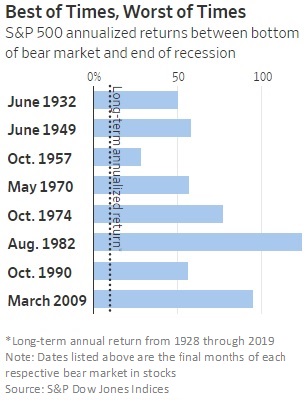
S&P 500 annualized returns between bottom of bear market and end of recession

Staying the Course

As always, without the ability to see what is only apparent in hindsight, we encourage you to focus instead on that which you can control. Right now, that is mostly doing all you can to keep yourself and your loved ones out of harm’s way. Please let us know how we can help.


Past performance does not guarantee future results. All investments include risk and have the potential for loss as well as gain.

Data sources for returns and standard statistical data are provided by the sources referenced and are based on data obtained from recognized statistical services or other sources we believe to be reliable. However, some or all information has not been verified prior to the analysis, and we do not make any representations as to its accuracy or completeness. Any analysis nonfactual in nature constitutes only current opinions, which are subject to change. Benchmarks or indices are included for information purposes  only  to  reflect  the  current  market  environment;  no  index  is  a directly  tradable investment.  There  may  be  instances  when  consultant  opinions  regarding any fundamental or quantitative analysis do not agree.

The  commentary  contained  herein  has  been  compiled  by  W.  Reid Culp,  III  from  sources  provided  by  TAGStone  Capital,  as well  as  commentary  provided  by  Mr.  Culp,  personally,  and  information independently  obtained  by  Mr.  Culp.  The  pronoun  “we,”  as  used  herein,  references collectively the sources noted above.

TAGStone Capital, Inc. provides this update to convey general information about market conditions and not for the purpose of providing investment advice. Investment in any of the companies or sectors mentioned herein may not be appropriate for you. You should consult your advisor from TAGStone for investment advice regarding your own situation.
IPOs: Profiles Are High. What About Returns?

Initial public offerings (IPOs) often attract initial public interest—especially when familiar brands become broadly available to investors for the first time.

In recent months, investors have had the opportunity to buy shares of ride‑hailing networks Uber and Lyft, workplace productivity services Zoom and Slack, and other high-profile businesses ranging from Pinterest to Beyond Meat.

News outlets contribute to the frenzy, building anticipation, tracking the early hours of trading, and casting judgment on the IPO’s success. Investors, perhaps lured by tales of outsized returns, try to get in on the action early.

New research by Dimensional Fund Advisors reveals the fundamental challenges IPO investors face. For example, investors may not be able to trade during the early hours of the IPO, when the biggest price movements frequently occur. Lockup periods also often restrict when shares held by early investors can be resold on secondary markets, which can meaningfully limit the available liquidity in the first six to 12 months after an IPO.

Medium‑term IPO performance is often underwhelming. The research team at Dimensional studied the first-year performance of more than 6,000 US IPOs from 1991 to 2018 and found they generally underperformed industry benchmarks. The researchers also found that known drivers of expected returns largely explain that underperformance.

Short-Term IPO Returns:

IPOs are commonly associated with outsized stock returns on the first day shares become available, although these returns may not be attainable by all investors due to the allocation process. Researchers have shown that initial trading prices typically exceed the IPO offering price.1 However, accessing these first-day returns requires an allocation from the underwriting banks. Studies have documented an adverse selection problem associated with IPO share allocations and find that allocations to IPOs having poor first-day returns have generally been easier to obtain, while allocations to IPOs with good first‑day returns have usually been reserved for certain clients of the underwriting banks.2

Medium-Term IPO Returns:

Given that many investors may not be able to access these initial returns, Dimensional focused on the performance of IPOs in the secondary market. How do IPOs perform in their first year?

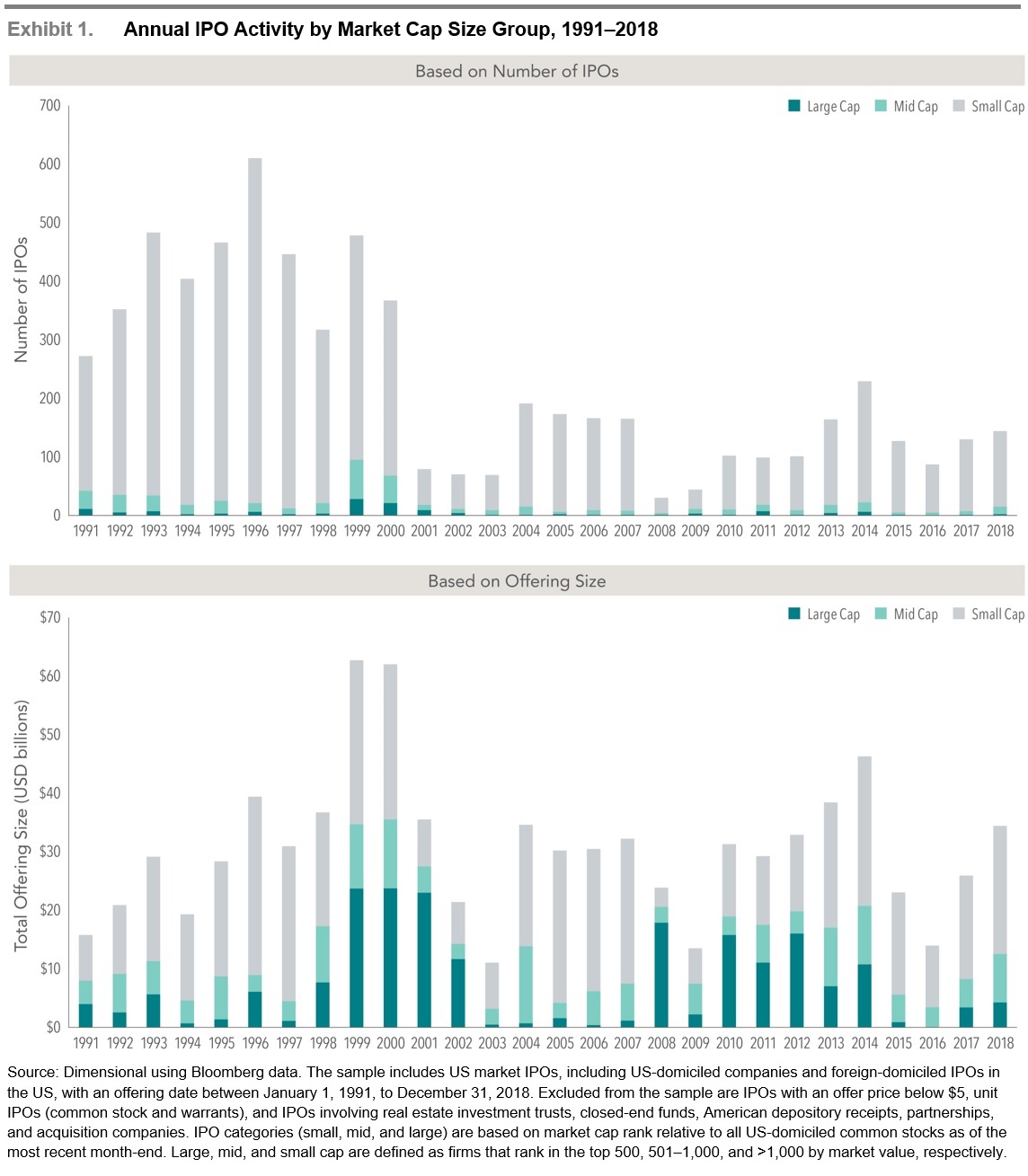
The sample for Dimensional’s study consists of 6,362 US IPOs that occurred from January 1991 to December 2018 and for which data is available.3  Exhibit 1, below, shows the annual frequency and market cap distribution of IPOs among firm size groups. The period from 1991 to 2000 is characterized by a relatively high IPO frequency rate of 420 per year and is followed by a less active 18-year period during which the rate falls to 120 IPOs on average per year. Although the number of IPOs has declined, the average IPO offering size is almost three times larger over the most recent period, as compared to the initial 10 years in the sample.

Most IPOs fall into the small cap size group, defined as firms that fall below the largest 1,000 US‑domiciled common stocks at the most recent month‑end. Large cap and mid cap IPOs represent 24% and 19%, respectively, of total capital raised through IPOs over the sample period.

Annual IPO Activity by Market Cap Size Group 1991-2018

IPO Performance:

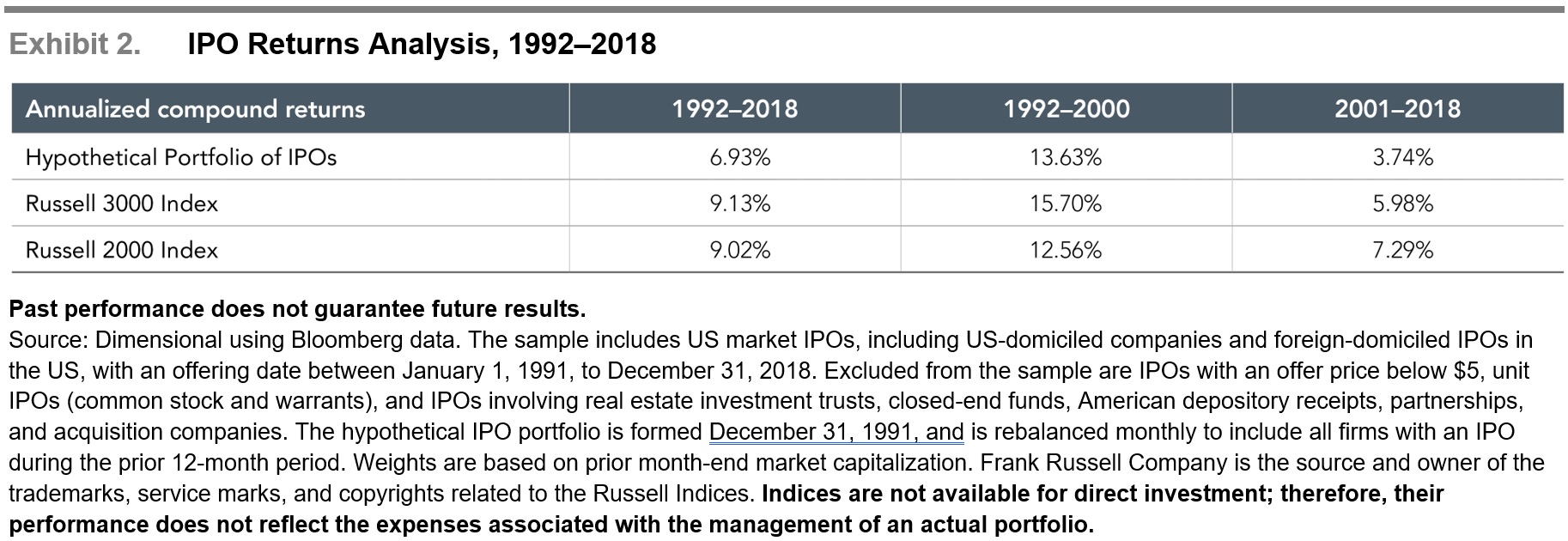
Dimensional evaluated IPO returns by forming a hypothetical market cap-weighted portfolio consisting of IPOs issued over the preceding 12-month period, rebalanced monthly.4 This methodology excludes the initial first-day returns by design to alleviate the adverse selection problem inherent in the IPO allocation process. Exhibit 2, below, compares the returns of the IPOs to the returns of the Russell 2000 and 3000 indices over the full sample period as well as two subperiods covering 1992–2000 and 2001–2018. IPOs underperform the Russell 3000 Index in both the overall period and sub-sample periods. For example, IPOs generate an annualized compound return of 6.93%, 13.63%, and 3.74% over the full, initial nine-year and final 18-year sample periods, respectively, as compared to 9.13%, 15.70%, and 5.98% for the Russell 3000 index over the same time horizons. In comparison to the Russell 2000 Index, the hypothetical portfolio of IPOs underperforms in the overall period (6.93% vs. 9.02%) and the 2001–2018 (3.74% vs. 7.29%) subperiod and outperform (13.63% vs. 12.56%) over the period from 1992 to 2000.

Known drivers of returns largely explain the underperformance of IPOs. IPOs have underperformed the market because, as a group, they have behaved like small growth, low profitability, high investment stocks, which have had lower expected returns than the market.5

IPO Returns Analysis 1992-2018

Summary:

Investors considering IPOs should be aware of potential adverse selection and post-offering activities, such as the expiration of insider lockup periods. Investors should also understand that IPOs have generally underperformed broader market benchmarks in recent decades and that their fundamental characteristics suggest lower expected returns.

Appendix:

Benjamin Graham’s Description of IPOs and Investment Bankers in the 1973 Edition of “The Intelligent Investor”

The term “investment banker” is applied to a firm that engages to an important extent in originating, underwriting, and selling new issues of stocks and bonds [i.e. IPOs]. (To underwrite means to guarantee to the issuing corporation, or other issuer, that the security will be fully sold.) A number of brokerage houses carry on a certain amount of underwriting activity. Generally, this is confined to participating in underwriting groups formed by leading investment bankers. There is an additional tendency for brokerage firms to originate and sponsor a minor amount of new-issue financing, particularly in the form of smaller issues of common stocks when a bull market is in full swing.

Investment banking is perhaps the most respectable department of the Wall Street community, because it is here that finance plays its constructive role of supplying new capital for the expansion of industry. In fact, much of the theoretical justification for maintaining active stock markets, notwithstanding their frequent speculative excesses, lies in the fact that organized security exchanges facilitate the sale of new issues of bonds and stocks. If investors or speculators could not expect to see a ready market for a new security offered them, they might well refuse to buy it.

The relationship between the investment banker and the investor is basically that of the salesman to the prospective buyer. For many years part the great bulk of the new offerings in dollar value has consisted of bond issues that were purchased in the main by financial institutions such as banks and insurance companies. In this business the security salesmen have been dealing with shrewd and experienced buyers. Hence any recommendations made by the investment bankers to these customers have had to pass careful and skeptical scrutiny. Thus, these transactions are almost always effected on a businesslike footing.

But a different situation obtains in a relationship between the individual security buyer and the investment banking firms, including the stockbrokers acting as underwriters. Here the purchaser is frequently inexperienced and seldom shrewd. He is easily influenced by what the salesman tells him, especially in the case of common-stock issues, since often his unconfessed desire in buying is chiefly to make a quick profit. The effect of all this is that the public investor’s protection lies less in his own critical faculty than in the scruples and ethics of the offering houses.

It is a tribute to the honesty and competence of the underwriting firms that they are able to combine fairly well the discordant roles of adviser and salesman. But it is imprudent for the buyer to trust himself to the judgement of the seller. In 1959 we stated at this point: “The bad results of this unsound attitude show themselves recurrently in the underwriting field and with notable effects in the sale of new common stock issues during periods of active speculation.” Shortly thereafter this warning proved urgently needed. As already pointed out, the years 1960-61 and, again 1968-69 were marked by an unprecedented outpouring of issues of lowest quality, sold to the public at absurdly high offering prices and in many cases pushed much higher by heedless speculation and some semimanipulation. A number of the more important Wall Street houses have participated to some degree in these less than creditable activities, which demonstrates that the familiar combination of greed, folly, and irresponsibility have not been exorcised form the financial scene.

The intelligent investor will pay attention to the advice and recommendations received from investment banking houses, especially those known by him to have an excellent reputation; but he will be sure to bring sound and independent judgement to bear upon these suggestions—either his own, if he is competent, or that of some other type of adviser.


Past performance does not guarantee future results. All investments include risk and have the potential for loss as well as gain.

Data sources for returns and standard statistical data are provided by the sources referenced and are based on data obtained from recognized statistical services or other sources we believe to be reliable. However, some or all information has not been verified prior to the analysis, and we do not make any representations as to its accuracy or completeness. Any analysis nonfactual in nature constitutes only current opinions, which are subject to change. Benchmarks or indices are included for information purposes  only  to  reflect  the  current  market  environment;  no  index  is  a directly  tradable investment.  There  may  be  instances  when  consultant  opinions  regarding any fundamental or quantitative analysis do not agree.

The  commentary  contained  herein  has  been  compiled  by  W.  Reid Culp,  III  from  sources  provided  by  TAGStone  Capital,  DFA,  Vanguard,  Morningstar,  as well  as  commentary  provided  by  Mr.  Culp,  personally,  and  information independently  obtained  by  Mr.  Culp.  The  pronoun  “we,”  as  used  herein,  references collectively the sources noted above.

TAGStone Capital, Inc. provides this update to convey general information about market conditions and not for the purpose of providing investment advice. Investment in any of the companies or sectors mentioned herein may not be appropriate for you. You should consult your advisor from TAGStone for investment advice regarding your own situation.

The Reality of Market Timing:

Over the course of the holidays, it’s not unusual for the stock market to be a topic of conversation at parties and other social gatherings.

A neighbor or relative might ask about which investments are good at the moment. The lure of getting in at the right time or avoiding the next downturn may tempt even disciplined, long-term investors. The reality of successfully timing markets, however, isn’t as straightforward as it sounds.

Outguessing the Market is Difficult:

Attempting to buy individual stocks or make tactical asset allocation changes at exactly the “right” time presents investors with substantial challenges. First and foremost, markets are fiercely competitive and adept at processing information. During 2018, a daily average of $462.8 billion in equity trading took place around the world.1 The combined effect of all this buying and selling is that available information, from economic data to investor preferences and so on, is quickly incorporated into market prices. Trying to time the market based on an article from this morning’s newspaper or a segment from financial television? It’s likely that information is already reflected in prices by the time an investor can react to it.

Why is market timing so hard? For investors to have a shot at successfully timing the market, they must make the call to buy or sell stocks correctly not just once, but twice. Professor Robert Merton, a Nobel laureate, said it well in a recent interview with Dimensional Fund Advisors:

“Timing markets is the dream of everybody. Suppose I could verify that I’m a .700 hitter in calling market turns. That’s pretty good; you’d hire me right away. But to be a good market timer, you’ve got to do it twice. What if the chances of me getting it right were independent each time? They’re not. But if they were, that’s 0.7 times 0.7. That’s less than 50-50. So, market timing is horribly difficult to do.”

In other words, it is unlikely that investors can successfully time the market, and if they do manage it, it may be the result of luck rather than skill.

How are professionals at market timing? Dimensional recently studied the performance of actively managed US-based mutual funds and found that even professional investors have difficulty beating the market. Over the last 20 years, 77% of equity funds and 92% of fixed income funds failed to survive and outperform their benchmarks after costs.2

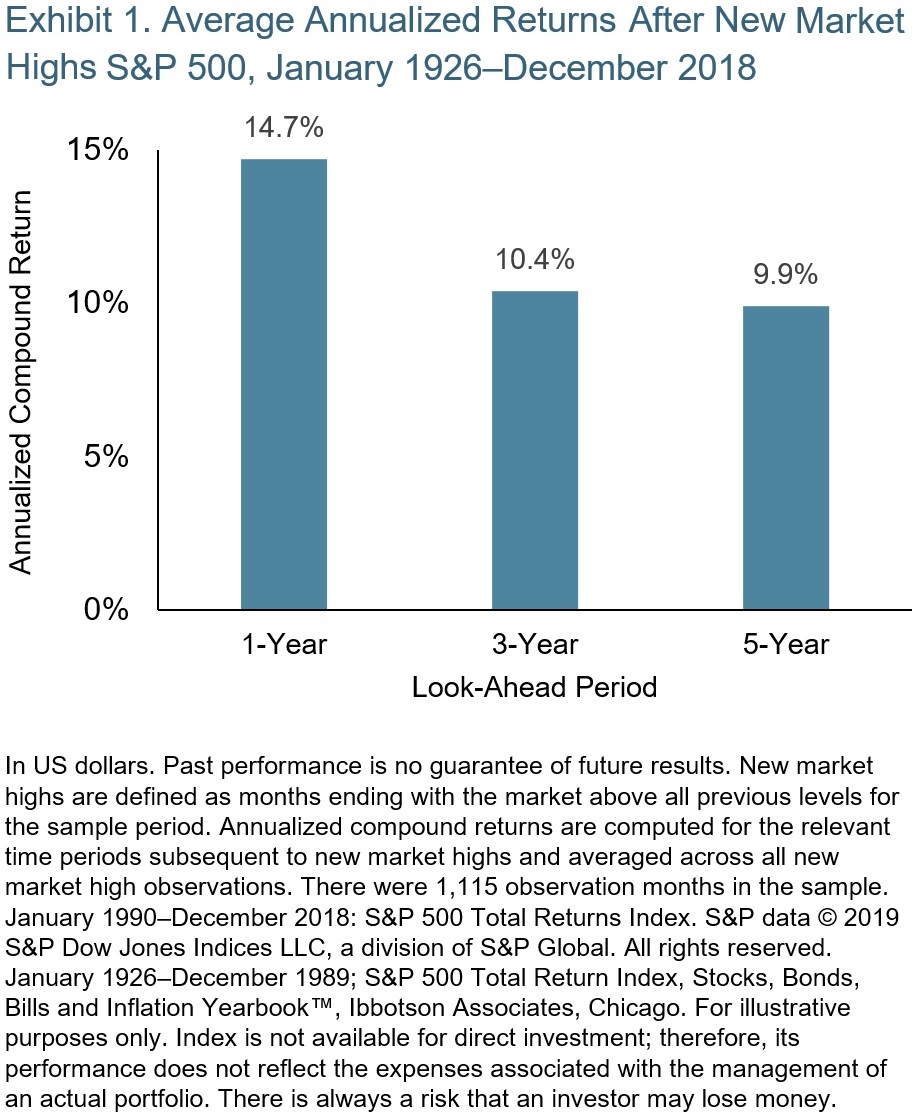
Can I time the market based on new highs? The S&P 500 Index has logged an incredible decade. Should this result impact investors’ allocations to equities? Exhibit 1 suggests that new market highs have not been a harbinger of negative returns to come. The S&P 500 went on to provide positive average annualized returns over one, three, and five years following new market highs.

Average Annualized Returns After New Market Highs

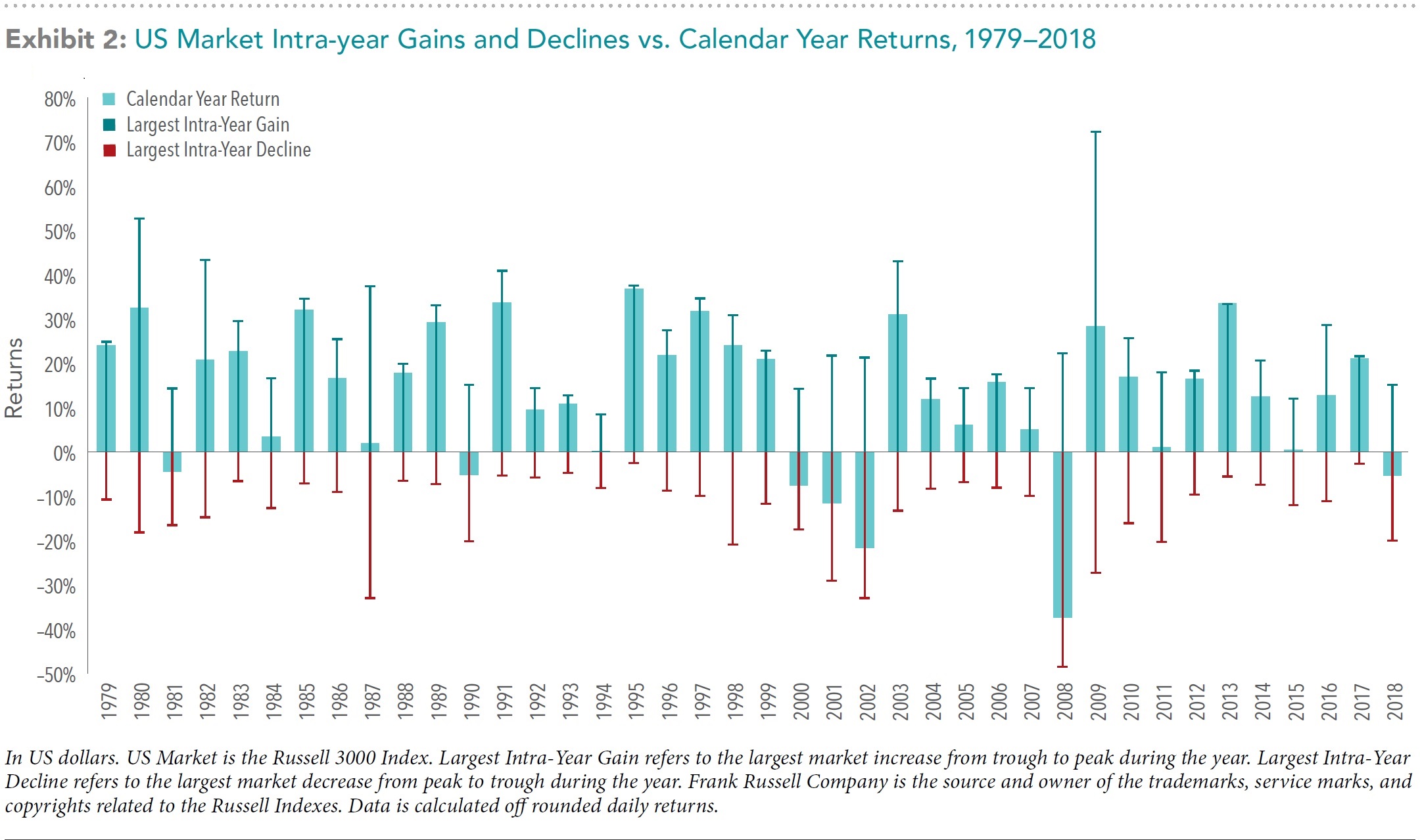
What about timing the market during periods of increased volatility? Exhibit 2, below, shows calendar year returns for the US stock market since 1979, as well as the largest intra-year declines that occurred during a given year. During this period, the average intra-year decline was about 14%. About half of the years observed had declines of more than 10%, and around a third had declines of more than 15%. Despite substantial intra-year drops, calendar year returns were positive in 33 years out of the 40 examined. This goes to show just how common market declines are and how difficult it is to say whether a large intra-year decline will result in negative returns over the entire year.

Returns Come from Just a Handful of Days:

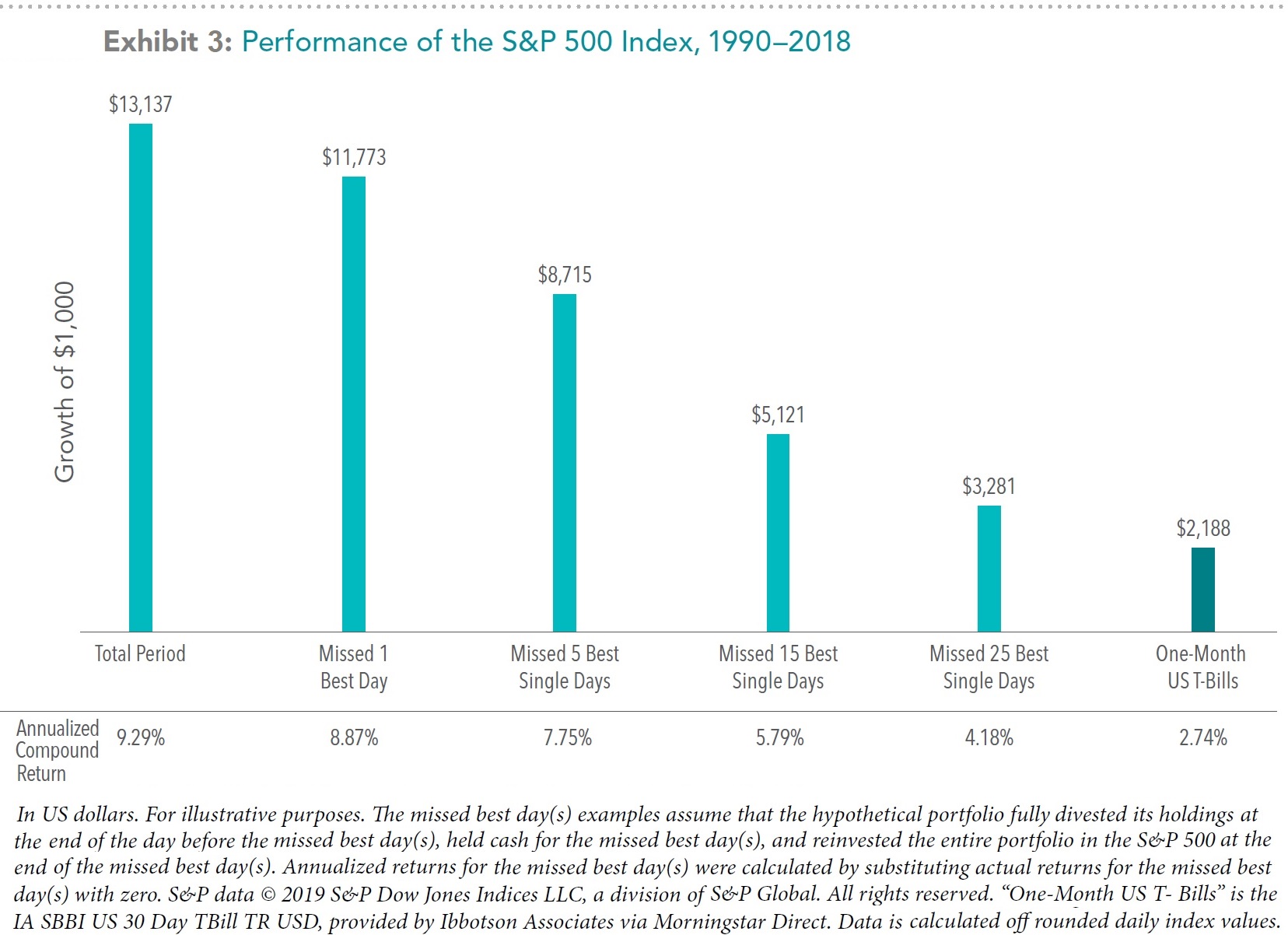
Further complicating the prospect of market timing being additive to portfolio performance is the fact that a substantial proportion of the total return of stocks over long periods comes from just a handful of days. Since investors are unlikely to be able to identify in advance which days will have strong returns and which will not, the prudent course is likely to remain invested during periods of volatility rather than jump into and out of stocks. Otherwise, an investor runs the risk of being on the sidelines on days when returns happen to be strongly positive.

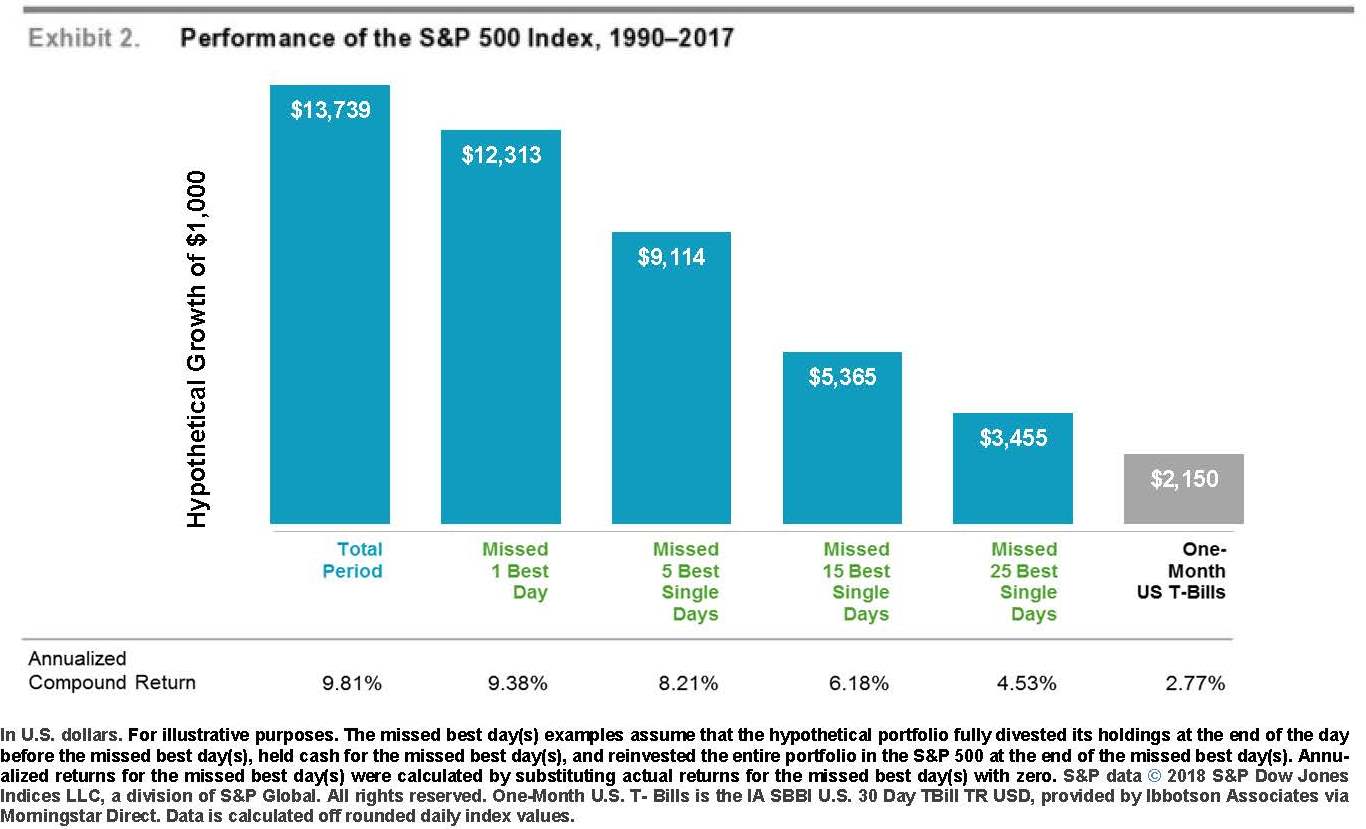
Exhibit 3, below, helps illustrate this point. It shows the annualized compound return of the S&P 500 Index going back to 1990 and illustrates the impact of missing out on just a few days of strong returns. The bars represent the hypothetical growth of $1,000 over the period and show what happened if you missed the best single day during the period or a handful of the best single days. The data shows that being on the sidelines for only a few of the best single days in the market would have resulted in substantially lower returns than the total period had to offer.

Performance of the S&P 500 Index if Best Days Missed, 1990-2018

Conclusion:

Outguessing markets is more difficult than many investors might think. While favorable timing is theoretically possible, there isn’t much evidence that it can be done reliably, even by professional investors. The positive news is that investors don’t need to be able to time markets to have a good investment experience.

Over time, capital markets have rewarded investors who have taken a long-term perspective and remained disciplined in the face of short-term noise. By focusing on the things that they can control (like having an appropriate asset allocation, diversification, and managing expenses, turnover, and taxes), investors can better position themselves to make the most of what capital markets have to offer.

While market volatility can be nerve-racking for investors, reacting emotionally and changing long-term investment strategies in response to short-term declines could prove more harmful than helpful. By adhering to a well-thought-out investment plan, ideally agreed upon in advance of periods of volatility, investors may be better able to remain calm during periods of short-term uncertainty.


1 Past performance is no guarantee of future results. US-domiciled open-end mutual fund data is from Morningstar. The sample includes funds at the beginning of the 20-year period ending December 31, 2018. For further details, see the Mutual Fund Landscape 2019.

2 In US dollars. Source: Dimensional, using data from Bloomberg LP. Includes primary and secondary exchange trading volume globally for equities. ETFs and funds are excluded. Daily averages were computed by calculating the trading volume of each stock daily as the closing price multiplied by shares traded that day. All such trading volume is summed up and divided by 252 as an approximate number of annual trading days.


Past performance does not guarantee future results. All investments include risk and have the potential for loss as well as gain.

Data sources for returns and standard statistical data are provided by the sources referenced and are based on data obtained from recognized statistical services or other sources we believe to be reliable. However, some or all information has not been verified prior to the analysis, and we do not make any representations as to its accuracy or completeness. Any analysis nonfactual in nature constitutes only current opinions, which are subject to change. Benchmarks or indices are included for information purposes only to reflect the current market environment; no index is a directly tradable investment. There may be instances when consultant opinions regarding any fundamental or quantitative analysis do not agree.

The commentary contained herein has been compiled by W. Reid Culp, III from sources provided by TAGStone Capital, DFA, Vanguard, Morningstar, as well as commentary provided by Mr. Culp, personally, and information independently obtained by Mr. Culp. The pronoun “we,” as used herein, references collectively the sources noted above.

TAGStone Capital, Inc. provides this update to convey general information about market conditions and not for the purpose of providing investment advice. Investment in any of the companies or sectors mentioned herein may not be appropriate for you. You should consult your advisor from TAGStone for investment advice regarding your own situation.

The Uncommon Average:

“I have found that the importance of having an investment philosophy—one that is robust and that you can stick with— cannot be overstated.”

—David Booth

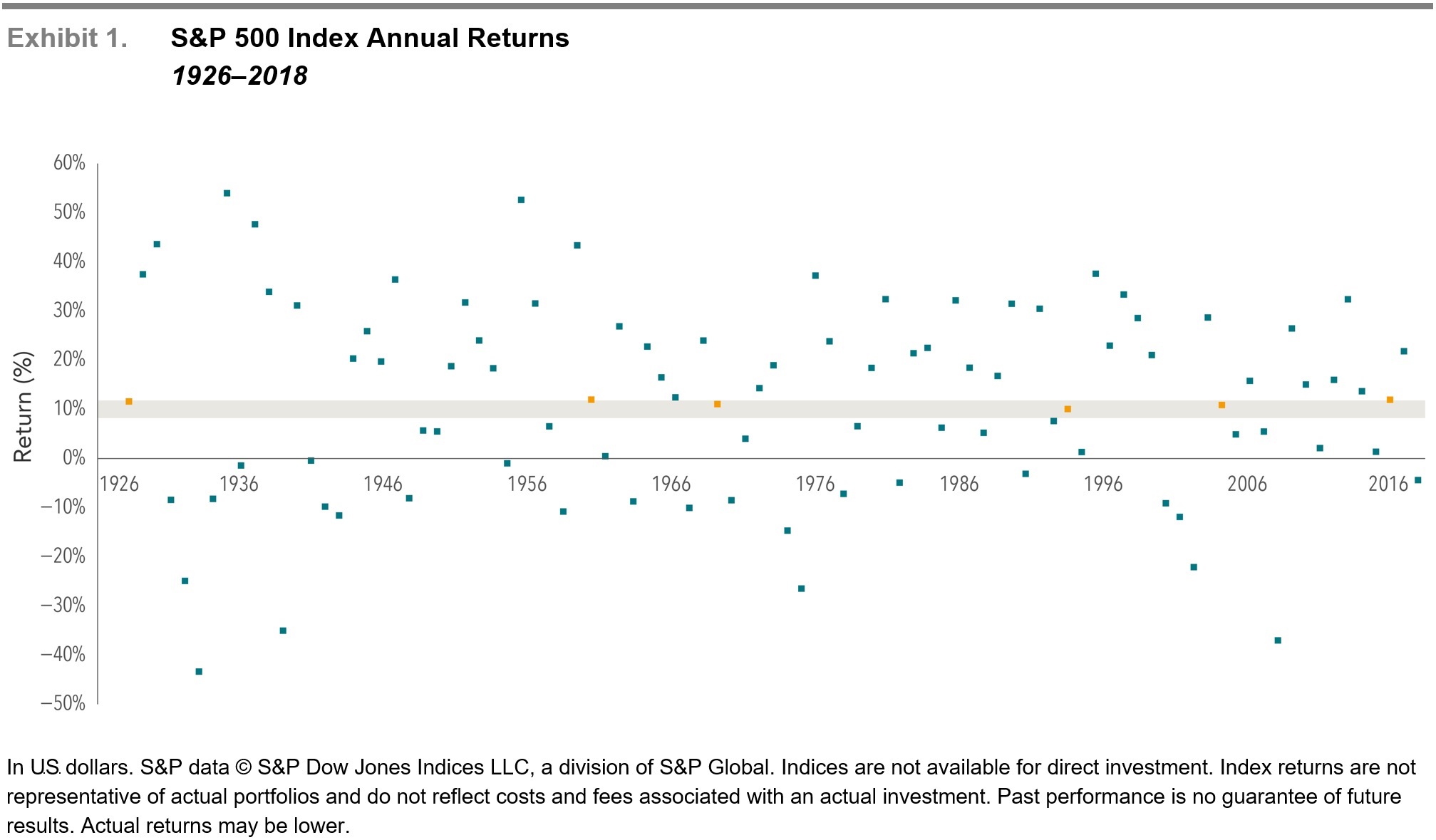
The U.S. stock market has delivered an average annual return of around 10% since 1926.1 But short-term results generally vary, and in any given period stock returns can be positive, negative, or flat. When setting expectations, it’s helpful to see the range of outcomes experienced by investors historically. For example, how often have the stock market’s annual returns actually aligned with its long-term average?

Exhibit 1, below, shows calendar year returns for the S&P 500 Index since 1926. The shaded band marks the historical average of 10%, plus or minus 2 percentage points. The S&P 500 Index had a return within this range in only six of the past 93 calendar years. In most years, the index’s return was outside of the range—often above or below by a wide margin—with no obvious pattern. For investors, the data highlights the importance of looking beyond average returns and being aware of the range of potential outcomes.

Uncommon Average S&P 500 Index Annual Returns 1926-2018

Tuning in to Different Frequencies:

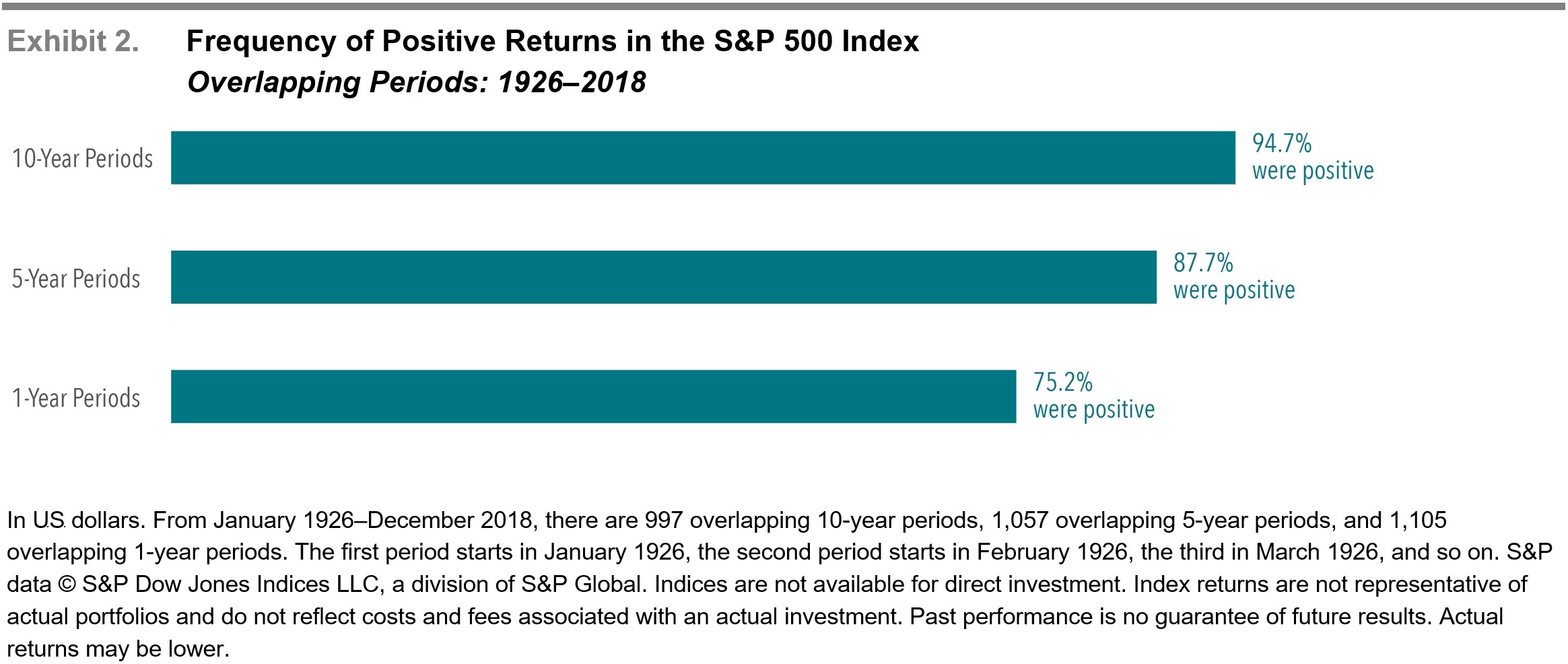
Despite year-to-year volatility, investors can potentially increase their chances of having a positive outcome by maintaining a long-term focus. Exhibit 2, below, documents the historical frequency of positive returns over rolling periods of one, five, and 10 years in the U.S. market. The data shows that, while positive performance is never assured, investors’ odds improve over longer time horizons.

Uncommon Average Frequency of Positive Returns in the S&P 500 Index

Recession Myths and Realities:

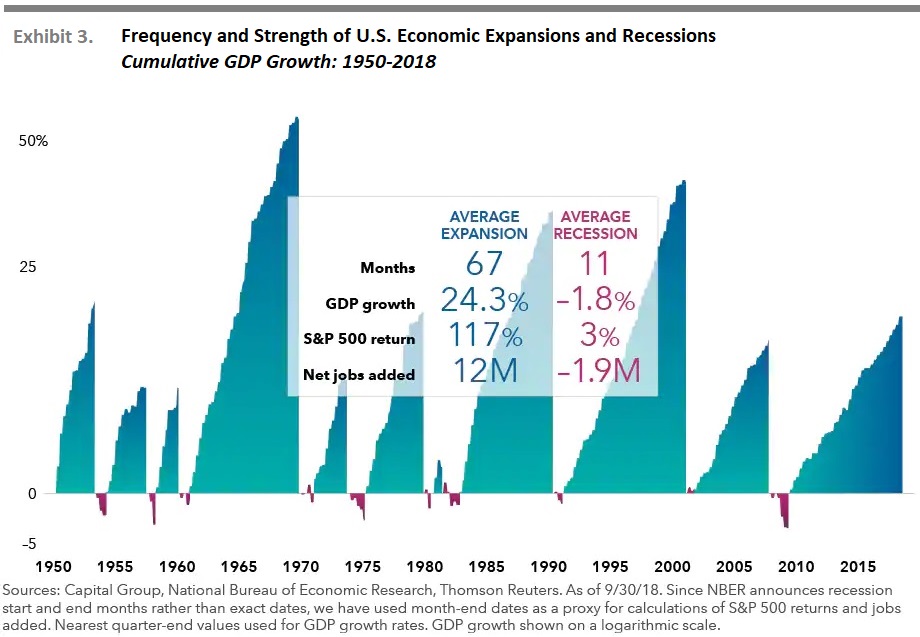
As much as the financial news and market pundits talk about the possibility of a pending recession, few news reports give the statistics for the frequency and length of economic expansions and recessions. While the statistics for recessions vary depending on when the measurement period is started, Exhibit 3, below, provides the statistics for the average expansion and recession since 1950.

There are three points to consider from viewing these statistics:

• Recessions have been infrequent—the U.S. has been in an official recession less than 15% of all months since 1950

• Recessions have been relatively short—the current economic expansion has been longer than the last 10 recessions combined

• Recessions have been less impactful compared with expansions—the average recession led to a contraction of -2% while an expansion grew the economy by an average of about 24%

Uncommon Average Frequency and Strength of U.S. Economic Expansions and Recessions

Staying Focused:

While some investors might find it easy to stay the course in years with above-average returns, periods of substantially disappointing results may test an investor’s faith in equity markets. Being aware of the range of potential outcomes can help investors remain disciplined, which in the long term can increase the odds of a successful investment experience.

What can help investors endure the ups and downs? While there is no silver bullet, understanding how markets work and trusting market prices are good starting points. An asset allocation that aligns with personal risk tolerances and investment goals is also valuable. By thoughtfully considering these and other issues, investors may be better prepared to stay focused on their long-term goals during different market environments.


[1] As measured by the S&P 500 Index from 1926-2018.


Past performance does not guarantee future results. All investments include risk and have the potential for loss as well as gain.

Data sources for returns and standard statistical data are provided by the sources referenced and are based on data obtained from recognized statistical services or other sources we believe to be reliable. However, some or all information has not been verified prior to the analysis, and we do not make any representations as to its accuracy or completeness. Any analysis nonfactual in nature constitutes only current opinions, which are subject to change. Benchmarks or indices are included for information  purposes  only  to  reflect  the  current  market  environment;  no  index  is  a directly  tradable  investment.  There  may  be  instances  when  consultant  opinions  regarding any fundamental or quantitative analysis do not agree.

The  commentary  contained  herein  has  been  compiled  by  W.  Reid  Culp,  III  from  sources  provided  by  TAGStone  Capital,  Capital  Directions,  DFA,  Vanguard,  Morningstar,  as  well  as  commentary  provided  by  Mr.  Culp,  personally,  and  information  independently  obtained  by  Mr.  Culp.  The  pronoun  “we,”  as  used  herein,  references collectively the sources noted above.

TAGStone Capital, Inc. provides this update to convey general information about market conditions and not for the purpose of providing investment advice. Investment in any of the companies or sectors mentioned herein may not be appropriate for you. You should consult your advisor from TAGStone for investment advice regarding your own situation.

Blink Moments:

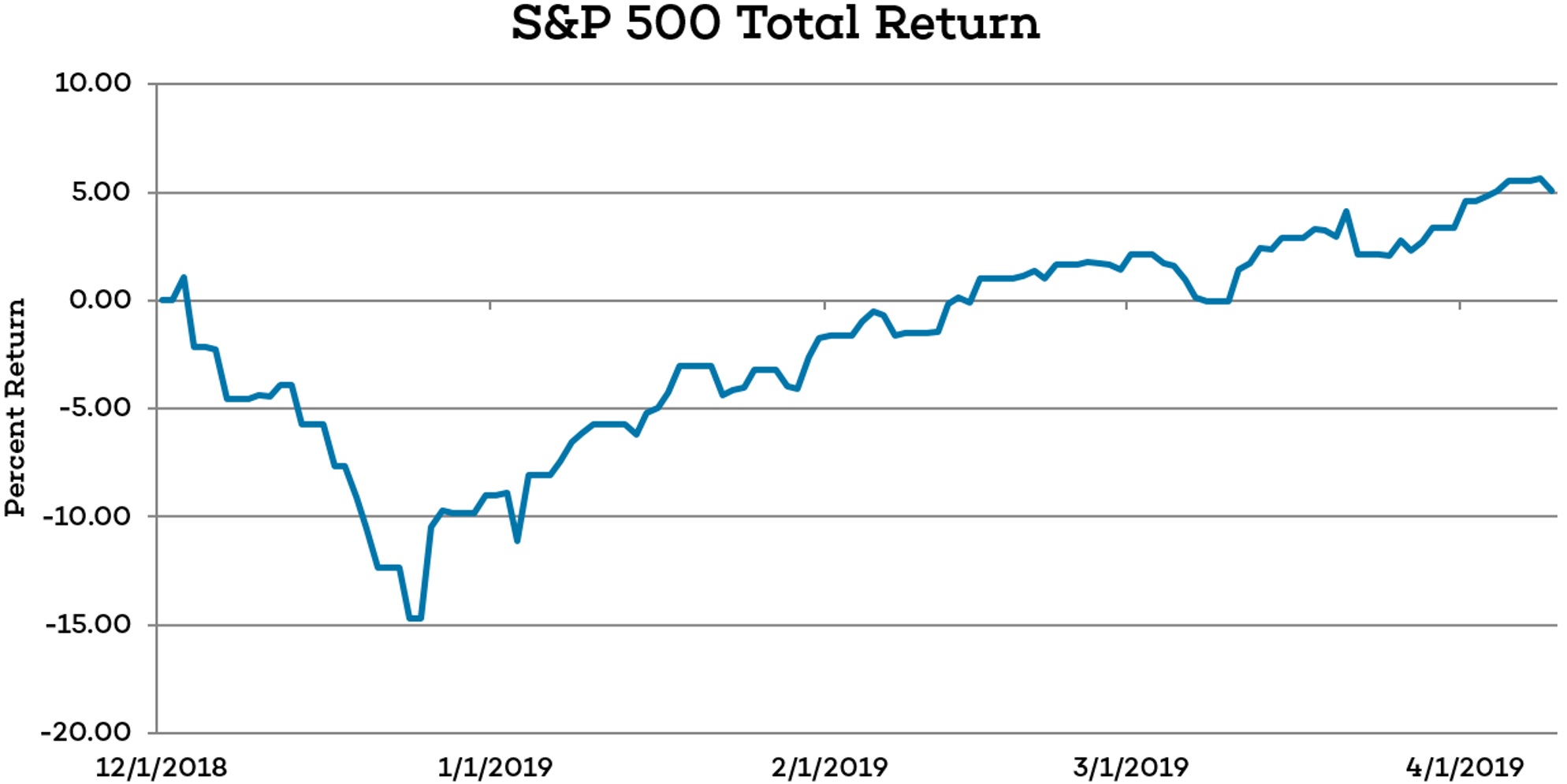
After a turbulent end to 2018 sent stock indices around the globe into bear-market territory, equities staged a big recovery in the first quarter of 2019. For the quarter, the S&P 500 index gained 13.65% and was within a few percentage points of its record high. The Russell 2000 small stock index gained even more, rising 14.58%. Large-cap foreign stocks, emerging markets stocks, and REIT (real estate) stocks enjoyed robust recoveries as well.

Alas, the many thousands of investors who bolted from the market in December weren’t along for the ride.

As markets swooned in December, according to Lipper, investors pulled $98 billion from U.S. equity funds, most of it coming late in the month after the steep selloff on Christmas Eve. The outflows weren’t just limited to stock funds. Morningstar estimates bond funds saw net outflows of $43 billion in December as investor anxiety about rising interest rates drove them to flee fixed income. Meanwhile, money-market funds saw their largest inflows since 2008, with a net $162 billion moving into that category in 2018.

In that regard, it should come as no surprise that stocks and, to a lesser extent, bonds saw a big rebound to start 2019. Individual investors have a long, sad history of doing exactly the wrong thing at the wrong time with their money. The events of the past six months have proved no exception.


On the other hand, more rational investors didn’t head for the exits in December, because they knew a 20% decline in stocks has historically occurred every 3-4 years. But most investors experience moments in their investment lifetimes when emotions overwhelm rational thought. We call these “blink moments.”

There have been many of them in just the past two decades: the bursting of the dot-com bubble, 9/11, and two bear markets in which stocks dropped more than 50%. These are a few of the big negative ones, but blink moments happen on the upside, too. The temptation to invest in dot-com stocks in the late 1990s, speculative real estate in 2006, or Bitcoin in 2017, was a siren song many investors couldn’t resist, and they paid dearly for it.

The Value of Wealth Counsel

Like many industries elsewhere in the world today, technology is commoditizing the investment management industry. However, this commoditization is missing the big picture. While analytics, plans, and platforms are certainly important tools in the wealth management process, they are just that—tools. It’s the relationship that you have with your wealth manager that really counts in blink moments. During these critical times when you don’t trust your own decision-making, many investors value the counsel they receive from a trusted person who knows their financial situation intimately.

It’s in these times, when emotions are at their peak, that investors face the greatest risk to their financial wellbeing. An important role of a wealth manager is to be the trusted buffer between the client and the whims of the stock market—the whims that separate many investors from their money.

Perils of Concentrated Stock Portfolios

For the better part of the 20th century, most investors followed a similar approach to constructing an investment portfolio. They used a stockbroker to buy a handful of stocks they liked (or that the broker convinced them to like) and held them in the portfolio for the long term.

Two things changed this dynamic in the 1970s. First, the long, deep economic slump in the United States during that decade introduced many investors to the downside of unsystematic risk—the risk you assume when you have a concentrated-stock portfolio that ties your investment fate to the fate of only a handful of companies. Many shareholders of U.S. auto, airline, and bank stocks found this out the hard way during that decade.

Second, this awakening of the investing public to the perils of concentrated-stock portfolios also coincided with mutual funds exploding onto the scene in the late 1970s and early 1980s. Mutual funds enabled investors to diversify away unsystematic risk by having exposure to hundreds of different securities in a single investment. As a result, in the ensuing four decades, mutual funds and ETFs became the preferred way for investors and their advisors to allocate investment assets. It’s rare today for long-term investors to concentrate new investment proceeds in just a handful of companies.

However, we still see three scenarios where certain investors come to us with a significant part of their net worth concentrated in one, or several, stocks:

- Businesses owners who have sold their company for stock in the acquiring company

- Heirs who have inherited large positions of low-basis stock

- Retired executives who have amassed significant amounts of stock in the companies they worked for through bonuses and options

The path to amassing these concentrated-stock positions is varied, but the resistance to diversifying away the unsystematic risk inherent in such positions generally falls into two categories. Either the investor opposes selling the positions and incurring capital gains taxes, or they have seen their concentrated-stock positions outperform the broad market and are convinced the outperformance will continue. Many times, it’s both.

We certainly sympathize with these concerns. It’s never fun to sell a stock that has performed well, or even adequately, and pay the resultant capital gains taxes. But it’s also not fun to have the misfortune of being trapped in a stock that suddenly experiences a dramatic downturn—sometimes temporary and sometimes permanent—due to circumstances in the company unrelated to the overall stock market.

Recent Examples of Single-Stock Risk

The financial news was rife with such examples in First Quarter 2019:

- Boeing: After a second crash of the aircraft manufacturer’s 737 MAX aircraft raised questions about the safety of the plane’s flight-management software, Boeing’s stock fell 18% over a three-week period in March.

- Kraft-Heinz: After an earnings miss by the consumer products giant raised investor fears that massive cost-cutting at the company was having an adverse effect on future profitability, the stock plunged 27% on February 22. Kraft-Heinz stock is now down nearly 50% since November and down 65% from its November 2017 high.

- Prada: The maker of handbags and other high-fashion accessories saw its shares drop 11% in a single trading session in March as consumer demand for the brand in China dropped dramatically.

Each of these unexpected downturns occurred while the broad stock market was surging. These are recent examples, but we have seen other heart-wrenching instances in the past twenty years of investors who were significantly affected by being in the wrong stock at the wrong time. Wachovia, Delta, Enron, WorldCom, GM, and Lehman come to mind. Investors who were once concentrated in these stocks would dearly love to turn back the clock and diversify their positions before the stocks experienced their unexpected downturns.

While diversifying concentrated-stock positions is emotionally and financially painful in the short term, it is a way of hedging against future, unknowable corporate missteps and misplaced gains. As Benjamin Franklin quipped a couple of centuries ago, “An ounce of prevention is worth a pound of cure.”


Past performance does not guarantee future results. All investments include risk and have the potential for loss as well as gain.

Data sources for returns and standard statistical data are provided by the sources referenced and are based on data obtained from recognized statistical services or other sources we believe to be reliable. However, some or all information has not been verified prior to the analysis, and we do not make any representations as to its accuracy or completeness. Any analysis nonfactual in nature constitutes only current opinions, which are subject to change. Benchmarks or indices are included for information  purposes  only  to  reflect  the  current  market  environment;  no  index  is  a directly  tradable  investment.  There  may  be  instances  when  consultant  opinions  regarding any fundamental or quantitative analysis do not agree.

The  commentary  contained  herein  has  been  compiled  by  W.  Reid  Culp,  III  from  sources  provided  by  TAGStone  Capital,  Capital  Directions,  DFA,  Vanguard,  Morningstar,  as  well  as  commentary  provided  by  Mr.  Culp,  personally,  and  information  independently  obtained  by  Mr.  Culp.  The  pronoun  “we,”  as  used  herein,  references collectively the sources noted above.

TAGStone Capital, Inc. provides this update to convey general information about market conditions and not for the purpose of providing investment advice. Investment in any of the companies or sectors mentioned herein may not be appropriate for you. You should consult your advisor from TAGStone for investment advice regarding your own situation.

Why Should You Diversify?

As 2019 begins, and with U.S. stocks outperforming non-U.S. stocks in recent years, some investors have again turned their attention towards the role that global diversification plays in their portfolios.

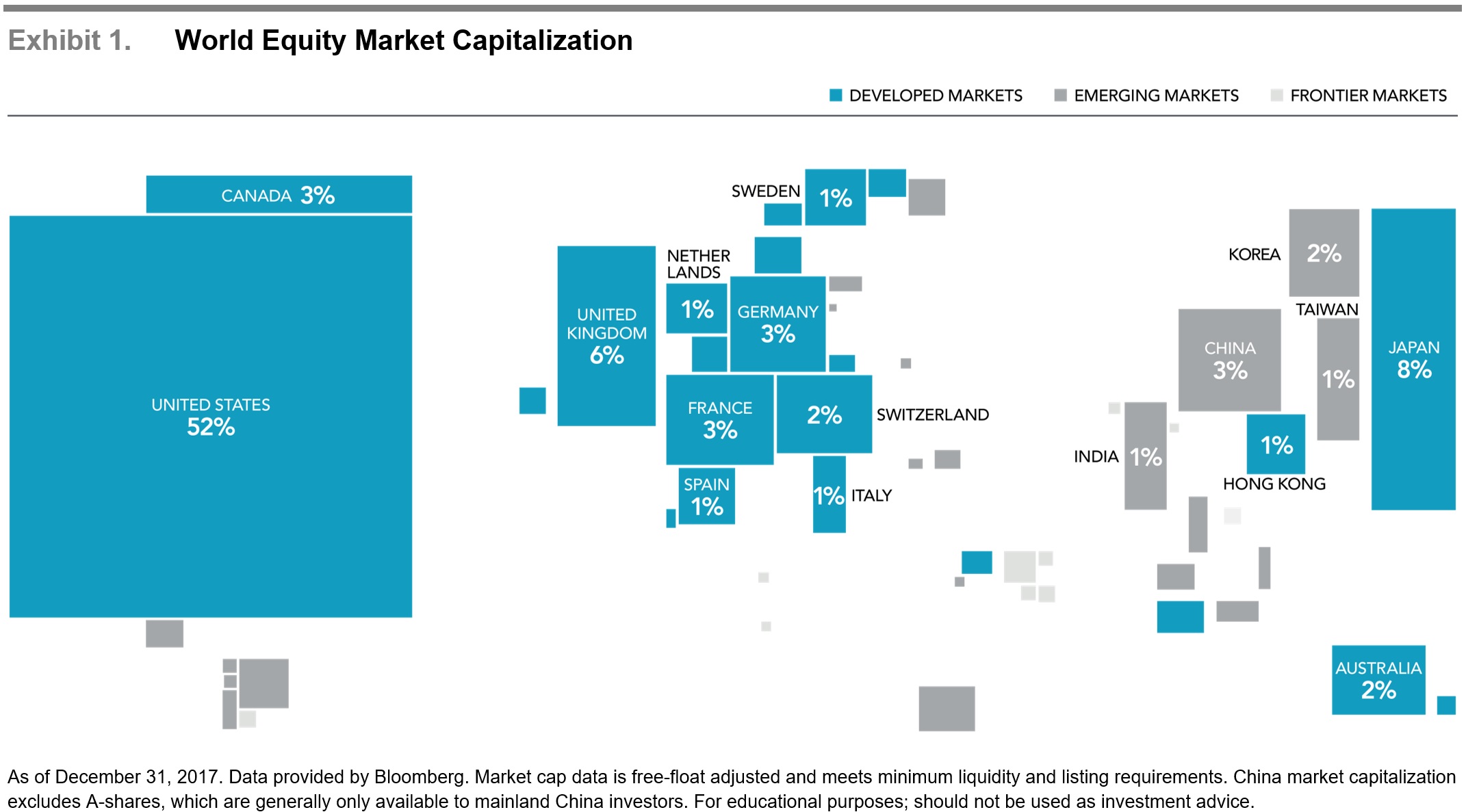
For the five-year period ending October 31, 2018, the S&P 500 Index had an annualized return of 11.34% while the MSCI World ex USA Index returned 1.86%, and the MSCI Emerging Markets Index returned 0.78%. As U.S. stocks have outperformed international and emerging markets stocks over the last several years, some investors might be reconsidering the benefits of investing outside the U.S.

While there are many reasons why a U.S.-based investor may prefer a degree of home bias in their equity allocation, using return differences over a relatively short period as the sole input into this decision may result in missing opportunities that the global markets offer. While international and emerging markets stocks have delivered disappointing returns relative to the U.S. over the last few years, it is important to remember that:

1.     Non-U.S. stocks help provide valuable diversification benefits.

2.     Recent performance is not a reliable indicator of future returns.

There's a World of Opportunity in Equities

The global equity market is large and represents a world of investment opportunities. As shown in Exhibit 1, nearly half of the investment opportunities in global equity markets lie outside the U.S. Non-U.S. stocks, including developed and emerging markets, account for 48% of world market capitalization1 and represent thousands of companies in countries all over the world. A portfolio investing solely within the U.S. would not be exposed to the performance of those markets.

The Lost Decade

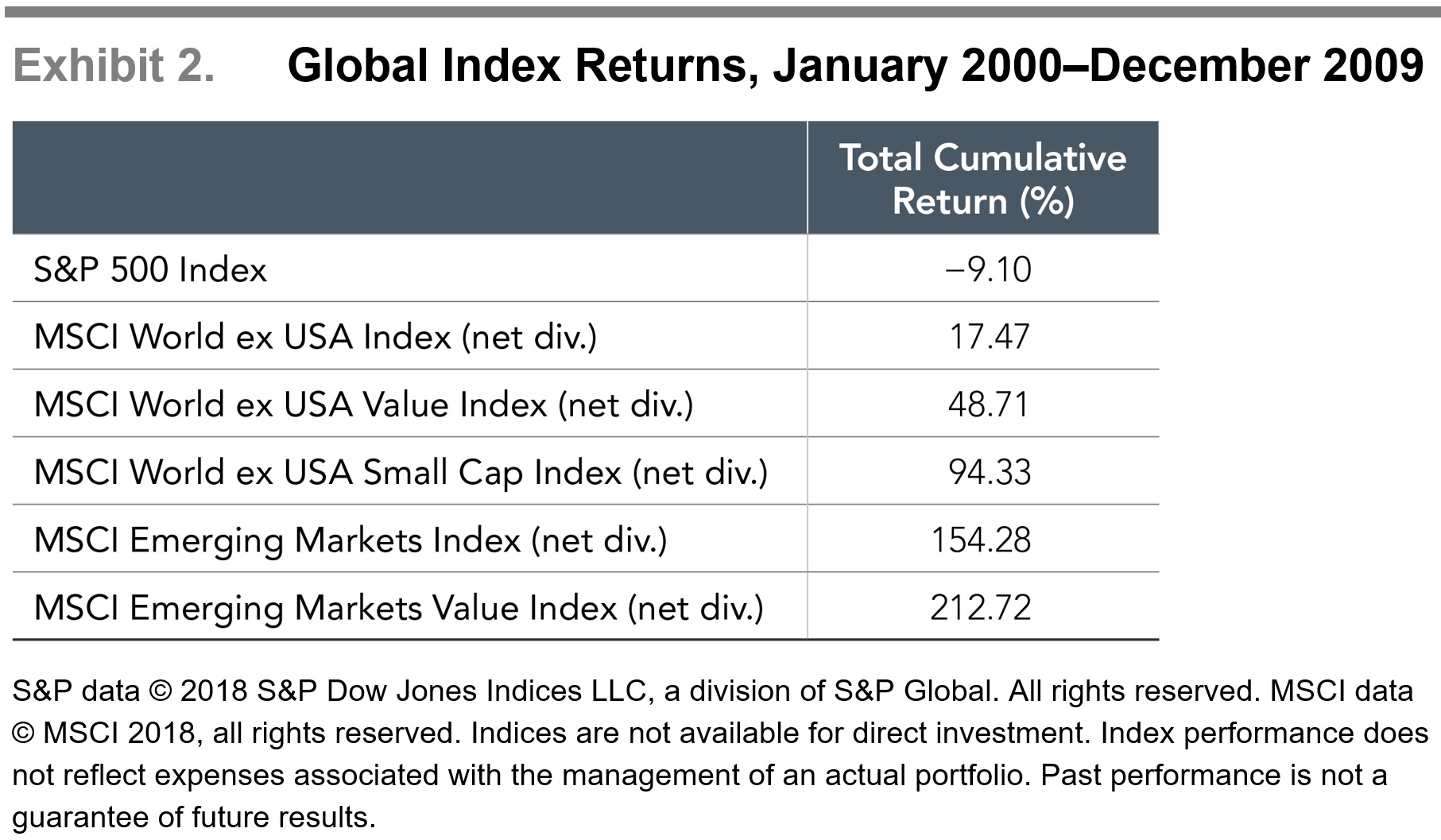
We can examine the potential opportunity cost associated with failing to diversify globally by reflecting on the period in global markets from 2000–2009. During this period, often called the “lost decade” by U.S. investors, the S&P 500 Index recorded its worst ever 10-year performance with a total cumulative return of –9.1%. However, looking beyond U.S. large-cap equities, conditions were more favorable for global equity investors as most equity asset classes outside the U.S. generated positive returns over the course of the decade. (See Exhibit 2.) Expanding beyond this period and looking at performance for each of the 11 decades starting in 1900 and ending in 2010, the U.S. market outperformed the world market in five decades and underperformed in the other six.2  This further reinforces why an investor pursuing the equity premium should consider a global allocation. By holding a globally diversified portfolio, investors position themselves to capture returns wherever they occur.


Pick a Country?

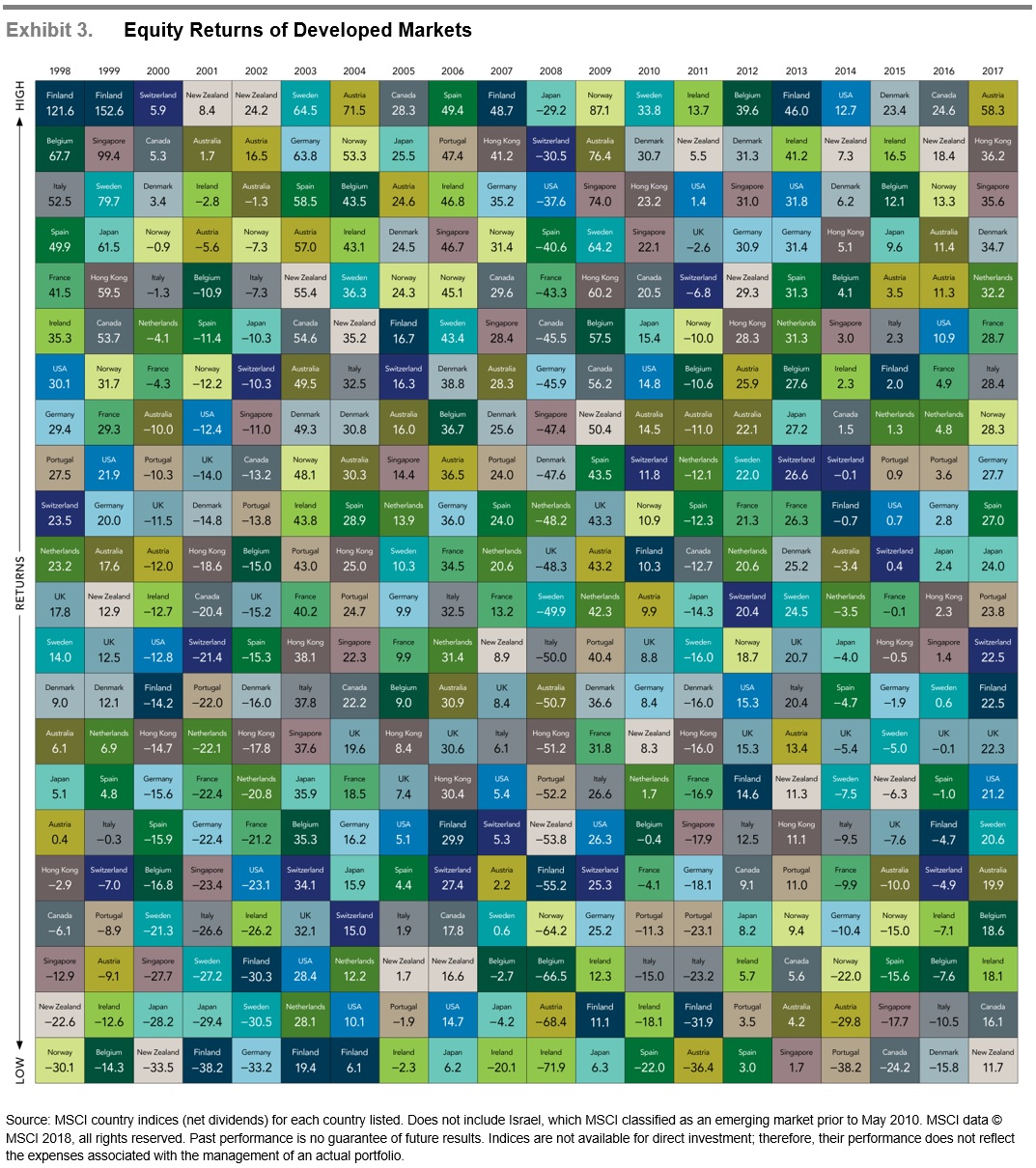
Are there systematic ways to identify which countries will outperform others in advance? Exhibit 3 illustrates the randomness in country equity market rankings (from highest to lowest) for 22 different developed market countries over the past 20 years. This graphic conveys how difficult it would be to execute a strategy that relies on picking the best country and the resulting importance of diversification.

In addition, concentrating a portfolio in any one country can expose investors to large variations in returns. The difference between the best- and worst performing countries can be significant. For example, since 1998, the average return of the best performing developed market country was approximately 44%, while the average return of the worst-performing country was approximately –16%. Diversification means an investor’s portfolio is unlikely to be the best or worst performing relative to any individual country, but diversification also provides a means to achieve a more consistent outcome and more importantly helps reduce and manage catastrophic losses that can be associated with investing in just a few stocks or a single country.

A Diversified Approach

Over long periods of time, investors may benefit from consistent exposure in their portfolios to both U.S. and non-U.S. equities. While both asset classes offer the potential to earn positive expected returns in the long run, they may perform quite differently over short periods. While the performance of different countries and asset classes will vary over time, there is no reliable evidence that this performance can be predicted in advance. An approach to equity investing that uses the global opportunity set available to investors can provide diversification benefits as well as potentially higher expected returns.

1. The total market value of a company’s outstanding shares computed as price times shares outstanding.

2. Source: Annual country index return data from the Dimson-Marsh-Staunton (DMS) Global Return Data, provided by Morningstar, Inc.


Past performance does not guarantee future results. All investments include risk and have the potential for loss as well as gain.

Data sources for returns and standard statistical data are provided by the sources referenced and are based on data obtained from recognized statistical services or other sources we believe to be reliable. However, some or all information has not been verified prior to the analysis, and we do not make any representations as to its accuracy or completeness. Any analysis nonfactual in nature constitutes only current opinions, which are subject to change. Benchmarks or indices are included for information  purposes  only  to  reflect  the  current  market  environment;  no  index  is  a directly  tradable  investment.  There  may  be  instances  when  consultant  opinions  regarding any fundamental or quantitative analysis do not agree.

The  commentary  contained  herein  has  been  compiled  by  W.  Reid  Culp,  III  from  sources  provided  by  TAGStone  Capital,  Capital  Directions,  DFA,  Vanguard,  Morningstar,  as  well  as  commentary  provided  by  Mr.  Culp,  personally,  and  information  independently  obtained  by  Mr.  Culp.  The  pronoun  “we,”  as  used  herein,  references collectively the sources noted above.

TAGStone Capital, Inc. provides this update to convey general information about market conditions and not for the purpose of providing investment advice. Investment in any of the companies or sectors mentioned herein may not be appropriate for you. You should consult your advisor from TAGStone for investment advice regarding your own situation.

Where's the Value?

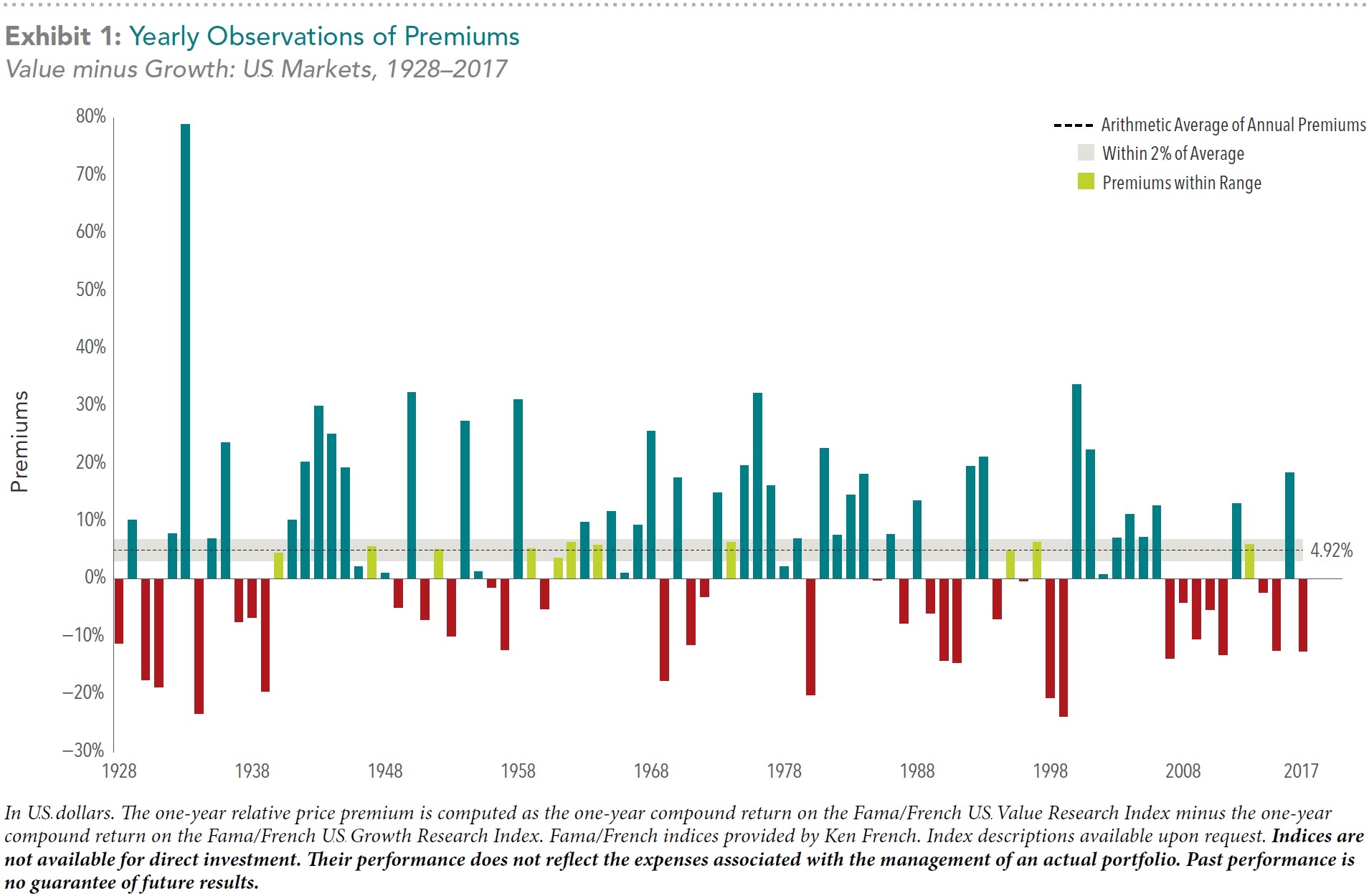
From 1928–2017 the value premium1 in the U.S. had a positive annualized return of approximately 3.5%.2 In seven of the last 10 calendar years, however, the value premium in the U.S. has been negative.

This has prompted some investors to wonder if such an extended period of underperformance may be cause for concern. But are periods of underperformance in the value premium that unusual? We can look to history to help make sense of this question.

Short-Term Results

Exhibit 1 shows yearly observations of the U.S. value premium going back to 1928. We can see the annual arithmetic average for the premium is close to 5%, but in any given year the premium has varied widely, sometimes experiencing extreme positive or negative performance. In fact, there are only a handful of years that were within a 2% range of the annual average—most other years were farther above or below the mean. In the last 10 years alone there have been premium observations that were negative, positive, and in line with the historical average. This data helps illustrate that there is a significant amount of variability around how long it may take a positive value premium to materialize.

Long-Term Results

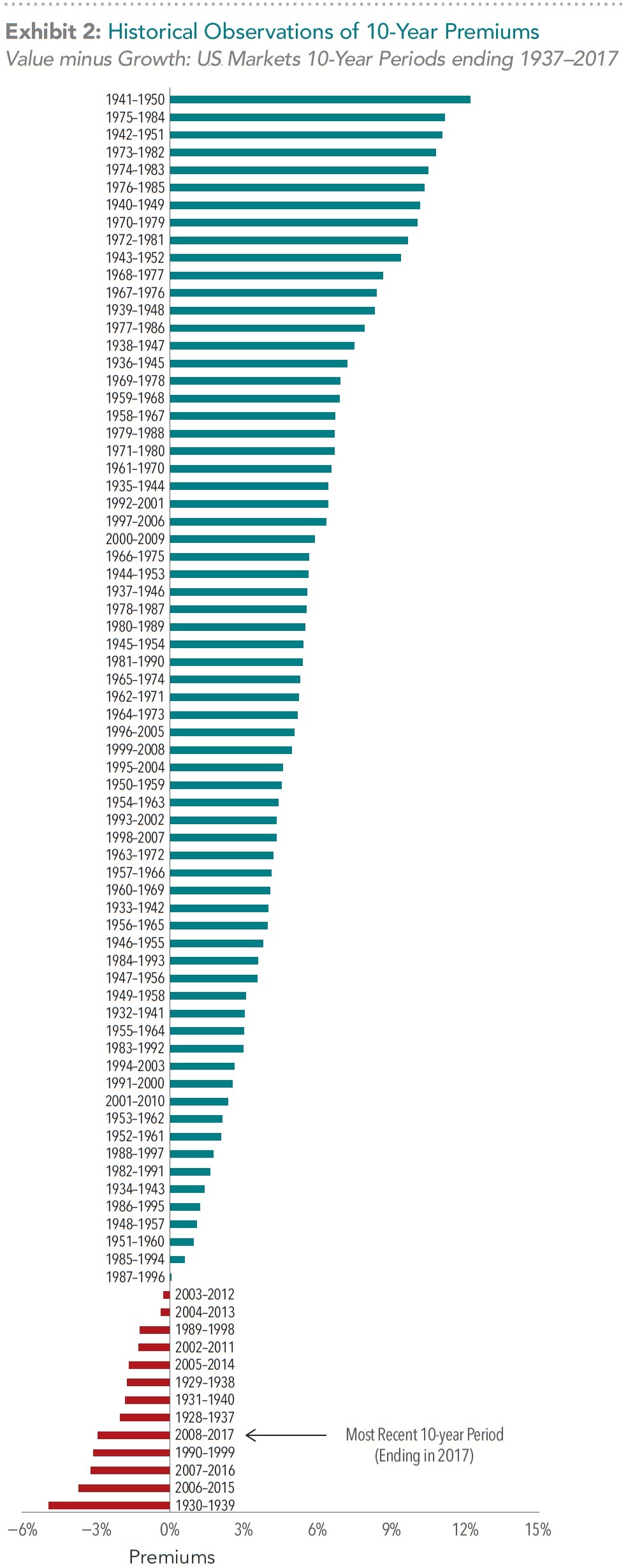
But what about longer-term underperformance? While the current stretch of extended underperformance for the value premium may be disappointing, it is not unprecedented. Exhibit 2 documents 10-year annualized performance periods for the value premium, sorted from lowest to highest by end date (calendar year). The earliest 10-year period in the series began in 1928 and ended in 1937.

This chart shows us that the best 10-year period for the value premium was from 1941–1950 (at the top), while the worst was from 1930–1939 (at the bottom). In most cases, we can see that the value premium was positive over a given 10-year period. As the arrow indicates, however, the value premium for the most recent 10-year period (ending in 2017) was negative. To put this in context, the most recent 10 years is one of only 13 periods since 1937 that had a negative annualized value premium. Of these, the most recent period of underperformance has been fairly middle-of-the-road in magnitude.

Frequency of Long-Term Results

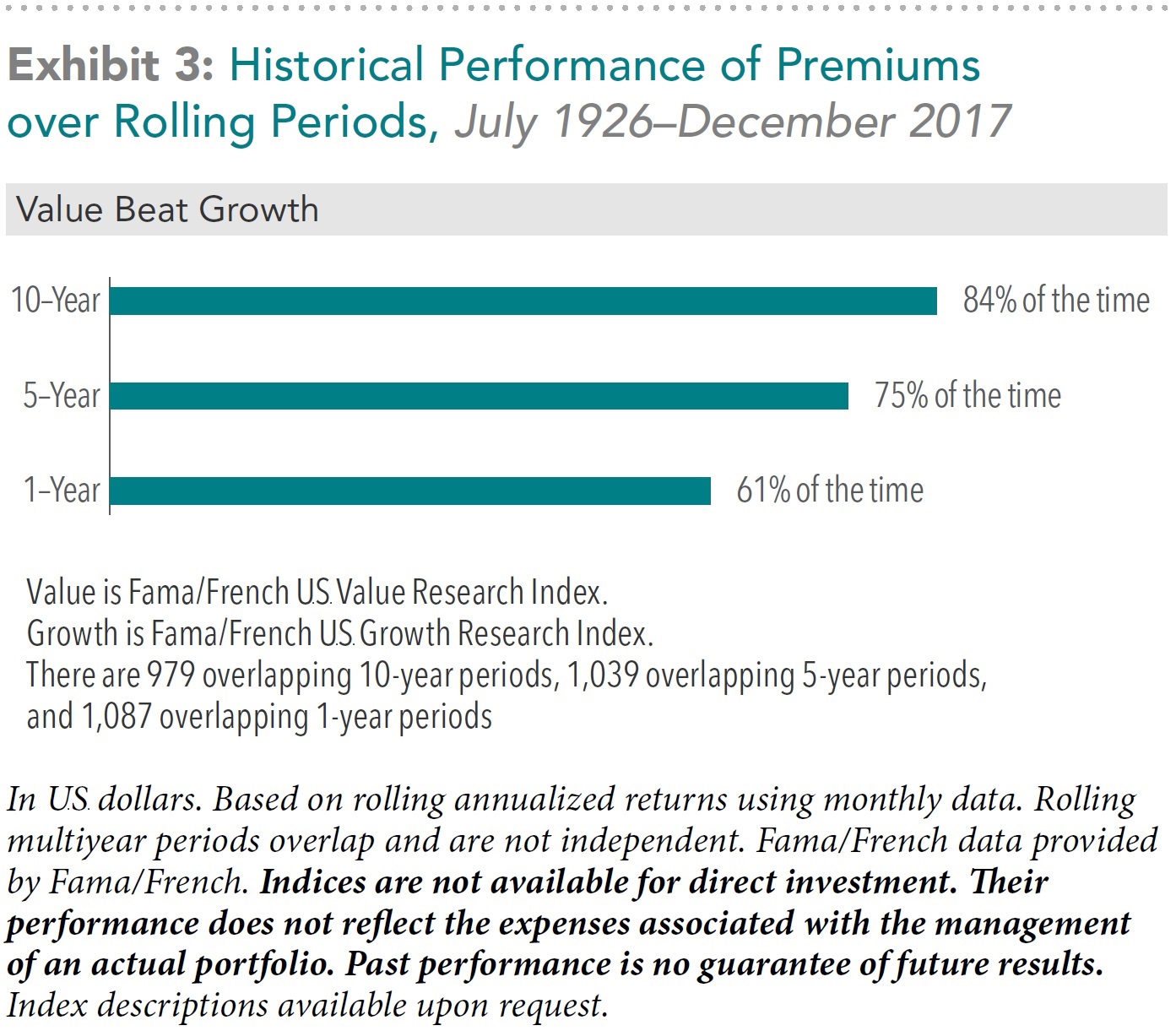
While there is uncertainty around how long periods of underperformance may last, historically the frequency of a positive value premium has increased over longer time horizons. Exhibit 3 shows the percentage of time that the value premium was positive over different time periods going back to 1926. When the length of time measured increased, the chance of a positive value premium increased. For example, when the time period measured goes from five years to 10 years, the frequency of positive average premiums increased from 75% to 84%.

Maintaining Consistency

What does all this mean for investors? While a positive value premium is never guaranteed, the premium has historically had a greater chance of being positive the longer the time horizon observed. Even with long-term positive results though, periods of extended underperformance can happen from time to time. Because the value premium has not historically materialized in a steady or predictable fashion, a consistent investment approach that maintains an emphasis on value stocks in all market environments may allow investors to more reliably capture the premium over the long run. Additionally, keeping implementation costs low and integrating multiple dimensions of expected stock returns (such as size and profitability) can improve the consistency of expected outperformance.

[1] The value premium is the return difference between stocks with low relative prices (value) and stocks with high relative prices (growth).

[2] Computed as the return difference between the Fama/French U.S. Value Research Index and the Fama/French U.S. Growth Research Index. Fama/French indices provided by Ken French.


Past performance does not guarantee future results. All investments include risk and have the potential for loss as well as gain.

Data sources for returns and standard statistical data are provided by the sources referenced and are based on data obtained from recognized statistical services or other sources we believe to be reliable. However, some or all information has not been verified prior to the analysis, and we do not make any representations as to its accuracy or completeness. Any analysis nonfactual in nature constitutes only current opinions, which are subject to change. Benchmarks or indices are included for information  purposes  only  to  reflect  the  current  market  environment;  no  index  is  a directly  tradable  investment.  There  may  be  instances  when  consultant  opinions  regarding any fundamental or quantitative analysis do not agree.

The  commentary  contained  herein  has  been  compiled  by  W.  Reid  Culp,  III  from  sources  provided  by  TAGStone  Capital,  Capital  Directions,  DFA,  Vanguard,  Morningstar,  as  well  as  commentary  provided  by  Mr.  Culp,  personally,  and  information  independently  obtained  by  Mr.  Culp.  The  pronoun  “we,”  as  used  herein,  references collectively the sources noted above.

TAGStone Capital, Inc. provides this update to convey general information about market conditions and not for the purpose of providing investment advice. Investment in any of the companies or sectors mentioned herein may not be appropriate for you. You should consult your advisor from TAGStone for investment advice regarding your own situation.

E + R = O, a Formula for Success

Combining an enduring investment philosophy with a simple formula that helps maintain investment discipline can increase the odds of having a positive financial experience.

"The important thing about an investment philosophy is that you have one you can stick with.”

David Booth
Founder and Executive Chairman
Dimensional Fund Advisors

An Enduring Investment Philosophy

Investing is a long-term endeavor. Indeed, people will spend decades pursuing their financial goals. But being an investor can be complicated, challenging, frustrating, and sometimes frightening. This is exactly why, as David Booth says, it is important to have an investment philosophy you can stick with, one that can help you stay the course.

This simple idea highlights an important question: How can investors maintain discipline through bull markets, bear markets, political strife, economic instability, or whatever crisis du jour threatens progress towards their investment goals?

Over their lifetimes, investors face many decisions, prompted by events that are both within and outside their control. Without an enduring philosophy to inform their choices, they can potentially suffer unnecessary anxiety, leading to poor decisions and outcomes that are damaging to their long-term financial well-being.

When they don’t get the results they want, many investors blame things outside their control. They might point the finger at the government, central banks, markets, or the economy. Unfortunately, the majority will not do the things that might be more beneficial—evaluating and reflecting on their own responses to events and taking responsibility for their decisions.

e + r = o

Some people suggest that among the characteristics that separate highly successful people from the rest of us is a focus on influencing outcomes by controlling their reactions to events, rather than the events themselves. This relationship can be described in the following formula1:

e + r = o (Event + Response = Outcome)

Simply put, this means an outcome—either positive or negative—is the result of how you respond to an event, not just the result of the event itself. Of course, events are important and influence outcomes, but not exclusively. If this were the case, everyone would have the same outcome regardless of their response.

Let’s think about this concept in a hypothetical in

investment context. Say a major political surprise, such as Brexit, causes a market to fall (“event’). In a panicked response, potentially fueled by gloomy media speculation of the resulting uncertainty, an investor sells some or all of his or her investment (“response”). Lacking a long-term perspective and reacting to the short-term news, our investor misses out on the subsequent market recovery and suffers anxiety about when, or if, to get back in, leading to suboptimal investment returns (“outcome”).

To see the same hypothetical example from a different perspective, a surprise event causes markets to fall suddenly (“e”). Based on his or her understanding of the long-term nature of returns and the short-term nature of volatility spikes around news events, an investor is able to control his or her emotions (“r’) and maintain investment discipline, leading to a higher chance of a successful long‑term outcome (“o”).

This example reveals why having an investment philosophy is so important. By understanding how markets work and maintaining a long-term perspective on past events, investors can focus on ensuring that their responses to events are consistent with their long-term plan.

The Foundation of an Enduring Philosophy

An enduring investment philosophy is built on solid principles backed by decades of empirical academic evidence. Examples of such principles might be:

-- trusting that prices are set to provide a fair expected return;

-- recognizing the difference between investing and speculating;

-- relying on the power of diversification to manage risk and increase the reliability of outcomes; and

-- benchmarking your progress against your own realistic long-term investment goals.

Combined, these principles might help us react better to market events, even when those events are globally significant or when, as some might suggest, a paradigm shift has occurred, leading to claims that “it’s different this time.” Adhering to these principles can also help investors resist the siren calls of new investment fads or worse, outright scams.

The Guiding Hand of a Trusted Advisor

Without education and training—sometimes gained from bitter experience—it is hard for non-investment professionals to develop a cogent investment philosophy. And even the most self-aware find it hard to manage their own responses to events. This is why a financial advisor can be so valuable—by providing the foundation of an investment philosophy and acting as an experienced counselor when responding to events. 

Investing will always be both alluring and scary at times, but a view of how to approach investing combined with the guidance of a professional advisor can help people stay the course through challenging times. Advisors can provide an objective view and help investors separate emotions from investment decisions. Moreover, great advisors can educate, communicate, set realistic financial goals, and help their clients deal with their responses even to the most extreme market events.

In the spirit of the “e + r = o” formula, good advice, driven by a sound philosophy, can help increase the probability of having a successful financial outcome.2

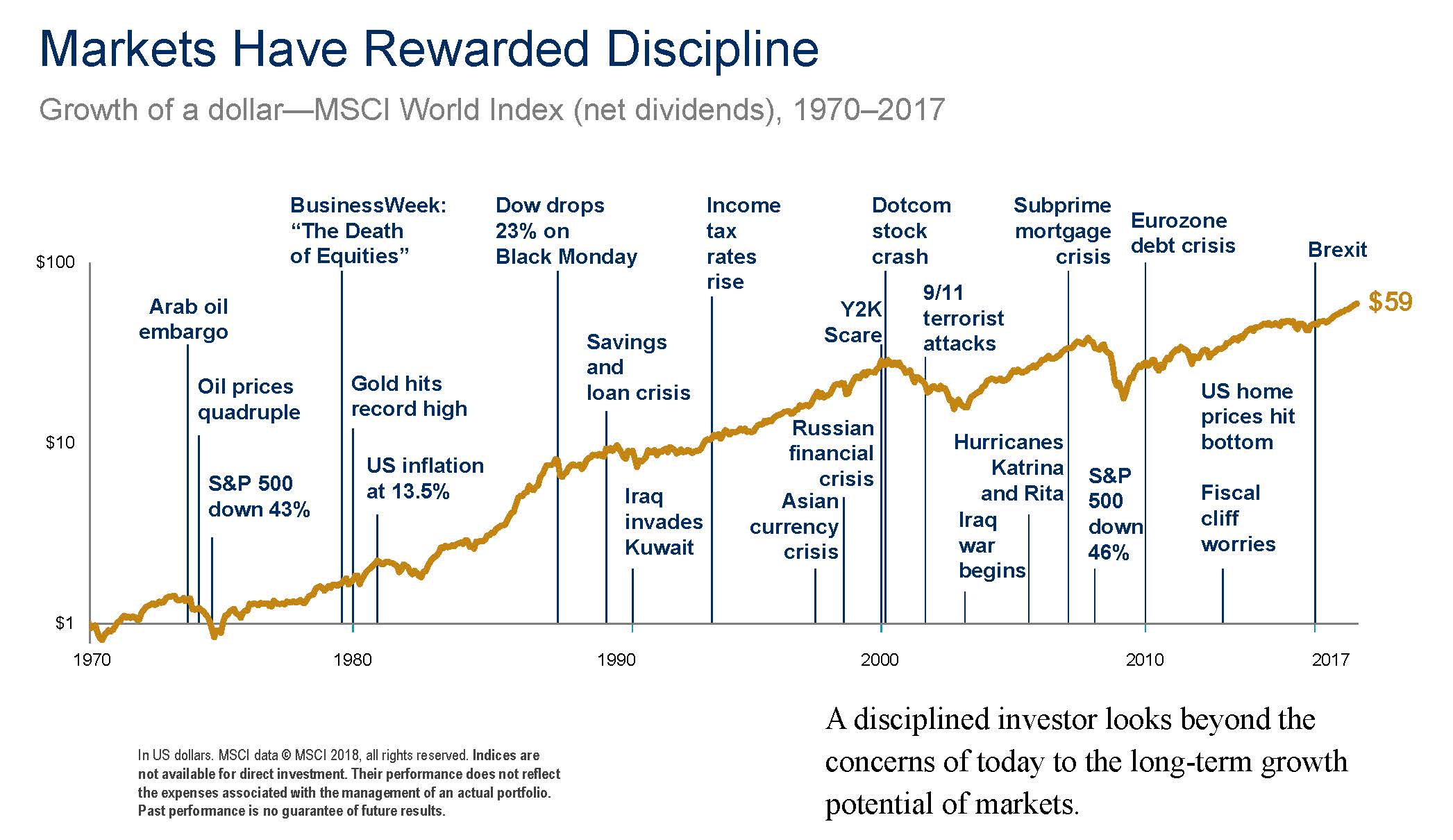
Markets Have Rewarded Discipline

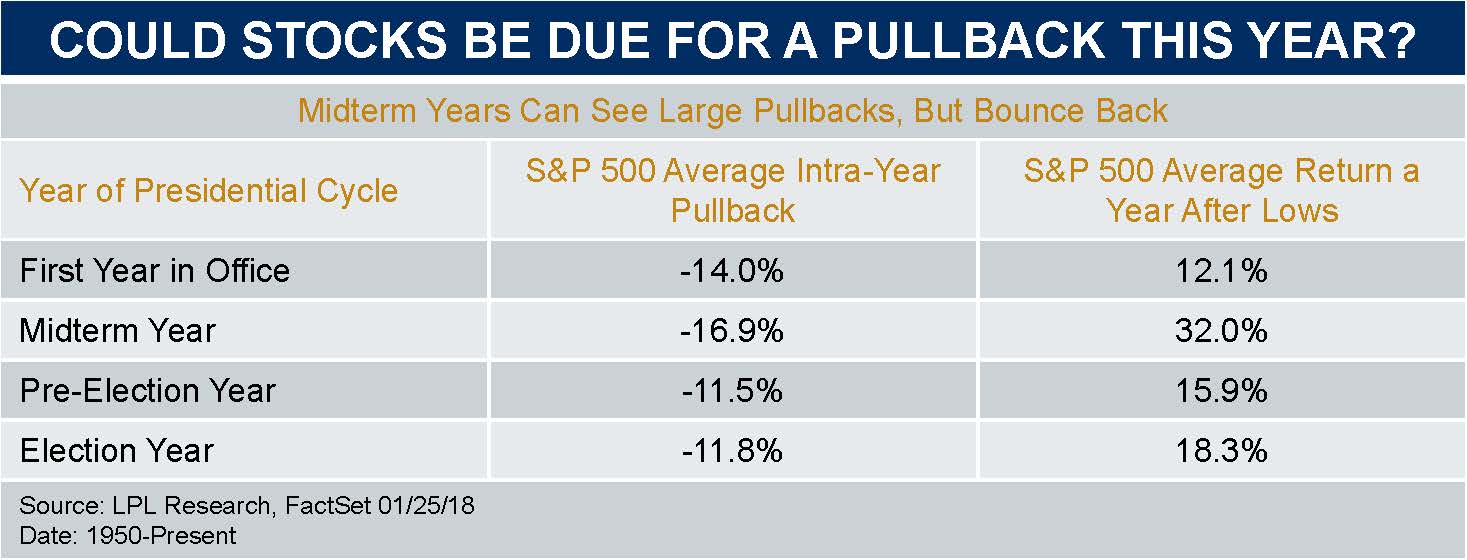
As we head into the election season, a look back at past-market crises can serve as an important reminder for investors today. As we have discussed before, the intra-year decline of the S&P 500 Index of large U.S. stocks has averaged 14.1% since 1980. That is the decline from the market high to the market low in any given 12-month calendar year.

However, as seen in the table below, the average intra-year decline of the S&P 500 Index during midterm election years, like 2018, is much higher. In midterm election years, the intra-year decline of the S&P 500 Index has averaged 16.9% since 1950.

For many, feelings of elation or despair can go with headlines leading up to and after controversial elections. We should remember that markets can be

volatile and recognize that, in the moment, doing nothing may feel paralyzing. Throughout these ups and downs, however, if one had hypothetically invested $10,000 in a globally diversified portfolio of stocks in January 1970 and stayed invested, that investment would be worth about $590,000 at the end of 2017.

[1] Jack Canfield, The Success Principles: How to Get from Where You Are to Where You Want to Be (New York: HarperCollins Publishers, 2004).

[2] Adapted from “E+R=O, a Formula for Success,” The Front Foot Adviser, by David Jones, Vice President and Head of Financial Adviser Services, EMEA.


Past performance does not guarantee future results. All investments include risk and have the potential for loss as well as gain.

Data sources for returns and standard statistical data are provided by the sources referenced and are based on data obtained from recognized statistical services or other sources we believe to be reliable. However, some or all information has not been verified prior to the analysis, and we do not make any representations as to its accuracy or completeness. Any analysis nonfactual in nature constitutes only current opinions, which are subject to change. Benchmarks or indices are included for information  purposes  only  to  reflect  the  current  market  environment;  no  index  is  a directly  tradable  investment.  There  may  be  instances  when  consultant  opinions  regarding any fundamental or quantitative analysis do not agree.

The  commentary  contained  herein  has  been  compiled  by  W.  Reid  Culp,  III  from  sources  provided  by  TAGStone  Capital,  Capital  Directions,  DFA,  Vanguard,  Morningstar,  as  well  as  commentary  provided  by  Mr.  Culp,  personally,  and  information  independently  obtained  by  Mr.  Culp.  The  pronoun  “we,”  as  used  herein,  references collectively the sources noted above.

TAGStone Capital, Inc. provides this update to convey general information about market conditions and not for the purpose of providing investment advice. Investment in any of the companies or sectors mentioned herein may not be appropriate for you. You should consult your advisor from TAGStone for investment advice regarding your own situation.


Sailing with the Tides

Embarking on a financial plan is like sailing around the world. The voyage won’t always go according to plan, and there’ll be rough seas. But the odds of reaching your destination increase greatly if you are prepared, flexible, patient, and well-advised.

A mistake many inexperienced sailors make is not having a plan at all. They embark without a clear sense of their destination. And once they do decide, they often find themselves lost at sea in the wrong boat with inadequate provisions.

Likewise, in planning an investment journey, you need to decide on your goal. A first step might be to consider whether the goal is realistic and achievable. For instance, while you may long to retire in the south of France, you may not be prepared to sacrifice your needs today to satisfy that distant desire.

Sailing with the Tides (Continued)

Once you are set on a realistic destination, you need to ensure you have the right portfolio to get you there. Have you planned for multiple contingencies? What degree of “bad weather” can your plan withstand along the way?

Key to a successful voyage is a good navigator. A trusted advisor is like that, regularly taking coordinates and making adjustments, if necessary. If your circumstances change, the advisor may suggest you replot your course.

As with the weather at sea, markets can be unpredictable. A sudden squall can whip up waves of volatility, tides can shift, and strong currents can threaten to blow you off course. Like a seasoned sailor, an experienced advisor will work with the conditions.

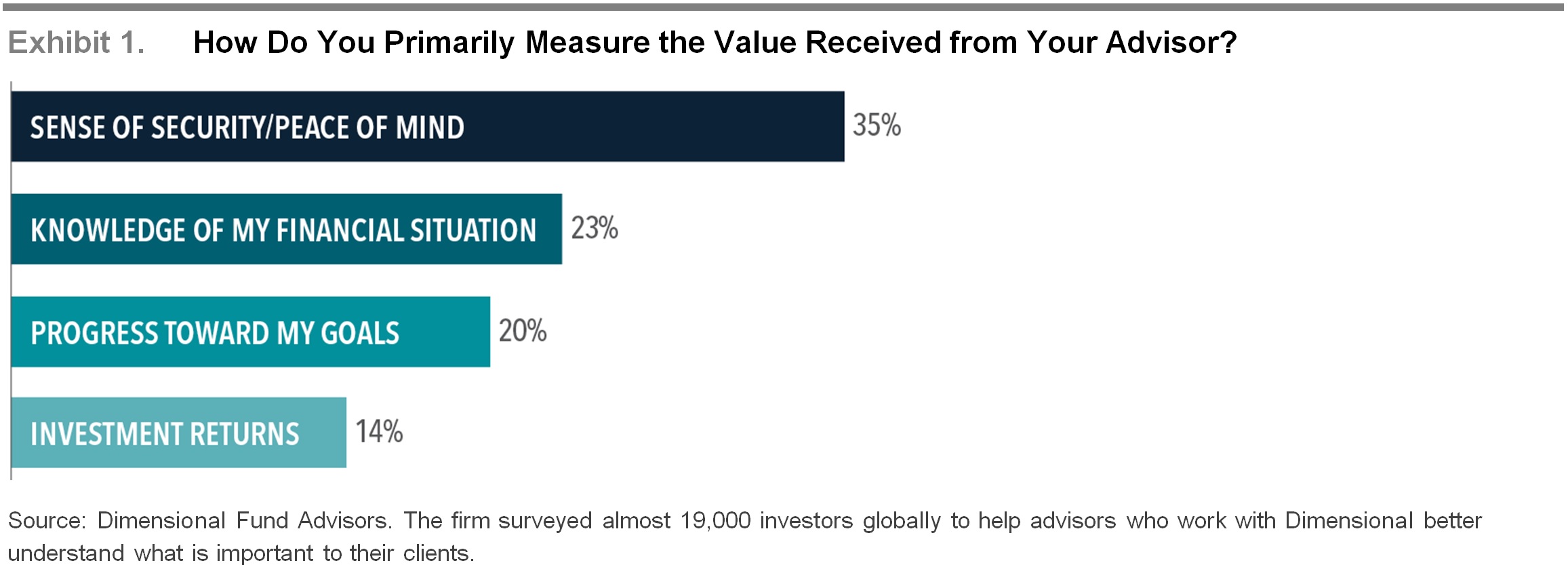
Exhibit 1. A recent survey conducted by Dimensional Fund Advisors found that, along with progress towards their goals, investors place a high value on the sense of security they receive from their relationship with a financial advisor.

Sailing with the Tides (Continued)

Once the storm passes, you can pick up speed again. Just as a sturdy vessel will help you withstand most conditions at sea, a well-diversified portfolio can act as a bulwark against the sometimes tempestuous conditions in markets.

Circumnavigating the globe is not exciting every day. Patience is required with local customs and paperwork as you pull into different ports. Likewise, a lack of attention to costs and taxes is the enemy of many a long-term financial plan.

Distractions can also send investors, like sailors, off course. In the face of “hot” investment trends, it takes discipline not to veer from your chosen plan. Like the sirens of Greek mythology, media pundits can also be diverting, tempting you to change tack and act on news that is already priced into markets.

A lack of flexibility is another impediment to a successful investment journey. If it doesn’t look as though you’ll make your destination in time, you may have to extend your voyage, take a different route to get there, or even moderate your goal.

Sailing with the Tides (Continued)

The important point is that you become comfortable with the idea that uncertainty is inherent to the investment journey, just as it is with any sea voyage. That is why preparation and planning are so critical. While you can’t control every outcome, you can be prepared for the range of possibilities and understand that you have clear choices if things don’t go according to plan.

If you can’t live with the volatility, you can change your plan. If the goal looks unachievable, you can lower your sights. If it doesn’t look as if you’ll arrive on time, you can extend your journey.

Of course, not everyone’s journey is the same. Neither is everyone’s destination. We take different routes to different places, and we meet a range of challenges and opportunities along the way.

But for all of us, it’s critical that we are prepared for our journeys in the right vessel, keep our destinations in mind, stick with the plans, and have a trusted navigator to chart our courses and keep us on target.1

© 2018 S&P Dow Jones Indices LLC, a division of S&P Global. All rights reserved. Not representative of an actual investment. Indices are not available for direct investment; therefore, their performance does not reflect the expenses associated with the management of an actual portfolio.

Stormy Weather

Headlines from the “lost decade”2 can help illustrate several periods when markets were volatile.

May 1999: Dow Jones Industrial Average Closes Above 11,000 for the First Time

March 2000: Nasdaq Stock Exchange Index Reaches an All-Time High of 5,048

April 2000: In Less Than a Month, Nearly a Trillion Dollars of Stock Value Evaporates

October 2002: Nasdaq Hits a Bear-Market Low of 1,114

September 2005: Home Prices Post Record Gains

September 2008: Lehman Files for Bankruptcy, Merrill Is Sold

Staying the Course

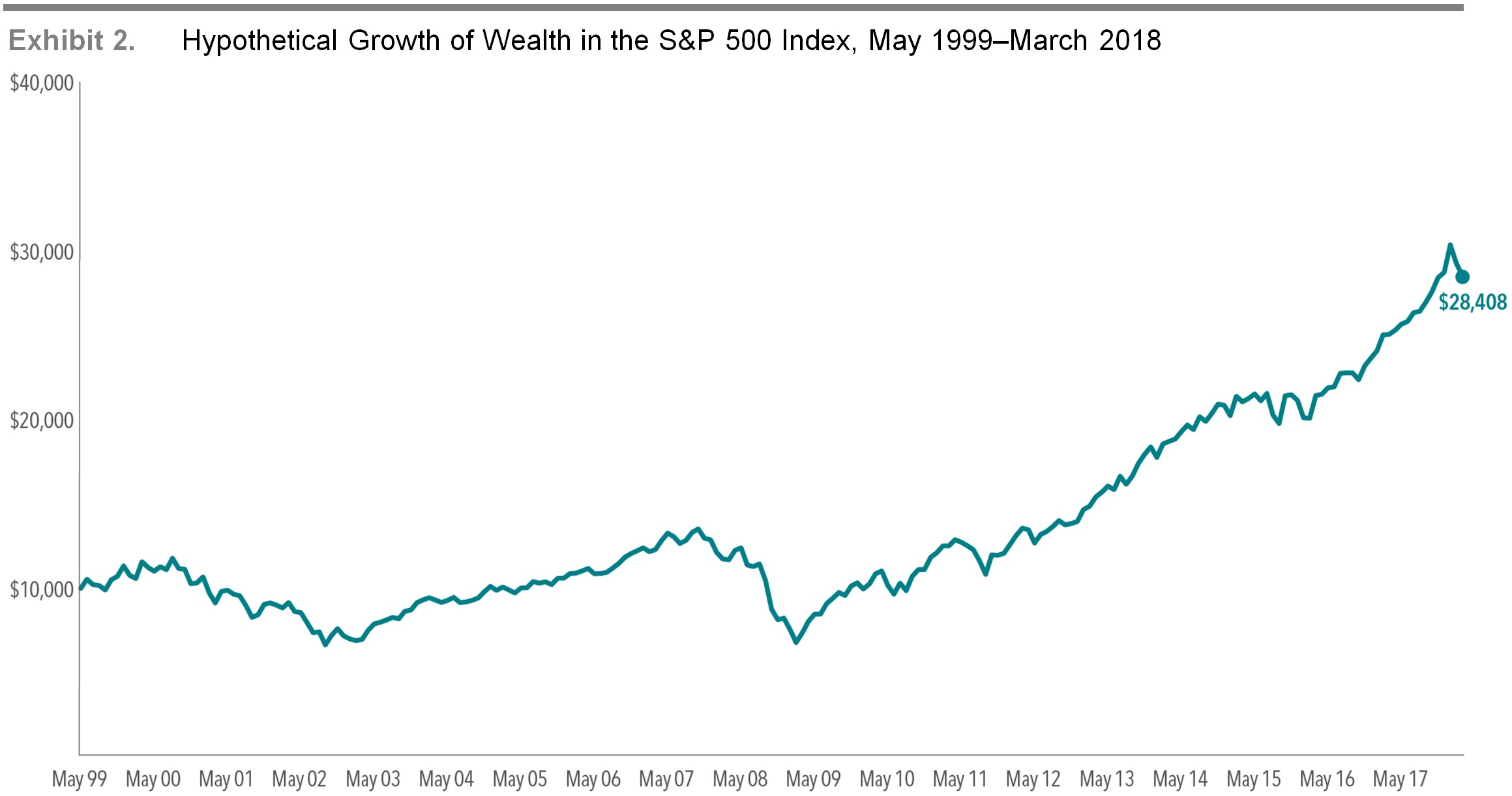
While these events are now a decade or more behind us, they can still serve as an important reminder for investors today. For many, feelings of elation or despair can accompany headlines like these. We should remember that markets can be volatile and recognize that, in the moment, doing nothing may feel paralyzing. Throughout these ups and downs, however, if one had hypothetically invested $10,000 in U.S. stocks in May 1999 and stayed invested, that investment would be worth approximately $28,000 today.3

[1] Source: Dimensional Fund Advisors, LP. Adapted from “Sailing with the Tides,” Outside the Lines by Jim Parker, March 2018.

[2] For the U.S. stock market, this is generally understood as the period inclusive of 1999-2009

[3] As measured by the S&P 500 Index. A hypothetical portfolio of $10,000 invested on April 30, 1999, and tracking the S&P 500 Index, would have grown to $28,408 on March 31, 2018. However, performance of a hypothetical investment does not reflect transaction costs, taxes, or returns that any investor actually attained and may not reflect the true costs, including management fees, of an actual portfolio. Changes in any assumptions may have a material impact on the hypothetical returns presented. It is not possible to invest directly in an index.


Past performance does not guarantee future results. All investments include risk and have the potential for loss as well as gain.

Data sources for returns and standard statistical data are provided by the sources referenced and are based on data obtained from recognized statistical services or other sources we believe to be reliable. However, some or all information has not been verified prior to the analysis, and we do not make any representations as to its accuracy or completeness. Any analysis nonfactual in nature constitutes only current opinions, which are subject to change. Benchmarks or indices are included for information  purposes  only  to  reflect  the  current  market  environment;  no  index  is  a directly  tradable  investment.  There  may  be  instances  when  consultant  opinions  regarding any fundamental or quantitative analysis do not agree.

The  commentary  contained  herein  has  been  compiled  by  W.  Reid  Culp,  III  from  sources  provided  by  TAGStone  Capital,  Capital  Directions,  DFA,  Vanguard,  Morningstar,  as  well  as  commentary  provided  by  Mr.  Culp,  personally,  and  information  independently  obtained  by  Mr.  Culp.  The  pronoun  “we,”  as  used  herein,  references collectively the sources noted above.

TAGStone Capital, Inc. provides this update to convey general information about market conditions and not for the purpose of providing investment advice. Investment in any of the companies or sectors mentioned herein may not be appropriate for you. You should consult your advisor from TAGStone for investment advice regarding your own situation.

Recent Market Correction

After a period of relative calm in the markets, in recent days the increase in volatility in the stock market has resulted in renewed anxiety for many investors.

From January 27 to February 8, the U.S. market (as measured by the S&P 500 Index) fell more than 10%, marking the first stock market correction in more than two years. A stock market correction is defined as a 10% decline from the previous high. The last correction was in January 2016, when the market fell 11% in the worst start to any year on record. The recent correction has left many investors wondering what the future holds and if they should make changes to their portfolios.

While it may be difficult to remain calm during a substantial market decline, it is important to remember that volatility is a normal part of investing. Additionally, for long-term investors, reacting emotionally to volatile markets may be more detrimental to portfolio performance than the drawdown itself.

Intra-Year Declines

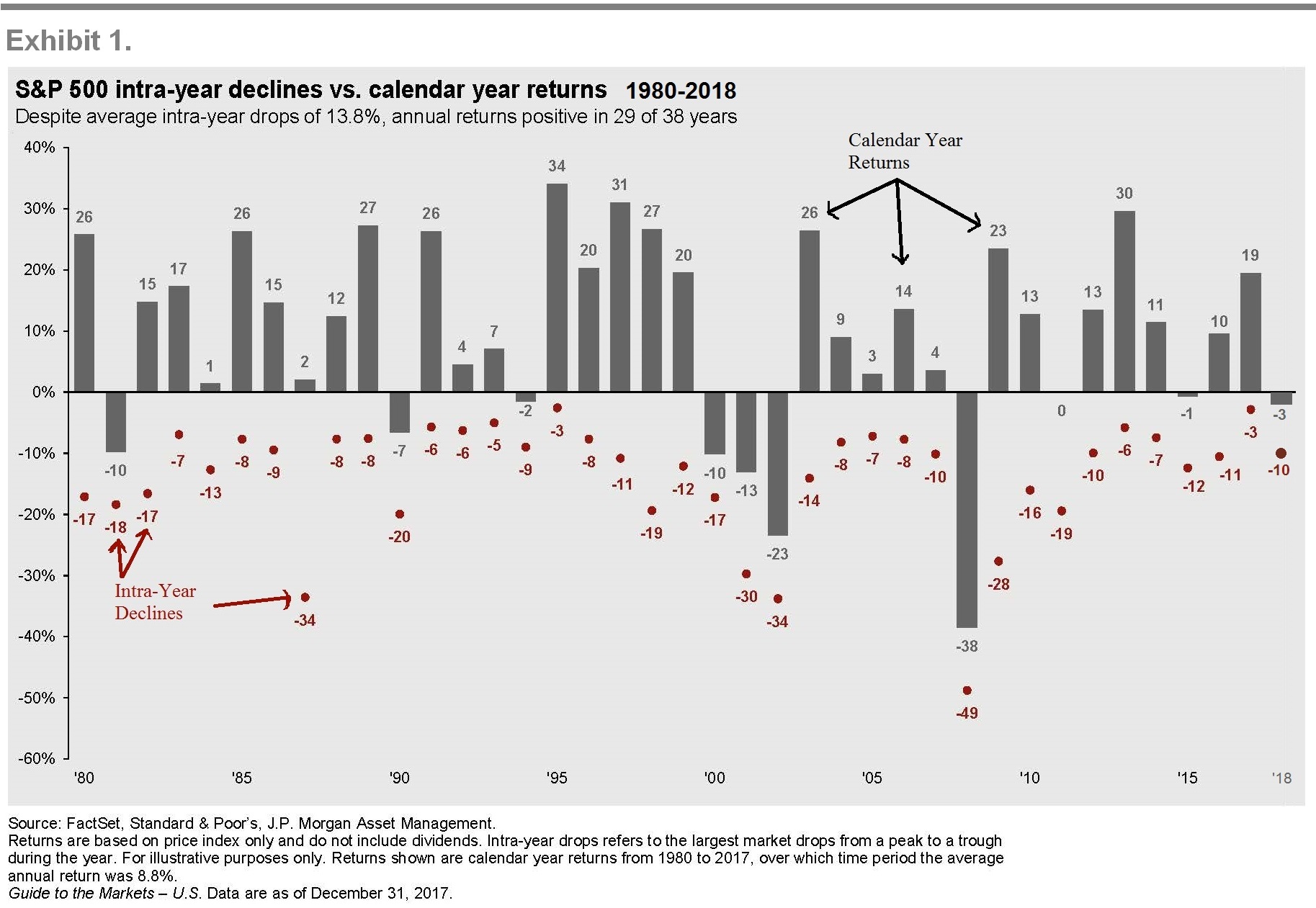
Exhibit 1 shows calendar year returns for the U.S. stock market since 1980, as well as the largest intra-year declines that occurred during each year. During this period, the average intra-year decline was about 14%. About half of the years observed had declines of more than 10%, and around a third had declines of more than 15%. Despite substantial intra-year drops, calendar year returns were positive in 29 years out of the 39 examined. This shows just how common market declines are and how difficult it is to say whether a large intra-year decline will result in negative returns over the entire year.1

Reacting Impacts Performance

If one was to try and time the market in order to avoid the potential losses associated with periods of increased volatility, would this help or hinder long-term performance? If current market prices aggregate the information and expectations of market participants, it should be difficult, if not impossible, to profitably time the market. In other words, it is unlikely that investors can successfully time the market, and if they do manage it, it may be a result of luck rather than skill.

It is also important to keep in mind that market timing generally involves both a buy and a sell decision. For example, if an investor believes the market is too high, the investor would need to decide when to sell. At a later point in time, the investor would need to make a decision when to buy back in. While it’s difficult to make a properly timed sell decision, it’s even more difficult to combine a properly timed sell decision with a properly timed buy decision.

When trying to time a market correction, it’s helpful to keep in mind a quote from the legendary Wall Street investor, Peter Lynch:

"Far more money has been lost by investors preparing for corrections, or trying to anticipate corrections than has been lost in corrections themselves.”[2]

And We’re Only Talking a Few Days

Further complicating the prospect of market timing being additive to portfolio performance is the fact that a substantial proportion of the total return of stocks over long periods comes from just a handful of days. The inability of investors to be able to predict which days will have strong returns and which will not is another reason for investors to remain invested during periods of volatility rather than jump in and out of stocks. Otherwise, an investor runs the risk of being on the sidelines on days when returns happen to be strongly positive.

Exhibit 2 helps illustrate this point. It shows the annualized compound return of the S&P 500 Index going back to 1990 and illustrates the impact of missing out on just a few days of strong returns. The bars represent the hypothetical growth of $1,000 over the period and show what happened if you missed the best single day during the period and what happened if you missed a handful of the best single days. The data shows that being on the sidelines for only a few of the best single days in the market would have resulted in substantially lower returns than the total period had to offer.3

Asset Allocation Decision

The foundation of an investor’s investment plan should be a pre-determined ratio between stocks and bonds, also called an asset allocation. In general, the higher the ratio of stocks to bonds in an investor’s portfolio, the riskier the portfolio is considered to be since stocks generally have a greater risk of loss than bonds. The ratio should be set at a level that the investor can stick with through market ups and downs, based on their ability and willingness to take risk. The biggest risk that most individual investors face is the risk that they will sell out of their stocks at the bottom of a market cycle.

An investor’s hypothetical financial ability to bear a financial loss is easy to measure because it can be reduced to a mathematical conclusion based on the investor’s financial assets and time until they need the money. However, an investor’s “stomach” for volatility is more difficult to measure because most people don’t know how they will react when they see a significant drop in the price of stocks of 20%, 25%, or 30%. When times are good, like now, people become overconfident and many investors will overstate their willingness to withstand volatility.

Since there is a subjective nature to determining an investor’s ratio between stocks and bonds, two rules of thumbs may help:

Asset Allocation Decision (Continued)

1. When looking across the spectrum of all individual investors, the most common ratio is about 60% stocks and 40% bonds.

2. Younger investors are able to assume more risk since they have a longer time to make up a market downturn. So, one way to determine your ratio is to take 110 minus your age equals how much you should have in stocks (For example, 110 – 45 years old = 65% allocation to stocks).

Finally, Benjamin Graham, the great teacher of Warren Buffett, advocates in his book The Intelligent Investor (probably the most-respected investment book ever written) using a 50/50 stock/bond ratio as a baseline, and shifting as far as 25/75 in either direction, based upon current market conditions. Graham explains it this way:

"The sound reason for increasing the percentage in common stocks [beyond 50%] would be the appearance of ‘bargain price’ levels created in a protracted bear market. Conversely, sound procedure would call for reducing the common-stock component below 50% when in the judgment of the investor the market level has become dangerously high."

Systematic Rebalancing Helps

While the evidence has shown that it is difficult to use market timing to produce superior results, systematically rebalancing a portfolio is an important aspect of TAGStone’s investment process. Systematic rebalancing is designed to sell certain assets that have gone up above their target level and purchase certain assets that have gone down below their target level.

TAGStone is able to rebalance your portfolio periodically between stocks and bonds. If you have selected a 60/40 ratio, then 60% of your portfolio is allocated to stocks and 40% is allocated to bonds. If stocks go up, and your allocation to stocks goes to 75% of your portfolio for example, then TAGStone has the ability, after discussing with you, to sell a portion of your stocks that have increased in value and redeploy the proceeds into bonds.

In addition, some of the fund managers utilized by TAGStone periodically rebalance within the funds that they manage. This means, in general, they are selling stocks that have gone up in value and buying stocks at lower valuations based on predetermined market metrics.

For many investors, now is a relevant time to carefully consider rebalancing. The surge in stock prices over the last fourteen months has pushed up the stock allocation for many investors above their long-term target level. While it’s not pleasant to sell stocks when they are on an upward trend, momentum is a difficult factor to trade and trends can reverse at any point without a clear reason.

Staying Disciplined

With the recent volatility, investors may be asking themselves: “Is now a good time for me to revisit a change in my asset allocation?” An appropriate answer is highly dependent upon an investor’s unique situation and their risk and return objectives. For investors considering a change to their asset allocation, a disciplined approach with a long-term view is likely more prudent than making a decision based on a reaction to short-term market movements.

While market volatility can be nerve-racking for investors, reacting emotionally and changing long-term investment strategies in response to short-term declines could prove more harmful than helpful. By adhering to a well-thought-out investment plan, ideally agreed upon in advance of periods of volatility, investors may be better able to remain calm during periods of short-term uncertainty.

Over the long term, the financial markets have rewarded investors. People expect a positive return on the capital they supply, and historically, the equity and bond markets have provided meaningful growth of wealth. As investors prepare for 2018 and what the year may bring, we should remember that frequent changes to an investment strategy can hurt performance. Rather than trying to time the market based on hunches, headlines, or indicators, investors, who pick and stay disciplined to an asset allocation, should benefit from expected long-term positive market returns.

1. Source: Dimensional Fund Advisors, LP

2. https://www.cbsnews.com/news/the-smartest-things-ever-said-about-market-timing

3. Source: Dimensional Fund Advisors, LP


Past performance does not guarantee future results. All investments include risk and have the potential for loss as well as gain.

Data sources for returns and standard statistical data are provided by the sources referenced and are based on data obtained from recognized statistical services or other sources we believe to be reliable. However, some or all information has not been verified prior to the analysis, and we do not make any representations as to its accuracy or completeness. Any analysis nonfactual in nature constitutes only current opinions, which are subject to change. Benchmarks or indices are included for information  purposes  only  to  reflect  the  current  market  environment;  no  index  is  a directly  tradable  investment.  There  may  be  instances  when  consultant  opinions  regarding any fundamental or quantitative analysis do not agree.

The  commentary  contained  herein  has  been  compiled  by  W.  Reid  Culp,  III  from  sources  provided  by  TAGStone  Capital,  Capital  Directions,  DFA,  Vanguard,  Morningstar,  as  well  as  commentary  provided  by  Mr.  Culp,  personally,  and  information  independently  obtained  by  Mr.  Culp.  The  pronoun  “we,”  as  used  herein,  references collectively the sources noted above.

TAGStone Capital, Inc. provides this update to convey general information about market conditions and not for the purpose of providing investment advice. Investment in any of the companies or sectors mentioned herein may not be appropriate for you. You should consult your advisor from TAGStone for investment advice regarding your own situation.