

How to Have Family Conversations About Money

How to Have Family Conversations About Money

Money plays a role in so many of the decisions we make, yet it remains one of the last true taboos in American life. Despite its importance, 62% of people say they don’t talk about money at all—not with family, not with friends and in nearly half of cases, not even with their spouse or partner. In fact, most Americans feel more comfortable discussing politics, religion or even the details of their love lives than their bank accounts.

In our work with families, we see this reluctance constantly—and the avoidable problems it creates. Money is tied to identity and emotion, including feelings of self-worth, fear of judgment, embarrassment or shame around things like spending, saving and debt. As uncomfortable as these feelings may be, avoiding these conversations carries a real cost. Silence can create stress, undermine financial security and strain relationships across generations.

These conversations are especially important to have with family. Understanding each other’s expectations, responsibilities and values leads to smarter planning and strengthens families along the way. Talking about money—even imperfectly—is one of the most powerful steps families can take toward long-term financial well-being.

Discussing Finances with Adult Children: Setting Expectations Early

For parents with adult children, looping them into your financial plan helps give them the information and tools they may need to help you one day or ensure your estate plan and legacy wishes are fulfilled. Consider discussing:

Your financial plan: Share how you expect to spend your retirement and what lifestyle adjustments you expect to make. For instance, do you plan to downsize or relocate? Are you planning to spend more time with the grandkids? Take the time to understand if your plans align with your children’s so there are no misunderstandings.

Your estate plan: Let children know what you intend to leave behind, whether it’s financial assets, property or personal valuables. Surprises can lead to conflict, while clarity early on can help prevent it. There are no hard and fast rules about what you need to share. If you’re uncomfortable with specific dollar amounts, for instance, you could use percentages or rough ballparks.

Your goals and values: Wealth planning isn’t just about assets; it’s also largely about purpose. Explain what’s important to you and what you hope to accomplish with your wealth. For instance, are you hoping to help fund your grandchildren’s education? Are there philanthropic causes you value? Helping your children understand the “why” behind financial decisions can make it more likely your legacy is carried out.

Discussing Finances with Aging Parents: Planning Before a Crisis

For children of aging parents, approaching financial topics can feel daunting. It might feel like prying, or maybe money is a topic you’ve never broached with them before. But doing so now is far easier than navigating decisions in a crisis. Honest conversations about future plans and resources can prevent stressful last-minute decisions later. Consider discussing:

Long-term care plans: Do your parents have long-term care insurance or funds set aside for potential future health care needs? Have they thought about where they want to live as they age?

Key decision-making roles: Understanding responsibilities in advance can eliminate confusion when timing matters most. Find out who holds powers of attorney and will oversee medical or financial decisions if parents are unable to.

Financial safety and organization: Ask how parents have organized important documents and where they are kept. Who needs to know passwords to important accounts and where are they stored? Is there an estate planning attorney who has copies of documents such as wills and trusts?

How to Have Productive Money Conversations

While knowing what to talk about is important, having this discussion is another matter. They can be uncomfortable, to say the least, and they’re often downright emotional. A structured, thoughtful approach helps. Consider the following:

Choose the right setting: Avoid holidays and major family events. These are often already stressful times when emotions may be running high. Instead, schedule a dedicated time that allows for calm, uninterrupted conversation. Let participants know the topic in advance so they can come prepared with questions and concerns.

Set an agenda: Be clear about the purpose of the conversation. Are you educating loved ones about your financial situation? Discussing an estate plan? Addressing specific concerns like debt or spending? Putting the agenda in writing can help keep the discussion focused.

Acknowledge emotions: Money is deeply emotional, and strong feelings are a normal part of the conversation. Acknowledging that reality upfront can help defuse tension. Aim to create an environment where everyone feels heard and respected—by asking open-ended questions, encouraging family members to share their perspectives and resisting the impulse to blame or shame.

Turn conversation into action: By the end of the discussion, make sure everyone understands their role. Sometimes the goal of a meeting is simply transparency, and no follow-up is required. In other cases, families may need to outline next steps or ask for help.

We’re Here to Help

Conversations about money within families can be complex, emotional, and consequential. As your financial advisor, we can help clarify complex issues and outline planning strategies for you and your family to consider. We can also help facilitate family meetings, serving as a resource to guide conversation and answer questions as they come up. If you’re ready to talk to your family about money, reach out. We’re here to support you every step of the way.


Past performance does not guarantee future results. All investments include risk and have the potential for loss as well as gain.

Data sources for returns and standard statistical data are provided by the sources referenced and are based on data obtained from recognized statistical services or other sources we believe to be reliable. However, some or all information has not been verified prior to the analysis, and we do not make any representations as to its accuracy or completeness. Any analysis nonfactual in nature constitutes only current opinions, which are subject to change. Benchmarks or indices are included for information purposes  only  to  reflect  the  current  market  environment;  no  index  is  a directly  tradable investment.  There  may  be  instances  when  consultant  opinions  regarding any fundamental or quantitative analysis do not agree.

The  commentary  contained  herein  has  been  compiled  by  W.  Reid Culp,  III  from  sources  provided  by  TAGStone  Capital,  as well  as  commentary  provided  by  Mr.  Culp,  personally,  and  information independently  obtained  by  Mr.  Culp.  The  pronoun  “we,”  as  used  herein,  references collectively the sources noted above.

TAGStone Capital, Inc. provides this update to convey general information about market conditions and not for the purpose of providing investment advice. Investment in any of the companies or sectors mentioned herein may not be appropriate for you. You should consult your advisor from TAGStone or others for investment advice regarding your own situation.


At a Glance

  • Estate planning at higher levels of wealth is an execution and coordination challenge—not merely a legal exercise.
  • The greatest risks arise where intent, legal documents, asset titling, and beneficiary designations drift out of alignment.
  • Sophisticated families approach estate planning as an ongoing, advisor‑guided process that evolves with assets, entities, and family dynamics.

Part 2: Step-by-Step Estate Planning for Sophisticated Families

In Part 1 of this series, we addressed why estate planning matters—and why, for many families, it represents one of the most meaningful acts of stewardship they can undertake. In this follow‑up, we turn to the how.

For families with significant assets, multiple entities, or multigenerational considerations, estate planning is rarely a single document or moment in time. It is a procedural process that requires clarity of intent, disciplined implementation, and ongoing coordination across advisors.

What follows is a practical framework that reflects how sophisticated families typically approach estate planning—methodically, deliberately, and with an eye toward fiduciary, tax, and governance risk.

Hurdle #1: Deciding Who Gets What

The first step is deceptively simple: defining what should happen after you pass. In practice, this is where many long‑term issues are either resolved—or unintentionally created.

At higher levels of wealth, this exercise often extends beyond a single balance sheet. It may involve operating businesses, real estate partnerships, concentrated investment positions, family trusts, or philanthropic structures. Decisions made here can have downstream consequences for estate taxes, GST planning, liquidity, and family governance.

Rather than attempting to control every detail, sophisticated families focus first on priorities:

  • Who are the intended beneficiaries, and at what stages of life?
  • Are there second marriages, blended families, or differing levels of financial maturity?
  • Which assets are illiquid, and which are expected to fund liquid needs?


These questions are best addressed while capacity is intact and family dynamics can be navigated thoughtfully—often in parallel with broader lifetime planning decisions.

Who Gets What? A Strategic Checklist

  • Estimate net worth across all major assets and liabilities (ballpark is sufficient initially).
  • Identify primary beneficiaries, contingent beneficiaries, and charitable interests.
  • Consider how the bulk of the estate should be allocated, recognizing potential estate tax and GST implications.
  • Identify specific assets or heirlooms with emotional or historical significance.
  • Consider to whom or what entity you might like to leave these particular possessions.
  • Identify who you’d like to name as executor and/or trustee, to settle your estate and administer your trusts once you pass. (As described in this ACTEC article, “What It Means to be a Trustee: A Guide for Clients,” the person should be reliable to carry out their duties in a timely and responsible manner.)
  • Flag potential conflicts of interest or competing expectations among beneficiaries, such as multiple heirs each hoping to inherit the family cabin.
  • Identify individuals you would explicitly exclude, such as ex-spouses or estranged family members.


For many families, this stage benefits from advisor facilitation—not to dictate outcomes, but to surface blind spots before they harden into documents.

Hurdle #2: Making It Legal

Once intent is clear, the next step is translating that intent into enforceable legal structures. This is where technical precision matters—and where coordination failures can be costly.

While it is technically possible to rely on generic templates, we rarely see it hold up over time—particularly for families with layered trusts, operating entities, or long-term legacy objectives. Missing or imprecise legal language can easily undermine even well-intentioned plans. A reputable estate planning attorney does more than draft documents: they take the time to understand your family, translate intent into enforceable structures, anticipate tax and fiduciary risk, and collaborate with your financial advisors to ensure documents, asset ownership, and beneficiary designations work together. Once established, that relationship materially improves the plan’s durability and ease of ongoing maintenance.

Sophisticated estate plans often involve a combination of:

  • Will. Nearly every estate plan begins with a will. At a minimum, a will directs how assets passing through probate are distributed, names one or more executors to administer the estate, and appoints guardians for minor children where applicable. For families with modest complexity and clear beneficiary designations, a will may address the essentials. For more complex estates, the will functions as a backstop—capturing assets not otherwise titled or governed by trust arrangements and ensuring orderly administration through the probate process.
  • Revocable Living Trust (RLT). As assets, relationships, or family dynamics become more complex, many families supplement a will with a revocable living trust. An RLT allows the bulk of the estate to bypass public probate, providing greater privacy, continuity, and administrative efficiency. More importantly, it enables flexibility that a will alone cannot provide—such as supporting a surviving spouse during their lifetime while preserving remainder interests for children from a prior marriage, staging distributions for beneficiaries who are not yet ready to manage wealth, or protecting assets from a beneficiary’s creditors or spendthrift tendencies. Properly structured, an RLT also facilitates seamless management during incapacity and a smoother transition at death.
  • Specialized Trusts. Families with business interests, philanthropic goals, or multigenerational planning objectives often rely on additional trust structures to address specific risks and opportunities. These may include trusts designed to mitigate estate and GST taxes, support business succession, fund charitable initiatives, or establish long‑term family governance frameworks.


For families pursuing dynasty‑style planning, documents may also incorporate directed trustees, trust protectors, or successor governance provisions—structures that require careful alignment between legal language and real‑world administration.

A recurring risk at this stage is assuming that documents alone are sufficient. In reality, fiduciary risk often arises when documents say one thing and accounts, titles, or beneficiary forms say another.

Equally important is incapacity planning. Powers of attorney, healthcare directives, and trustee succession provisions should be evaluated alongside the broader lifetime planning framework, not treated as afterthoughts.

Hurdle #3: Getting It Together

This final step is where many estate plans quietly fail—not due to poor legal drafting, but due to incomplete implementation.

For trustees and executors, administrative clarity is not a convenience; it is a fiduciary necessity. Even well‑constructed plans can unravel if assets are mis‑titled, beneficiary designations are outdated, or key information is inaccessible.

Implementation and Governance Checklist

  • Maintain a detailed and current inventory of financial assets, including investment accounts, bank accounts, retirement plans, insurance policies, business interests, and any entities or partnerships in which you hold an interest.
  • Document who should receive specific collectibles, heirlooms, or personal property—typically through a separate, adjustable memorandum referenced by your will or trust.
  • Identify key professionals your trustees, executors, or beneficiaries may need to contact, such as your financial advisor, estate planning attorney, accountant, or insurance advisor.
  • Compile practical information fiduciaries will need to administer the estate efficiently: where legal documents are stored; how to access digital accounts, security codes, and devices; and contact information for household, caregiving, or pet care arrangements.
  • Confirm that revocable living trusts are fully funded with major assets so they can function as intended, with assistance from your estate planning counsel where needed.
  • Ensure homes, vehicles, business interests, and other titled assets are properly owned and aligned with the estate plan (individual, joint, trust, or entity ownership).
  • Review beneficiary designations on retirement accounts, insurance policies, and transfer on death assets regularly to ensure consistency with overall intent.
  • Reduce accumulated physical clutter and outdated records to avoid imposing unnecessary administrative and emotional burdens on fiduciaries and heirs.
  • Revisit each of these steps on a recurring basis—particularly after births, deaths, marriages, divorces, relocations, major financial events, legislative changes, or material shifts in family or trust structures.


For families with ongoing trusts or multigenerational arrangements, this review cadence is not optional; it is a core governance discipline as assets grow, laws evolve, and fiduciary responsibilities expand.

Security also warrants explicit treatment as a fiduciary risk-mitigation issue. Trustees and executors have a duty to safeguard sensitive personal and financial information against identity theft, fraud, and unauthorized access—while still being able to locate and act on that information efficiently when required. Poor security practices can delay administration, increase costs, and expose fiduciaries to avoidable liability. For this reason, many sophisticated families use secure digital vaults or reputable password managers to centralize account access, document locations, and critical credentials. When selecting these tools, it is prudent to designate an emergency or fiduciary contact with clearly defined access rights, so information is neither inaccessible nor overly exposed at the moment it is needed most.

How We Help

Estate planning is often described as a legal exercise. In practice, for families with meaningful complexity, it is a coordination challenge that unfolds over time—across advisors, entities, and generations.

We work with families and fiduciaries to ensure that intent, legal structures, asset ownership, beneficiary designations, and administrative execution remain aligned—not just at the moment documents are signed, but as circumstances evolve. Our role is not to replace estate counsel or trustees, but to help orchestrate the process so decisions made during life carry through cleanly after death.

For families who already have documents in place, we are often engaged to review implementation and readiness: asset titling, beneficiary alignment, liquidity planning, fiduciary access, and trustee coordination—before issues surface and before execution risk becomes visible.

Estate plans are not static. Neither are families, assets, or laws. A disciplined, advisor-guided coordination process helps ensure that what you have built—and what you intend—is ultimately carried out as designed.


Past performance does not guarantee future results. All investments include risk and have the potential for loss as well as gain.

Data sources for returns and standard statistical data are provided by the sources referenced and are based on data obtained from recognized statistical services or other sources we believe to be reliable. However, some or all information has not been verified prior to the analysis, and we do not make any representations as to its accuracy or completeness. Any analysis nonfactual in nature constitutes only current opinions, which are subject to change. Benchmarks or indices are included for information purposes  only  to  reflect  the  current  market  environment;  no  index  is  a directly  tradable investment.  There  may  be  instances  when  consultant  opinions  regarding any fundamental or quantitative analysis do not agree.

The  commentary  contained  herein  has  been  compiled  by  W.  Reid Culp,  III  from  sources  provided  by  TAGStone  Capital,  as well  as  commentary  provided  by  Mr.  Culp,  personally,  and  information independently  obtained  by  Mr.  Culp.  The  pronoun  “we,”  as  used  herein,  references collectively the sources noted above.

TAGStone Capital, Inc. provides this update to convey general information about market conditions and not for the purpose of providing investment advice. Investment in any of the companies or sectors mentioned herein may not be appropriate for you. You should consult your advisor from TAGStone or others for investment advice regarding your own situation.


At a Glance

  • Estate planning failures are rarely legal—they are usually coordination failures that surface at the worst possible time.
  • Even financially sophisticated families often delay planning, leaving loved ones to manage complex estates under emotional stress.
  • A well‑coordinated estate plan reduces settlement delays, costs, and family conflict while preserving long‑term intent.

Part 1: The Strategic Importance of Estate Planning

Fact: When you pass, you will leave behind an estate—and someone will be responsible for settling it. The size and complexity of that estate will vary, but there is no escaping death, taxes, and the operational realities that follow.

Despite widespread awareness that estate planning matters, execution remains remarkably low. As of 2025, fewer than one in four U.S. adults has a will, and only a small minority have implemented a living trust. In other words, most families still enter the estate settlement process without even basic legal documentation in place. The gap between intent and preparation creates unnecessary costs, delays, and stress for those left behind.

So why do so many families—often highly successful ones—put off estate planning until circumstances force their hand?

Estate Planning Is an Act of Leadership

Since 2015, Caring.com has tracked Americans’ estate planning behavior. While recent surveys show modest improvement following the pandemic, procrastination remains the dominant obstacle. In the most recent survey, roughly 43% of those without a will reported that they simply “haven’t gotten around to it.”

This hesitation is rarely about indifference. More often, it reflects the emotional weight of confronting mortality, paired with the logistical complexity of modern wealth. Families with multiple entities, closely held businesses, real estate, trusts, and multigenerational goals are busy managing today’s demands—until an unexpected event turns delay into disruption.

For families with meaningful wealth, estate planning is not merely an administrative task. It is an act of leadership—one that spares loved ones from having to make difficult decisions under emotional distress and time pressure.

The Real Benefits of a Well‑Coordinated Estate Plan

If you’ve been postponing estate planning, you are far from alone. But regardless of age or stage of life, proactive planning delivers tangible benefits—especially when coordination is prioritized over paperwork alone.

A thoughtfully structured and well‑maintained estate plan is one of the most meaningful gifts you can leave your family. It reduces uncertainty, minimizes friction, and allows those you care about to focus on healing rather than logistics.

According to EstateExec’s most recent data, the process of settling an estate now averages nearly 16 months, and complex or multi‑entity estates often take significantly longer—as much as 42 months for estates over $5 million. Delays are rarely caused by a single missing document; they are usually the result of poor coordination among accounts, entities, beneficiaries, and decision‑makers.

Effective estate planning delivers several critical advantages:

  • Clarity: Clearly documented intentions—supported by proper titling and beneficiary designations—make it far more likely that your wishes are carried out as intended.
  • Speed: Coordinated planning reduces administrative bottlenecks and shortens the time required to transfer assets to heirs.
  • Cost Control: Fewer delays and disputes generally translate into lower legal, tax, and administrative expenses.
  • Tax Efficiency: Thoughtful planning allows families to implement both foundational and advanced strategies to transfer wealth more efficiently.
  • Protection: Anticipating risks in advance helps shield assets from unintended recipients, creditor claims, and avoidable family conflict.

The Hidden Cost: Coordination Failure

Many families assume estate planning is complete once documents are signed. In reality, the most common failures occur after the ink dries.

Unfunded trusts, outdated beneficiary designations, unclear successor roles, and missing information can derail even well‑drafted plans. The result is often prolonged settlement timelines, increased expenses, and avoidable strain among family members.

At TAGStone Capital, we work closely with families, their attorneys, and trustees to ensure estate plans function as intended—not just legally, but operationally. Effective coordination before and after death is what transforms good documents into successful outcomes.

Step‑by‑Step Planning: What Comes Next

So what prevents families from turning good intentions into durable plans?

In Part 2 of this series, Protecting What’s Yours (After You Pass) – Part 2: The Estate Planning Process, we will walk through the three most common hurdles that stand between families and effective estate planning:

  1. Deciding who gets what
  2. Making it legal
  3. Getting—and staying—organized

Each step matters. Skipping any one of them increases the likelihood that your estate plan creates confusion instead of clarity.

Planning Doesn’t Begin at Death

Estate planning is not a one‑time event, and it does not begin after you pass. It starts with how your assets, accounts, entities, and decision‑making structures are organized while you are alive.

If you have not yet addressed that foundation, we recommend starting with our earlier post: Protecting What’s Yours (While You’re Alive).

How We Help

If your family’s legacy matters—not just in principle but in practice—coordination matters. We help families align their estate plans with their broader financial picture, working directly with their attorneys and trustees to reduce complexity, improve execution, and preserve family harmony.

Schedule a 15‑minute estate coordination call to discuss how your current plan fits together—and where it may need attention.


Past performance does not guarantee future results. All investments include risk and have the potential for loss as well as gain.

Data sources for returns and standard statistical data are provided by the sources referenced and are based on data obtained from recognized statistical services or other sources we believe to be reliable. However, some or all information has not been verified prior to the analysis, and we do not make any representations as to its accuracy or completeness. Any analysis nonfactual in nature constitutes only current opinions, which are subject to change. Benchmarks or indices are included for information purposes  only  to  reflect  the  current  market  environment;  no  index  is  a directly  tradable investment.  There  may  be  instances  when  consultant  opinions  regarding any fundamental or quantitative analysis do not agree.

The  commentary  contained  herein  has  been  compiled  by  W.  Reid Culp,  III  from  sources  provided  by  TAGStone  Capital,  as well  as  commentary  provided  by  Mr.  Culp,  personally,  and  information independently  obtained  by  Mr.  Culp.  The  pronoun  “we,”  as  used  herein,  references collectively the sources noted above.

TAGStone Capital, Inc. provides this update to convey general information about market conditions and not for the purpose of providing investment advice. Investment in any of the companies or sectors mentioned herein may not be appropriate for you. You should consult your advisor from TAGStone or others for investment advice regarding your own situation.


At a Glance

  • For high‑net‑worth families still accumulating assets, the decision of when to claim Social Security is not merely a retirement timing question—it is a capital allocation decision.
  • Claiming earlier or later affects lifetime after‑tax income, portfolio withdrawal rates, Medicare premiums (IRMAA), and the ability to execute tax strategies such as Roth conversions in low‑income years.
  • Break‑even analysis provides a useful starting framework, but the optimal claiming strategy must be evaluated in the context of longevity risk, taxes, and overall balance‑sheet management.

What Does a Social Security Break-Even Really Mean for High-Net-Worth Families?

To introduce the concept of break‑even, consider a race between two horses—Early Bird (No. 62) and Late Breaker (No. 70). Late Breaker is the stronger, faster horse, but to keep the race competitive, Early Bird is given a meaningful head start.

Given enough time, Late Breaker will inevitably catch up. The moment when both horses have covered the same total distance is the break‑even. If the race ends after that point, Late Breaker wins decisively. If the race ends before then, Early Bird finishes ahead.

This analogy mirrors how Social Security benefits accumulate. Claiming early provides a head start in the form of more payments, but at a slower pace. Delaying benefits produces larger, inflation‑adjusted payments, but it takes time for those higher payments to overtake the cumulative total received by an early claimant.

For high‑net‑worth families, however, the more important question is not which horse eventually wins the race—it is how this race fits within the broader capital allocation strategy. Social Security represents a government‑backed, inflation‑adjusted income stream with longevity protection. Deciding when to claim determines how much of that future income is effectively “purchased” and how much risk remains on the investment portfolio.

Another way to view delaying Social Security is as a form of longevity insurance. By waiting, you shift the financial risk of living longer than expected away from your portfolio and onto the federal government—while preserving flexibility in the early years of retirement.

How Does Social Security Break-Even Analysis Work in Practice?

In practice, there are more than two horses in the race and more than two claiming options. Social Security benefits can be claimed any time between age 62 and age 70. Each additional year of delay increases monthly benefits, up to age 70. Any two claiming ages have their own unique break‑even point.

Consider three common scenarios:

  1. Claim benefits at age 62.
  2. Claim benefits at full retirement age (67 for individuals born in 1960 or later).
  3. Claim benefits at age 70.

If benefits are claimed at age 62—60 months before full retirement age—the monthly benefit is permanently reduced by 30%. Using a $2,000 full benefit as an example, this results in monthly income of $1,400.

Claiming at full retirement age produces the full $2,000 monthly benefit.

Delaying until age 70 increases benefits by 24% due to delayed retirement credits, resulting in a monthly benefit of $2,480.

When cumulative benefits from these options are plotted over time, the break‑even points become clear—each representing the age at which delaying produces a higher total lifetime payout than claiming earlier:

What Is the Implied Return of Delaying Social Security Benefits?

Using the assumptions above:

  • The break‑even between claiming at age 62 and age 67 occurs around age 78.
  • The break‑even between claiming at age 67 and age 70 occurs around age 82.
  • The break‑even between claiming at age 62 and age 70 occurs around age 80.


Life expectancy is a critical variable, but for affluent households it is not the only one. Another way to evaluate delaying Social Security is through an internal rate of return lens. By delaying benefits, you are effectively exchanging near‑term cash flow for a higher, inflation‑adjusted income stream later in life.

From an internal rate of return perspective, delaying Social Security—particularly from full retirement age to 70—has historically implied a real return in the range of roughly 4% to 5%. For families with sufficient assets to self‑fund the early years of retirement, that return is competitive with high‑quality, low‑risk fixed‑income alternatives while also providing inflation protection and longevity insurance. Framed this way, the decision moves beyond a retirement rule‑of‑thumb and becomes a deliberate capital allocation choice.

What Other Factors Should High-Net-Worth Families Consider When Claiming Social Security?

Break‑even analysis is a helpful starting point, but it does not capture the full picture for successful families.

Taxation of benefits. Up to 85% of Social Security benefits may be subject to federal income tax, depending on other sources of income. Claiming earlier or later can materially affect the taxation of benefits when combined with portfolio withdrawals, earned income, or required minimum distributions.

Medicare premiums (IRMAA). Higher reported income can trigger increased Medicare Part B and Part D premiums through IRMAA surcharges. Coordinating the timing of Social Security with other income sources can help manage these thresholds over time.

Roth conversion opportunities. For many high‑income households, the years between retirement and required minimum distributions represent a valuable planning window. Delaying Social Security during these lower‑income years can create space to execute Roth conversions, potentially reducing future RMDs, lowering lifetime taxes, and mitigating IRMAA exposure. (See our related discussion on Roth conversions prior to RMDs and managing IRMAA during low‑income years.)

Lifestyle and flexibility. Some families prioritize higher income early in retirement to support travel, family support, or philanthropic goals. Others value the certainty of higher guaranteed income later in life. These preferences matter and should be incorporated into the analysis.

Ultimately, Social Security claiming decisions sit at the intersection of longevity, taxes, portfolio withdrawals, and Medicare planning. Break‑even analysis clarifies the math, but optimal outcomes require coordination with a broader financial strategy. This is an area where thoughtful, individualized analysis can meaningfully improve after‑tax results and long‑term financial flexibility.


Past performance does not guarantee future results. All investments include risk and have the potential for loss as well as gain.

Data sources for returns and standard statistical data are provided by the sources referenced and are based on data obtained from recognized statistical services or other sources we believe to be reliable. However, some or all information has not been verified prior to the analysis, and we do not make any representations as to its accuracy or completeness. Any analysis nonfactual in nature constitutes only current opinions, which are subject to change. Benchmarks or indices are included for information purposes  only  to  reflect  the  current  market  environment;  no  index  is  a directly  tradable investment.  There  may  be  instances  when  consultant  opinions  regarding any fundamental or quantitative analysis do not agree.

The  commentary  contained  herein  has  been  compiled  by  W.  Reid Culp,  III  from  sources  provided  by  TAGStone  Capital,  as well  as  commentary  provided  by  Mr.  Culp,  personally,  and  information independently  obtained  by  Mr.  Culp.  The  pronoun  “we,”  as  used  herein,  references collectively the sources noted above.

TAGStone Capital, Inc. provides this update to convey general information about market conditions and not for the purpose of providing investment advice. Investment in any of the companies or sectors mentioned herein may not be appropriate for you. You should consult your advisor from TAGStone or others for investment advice regarding your own situation.


At a Glance

  • The greatest investment risk for affluent investors is often behavioral, not financial — emotional reactions, overconfidence, and narrative-driven decisions can quietly erode long-term outcomes.

  • Improving decision quality matters more as wealth grows — avoiding large, irreversible mistakes is far more impactful than trying to optimize short-term returns.

  • Disciplined frameworks and outside perspective help protect long-term plans — especially during periods of volatility, transition, or heightened uncertainty.

As the old year draws to a close and a new one begins, millions of Americans will once again make New Year’s resolutions. For many, these resolutions focus on health or wealth, and when it comes to financial resolutions, the usual suspects tend to surface: spend less, save more, and pay down debt.

For affluent investors and families, however, financial outcomes are rarely limited by access to capital. Instead, the greatest risk often comes from behavioral missteps made during periods of uncertainty, transition, or emotional intensity—when the consequences of a single decision can compound over years or even decades.

These traditional resolutions are, of course, worthwhile. But this year, consider adding another set of commitments that go beyond budgeting and focus on the behavioral tendencies that shape—and sometimes sabotage—financial decision‑making. The following behavioral finance resolutions are designed to help you make sound, deliberate financial choices in the year ahead.

Dial Down Your Emotions

Emotions often move faster than logic. They can override rational thinking and push investors toward decisions that may feel reassuring in the moment but undermine long‑term financial health. This year, resolve to take emotion out of investing as much as possible.

In our work with high‑net‑worth families, we most often see emotional decision‑making surface during market drawdowns, liquidity events, or periods of concentrated exposure—when the dollar impact of reacting impulsively can be material.

Separating feelings from financial choices can help sidestep several potentially damaging behavioral biases, including loss aversion. Loss aversion is the tendency to fear losses more than we value gains. It can lead to panic selling during volatile markets, locking in losses, and missing subsequent recoveries. Conversely, it may cause investors to hold onto losing positions far too long, unwilling to realize losses even when doing so would be financially prudent.

At higher levels of wealth, these decisions are rarely about timing the market perfectly. They are about avoiding large, irreversible allocation errors at precisely the wrong moment.

Emotional investing can also fuel home bias—the instinct to stick with what feels familiar. This might mean favoring a particular company, industry, or even domestic markets at the expense of broader diversification. Instead, it helps to view investments not as reflections of personal preference or identity, but simply as tools designed to support long‑term objectives.

Get a Second Opinion

From time to time, even disciplined investors may feel tempted to alter a long‑term financial plan. Before acting, it often pays to seek a second opinion. Thoughtful counsel can help rein in two common behavioral biases: overconfidence and confirmation bias.

This tendency is especially common among successful professionals and business owners who are accustomed to making confident decisions in their operating lives and may unintentionally carry that same decisiveness into complex investment choices.

Overconfidence bias reflects the belief that one can predict outcomes with greater accuracy than is realistically possible. Left unchecked, it may lead to behaviors such as market timing or taking oversized positions in perceived “can’t‑miss” opportunities.

Confirmation bias, meanwhile, is the tendency to seek out information that supports existing beliefs while discounting evidence to the contrary. This can create an echo chamber, making it difficult to objectively assess whether an investment decision is truly sound.

A thoughtful second opinion is less about outsourcing judgment and more about improving decision quality by introducing disciplined friction before capital is reallocated. Seeking outside perspective helps pressure‑test ideas, surface overlooked assumptions, and move forward with greater clarity.

Keep an Open Mind

Financial markets evolve constantly. Rigid thinking increases the risk of missing emerging opportunities or holding onto investments that no longer serve a portfolio’s goals.

We often encounter this dynamic after long periods of market leadership by a particular asset class, strategy, or geography—when familiarity begins to masquerade as prudence.

Maintaining an open mind allows investors to reevaluate long‑held assumptions and adapt as new information emerges. This helps counter status quo bias, the impulse to stick with the current situation simply because it is familiar. It also mitigates anchoring—the tendency to rely too heavily on the first piece of information encountered. For example, investors may anchor to the original purchase price of a stock and use it as a reference point for future decisions, rather than focusing on more relevant fundamentals.

As portfolios grow more complex, flexibility becomes an asset in its own right.

Look at Things From Different Angles

How information is presented can dramatically influence how it is interpreted. The same facts may feel very different depending on framing, a reality well understood by marketers, pundits, and headline writers seeking attention.

Before accepting any narrative as true—particularly in finance—it is worth examining the issue from multiple angles. Seeking out contrarian viewpoints, reframing the story, and asking what the opposite case might look like can all be valuable exercises.

This approach helps guard against framing bias, where decisions are influenced more by presentation than by substance. For instance, a fund described as having a “5% chance of loss” may feel riskier than one described as having a “95% chance of success,” even though both statements convey the same probability.

For investors managing significant wealth, reframing decisions in probabilistic terms rather than narrative ones can materially reduce emotional influence and support greater long‑term consistency.

Stepping back, asking questions, and challenging initial interpretations often leads to more balanced and resilient decision‑making.

Start a Media Diet

Today’s information ecosystem is noisy, fragmented, and optimized to capture attention. Headlines are designed to provoke emotion, while social media algorithms tend to amplify the most sensational viewpoints.

For affluent investors, persistent exposure to market narratives can encourage unnecessary portfolio activity—even when a well‑constructed long‑term plan is already in place.

A deliberate media diet can help restore balance. This does not require complete disengagement, but it may involve limiting exposure to unvetted commentary and prioritizing sources with strong editorial standards. A healthy media diet also means resisting the urge to check markets constantly; long‑term strategies do not require play‑by‑play updates.

A more intentional media environment helps curb availability bias, where highly publicized events distort perceptions of risk. It also mitigates recency bias, which leads investors to overweight recent market movements. By reducing exposure to trending narratives, it further limits the pull of herding—the impulse to follow the crowd.

Reducing noise is not about disengaging from markets; it is about preserving decision‑making bandwidth for moments that truly matter.

Why Behavioral Discipline Matters More as Wealth Grows

As wealth increases, financial complexity tends to rise alongside it. Additional assets, entities, and stakeholders introduce more variables—and more emotionally charged decisions. In this environment, behavioral discipline becomes increasingly central to long‑term success. The cost of small mistakes grows, while the marginal benefit of impulsive action declines.

Many of the most impactful financial decisions are not urgent, but they are consequential. Having a clear framework—and a thoughtful sounding board—can help ensure those decisions are made deliberately rather than reactively.

If you ever have questions or would like to talk through how these principles apply to your own situation, we would be happy to have a conversation.


Past performance does not guarantee future results. All investments include risk and have the potential for loss as well as gain.

Data sources for returns and standard statistical data are provided by the sources referenced and are based on data obtained from recognized statistical services or other sources we believe to be reliable. However, some or all information has not been verified prior to the analysis, and we do not make any representations as to its accuracy or completeness. Any analysis nonfactual in nature constitutes only current opinions, which are subject to change. Benchmarks or indices are included for information purposes  only  to  reflect  the  current  market  environment;  no  index  is  a directly  tradable investment.  There  may  be  instances  when  consultant  opinions  regarding any fundamental or quantitative analysis do not agree.

The  commentary  contained  herein  has  been  compiled  by  W.  Reid Culp,  III  from  sources  provided  by  TAGStone  Capital,  as well  as  commentary  provided  by  Mr.  Culp,  personally,  and  information independently  obtained  by  Mr.  Culp.  The  pronoun  “we,”  as  used  herein,  references collectively the sources noted above.

TAGStone Capital, Inc. provides this update to convey general information about market conditions and not for the purpose of providing investment advice. Investment in any of the companies or sectors mentioned herein may not be appropriate for you. You should consult your advisor from TAGStone or others for investment advice regarding your own situation.


In recent months, two themes have dominated investor conversations: AI investing and the renewed belief in gold as a timeless safe haven. Both trends have resurfaced at the exact moments when crowd enthusiasm is high. That’s why we’re taking a closer look at the gold safety myths and the rising excitement around artificial intelligence as we enter the final stretch of 2025.

This quarter’s article, “When the Crowd Rushes In: AI, Gold, and the Enduring Rules of Investing,” explores how investor psychology fuels these cycles — why AI exposure is already embedded in well-diversified portfolios, why gold does not meet the definition of a productive long-term asset, and why the oldest rules of disciplined investing remain the most reliable. When the noise grows louder, the crowd is usually running in the wrong direction.

When the Crowd Rushes In: AI, Gold, and the Enduring Rules of Investing

Technology evolves, headlines shift, and markets transform, but the forces that drive investor behavior—fear, greed, impatience, and hope—remain constant. Human nature doesn’t change.

This quarter, the conversation around artificial intelligence dominated the financial world. A handful of highly profitable firms have transformed how the world works, creating real value and cash flow. But surrounding them is a mix of speculative enterprises and questions about how quickly some have built out their data centers. In that way, AI isn’t just a technology story—it’s a behavioral one.

The Long-Term Power of Stocks in a World Obsessed with AI

Every market cycle needs a story, and AI has become the story of this one. History suggests we’ve been here before. Railroads, radio, the internet—each revolutionized the world, but investors didn’t profit equally. Few doubt that AI will be a game changer, but no one knows for sure which companies will benefit more in the long run.

When enthusiasm runs high, patience and discipline can start to feel outdated. The excitement of innovation often invites speculation. As Warren Buffett observed, “What the wise man does in the beginning, the fool does in the end.”

We forget that companies—not stories—compound wealth. Some of the greatest long-term performers of the last century were unglamorous businesses quietly earning profits year after year while the world’s attention drifted elsewhere.

Why Diversification—and Discipline—Still Drive Real Wealth

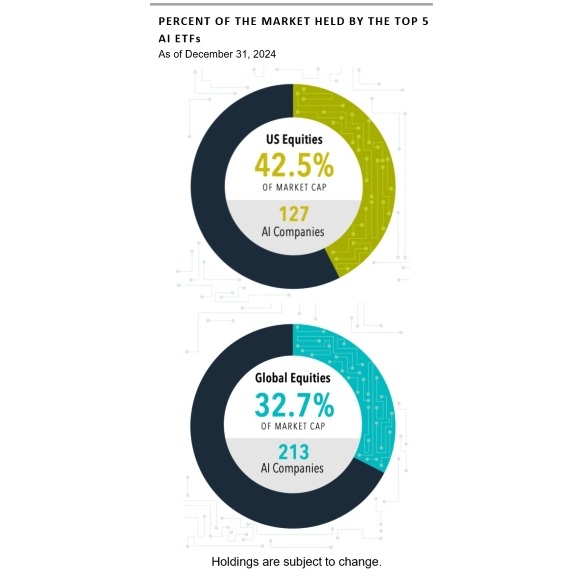
Percent of Market Held by Top 5 AI ETFs

While the world debates how to invest in AI, the truth is simpler—and far more reassuring: you already own it.

Through a well-diversified portfolio of global businesses, you indirectly own hundreds of companies applying AI to become faster, smarter, and more efficient. From NVIDIA to Honeywell to Caterpillar, innovation isn’t a sidecar—it’s embedded in the very fabric of modern enterprise. And for long-term investors, the surest way to benefit from AI’s growth isn’t speculation—it’s ownership.

The rise of AI has inspired new funds and flashy tickers, but according to Dimensional’s research, the five biggest AI-focused ETFs (AIQ, BOTZ, QTUM, ARKQ, and ROBT) already include more than 40% of the entire U.S. stock market. Owning a broad, diversified portfolio already gives you exposure to hundreds of companies using or developing AI—you don’t need to chase new “AI-only” funds to benefit from the trend.

This underscores a comforting truth: investors don’t have to predict which company becomes the next great innovator. A globally diversified portfolio naturally captures the growth of AI and other technologies as they spread across industries. The winners of tomorrow are often found in places few expect today, from industrials and logistics to healthcare and finance.

Gold: The Eternal Mirage of Safety

This year, gold joined AI in the headlines, breaking record highs and rekindling old fascinations. Like AI, it stirs emotion. But unlike AI, gold doesn’t innovate, hire, or compound. It simply sits there.

In his 2012 Fortune essay “Why Stocks Beat Gold and Bonds,” Warren Buffett imagined all the world’s gold—then about 170,000 metric tons—as a 68-foot cube that could fit neatly inside Yankee Stadium’s infield. At that time, the cube was worth about $9.6 trillion. For the same amount, Buffett wrote, one could buy every acre of U.S. farmland (roughly 400 million acres producing $200 billion a year in crops), sixteen ExxonMobils (each earning over $40 billion a year), and still have $1 trillion in “walking-around money.” The gold cube, by contrast, would just sit there. Buffett quipped, “You can fondle the cube, but it will not respond.”

Fast-forward to 2025. At $4,000 per ounce, that same cube—now around 212,000 metric tons—is worth roughly $27 trillion. That’s enough to buy every acre of U.S. farmland plus Apple, Microsoft, and Amazon combined—with change left over. Yet the cube still produces nothing.

If you own an ounce of gold for 100 years, you will still own one ounce at the end. That is its essence—its appeal and its limitation alike. It’s permanent, inert, and emotionally reassuring but financially unproductive.

History bears this out. In 1980, gold traded at $800 per ounce and has increased about 5× to $4,000 per ounce today. Contrast that with $800 invested in large-cap US stocks in 1980, which, with dividends reinvested, would have grown to $141,000, yielding a 176× total return and a 12% annual compound return.

Melt Ups, Behavior, and the “Greater Fool”

The desire to own what everyone else is buying runs deep. Whether it’s AI stocks or gold coins, the underlying impulse is the same—a search for safety, belonging, and certainty.

Behavioral finance has documented this truth repeatedly: investors feel the pain of losses roughly twice as strongly as the pleasure of gains. That imbalance helps explain why people sell in downturns and buy in melt-ups.

The risk during melt-up phases is that you feel you’re missing out on gains others seem to be making, and you buy assets mainly because they have gone up in price without understanding their intrinsic value or fundamentals. Too often, this leads to buying after assets become overpriced—just before a correction or long drawdown.

The Quiet Power of Productive Assets

At TAGStone, our philosophy has never changed: own productive assets, maintain balance, and let time work for you. Stocks represent real businesses creating real goods and services. Bonds represent loans to those businesses and governments. Both have a purpose. Together, they form a resilient system designed to protect purchasing power and generate growth through compounding.

Your edge as a long-term investor isn’t superior information or faster trades. It’s temperament—the ability to stay rational when the crowd isn’t. Buffett has often said that “the stock market is designed to transfer money from the active to the patient.” Every quarter offers fresh evidence that he’s right.

The excitement around AI and gold tells us more about investor psychology than about either asset. If the melt-up phase turns into a market blow-off, watch out for the urge to buy into truly speculative assets. Just as Microsoft, Apple, and Amazon rose from the ashes of the dot-com bust, this cycle will produce some truly profitable companies, but mixed in with those gems will be some busts. As mentioned above, your globally diversified portfolio already owns AI and will continue—quietly and tax‑efficiently—to accumulate the winners as they emerge.

A Final Word

Every cycle arrives with a new rationale for why “this time is different.” Yet history always rhymes. The same impulses that drove investors toward dot-coms in 1999, or toward gold in 1980, are at work again. Technology will continue to reshape our world, and gold will continue to glitter when anxiety rises. But the enduring truths of investing remain the same: productive assets compound, human nature overreacts, and patience wins.

In a world chasing the next big thing, the real opportunity lies in doing what few others can—staying calm, disciplined, and focused on what endures. The crowd will always rush in. The patient investor simply lets them pass.


Past performance does not guarantee future results. All investments include risk and have the potential for loss as well as gain.

Data sources for returns and standard statistical data are provided by the sources referenced and are based on data obtained from recognized statistical services or other sources we believe to be reliable. However, some or all information has not been verified prior to the analysis, and we do not make any representations as to its accuracy or completeness. Any analysis nonfactual in nature constitutes only current opinions, which are subject to change. Benchmarks or indices are included for information purposes  only  to  reflect  the  current  market  environment;  no  index  is  a directly  tradable investment.  There  may  be  instances  when  consultant  opinions  regarding any fundamental or quantitative analysis do not agree.

The  commentary  contained  herein  has  been  compiled  by  W.  Reid Culp,  III  from  sources  provided  by  TAGStone  Capital,  as well  as  commentary  provided  by  Mr.  Culp,  personally,  and  information independently  obtained  by  Mr.  Culp.  The  pronoun  “we,”  as  used  herein,  references collectively the sources noted above.

TAGStone Capital, Inc. provides this update to convey general information about market conditions and not for the purpose of providing investment advice. Investment in any of the companies or sectors mentioned herein may not be appropriate for you. You should consult your advisor from TAGStone or others for investment advice regarding your own situation.


Educating the Next Generation About Family Wealth

Over the next few decades, an enormous amount of wealth is expected to pass from older to younger generations. This has been dubbed the “Great Wealth Transfer,” and one estimate suggests that $124 trillion will change hands by 2048. It’s an eye-popping figure, to be sure, but it also highlights the reality that many families are, or soon will be, navigating how to pass on their wealth. A top-of-mind question: Is the next generation ready to take on the responsibility?

Wealth is not just cash in the bank; it can include investments, real estate, businesses and more that require stewardship and foresight. Successful management means preserving and growing assets and using them wisely. Striking the right balance here is key: For the next generation to succeed, it takes intentional preparation and education.

Plant the Seeds of Financial Literacy Early

Where to begin? In an ideal world, financial education starts in early childhood and is treated as an open and ongoing conversation as kids age. The goal is to build financial literacy gradually, so wealth management feels natural rather than overwhelming.

When kids are young, this might mean introducing simple topics like the difference between saving and spending. Managing an allowance can help put those ideas into practice. As kids get older you can begin introducing more complex topics, such as investing, compound interest, debt and taxes.

It’s equally important to engage adult children, many of whom may have received no other formal financial education. While 29 states now have K–12 financial education requirements in public schools, this focus has largely come to the forefront only in the last few years. If your kids are adults now, they may have missed out. So it’s worth finding out what they know, what they don’t know and what they’d like to know more about.

Putting Structure Around Family Wealth Education

In addition to ongoing conversations about money, your family might benefit from more intentional ways of building financial literacy. Some families hold regular financial meetings where they share goals, key issues and address questions or concerns. Others put together more formal workshops with wealth advisors or other experts.

There also is a wealth of credible educational content online that is built to both educate and engage audiences around financial literacy topics.

Turning Wealth Conversations into Real-World Experience

Eventually, theory should give way to practice. As younger family members learn the basics, you might consider providing a "practice portfolio," giving them the chance to make investment decisions with small amounts of money and learn from their successes and mistakes.

When family members have honed their knowledge, consider assigning them real responsibilities that match their skills and interest. This might mean relatively simple tasks like helping guide gifts made through a donor-advised fund. Or these responsibilities could be more involved, such as taking a role in the family business or helping to make investment decisions with the family’s wealth. With your guidance and oversight, these experiences can help develop confidence and capability.

Grounding Family Wealth in Purpose and Values

One of the most important things that helps guide families on how to grow and spend wealth is imparting a strong value system. Values can help you frame wealth as a tool rather than a goal.

Your values will be unique to you, but some worth considering may be:

  • Stewardship: Recognizing the responsibility that comes with wealth. Stewardship encourages careful management and intentional choices so resources can benefit both current and future generations.
  • Giving back: Using wealth to help create positive change in your community and the greater world.
  • Self-worth beyond wealth: Remembering that wealth is a tool to achieve goals—whether gaining an education, pursuing passion or giving back, for instance—not a measure of personal value.


By grounding financial decisions in values, families can help prevent counterproductive or reckless financial decisions, foster responsibility and ensure wealth is not seen as something to be simply consumed.

Keeping Family Wealth Conversations Going Across Generations

Discussing money isn’t always easy, and for many families, it’s downright taboo. While 66% of Americans say conversations about wealth are important, 62% say they never have them.

But getting over this hurdle is incredibly valuable. The most successful families treat wealth education not as a one-time event, but as an ongoing process that evolves as your family grows and your financial picture changes. We can work with you to create an environment where family members can openly discuss the unique challenges and opportunities that come with wealth.

If you’re thinking about how to prepare the next generation for responsibility—not just inheritance—we’re happy to help.


Past performance does not guarantee future results. All investments include risk and have the potential for loss as well as gain.

Data sources for returns and standard statistical data are provided by the sources referenced and are based on data obtained from recognized statistical services or other sources we believe to be reliable. However, some or all information has not been verified prior to the analysis, and we do not make any representations as to its accuracy or completeness. Any analysis nonfactual in nature constitutes only current opinions, which are subject to change. Benchmarks or indices are included for information purposes  only  to  reflect  the  current  market  environment;  no  index  is  a directly  tradable investment.  There  may  be  instances  when  consultant  opinions  regarding any fundamental or quantitative analysis do not agree.

The  commentary  contained  herein  has  been  compiled  by  W.  Reid Culp,  III  from  sources  provided  by  TAGStone  Capital,  as well  as  commentary  provided  by  Mr.  Culp,  personally,  and  information independently  obtained  by  Mr.  Culp.  The  pronoun  “we,”  as  used  herein,  references collectively the sources noted above.

TAGStone Capital, Inc. provides this update to convey general information about market conditions and not for the purpose of providing investment advice. Investment in any of the companies or sectors mentioned herein may not be appropriate for you. You should consult your advisor from TAGStone or others for investment advice regarding your own situation.


At a Glance

Protecting your assets while you are alive involves planning for periods when you may be unavailable or incapacitated. Key tools include a financial power of attorney, trusted contact persons on financial accounts, and a healthcare advance directive to ensure your wishes are followed.

Protecting What’s Yours (While You’re Alive)

Whether due to disability, dementia, or simply enjoying an exotic vacation, there are many ways you can end up unavailable to make critical financial or health care choices for yourself or your loved ones. If you’ve not documented your desires in advance, it can add extra stress for everyone, plus the outcomes may not be what anyone had in mind!

One source of confusion over when and how to protect your assets is understanding which legal logistics apply during your lifetime, and which don’t come into play until after you pass.

If you’re interested in how estate planning shifts once you’re gone, we cover that separately in Protecting What’s Yours (After You Pass) — including both why it matters and how it works step by step.

Today, we’ll cover a trio of tools for protecting your interests while you are alive:

  1. A financial power of attorney
  2. Trusted contact person(s)
  3. A healthcare advance directive

I. A Financial Power of Attorney

The Basics. A financial power of attorney (POA) is a legal document authorizing someone (your “agent”) to make financial decisions on your behalf. No matter how much authority you grant an agent, they still owe you a fiduciary level of care, which means any decisions they make for you must be based on what they believe to be in your best financial interests.

When It Applies. A POA applies while you are alive, but unavailable to act for yourself. You can structure it to:

  • Begin immediately or upon a triggering event (such as a debilitating accident or illness)
  • Remain in force during a finite time period or be ongoing
  • Apply to all your financial matters, or only to specific transactions


Common Scenarios. A financial POA can be helpful to address:

  • Capacity: If you become incapacitated due to illness, injury or dementia.
  • Availability: If you’re unable to be present for a financial transaction, such as if you’re traveling abroad or you’re otherwise preoccupied.
  • Convenience: If you’d simply like to make it convenient for someone else to be able to make financial decisions for you – such as your spouse or a trusted sibling (in general), your parents (if you’re heading off to college), or your adult children (if you’re aging).


Additional Tips.

  • Again, anyone to whom you grant a POA is only your legal agent while you are alive; their authority ends the moment you pass away. Your estate’s trustees should take it from there, as we discuss in Protecting What’s Yours (After You Pass).
  • Your agent(s) should have access to the documents that describe the POA you’ve granted them. If they can’t prove what their role is, they may not be able to act on it when needed.
  • Some banks and account custodians have their own POA forms they would prefer you use; also, they may be wary of POA paperwork that is several years old. Check with the financial institutions you frequent about their policies, and consider annually reestablishing any durable POAs, to ensure they remain relevant.
  • You cannot grant a POA if you are deemed to be of unsound mind. This makes sense, since you may inadvertently name a “bad” player … or others may be able to contest the POA you’ve established. Don’t wait until it’s too late.

II. Trusted Contact Person(s)

The Basics. In 2017, the SEC approved the role of trusted contact person as part of a FINRA Rule 4512 amendment. The amendment requires your account custodians (brokers) to encourage you to name a trusted contact as an extra line of defense for your investment accounts. If the custodian feels you are being financially exploited, they then have a back-up person they can talk to about some of their concerns. The additional input may enable them to delay disbursing funds from your account “where there is a reasonable belief of financial exploitation.” [Source]

When It Applies. While the primary aim of the FINRA amendment is to prevent financial elder abuse, there are at least two scenarios when a trusted contact can be useful:

  • If you are unavailable, and the custodian believes your account may have been compromised
  • If you are cognitively impaired


Common Scenarios. Imagine you’re on a mid-Atlantic cruise, and your broker receives a suspicious trade order from “you.” They try, but cannot reach you to verify it’s really you. If there is no trusted contact to reach out to, they may have little choice but to execute the trade and disburse the funds as ordered. If a trusted contact can instead provide evidence that the order is likely fraudulent, your broker may be able to place a temporary hold before disbursing the funds.

Similarly, if a loved one is exhibiting signs of dementia, a trusted contact can help prevent them from falling prey to financial exploitation. What if your aging parent tries to empty out their own bank account to help a “friend” in need? If your parents have named you as a trusted contact, an account custodian who suspects foul play can reach out to you, explain the circumstances, and receive your “second opinion.”

Additional Tips. If you’ve named someone as a trusted contact, your broker or account custodian can discuss some of your relevant circumstances with them, and gather pertinent information from them. But a trusted contact cannot make any financial decisions on your behalf, nor can they view your account. Unless you grant it to them separately, a trusted contact does not have a financial power of attorney, as described in Section I.

III. A Healthcare Advance Directive

The Basics. Your healthcare advance directive can offer two types of protection:

  • Your living will provides your life-sustaining and end-of-life medical care instructions, and related healthcare preferences, in case a time comes when you cannot state them for yourself.
  • Your healthcare directive can also name healthcare representative(s), or agent(s) and grant them healthcare power of attorney. If you cannot make your own healthcare decisions, your agent can decide on your behalf, guided by your living will. Medical professionals can also more freely discuss your condition with your agent, without violating HIPAA privacy rules.


When It Applies. Your healthcare advance directive only comes into play if you are alive, but unable to direct your own medical care.

Common Scenarios. Accidents and illnesses can rob you of your mental capacity – temporarily or permanently. If you do not have an advance directive in place, healthcare professionals and/or key family members may have to make medical decisions for you, without knowing what you would have preferred. Also, the individual(s) you would most want to have making decisions on your behalf may not be able to do so if you haven’t named them as your representative(s) in your advance directive. This can be stressful if not heartbreaking for everyone involved.

Additional Tips.

  • Not only should almost everyone have an advance directive, it should be easy to get ahold of it when needed. Distribute copies to your primary physician and any of your other healthcare providers to keep on file. Give it to key family members. At TAGStone Capital, we also maintain a portal for storing clients’ essential paperwork – including advance directives.
  • IMPORTANT: Do you have children who recently turned 18? As soon as your child is an adult, healthcare providers may not be able to even discuss your child’s case with you unless you have a healthcare power of attorney. Also, as described in this Wall Street Journal piece, if your child is attending school in another state, it’s worth establishing a healthcare power of attorney in their state and yours.

How Can TAGStone Capital Help?

We hope our summary has helped clarify the role these protections play in safeguarding what’s yours during your lifetime. In practice, incapacity planning is only one part of a broader continuum that extends into estate administration after death. For families who want to understand how these responsibilities transition to trustees, executors, and heirs, we explore those considerations in our companion series, Protecting What’s Yours (After You Pass).

Professional legal counsel is often warranted as you work through these decisions. If helpful, we can coordinate with your existing advisors or introduce you to experienced professionals, and we can assist in organizing and maintaining these documents as part of a broader planning framework.

Need help coordinating these documents with your financial plan?
Schedule a complimentary 15-minute conversation to discuss how these protections fit into your broader wealth strategy.


Past performance does not guarantee future results. All investments include risk and have the potential for loss as well as gain.

Data sources for returns and standard statistical data are provided by the sources referenced and are based on data obtained from recognized statistical services or other sources we believe to be reliable. However, some or all information has not been verified prior to the analysis, and we do not make any representations as to its accuracy or completeness. Any analysis nonfactual in nature constitutes only current opinions, which are subject to change. Benchmarks or indices are included for information purposes  only  to  reflect  the  current  market  environment;  no  index  is  a directly  tradable investment.  There  may  be  instances  when  consultant  opinions  regarding any fundamental or quantitative analysis do not agree.

The  commentary  contained  herein  has  been  compiled  by  W.  Reid Culp,  III  from  sources  provided  by  TAGStone  Capital,  as well  as  commentary  provided  by  Mr.  Culp,  personally,  and  information independently  obtained  by  Mr.  Culp.  The  pronoun  “we,”  as  used  herein,  references collectively the sources noted above.

TAGStone Capital, Inc. provides this update to convey general information about market conditions and not for the purpose of providing investment advice. Investment in any of the companies or sectors mentioned herein may not be appropriate for you. You should consult your advisor from TAGStone or others for investment advice regarding your own situation.