
Is Inflation Haunting Your Financial Dreams? – Part 1: What We Know

Part 1: What We Know

Has the specter of inflation got you spooked? Recent headlines are filled with sightings. In this two-part series, let’s take a closer look at what to make of all the commentary and what you can do about it as an investor. First and foremost, we caution against succumbing to fear or panic in the face of inflation. As usual, careful planning is still your best guide.

What Is Inflation?

Inflation is the rate at which a currency loses its purchasing power as prices increase over time. So, say a cup of coffee cost $1.00 twenty years ago. If the average annual inflation rate had been 2% between then and now, that same pour would now cost you $1.49. Various goods, services, and sectors often experience different inflation rates at separate times, but general inflation is usually calculated based on the Consumer Price Index (CPI) or a similar broad pricing index.

Recent headlines have been reporting a noticeable uptick in inflation. Superlatives like “best” and “worst” grab the most attention, so outlets have been abuzz with reports of how a 5% May consumer pricing surge was “the biggest 12-month inflation spike since 2008.”

Putting Inflation in Proper Context

Before you read too much into these recently rising numbers, it’s worth remembering their context. We’re comparing May 2021 to May 2020, when we were still deep into what The Wall Street Journal called a “screwy” pandemic economy. The WSJ explained, “If a company takes a hit in one year and then gets back to normal the next, it can look like its profits are soaring when in fact they are just getting back on track.”

Zooming out even further, the Federal Reserve’s 10 Year Break-Even Inflation Rate is one common estimate of the market’s expected average annual inflation rate for the next ten years. As of mid-June, that rate stood at 2.3%. That’s up from the lower 1.2% rate expectation from mid-June 2020, but it’s still not eye-popping.

This leads to another crucial point: Not all inflation is bad. A bit of inflation goes hand in hand with economic growth and reasonable interest rates for lenders and borrowers alike. A 2% annual inflation rate is typically considered a desirable norm for greasing the wheels of commerce without destroying the working relationship between currencies and costs.

What if Inflation Runs Amok?

And yet, while inflation has its purposes, it concerns many savers and investors if it goes on a rampage. When it does, uncertainty has spiked as well, wreaking havoc on commerce, the economy, job markets, real estate, and financial markets. (Deflation—the opposite of inflation—can also upset the economy if prices drop too precipitously.)

Investors who were around in the 1970s may remember the last time the U.S. experienced red-hot inflation and what it felt like when it spiked to a feverish 14.8% in 1980.

The New York Times described it as an era when “prices of real assets like houses, gold and oil soared. Average mortgage rates exceeded 17 percent, and interest rates on bank certificates of deposit approached 12 percent. It was hard to know whether a 5 percent pay raise was cause for celebration or despair.” While 12% CD rates may sound great, when interest and inflation rates are comparable, the real returns from even high-interest CDs essentially become a wash.

After the 1980 high-water mark, the Volcker-era Federal Reserve tamped inflation back down. So younger investors have heard of, but never experienced such steep inflation for such an extended time. Despite occasional alarm bells, inflation has mostly continued to hit the snooze button for decades. At least so far.

In Part 2, we’ll cover why forecasts remain as fuzzy as ever and how investors can best prepare for whatever may happen next.


Past performance does not guarantee future results. All investments include risk and have the potential for loss as well as gain.

Data sources for returns and standard statistical data are provided by the sources referenced and are based on data obtained from recognized statistical services or other sources we believe to be reliable. However, some or all information has not been verified prior to the analysis, and we do not make any representations as to its accuracy or completeness. Any analysis nonfactual in nature constitutes only current opinions, which are subject to change. Benchmarks or indices are included for information purposes  only  to  reflect  the  current  market  environment;  no  index  is  a directly  tradable investment.  There  may  be  instances  when  consultant  opinions  regarding any fundamental or quantitative analysis do not agree.

The  commentary  contained  herein  has  been  compiled  by  W.  Reid Culp,  III  from  sources  provided  by  TAGStone  Capital,  as well  as  commentary  provided  by  Mr.  Culp,  personally,  and  information independently  obtained  by  Mr.  Culp.  The  pronoun  “we,”  as  used  herein,  references collectively the sources noted above.

TAGStone Capital, Inc. provides this update to convey general information about market conditions and not for the purpose of providing investment advice. Investment in any of the companies or sectors mentioned herein may not be appropriate for you. You should consult your advisor from TAGStone or others for investment advice regarding your own situation.

All Things in Moderation

The First Quarter 2021 is off to a good start. Most people are eager to return to normal with travel, dining, and shopping this summer. Financial markets are no different.

We see similar pent-up yearnings in an array of analysts’ second-quarter financial forecasts. Check out these second-quarter forecast headlines:

A second coming? That last one shows the extent of optimism found in the current narrative diffusing through the global financial markets.

Now, think back to April 2020. A year ago, fear was tempting many investors to pile into safe-harbor holdings, even as most markets staged robust and surprising recoveries.

This year, we’re seeing many of those same investors chasing all kinds of hot holdings, as they now embrace an absence of fear. Consider these quarter-end headlines:

In its quarter-end recap, The Wall Street Journal summarized similar sentiments as follows:

“If there is a unifying theme to all this, it is that investors big and small showed no fear of risk-taking to start 2021. In fact, they embraced it.”

Sometimes, an extra shot of bravery is just what the doctor ordered. “No fear,” you might tell yourself as you enter your first marathon, launch a new business, or hug your college-bound child farewell. In investing, however, no fear can be as damaging as an excess dose of fear.

There are numerous proverbial sayings in every culture along the lines of “all things in moderation.” While taking things in moderation is often true in life, it’s true in investing too.

Moderation is vital to keep in mind given the investment environment we encounter today. The efficient market hypothesis proposes that asset prices are set by rational investors, whose primary concerns are systematic risk and expected returns. However, asset prices may now, more than normal, be fueled by investors’ desire to be part of a social movement, hopes to strike it rich, or plain old envy. While there are many reasons to own a stock, it helps to keep an accurate assessment of the potential risks and rewards involved in any given approach.

Staying the Course

We hope favorable markets continue, but investing is not a game of chance. If you were a client of ours last April, we were honored to be by your side to remind you that your disciplined investment strategy was in place. Your globally diversified portfolio is structured to help you maximize expected returns while minimizing the risks involved.

At the time, we encouraged you to stick to the plan. Today, we encourage you to do the same. Markets may run hot or cold. The scenery may be different. But your financial journey is still the same.


Past performance does not guarantee future results. All investments include risk and have the potential for loss as well as gain.

Data sources for returns and standard statistical data are provided by the sources referenced and are based on data obtained from recognized statistical services or other sources we believe to be reliable. However, some or all information has not been verified prior to the analysis, and we do not make any representations as to its accuracy or completeness. Any analysis nonfactual in nature constitutes only current opinions, which are subject to change. Benchmarks or indices are included for information purposes  only  to  reflect  the  current  market  environment;  no  index  is  a directly  tradable investment.  There  may  be  instances  when  consultant  opinions  regarding any fundamental or quantitative analysis do not agree.

The  commentary  contained  herein  has  been  compiled  by  W.  Reid Culp,  III  from  sources  provided  by  TAGStone  Capital,  as well  as  commentary  provided  by  Mr.  Culp,  personally,  and  information independently  obtained  by  Mr.  Culp.  The  pronoun  “we,”  as  used  herein,  references collectively the sources noted above.

TAGStone Capital, Inc. provides this update to convey general information about market conditions and not for the purpose of providing investment advice. Investment in any of the companies or sectors mentioned herein may not be appropriate for you. You should consult your advisor from TAGStone or others for investment advice regarding your own situation.

The Power of Small, Quiet Acts


Today, let’s pause and take a moment to reflect on the wondrous powers of small, quiet acts.

Pandemic aside, there have been plenty of great, big year-end reviews and year-ahead teasers, clamoring for your current attention. Describing 2020 as an “everything rally,” One Wall Street Journal columnist wrote, “Investors ended one of Wall Street’s wildest years on record by piling into everything from bitcoin to emerging markets, raising expectations that a powerful economic comeback will fuel even more gains.”

The excitement is not entirely unfounded. Last March, when the S&P 500 dove into a bear market almost overnight, it was hard to expect anything but a long, grim year ahead. Of course, in hindsight, we now know markets rebounded nearly as quickly as they plummeted. They ultimately delivered strong annual returns across most domestic and international asset classes. The fourth quarter was no exception to this tale of remarkable resilience.

Why would markets soar during still-sour economies? We could describe any number of rational reasons near-term market pricing mechanisms are continuing to operate exactly as expected … which is to say, according to anyone’s next lucky guess.

Unfortunately, that hasn’t stopped hordes of hopefuls from trying to score big on the latest tricks of the trade. From the adventures of Robinhood, to record-busting bitcoins, to blank-check SPACs, rising markets often tempt the uninitiated with enticing offers to earn “easy” money.

Whether the temptation is to abandon a free-falling market (like the one we encountered less than a year ago) or chase after winning streaks, an investor’s best move remains the same. Concentrated bets on hot hands generate wildly unpredictable outcomes, making them far closer to being dicey gambles than sturdy investments.

Trust, instead, in the durability of your carefully planned investment portfolio. Focus instead on small, quiet acts. That’s what we’re here for, for example, to:

  • Remind you that your globally diversified portfolio already holds an appropriate allocation to Tesla stock (which may be a lot, a little, or none, depending on your financial goals).
  • Guide you in rebalancing your portfolio if recent gains have overexposed it to market risks.
  • Help you interpret the 5,600 pages of the newly passed Consolidated Appropriations Act, 2021, so you can manage your next financial moves accordingly.
  • Assess potential ramifications of the Biden tax proposals, and advise you on any additional defensive tax planning that may be warranted for you in the years ahead.
  • Remain by your side as you encounter whatever other challenges and opportunities 2021 has in store for you and your family.

These aren’t loud acts you’ll read about in the paper, but they’re the stuff financial dreams are made of. How else can we help you achieve your personal financial goals, come what may in the headline news? Tell us more. We’re here to hear you. In the meantime, we wish you and yours a healthy and prosperous 2021.


Past performance does not guarantee future results. All investments include risk and have the potential for loss as well as gain.

Data sources for returns and standard statistical data are provided by the sources referenced and are based on data obtained from recognized statistical services or other sources we believe to be reliable. However, some or all information has not been verified prior to the analysis, and we do not make any representations as to its accuracy or completeness. Any analysis nonfactual in nature constitutes only current opinions, which are subject to change. Benchmarks or indices are included for information purposes  only  to  reflect  the  current  market  environment;  no  index  is  a directly  tradable investment.  There  may  be  instances  when  consultant  opinions  regarding any fundamental or quantitative analysis do not agree.

The  commentary  contained  herein  has  been  compiled  by  W.  Reid Culp,  III  from  sources  provided  by  TAGStone  Capital,  as well  as  commentary  provided  by  Mr.  Culp,  personally,  and  information independently  obtained  by  Mr.  Culp.  The  pronoun  “we,”  as  used  herein,  references collectively the sources noted above.

TAGStone Capital, Inc. provides this update to convey general information about market conditions and not for the purpose of providing investment advice. Investment in any of the companies or sectors mentioned herein may not be appropriate for you. You should consult your advisor from TAGStone for investment advice regarding your own situation.

Six Financial Best Practices for Year-End 2020

Has 2020 left you feeling like the fabled Sisyphus, forever pushing a boulder up a steep hill? Thankfully, with multiple COVID-19 vaccines in the works, there’s hope the load will lighten in the new year, fast approaching. While we prepare for a fresh start, here are six financial best practices for year-end 2020 and beyond, none of which require any heavy lifting.

  1. Give as you’re able, get a little back. What the 2017 Tax Cuts and Jobs Act (TCJA) took from charitable giving, this year’s CARES Act partially gave back – at least for 2020.
      • A $300 “Gift”: Under the TCJA, it became much harder to realize itemized tax deductions beyond what the increased standard deductions already allow. But this year, the CARES Act lets you donate up to $300 to a qualified charity, and deduct it “above the line.” In other words, even if you’re taking a standard deduction, you can give a little extra, and receive an extra tax break back, without having to itemize your deductions.
      • Giving Large: If you are itemizing deductions, the CARES Act also temporarily suspends the usual “60% of your AGI” limit on qualified cash contributions. The exception does NOT apply to Donor Advised Fund contributions and has a few other restrictions. But if you’ve already been thinking about making a large donation to a favorite charity, 2020 might be an especially good year to do so – for all concerned.
  2. Revisit life’s risks. As the pandemic reminded us, life is full of surprises. That’s why it’s imperative to build wealth and protect it against the inevitable unexpected. Is your current coverage still well-aligned with your potentially altered lifestyle? Perhaps you’re driving less, with lower coverage requirements. Or new health or career risks now warrant stronger disability insurance. Might it be time to consider long-term care or umbrella coverage? Bottom line, there’s no time like the present to prepare for your future greatest risks.
  3. Leverage lower tax rates. While it’s never a sure bet, Federal income tax rates seem more likely to rise than fall over the next little while. Even before this year’s massive relief spending, the TCJA’s reduced individual income tax rates were set to expire after 2025, reverting to their prior, higher levels. As such, it may be worth deliberately incurring some lower-rate income taxes today, if they’ll probably spare you higher taxes on the same income later on. As a prime example, consider converting or contributing to a Roth IRA. You’ll pay income taxes today on the conversions or contributions, but then the assets grow tax-free, and remain tax-free when you withdraw them in retirement.
  4. Harness an HSA. Health Savings Accounts (HSAs) are another often-overlooked tax-planning tool. Instead of paying for a traditional lower-deductible/higher-cost healthcare plan, some may benefit from a higher-deductible/lower-cost plan plus an HSA. If a high-deductible plan/HSA combination is available to you, it may be worth considering – especially if a career change, early retirement, or some other triggering event has altered your healthcare coverage. HSA assets receive generous “triple tax-free” treatment – going in pre-tax, growing tax-free, and coming out tax-free (if spent on qualified medical expenses).
  5. Read a great book (or few). As we swing into a winter of continued social distancing, you may have more time than usual to curl up with a good book – whether in print or on your favorite device. Why not add a best financial book or two to the list? As good timing would have it, The Wall Street Journal personal financial columnist Jason Zweig recently shared an excellent “short shelf” list of his top picks. As Zweig reflects, “they all will help teach you how to think more clearly, which is the only way to become a wiser and better investor.” Looking for our own favorites? Let us know.
  6. Live a little more. Really, it’s always a best practice to ensure your financial priorities are driven by your life’s greatest goals – not the other way around. Perhaps our greatest purpose as your wealth advisor is to assist you and your family in achieving a satisfying work-life balance, come what may. What does this balance look like for you? Speaking of good reads, in his new book, “The Coffeehouse Investor’s Ground Rules,” Bill Schultheis offers his take:

“When you … have everything you need materially, how do you honor that part of your DNA that will forever yearn for more? It seems to me that the challenge is to turn this pursuit of ‘more’ away from material consumption and toward a ‘more’ that fosters more family, more community, more connections, more art, more creativity, more beauty.”

What more can we say about how to make best use of your time and money, this and every year? As always, we’re here to help you implement any or all of these best practices. In the meantime, we wish you and yours a happy and healthy 2021.


Past performance does not guarantee future results. All investments include risk and have the potential for loss as well as gain.

Data sources for returns and standard statistical data are provided by the sources referenced and are based on data obtained from recognized statistical services or other sources we believe to be reliable. However, some or all information has not been verified prior to the analysis, and we do not make any representations as to its accuracy or completeness. Any analysis nonfactual in nature constitutes only current opinions, which are subject to change. Benchmarks or indices are included for information purposes  only  to  reflect  the  current  market  environment;  no  index  is  a directly  tradable investment.  There  may  be  instances  when  consultant  opinions  regarding any fundamental or quantitative analysis do not agree.

The  commentary  contained  herein  has  been  compiled  by  W.  Reid Culp,  III  from  sources  provided  by  TAGStone  Capital,  as well  as  commentary  provided  by  Mr.  Culp,  personally,  and  information independently  obtained  by  Mr.  Culp.  The  pronoun  “we,”  as  used  herein,  references collectively the sources noted above.

TAGStone Capital, Inc. provides this update to convey general information about market conditions and not for the purpose of providing investment advice. Investment in any of the companies or sectors mentioned herein may not be appropriate for you. You should consult your advisor from TAGStone for investment advice regarding your own situation.

How to Master the Markets by Mastering Ourselves

Before we dive into the usual quarterly investment insights, here’s some fun trivia:

Did you know you have to count to 1,000 before you’ll find the letter “a” in a spelled-out number?

We thought you could use that break from the torrent of mid-year market commentaries on 2020’s bipolar extremes. The general theme has been how quickly global markets sold off and came back—even as economic and sociopolitical headlines continued to stoke bonfires of ongoing upheaval.

And the year is only half over.

We’ve seen comparisons to Rip Van Winkle, who could have slept through the extraordinary turmoil and awakened in June with only minor changes to his 60/40 stock/bond portfolio. We’re also seeing predictions that 60/40 portfolios have entered a lost decade of paltry performance. Still, other forecasters (perhaps to cover all grounds) suggest we’re in a time with “equal reasons for caution and optimism.” No kidding.

So, what’s it going to be for the rest of 2020? As always, with respect to your investments, it seems difficult to predict what to expect as an encore through year-end. Instead, we agree with Jason Zweig, who wrote this in his recent “Intelligent Investor” e-newsletter:

“The first half of 2020 should remind us that investing isn’t about conquering markets; it’s about mastering ourselves.”

In this context, perhaps our trivial pursuit is not so disconnected after all. We know markets are highly likely to deliver inflation-busting returns to those who can patiently “count to a thousand” while riding out the inevitable downturns. We also know investment success can take longer than you might think – potentially much longer.

Similar to what you might have first guessed about the elusive “a” in our numbering system, the initial assumptions we make about investing are often off-target until we take the time to think them through. As such, we continue to remind you of the evidence on how to persistently participate in markets, lost and found. We also continue to recommend allocating your wealth appropriately (for you) between the market’s higher-risk, higher-expected-return extremes, and the sheltering calm of more stable, reasonable-return holdings.

Have we mastered the right balance for you and your personal financial goals? If not, let us know, so we can help you revisit your ideal allocations. In the meantime, let others conquer the markets, as you consider these additional words from Zweig:

“To be an intelligent investor is to recognize that you’re in a lifelong struggle for self-control – an unending effort to keep yourself from yielding to fear or greed, believing that you know what the future holds or letting short-term news knock your long-term plans off track.”

Again, let us know if we can help you and your financial plans remain on track.

Long-Term Investors, Don’t Let a Recession Faze You

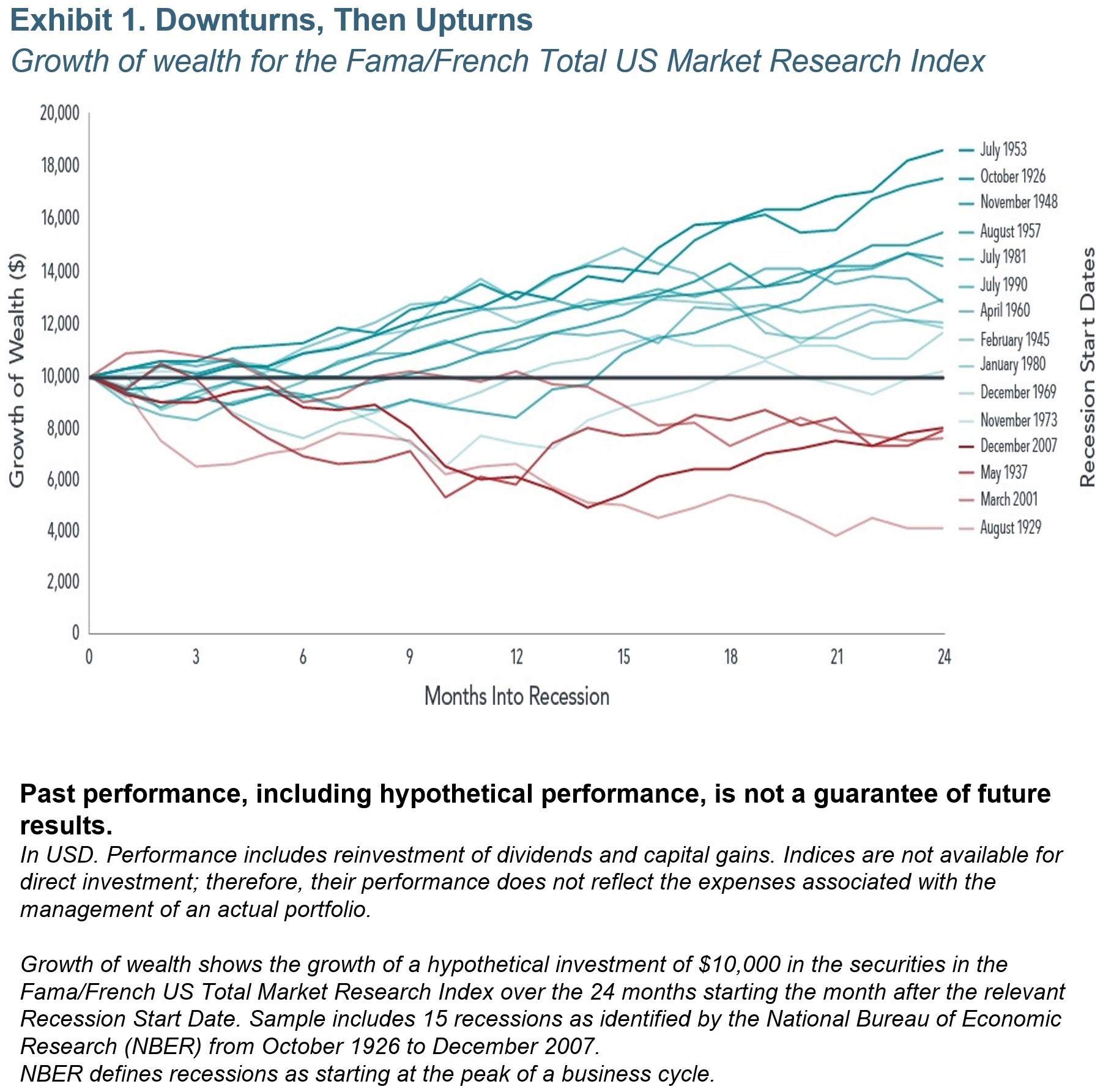
With activity in many industries sharply curtailed in an effort to reduce the chances of spreading the coronavirus, some economists say a recession is inevitable if one hasn’t already begun.1 From a markets perspective, we have already experienced a drop in stocks, as prices have likely incorporated the growing chance of recession. Investors may be tempted to abandon equities and go to cash because of perceptions of recessions and their impact. But across the two years that follow a recession’s onset, equities have a history of positive performance.

Data covering the past century’s 15 US recessions show that investors tended to be rewarded for sticking with stocks. Exhibit 1 shows that in 11 of the 15 instances, or 73% of the time, returns on stocks were positive two years after a recession began. The annualized market return for the two years following a recession’s start averaged 7.8%.

Downturns, Then Upturns

Staying the Course

Recessions understandably trigger worries over how markets might perform. But history can provide comfort to investors wondering whether now may be the time to move out of stocks.


Past performance does not guarantee future results. All investments include risk and have the potential for loss as well as gain.

Data sources for returns and standard statistical data are provided by the sources referenced and are based on data obtained from recognized statistical services or other sources we believe to be reliable. However, some or all information has not been verified prior to the analysis, and we do not make any representations as to its accuracy or completeness. Any analysis nonfactual in nature constitutes only current opinions, which are subject to change. Benchmarks or indices are included for information purposes  only  to  reflect  the  current  market  environment;  no  index  is  a directly  tradable investment.  There  may  be  instances  when  consultant  opinions  regarding any fundamental or quantitative analysis do not agree.

The  commentary  contained  herein  has  been  compiled  by  W.  Reid Culp,  III  from  sources  provided  by  TAGStone  Capital,  as well  as  commentary  provided  by  Mr.  Culp,  personally,  and  information independently  obtained  by  Mr.  Culp.  The  pronoun  “we,”  as  used  herein,  references collectively the sources noted above.

TAGStone Capital, Inc. provides this update to convey general information about market conditions and not for the purpose of providing investment advice. Investment in any of the companies or sectors mentioned herein may not be appropriate for you. You should consult your advisor from TAGStone for investment advice regarding your own situation.

Hunkering Down in Turbulent Times

“What the imagination can’t conjure, reality delivers with a shrug.”

—Trumbo (movie voice-over)

Brace yourself. Your First Quarter 2020 report is likely to leave you feeling at least a little disheartened. No matter how much we’ve written about preparing for perilous times like these, planning for it versus actually enduring it is like watching a tornado on YouTube versus being swept into one in real life.

Yet, we stand by our advice. For emotional and financial turbulence alike, your best bet when you’re in the eye of a storm is to hunker down, and trust in preparations already made.

If you’re comfortable with how we’ve been managing your wealth so far, expect more of the same. As your steadfast fiduciary advisor, we will continue to help you implement the kinds of investment opportunities that make sense for you and your portfolio. These may include:

  • Rebalancing your portfolio when warranted, to stay on course toward your long-term goals.
  • Tax-loss harvesting where practical, to offset the costs of recently incurred and/or future taxable gains. (Yes, we still fully expect to see future market growth!)
  • Roth IRA conversions when they may benefit your retirement planning.
  • Seizing other opportunities when your plans call for it. For example, if you’ve been holding a concentrated stock position to avoid incurring taxable gains, now may be the perfect time to reduce your risks and strengthen your portfolio by selling all or part of that position.

A Stress Test for Your Risk Tolerance

If, on the other hand, you’ve begun to seriously question your course, think of current conditions as a stress test. Is the risk tolerance you thought you had holding up for you?

Ask yourself objectively: Can I tough out the fears I’m feeling right now? If so, we encourage you to stick with your existing investment allocations despite the angst.

What if you decide your portfolio is no longer appropriate for you? If that’s the case, let’s get together promptly to plan your next steps. Above all, your wealth should be structured to enhance your personal well-being. If that’s not what’s happening, we welcome the opportunity to help you adjust your portfolio accordingly.

Another question often asked during market extremes goes something like this: I’m okay with my portfolio mix, but why not get out of the markets temporarily until the worst is over?

Recoveries Happen Quietly

Whether we leave your portfolio as is, or help you permanently reduce some of its risk exposure, we will never recommend trying to accurately time when to cleverly get out of, and safely jump back into volatile markets. While nobody knows exactly when a recovery will occur, history has informed us of what typically happens when it does. A recent Wall Street Journal piece explains, using the bull market that began back in 2009 as an illustration (emphasis ours)1:

"A surprising share of a new bull market’s returns pile up in its very early stages when people are most fearful. Take the one that ended last month. Putting $100,000 into an S&P 500 index fund on the day the bull began on March 9, 2009 and selling at last month’s peak would have seen that turn into $630,000 including dividends. Waiting just three months to make sure it wasn’t yet another head fake would have earned you only $450,000.”

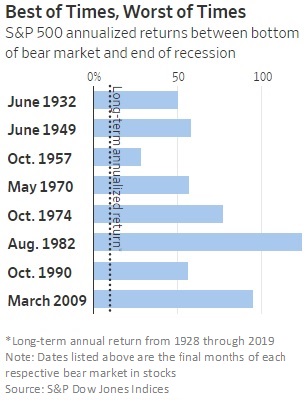
In other words, while most of us are still assuming there’s no hope in sight, the markets can quietly and often dramatically make their big come-back … at least for those who have kept a portion of their wealth invested in them. The chart below shows the annualized return of the S&P 500 during eight recessions from the point when the bear market in stocks bottomed to when the recession ended in the real economy (i.e. stocks generally bottom several months before the recession ends).

S&P 500 annualized returns between bottom of bear market and end of recession

Staying the Course

As always, without the ability to see what is only apparent in hindsight, we encourage you to focus instead on that which you can control. Right now, that is mostly doing all you can to keep yourself and your loved ones out of harm’s way. Please let us know how we can help.


Past performance does not guarantee future results. All investments include risk and have the potential for loss as well as gain.

Data sources for returns and standard statistical data are provided by the sources referenced and are based on data obtained from recognized statistical services or other sources we believe to be reliable. However, some or all information has not been verified prior to the analysis, and we do not make any representations as to its accuracy or completeness. Any analysis nonfactual in nature constitutes only current opinions, which are subject to change. Benchmarks or indices are included for information purposes  only  to  reflect  the  current  market  environment;  no  index  is  a directly  tradable investment.  There  may  be  instances  when  consultant  opinions  regarding any fundamental or quantitative analysis do not agree.

The  commentary  contained  herein  has  been  compiled  by  W.  Reid Culp,  III  from  sources  provided  by  TAGStone  Capital,  as well  as  commentary  provided  by  Mr.  Culp,  personally,  and  information independently  obtained  by  Mr.  Culp.  The  pronoun  “we,”  as  used  herein,  references collectively the sources noted above.

TAGStone Capital, Inc. provides this update to convey general information about market conditions and not for the purpose of providing investment advice. Investment in any of the companies or sectors mentioned herein may not be appropriate for you. You should consult your advisor from TAGStone for investment advice regarding your own situation.

IPOs: Profiles Are High. What About Returns?

Initial public offerings (IPOs) often attract initial public interest—especially when familiar brands become broadly available to investors for the first time.

In recent months, investors have had the opportunity to buy shares of ride‑hailing networks Uber and Lyft, workplace productivity services Zoom and Slack, and other high-profile businesses ranging from Pinterest to Beyond Meat.

News outlets contribute to the frenzy, building anticipation, tracking the early hours of trading, and casting judgment on the IPO’s success. Investors, perhaps lured by tales of outsized returns, try to get in on the action early.

New research by Dimensional Fund Advisors reveals the fundamental challenges IPO investors face. For example, investors may not be able to trade during the early hours of the IPO, when the biggest price movements frequently occur. Lockup periods also often restrict when shares held by early investors can be resold on secondary markets, which can meaningfully limit the available liquidity in the first six to 12 months after an IPO.

Medium‑term IPO performance is often underwhelming. The research team at Dimensional studied the first-year performance of more than 6,000 US IPOs from 1991 to 2018 and found they generally underperformed industry benchmarks. The researchers also found that known drivers of expected returns largely explain that underperformance.

Short-Term IPO Returns:

IPOs are commonly associated with outsized stock returns on the first day shares become available, although these returns may not be attainable by all investors due to the allocation process. Researchers have shown that initial trading prices typically exceed the IPO offering price.1 However, accessing these first-day returns requires an allocation from the underwriting banks. Studies have documented an adverse selection problem associated with IPO share allocations and find that allocations to IPOs having poor first-day returns have generally been easier to obtain, while allocations to IPOs with good first‑day returns have usually been reserved for certain clients of the underwriting banks.2

Medium-Term IPO Returns:

Given that many investors may not be able to access these initial returns, Dimensional focused on the performance of IPOs in the secondary market. How do IPOs perform in their first year?

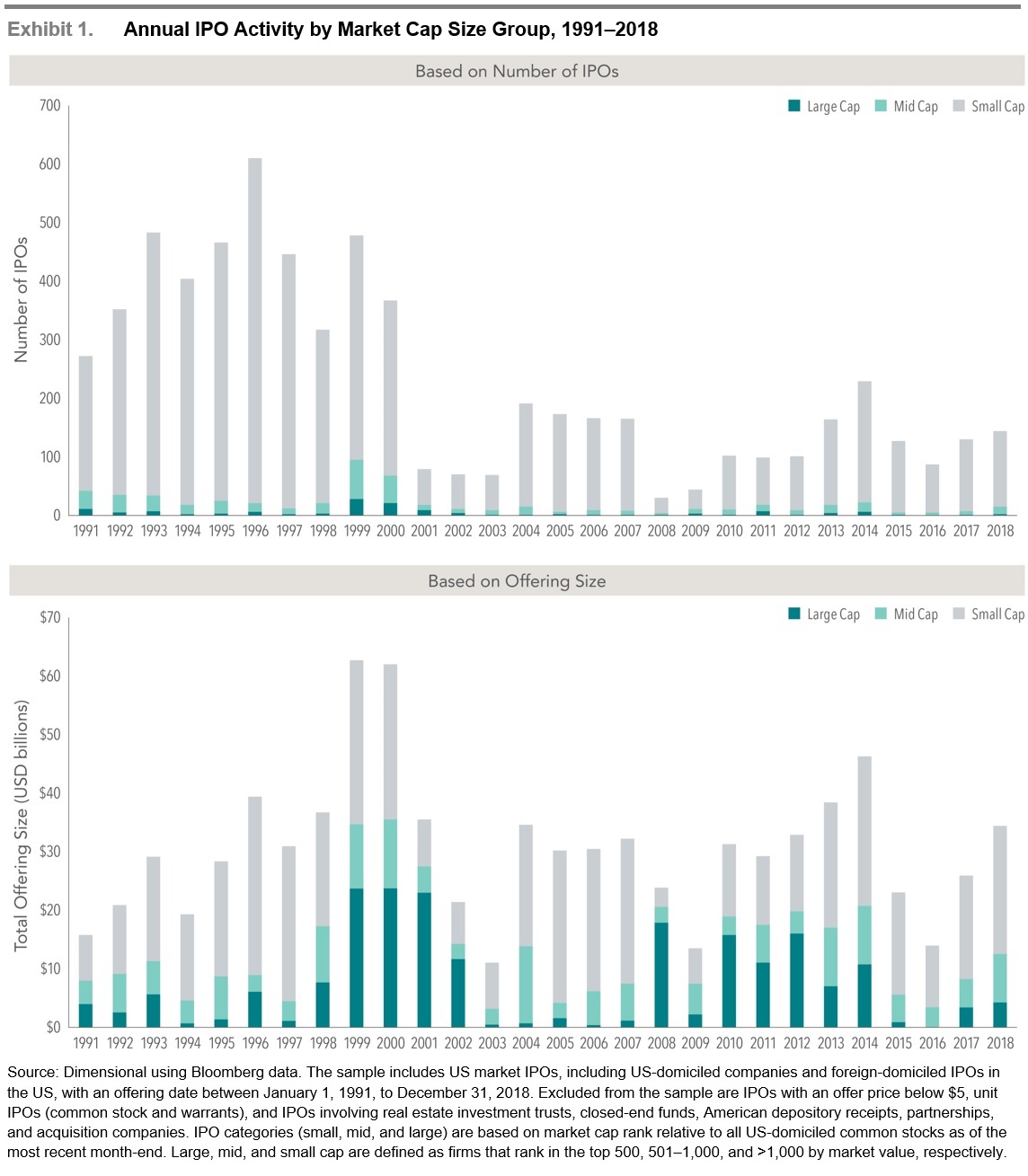
The sample for Dimensional’s study consists of 6,362 US IPOs that occurred from January 1991 to December 2018 and for which data is available.3  Exhibit 1, below, shows the annual frequency and market cap distribution of IPOs among firm size groups. The period from 1991 to 2000 is characterized by a relatively high IPO frequency rate of 420 per year and is followed by a less active 18-year period during which the rate falls to 120 IPOs on average per year. Although the number of IPOs has declined, the average IPO offering size is almost three times larger over the most recent period, as compared to the initial 10 years in the sample.

Most IPOs fall into the small cap size group, defined as firms that fall below the largest 1,000 US‑domiciled common stocks at the most recent month‑end. Large cap and mid cap IPOs represent 24% and 19%, respectively, of total capital raised through IPOs over the sample period.

Annual IPO Activity by Market Cap Size Group 1991-2018

IPO Performance:

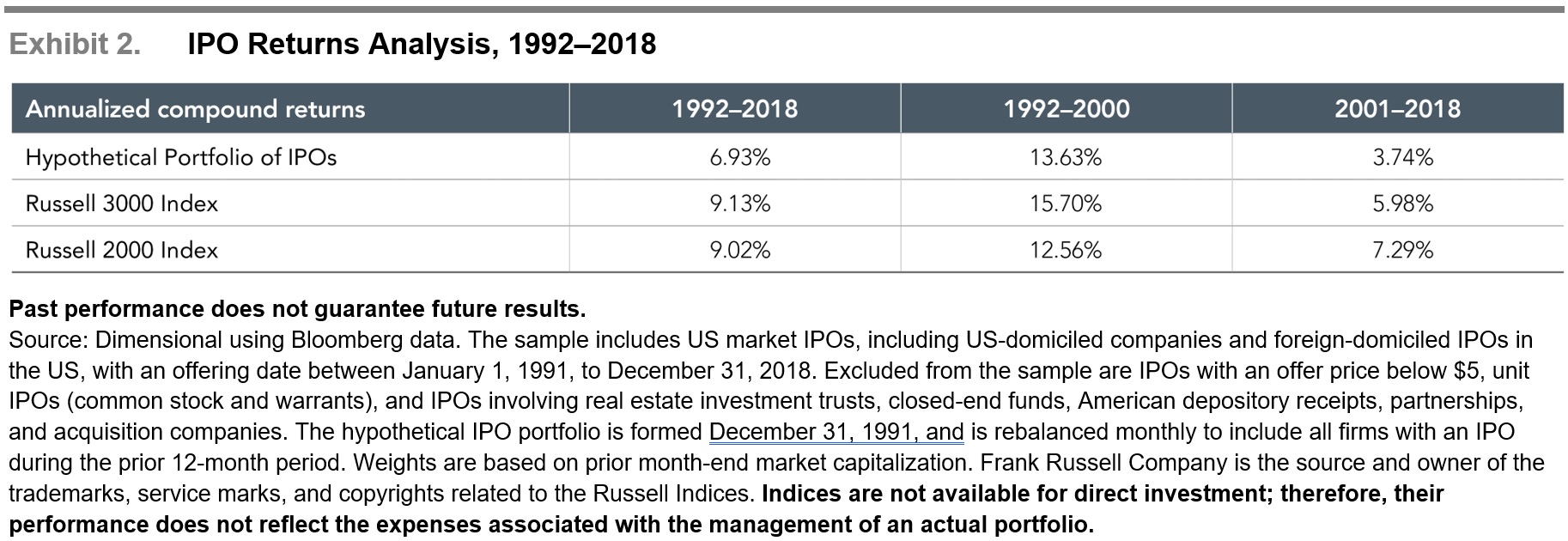
Dimensional evaluated IPO returns by forming a hypothetical market cap-weighted portfolio consisting of IPOs issued over the preceding 12-month period, rebalanced monthly.4 This methodology excludes the initial first-day returns by design to alleviate the adverse selection problem inherent in the IPO allocation process. Exhibit 2, below, compares the returns of the IPOs to the returns of the Russell 2000 and 3000 indices over the full sample period as well as two subperiods covering 1992–2000 and 2001–2018. IPOs underperform the Russell 3000 Index in both the overall period and sub-sample periods. For example, IPOs generate an annualized compound return of 6.93%, 13.63%, and 3.74% over the full, initial nine-year and final 18-year sample periods, respectively, as compared to 9.13%, 15.70%, and 5.98% for the Russell 3000 index over the same time horizons. In comparison to the Russell 2000 Index, the hypothetical portfolio of IPOs underperforms in the overall period (6.93% vs. 9.02%) and the 2001–2018 (3.74% vs. 7.29%) subperiod and outperform (13.63% vs. 12.56%) over the period from 1992 to 2000.

Known drivers of returns largely explain the underperformance of IPOs. IPOs have underperformed the market because, as a group, they have behaved like small growth, low profitability, high investment stocks, which have had lower expected returns than the market.5

IPO Returns Analysis 1992-2018

Summary:

Investors considering IPOs should be aware of potential adverse selection and post-offering activities, such as the expiration of insider lockup periods. Investors should also understand that IPOs have generally underperformed broader market benchmarks in recent decades and that their fundamental characteristics suggest lower expected returns.

Appendix:

Benjamin Graham’s Description of IPOs and Investment Bankers in the 1973 Edition of “The Intelligent Investor”

The term “investment banker” is applied to a firm that engages to an important extent in originating, underwriting, and selling new issues of stocks and bonds [i.e. IPOs]. (To underwrite means to guarantee to the issuing corporation, or other issuer, that the security will be fully sold.) A number of brokerage houses carry on a certain amount of underwriting activity. Generally, this is confined to participating in underwriting groups formed by leading investment bankers. There is an additional tendency for brokerage firms to originate and sponsor a minor amount of new-issue financing, particularly in the form of smaller issues of common stocks when a bull market is in full swing.

Investment banking is perhaps the most respectable department of the Wall Street community, because it is here that finance plays its constructive role of supplying new capital for the expansion of industry. In fact, much of the theoretical justification for maintaining active stock markets, notwithstanding their frequent speculative excesses, lies in the fact that organized security exchanges facilitate the sale of new issues of bonds and stocks. If investors or speculators could not expect to see a ready market for a new security offered them, they might well refuse to buy it.

The relationship between the investment banker and the investor is basically that of the salesman to the prospective buyer. For many years part the great bulk of the new offerings in dollar value has consisted of bond issues that were purchased in the main by financial institutions such as banks and insurance companies. In this business the security salesmen have been dealing with shrewd and experienced buyers. Hence any recommendations made by the investment bankers to these customers have had to pass careful and skeptical scrutiny. Thus, these transactions are almost always effected on a businesslike footing.

But a different situation obtains in a relationship between the individual security buyer and the investment banking firms, including the stockbrokers acting as underwriters. Here the purchaser is frequently inexperienced and seldom shrewd. He is easily influenced by what the salesman tells him, especially in the case of common-stock issues, since often his unconfessed desire in buying is chiefly to make a quick profit. The effect of all this is that the public investor’s protection lies less in his own critical faculty than in the scruples and ethics of the offering houses.

It is a tribute to the honesty and competence of the underwriting firms that they are able to combine fairly well the discordant roles of adviser and salesman. But it is imprudent for the buyer to trust himself to the judgement of the seller. In 1959 we stated at this point: “The bad results of this unsound attitude show themselves recurrently in the underwriting field and with notable effects in the sale of new common stock issues during periods of active speculation.” Shortly thereafter this warning proved urgently needed. As already pointed out, the years 1960-61 and, again 1968-69 were marked by an unprecedented outpouring of issues of lowest quality, sold to the public at absurdly high offering prices and in many cases pushed much higher by heedless speculation and some semimanipulation. A number of the more important Wall Street houses have participated to some degree in these less than creditable activities, which demonstrates that the familiar combination of greed, folly, and irresponsibility have not been exorcised form the financial scene.

The intelligent investor will pay attention to the advice and recommendations received from investment banking houses, especially those known by him to have an excellent reputation; but he will be sure to bring sound and independent judgement to bear upon these suggestions—either his own, if he is competent, or that of some other type of adviser.


Past performance does not guarantee future results. All investments include risk and have the potential for loss as well as gain.

Data sources for returns and standard statistical data are provided by the sources referenced and are based on data obtained from recognized statistical services or other sources we believe to be reliable. However, some or all information has not been verified prior to the analysis, and we do not make any representations as to its accuracy or completeness. Any analysis nonfactual in nature constitutes only current opinions, which are subject to change. Benchmarks or indices are included for information purposes  only  to  reflect  the  current  market  environment;  no  index  is  a directly  tradable investment.  There  may  be  instances  when  consultant  opinions  regarding any fundamental or quantitative analysis do not agree.

The  commentary  contained  herein  has  been  compiled  by  W.  Reid Culp,  III  from  sources  provided  by  TAGStone  Capital,  DFA,  Vanguard,  Morningstar,  as well  as  commentary  provided  by  Mr.  Culp,  personally,  and  information independently  obtained  by  Mr.  Culp.  The  pronoun  “we,”  as  used  herein,  references collectively the sources noted above.

TAGStone Capital, Inc. provides this update to convey general information about market conditions and not for the purpose of providing investment advice. Investment in any of the companies or sectors mentioned herein may not be appropriate for you. You should consult your advisor from TAGStone for investment advice regarding your own situation.

The Reality of Market Timing:

Over the course of the holidays, it’s not unusual for the stock market to be a topic of conversation at parties and other social gatherings.

A neighbor or relative might ask about which investments are good at the moment. The lure of getting in at the right time or avoiding the next downturn may tempt even disciplined, long-term investors. The reality of successfully timing markets, however, isn’t as straightforward as it sounds.

Outguessing the Market is Difficult:

Attempting to buy individual stocks or make tactical asset allocation changes at exactly the “right” time presents investors with substantial challenges. First and foremost, markets are fiercely competitive and adept at processing information. During 2018, a daily average of $462.8 billion in equity trading took place around the world.1 The combined effect of all this buying and selling is that available information, from economic data to investor preferences and so on, is quickly incorporated into market prices. Trying to time the market based on an article from this morning’s newspaper or a segment from financial television? It’s likely that information is already reflected in prices by the time an investor can react to it.

Why is market timing so hard? For investors to have a shot at successfully timing the market, they must make the call to buy or sell stocks correctly not just once, but twice. Professor Robert Merton, a Nobel laureate, said it well in a recent interview with Dimensional Fund Advisors:

“Timing markets is the dream of everybody. Suppose I could verify that I’m a .700 hitter in calling market turns. That’s pretty good; you’d hire me right away. But to be a good market timer, you’ve got to do it twice. What if the chances of me getting it right were independent each time? They’re not. But if they were, that’s 0.7 times 0.7. That’s less than 50-50. So, market timing is horribly difficult to do.”

In other words, it is unlikely that investors can successfully time the market, and if they do manage it, it may be the result of luck rather than skill.

How are professionals at market timing? Dimensional recently studied the performance of actively managed US-based mutual funds and found that even professional investors have difficulty beating the market. Over the last 20 years, 77% of equity funds and 92% of fixed income funds failed to survive and outperform their benchmarks after costs.2

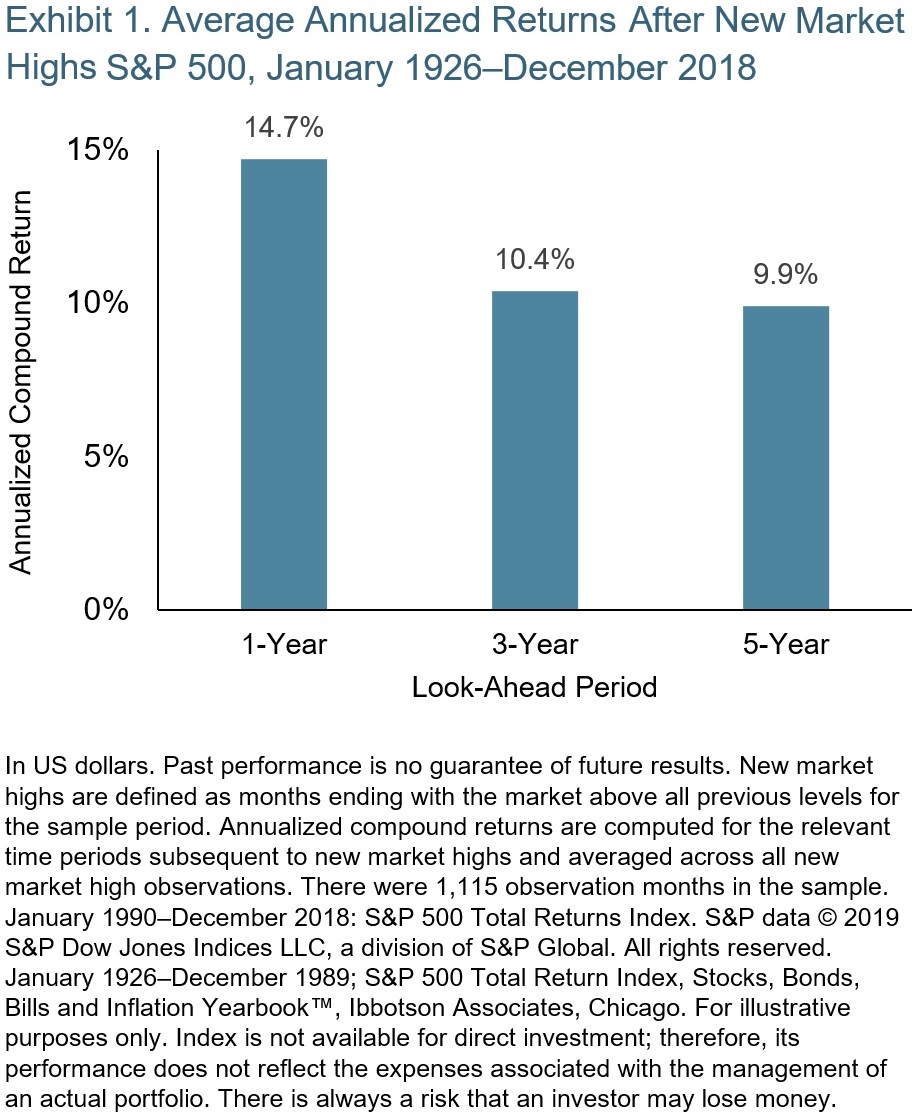
Can I time the market based on new highs? The S&P 500 Index has logged an incredible decade. Should this result impact investors’ allocations to equities? Exhibit 1 suggests that new market highs have not been a harbinger of negative returns to come. The S&P 500 went on to provide positive average annualized returns over one, three, and five years following new market highs.

Average Annualized Returns After New Market Highs

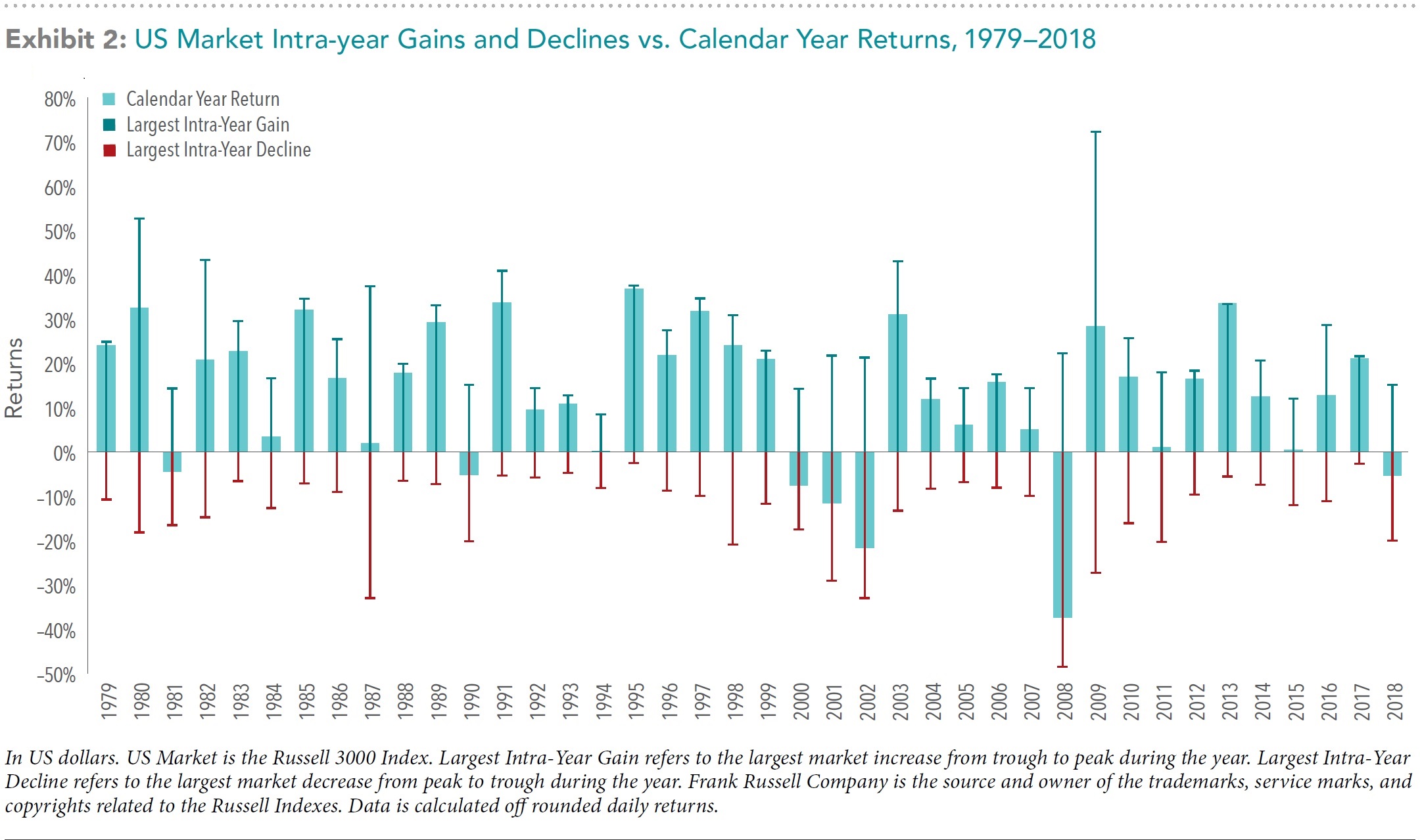
What about timing the market during periods of increased volatility? Exhibit 2, below, shows calendar year returns for the US stock market since 1979, as well as the largest intra-year declines that occurred during a given year. During this period, the average intra-year decline was about 14%. About half of the years observed had declines of more than 10%, and around a third had declines of more than 15%. Despite substantial intra-year drops, calendar year returns were positive in 33 years out of the 40 examined. This goes to show just how common market declines are and how difficult it is to say whether a large intra-year decline will result in negative returns over the entire year.

Returns Come from Just a Handful of Days:

Further complicating the prospect of market timing being additive to portfolio performance is the fact that a substantial proportion of the total return of stocks over long periods comes from just a handful of days. Since investors are unlikely to be able to identify in advance which days will have strong returns and which will not, the prudent course is likely to remain invested during periods of volatility rather than jump into and out of stocks. Otherwise, an investor runs the risk of being on the sidelines on days when returns happen to be strongly positive.

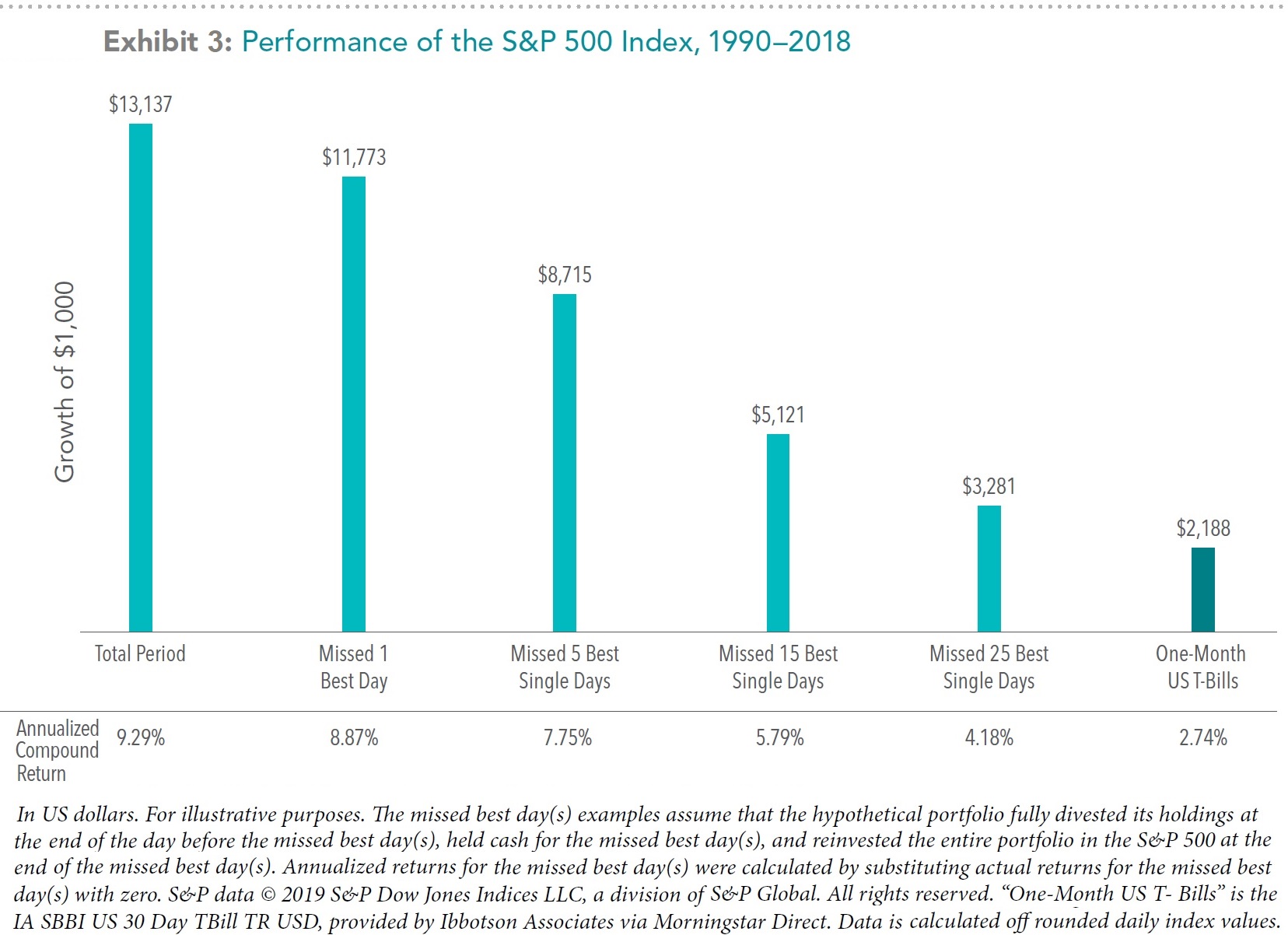
Exhibit 3, below, helps illustrate this point. It shows the annualized compound return of the S&P 500 Index going back to 1990 and illustrates the impact of missing out on just a few days of strong returns. The bars represent the hypothetical growth of $1,000 over the period and show what happened if you missed the best single day during the period or a handful of the best single days. The data shows that being on the sidelines for only a few of the best single days in the market would have resulted in substantially lower returns than the total period had to offer.

Performance of the S&P 500 Index if Best Days Missed, 1990-2018

Conclusion:

Outguessing markets is more difficult than many investors might think. While favorable timing is theoretically possible, there isn’t much evidence that it can be done reliably, even by professional investors. The positive news is that investors don’t need to be able to time markets to have a good investment experience.

Over time, capital markets have rewarded investors who have taken a long-term perspective and remained disciplined in the face of short-term noise. By focusing on the things that they can control (like having an appropriate asset allocation, diversification, and managing expenses, turnover, and taxes), investors can better position themselves to make the most of what capital markets have to offer.

While market volatility can be nerve-racking for investors, reacting emotionally and changing long-term investment strategies in response to short-term declines could prove more harmful than helpful. By adhering to a well-thought-out investment plan, ideally agreed upon in advance of periods of volatility, investors may be better able to remain calm during periods of short-term uncertainty.


1 Past performance is no guarantee of future results. US-domiciled open-end mutual fund data is from Morningstar. The sample includes funds at the beginning of the 20-year period ending December 31, 2018. For further details, see the Mutual Fund Landscape 2019.

2 In US dollars. Source: Dimensional, using data from Bloomberg LP. Includes primary and secondary exchange trading volume globally for equities. ETFs and funds are excluded. Daily averages were computed by calculating the trading volume of each stock daily as the closing price multiplied by shares traded that day. All such trading volume is summed up and divided by 252 as an approximate number of annual trading days.


Past performance does not guarantee future results. All investments include risk and have the potential for loss as well as gain.

Data sources for returns and standard statistical data are provided by the sources referenced and are based on data obtained from recognized statistical services or other sources we believe to be reliable. However, some or all information has not been verified prior to the analysis, and we do not make any representations as to its accuracy or completeness. Any analysis nonfactual in nature constitutes only current opinions, which are subject to change. Benchmarks or indices are included for information purposes only to reflect the current market environment; no index is a directly tradable investment. There may be instances when consultant opinions regarding any fundamental or quantitative analysis do not agree.

The commentary contained herein has been compiled by W. Reid Culp, III from sources provided by TAGStone Capital, DFA, Vanguard, Morningstar, as well as commentary provided by Mr. Culp, personally, and information independently obtained by Mr. Culp. The pronoun “we,” as used herein, references collectively the sources noted above.

TAGStone Capital, Inc. provides this update to convey general information about market conditions and not for the purpose of providing investment advice. Investment in any of the companies or sectors mentioned herein may not be appropriate for you. You should consult your advisor from TAGStone for investment advice regarding your own situation.

The Uncommon Average:

“I have found that the importance of having an investment philosophy—one that is robust and that you can stick with— cannot be overstated.”

—David Booth

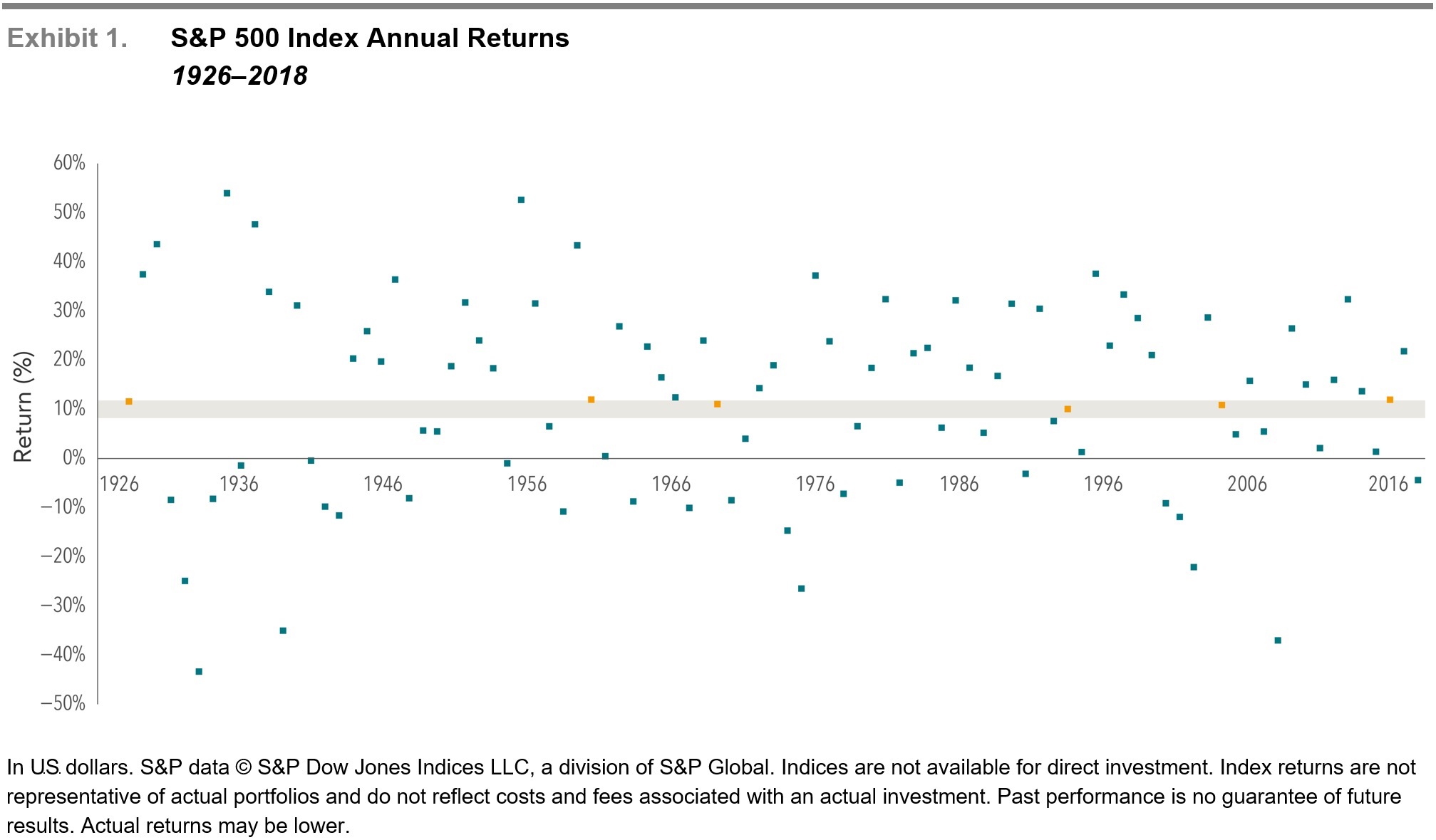
The U.S. stock market has delivered an average annual return of around 10% since 1926.1 But short-term results generally vary, and in any given period stock returns can be positive, negative, or flat. When setting expectations, it’s helpful to see the range of outcomes experienced by investors historically. For example, how often have the stock market’s annual returns actually aligned with its long-term average?

Exhibit 1, below, shows calendar year returns for the S&P 500 Index since 1926. The shaded band marks the historical average of 10%, plus or minus 2 percentage points. The S&P 500 Index had a return within this range in only six of the past 93 calendar years. In most years, the index’s return was outside of the range—often above or below by a wide margin—with no obvious pattern. For investors, the data highlights the importance of looking beyond average returns and being aware of the range of potential outcomes.

Uncommon Average S&P 500 Index Annual Returns 1926-2018

Tuning in to Different Frequencies:

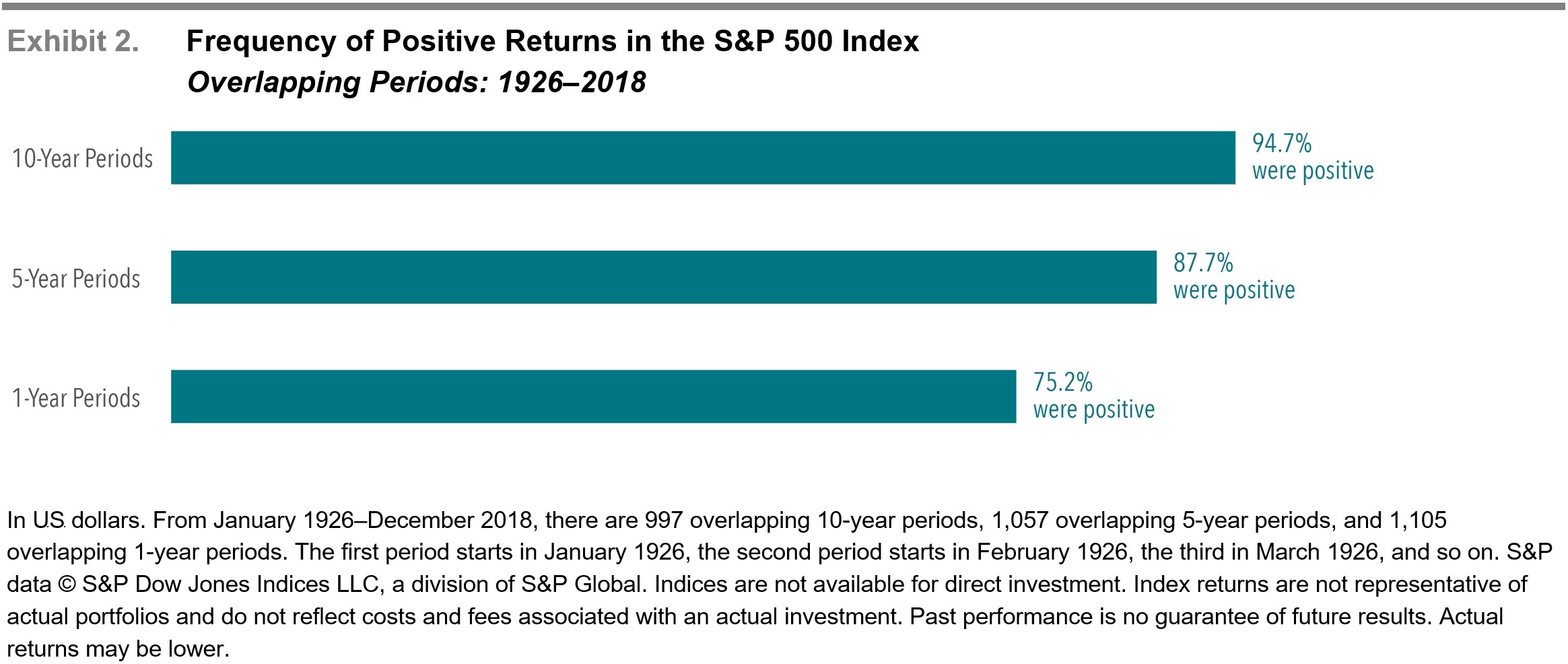
Despite year-to-year volatility, investors can potentially increase their chances of having a positive outcome by maintaining a long-term focus. Exhibit 2, below, documents the historical frequency of positive returns over rolling periods of one, five, and 10 years in the U.S. market. The data shows that, while positive performance is never assured, investors’ odds improve over longer time horizons.

Uncommon Average Frequency of Positive Returns in the S&P 500 Index

Recession Myths and Realities:

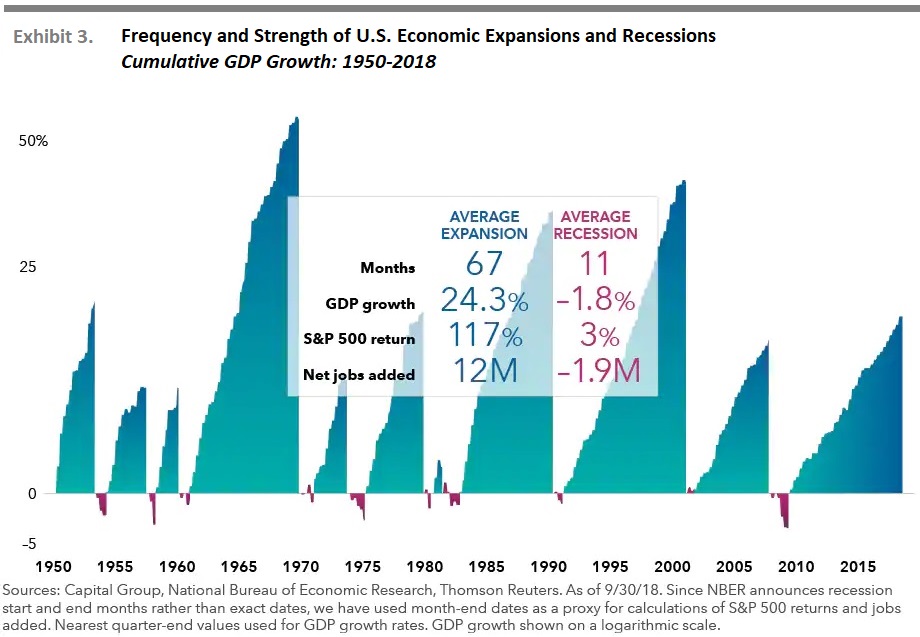
As much as the financial news and market pundits talk about the possibility of a pending recession, few news reports give the statistics for the frequency and length of economic expansions and recessions. While the statistics for recessions vary depending on when the measurement period is started, Exhibit 3, below, provides the statistics for the average expansion and recession since 1950.

There are three points to consider from viewing these statistics:

• Recessions have been infrequent—the U.S. has been in an official recession less than 15% of all months since 1950

• Recessions have been relatively short—the current economic expansion has been longer than the last 10 recessions combined

• Recessions have been less impactful compared with expansions—the average recession led to a contraction of -2% while an expansion grew the economy by an average of about 24%

Uncommon Average Frequency and Strength of U.S. Economic Expansions and Recessions

Staying Focused:

While some investors might find it easy to stay the course in years with above-average returns, periods of substantially disappointing results may test an investor’s faith in equity markets. Being aware of the range of potential outcomes can help investors remain disciplined, which in the long term can increase the odds of a successful investment experience.

What can help investors endure the ups and downs? While there is no silver bullet, understanding how markets work and trusting market prices are good starting points. An asset allocation that aligns with personal risk tolerances and investment goals is also valuable. By thoughtfully considering these and other issues, investors may be better prepared to stay focused on their long-term goals during different market environments.


[1] As measured by the S&P 500 Index from 1926-2018.


Past performance does not guarantee future results. All investments include risk and have the potential for loss as well as gain.

Data sources for returns and standard statistical data are provided by the sources referenced and are based on data obtained from recognized statistical services or other sources we believe to be reliable. However, some or all information has not been verified prior to the analysis, and we do not make any representations as to its accuracy or completeness. Any analysis nonfactual in nature constitutes only current opinions, which are subject to change. Benchmarks or indices are included for information  purposes  only  to  reflect  the  current  market  environment;  no  index  is  a directly  tradable  investment.  There  may  be  instances  when  consultant  opinions  regarding any fundamental or quantitative analysis do not agree.

The  commentary  contained  herein  has  been  compiled  by  W.  Reid  Culp,  III  from  sources  provided  by  TAGStone  Capital,  Capital  Directions,  DFA,  Vanguard,  Morningstar,  as  well  as  commentary  provided  by  Mr.  Culp,  personally,  and  information  independently  obtained  by  Mr.  Culp.  The  pronoun  “we,”  as  used  herein,  references collectively the sources noted above.

TAGStone Capital, Inc. provides this update to convey general information about market conditions and not for the purpose of providing investment advice. Investment in any of the companies or sectors mentioned herein may not be appropriate for you. You should consult your advisor from TAGStone for investment advice regarding your own situation.

Blink Moments:

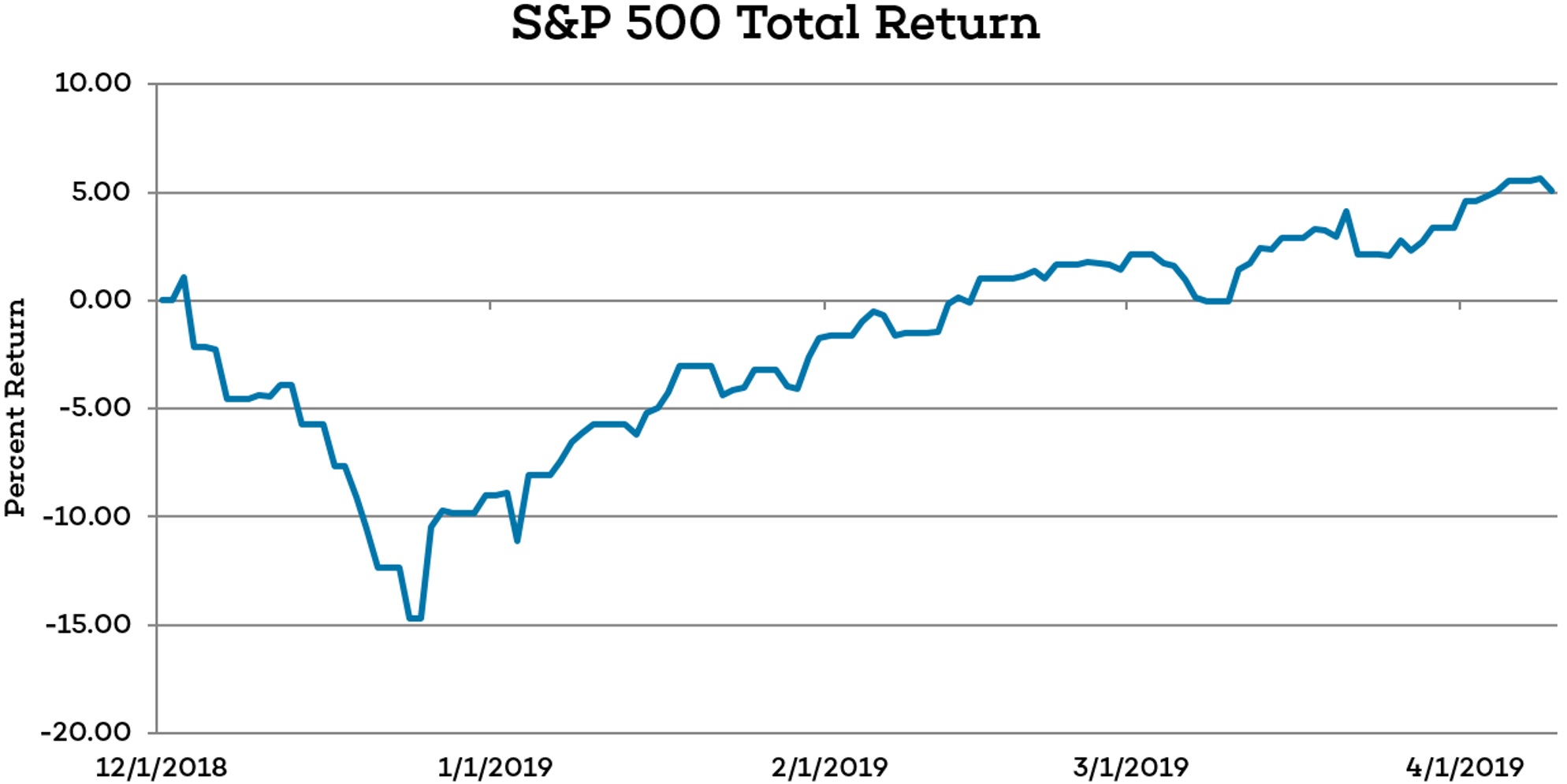
After a turbulent end to 2018 sent stock indices around the globe into bear-market territory, equities staged a big recovery in the first quarter of 2019. For the quarter, the S&P 500 index gained 13.65% and was within a few percentage points of its record high. The Russell 2000 small stock index gained even more, rising 14.58%. Large-cap foreign stocks, emerging markets stocks, and REIT (real estate) stocks enjoyed robust recoveries as well.

Alas, the many thousands of investors who bolted from the market in December weren’t along for the ride.

As markets swooned in December, according to Lipper, investors pulled $98 billion from U.S. equity funds, most of it coming late in the month after the steep selloff on Christmas Eve. The outflows weren’t just limited to stock funds. Morningstar estimates bond funds saw net outflows of $43 billion in December as investor anxiety about rising interest rates drove them to flee fixed income. Meanwhile, money-market funds saw their largest inflows since 2008, with a net $162 billion moving into that category in 2018.

In that regard, it should come as no surprise that stocks and, to a lesser extent, bonds saw a big rebound to start 2019. Individual investors have a long, sad history of doing exactly the wrong thing at the wrong time with their money. The events of the past six months have proved no exception.


On the other hand, more rational investors didn’t head for the exits in December, because they knew a 20% decline in stocks has historically occurred every 3-4 years. But most investors experience moments in their investment lifetimes when emotions overwhelm rational thought. We call these “blink moments.”

There have been many of them in just the past two decades: the bursting of the dot-com bubble, 9/11, and two bear markets in which stocks dropped more than 50%. These are a few of the big negative ones, but blink moments happen on the upside, too. The temptation to invest in dot-com stocks in the late 1990s, speculative real estate in 2006, or Bitcoin in 2017, was a siren song many investors couldn’t resist, and they paid dearly for it.

The Value of Wealth Counsel

Like many industries elsewhere in the world today, technology is commoditizing the investment management industry. However, this commoditization is missing the big picture. While analytics, plans, and platforms are certainly important tools in the wealth management process, they are just that—tools. It’s the relationship that you have with your wealth manager that really counts in blink moments. During these critical times when you don’t trust your own decision-making, many investors value the counsel they receive from a trusted person who knows their financial situation intimately.

It’s in these times, when emotions are at their peak, that investors face the greatest risk to their financial wellbeing. An important role of a wealth manager is to be the trusted buffer between the client and the whims of the stock market—the whims that separate many investors from their money.

Perils of Concentrated Stock Portfolios

For the better part of the 20th century, most investors followed a similar approach to constructing an investment portfolio. They used a stockbroker to buy a handful of stocks they liked (or that the broker convinced them to like) and held them in the portfolio for the long term.

Two things changed this dynamic in the 1970s. First, the long, deep economic slump in the United States during that decade introduced many investors to the downside of unsystematic risk—the risk you assume when you have a concentrated-stock portfolio that ties your investment fate to the fate of only a handful of companies. Many shareholders of U.S. auto, airline, and bank stocks found this out the hard way during that decade.

Second, this awakening of the investing public to the perils of concentrated-stock portfolios also coincided with mutual funds exploding onto the scene in the late 1970s and early 1980s. Mutual funds enabled investors to diversify away unsystematic risk by having exposure to hundreds of different securities in a single investment. As a result, in the ensuing four decades, mutual funds and ETFs became the preferred way for investors and their advisors to allocate investment assets. It’s rare today for long-term investors to concentrate new investment proceeds in just a handful of companies.

However, we still see three scenarios where certain investors come to us with a significant part of their net worth concentrated in one, or several, stocks:

- Businesses owners who have sold their company for stock in the acquiring company

- Heirs who have inherited large positions of low-basis stock

- Retired executives who have amassed significant amounts of stock in the companies they worked for through bonuses and options

The path to amassing these concentrated-stock positions is varied, but the resistance to diversifying away the unsystematic risk inherent in such positions generally falls into two categories. Either the investor opposes selling the positions and incurring capital gains taxes, or they have seen their concentrated-stock positions outperform the broad market and are convinced the outperformance will continue. Many times, it’s both.

We certainly sympathize with these concerns. It’s never fun to sell a stock that has performed well, or even adequately, and pay the resultant capital gains taxes. But it’s also not fun to have the misfortune of being trapped in a stock that suddenly experiences a dramatic downturn—sometimes temporary and sometimes permanent—due to circumstances in the company unrelated to the overall stock market.

Recent Examples of Single-Stock Risk

The financial news was rife with such examples in First Quarter 2019:

- Boeing: After a second crash of the aircraft manufacturer’s 737 MAX aircraft raised questions about the safety of the plane’s flight-management software, Boeing’s stock fell 18% over a three-week period in March.

- Kraft-Heinz: After an earnings miss by the consumer products giant raised investor fears that massive cost-cutting at the company was having an adverse effect on future profitability, the stock plunged 27% on February 22. Kraft-Heinz stock is now down nearly 50% since November and down 65% from its November 2017 high.

- Prada: The maker of handbags and other high-fashion accessories saw its shares drop 11% in a single trading session in March as consumer demand for the brand in China dropped dramatically.

Each of these unexpected downturns occurred while the broad stock market was surging. These are recent examples, but we have seen other heart-wrenching instances in the past twenty years of investors who were significantly affected by being in the wrong stock at the wrong time. Wachovia, Delta, Enron, WorldCom, GM, and Lehman come to mind. Investors who were once concentrated in these stocks would dearly love to turn back the clock and diversify their positions before the stocks experienced their unexpected downturns.

While diversifying concentrated-stock positions is emotionally and financially painful in the short term, it is a way of hedging against future, unknowable corporate missteps and misplaced gains. As Benjamin Franklin quipped a couple of centuries ago, “An ounce of prevention is worth a pound of cure.”


Past performance does not guarantee future results. All investments include risk and have the potential for loss as well as gain.

Data sources for returns and standard statistical data are provided by the sources referenced and are based on data obtained from recognized statistical services or other sources we believe to be reliable. However, some or all information has not been verified prior to the analysis, and we do not make any representations as to its accuracy or completeness. Any analysis nonfactual in nature constitutes only current opinions, which are subject to change. Benchmarks or indices are included for information  purposes  only  to  reflect  the  current  market  environment;  no  index  is  a directly  tradable  investment.  There  may  be  instances  when  consultant  opinions  regarding any fundamental or quantitative analysis do not agree.

The  commentary  contained  herein  has  been  compiled  by  W.  Reid  Culp,  III  from  sources  provided  by  TAGStone  Capital,  Capital  Directions,  DFA,  Vanguard,  Morningstar,  as  well  as  commentary  provided  by  Mr.  Culp,  personally,  and  information  independently  obtained  by  Mr.  Culp.  The  pronoun  “we,”  as  used  herein,  references collectively the sources noted above.

TAGStone Capital, Inc. provides this update to convey general information about market conditions and not for the purpose of providing investment advice. Investment in any of the companies or sectors mentioned herein may not be appropriate for you. You should consult your advisor from TAGStone for investment advice regarding your own situation.